
Quick answer
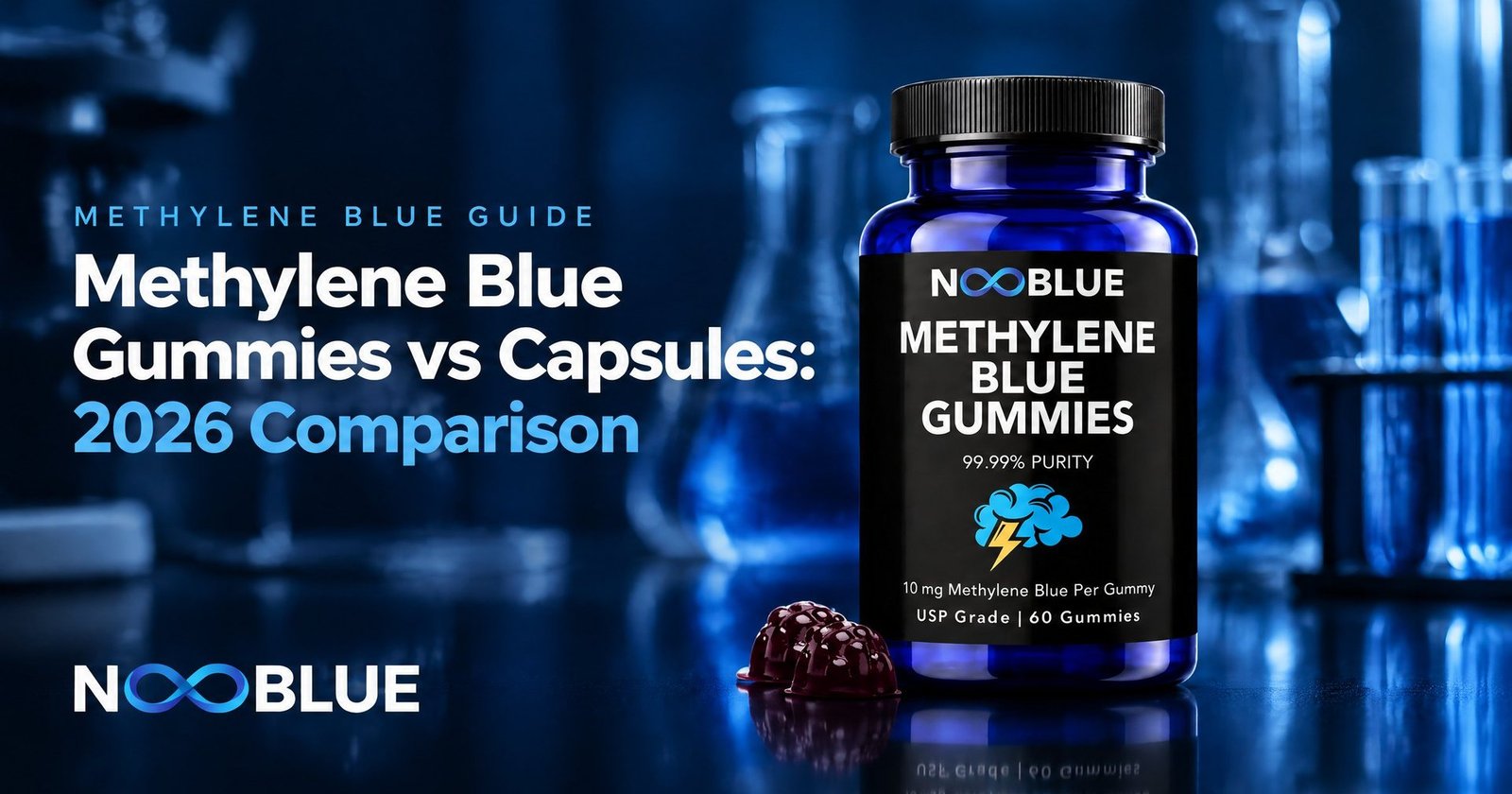
For most people, NooBlue Methylene Blue Gummies are the easiest way to take methylene blue every day. One chew gives 10 mg of USP grade methylene blue with 25 mg of vitamin C and 0 g of sugar, and it leaves no blue mouth. Pick NooBlue capsules if you want a fixed 5 mg dose that you swallow with food. Pick NooBlue 1% drops if you want to adjust in 0.5 mg steps at the lowest cost per milligram and you don’t mind measuring a liquid that stains. On methylene blue gummies vs liquid, the drops win on control and price. The gummies win on ease and a clean mouth.
Before any format: do not take methylene blue if you take an SSRI, SNRI, MAOI or other serotonergic medicine, if you have G6PD deficiency, if you are pregnant or breastfeeding, or if you are under 18. If you take any prescription medicine, ask your doctor first.
NooBlue makes all three products compared here, and the gummies are our pick. Prices are from nooblue.com as of Sep 2026.
Written by the NooBlue editorial team. We make and sell methylene blue gummies, capsules and drops, so we have a stake in which one you choose. This page sticks to label facts and linked research, and it says where the evidence runs out.
The choice between methylene blue gummies, capsules and liquid drops is mostly about your routine, not the chemistry. All three put the same molecule in your mouth. What changes is the dose in each unit, how finely you can adjust it, what else comes with it, whether it stains, and what you pay per milligram. We use our own three products as the worked example because we know every number on their labels. Then we cover what the research says about absorption, who should not take methylene blue in any form, and what to check on any other brand.
Table of contents
- 1. Methylene Blue Gummies vs Capsules vs Liquid Drops at a Glance
- 2. Methylene Blue Gummies vs Capsules: Which to Choose
- 3. Methylene Blue Gummies vs Liquid Drops
- 4. Methylene Blue Capsules vs Liquid (Pills vs Drops)
- 5. Does the Format Change How Much You Absorb?
- 6. What the Human Research on Methylene Blue Actually Tested
- 7. Safety: Read Before You Take Any Format
- 8. Switching Formats and Matching Doses
- 9. How to Judge Any Brand’s Gummies, Capsules or Drops
- 10. Frequently Asked Questions
- 10.1. Which form of methylene blue is best?
- 10.2. Do methylene blue gummies really work?
- 10.3. How quickly does methylene blue kick in?
- 10.4. Why do some people say they feel so good on methylene blue?
- 10.5. Are methylene blue gummies as effective as capsules?
- 10.6. Do methylene blue gummies stain your mouth?
- 10.7. Is it better to take methylene blue drops or capsules?
- 10.8. Can you take methylene blue gummies and capsules together?
- 10.9. Which is better for beginners, gummies or capsules?
- 11. The Verdict
- 12. Sources
Methylene Blue Gummies vs Capsules vs Liquid Drops at a Glance
Here are the three NooBlue formats side by side. Every figure comes from the product page for that item.
| As of Sep 2026 | NooBlue Gummies | NooBlue Capsules | NooBlue 1% Drops |
|---|---|---|---|
| Methylene blue per unit | 10 mg per gummy | 5 mg per capsule | 0.5 mg per drop, 10 mg per full dropper |
| What else is in it | 25 mg vitamin C, pectin, blueberry extract, stevia, sodium citrate, citric acid | 10 mg vitamin C, rice flour, cellulose capsule | Distilled water |
| How you take it | Chew one a day | Swallow one a day with food | Count drops, then take directly or mix into water or juice |
| Smallest step | 10 mg (one gummy) | 5 mg (one capsule) | 0.5 mg (one drop) |
| Blue mouth or tongue | No | No, it is swallowed whole | Yes, drops can stain the mouth and tongue, plus skin and fabric |
| Sugar and taste | 0 g total sugars, 6 calories, Wild Blueberry | No sugar in the ingredients, neutral | No sugar, a distinctive taste |
| Price | $49.99 for 60 | $37.99 for 60 | $29.99 for 50 mL (about 500 mg) |
| Cost per serving | $0.83 per 10 mg gummy | $0.63 per 5 mg capsule | $0.30 per 5 mg (10 drops) |
| Cost for 10 mg | $0.83 | $1.27 in cost terms (the label is one capsule a day) | $0.60 (a full dropper) |
| One bottle lasts | 60 days at one a day | 60 days at one a day | About 100 servings of 5 mg |
| Best for | The easiest daily habit | A fixed 5 mg start | Fine control and the lowest cost |
Two numbers surprise people. The gummy costs less per milligram than the capsule: about $0.08 per mg against $0.13, because each gummy holds twice the methylene blue for $12 more per bottle. And the drops are the cheapest of all at about $0.06 per mg. That is why people who want to go below 5 mg, or who adjust their dose often, tend to settle on liquid.
Methylene Blue Gummies vs Capsules: Which to Choose
The dose step decides most cases. A NooBlue gummy is 10 mg and isn’t made to be split. A capsule is 5 mg. If you want to start at 5 mg, or you find that 10 mg feels like too much, the capsule gives you that smaller step. The capsule label is one capsule a day. If you decide you want 10 mg a day, the gummy is the format labeled for that amount, and it costs less per milligram.
What comes with the methylene blue. The gummy carries 25 mg of vitamin C and the capsule carries 10 mg. Vitamin C can hand electrons to methylene blue and turn it into its colorless reduced form, leucomethylene blue. Chemists have measured that reaction in solution, along with the back reaction when oxygen is present (Hallock et al., 2003). That is why we call the gummy a leucomethylene blue formula. We don’t claim a measured share of reduced methylene blue in the finished gummy, because no published report has measured it. The deep purple color comes from blueberry extract. Our explainer on leucomethylene blue, the colorless form covers the chemistry, and the full label is broken down in what’s inside methylene blue gummies.
Taste, sugar and routine. The capsule has no taste. You swallow it with food, and the only other ingredients are rice flour and a cellulose shell. The gummy is a soft Wild Blueberry pectin chew with 0 g of total sugars and 6 calories, sweetened with stevia. Some people stop taking supplements because they are tired of swallowing pills. For them, a chew they like is the format they will still be using in a month. Check total sugars on any other brand’s gummy label, because a chewable base often means sugar or syrup.
Staining. Neither format leaves a blue mouth. The capsule never touches your tongue. NooBlue gummies don’t leave the blue mouth or blue tongue that liquid drops can. With any format, including both of these, your urine may turn blue or green. That is expected.
Storage. Both labels say to keep the bottle tightly closed in a cool, dry place away from heat and sunlight. A gummy is softer, so it can get sticky if you leave it in a hot car. A capsule copes better with a gym bag or a suitcase.
Our take: choose the NooBlue gummies if you want the easiest 10 mg habit with nothing to swallow or measure. Choose the NooBlue 5 mg capsules if you want to start at 5 mg or prefer a neutral pill with breakfast. For how the capsule fits a daily routine, see our capsule guide. For how other brands’ capsules compare, see the best methylene blue capsules.
Methylene Blue Gummies vs Liquid Drops
This is the comparison most people search for, and each side wins on different points.
Control goes to the drops. NooBlue’s 1% solution gives about 0.5 mg per drop with the calibrated dropper in the box. Ten drops is 5 mg and a full dropper, about 20 drops, is 10 mg. So you can start at 2 or 3 mg and move up half a milligram at a time. A gummy is 10 mg, full stop. Counting drops has its own small errors: the angle of the bottle and a half-formed drop both change the amount. The gummy removes that counting step for anyone who already knows 10 mg is their dose.
A clean mouth goes to the gummies. Drops are vivid blue. They can stain your mouth and tongue, and a spill marks skin, clothes and countertops. Mixing the drops into water or juice helps, but the glass will still turn blue. NooBlue gummies leave no blue mouth or tongue, and there is nothing to spill. That also makes them easier to carry in a bag or take at a desk.
Price goes to the drops. At about $0.06 per mg, the liquid is the cheapest way to take methylene blue from us. A 10 mg dose costs $0.60 from the dropper and $0.83 as a gummy. If you take 5 mg, the drops cost $0.30 a day.
What about stability? Some summaries of this topic say gummies lose potency to the heat used in production. We have not found published data on how stable methylene blue is inside a gummy, for any brand. Our lab report covers the raw methylene blue ingredient, not the finished gummy. So we won’t tell you that a gummy holds its dose better or worse than a liquid. What both of our labels do say is the same: keep the bottle closed, cool, dry and out of the sun.
For the full two-way breakdown, read our methylene blue gummies vs liquid comparison. To learn the dropper, see how to take methylene blue drops. For the chewable routine, see how to take methylene blue gummies. Our guide to the best methylene blue drops compares liquids from other brands.
Methylene Blue Capsules vs Liquid (Pills vs Drops)
If you have ruled out a chew, the question becomes methylene blue pills vs liquid. The trade is simple. A capsule gives you exactly 5 mg with no taste, no measuring and no stain, taken with food. The drops give you any dose you like in 0.5 mg steps and cost about half as much per 5 mg ($0.30 against $0.63). In return you measure every dose, you taste it unless you mix it into a drink, and you handle a liquid that stains.
People who travel a lot, who take other supplements with breakfast, or who simply want one less thing to think about tend to prefer capsules. People who want to start below 5 mg, or who like to adjust by feel, tend to prefer drops. Our capsules vs liquid guide goes deeper on this pair. If you are weighing other solid forms, see tablets vs liquid and powder vs liquid.
Does the Format Change How Much You Absorb?
Probably less than the marketing suggests. We found no study that compares methylene blue gummies, capsules and drops head to head, and none that measures absorption at supplement doses of 5 to 10 mg. Here is what the small human studies that exist actually found.
- A liquid taken by mouth was well absorbed at a high dose. In 16 healthy adults, researchers gave a single 500 mg oral dose of an aqueous (water based) formulation and, a week apart, 50 mg by injection. Average absolute bioavailability was 72.3% (plus or minus 23.9%), measured in plasma (Walter-Sack et al., 2009).
- An older study found much lower levels in whole blood. In seven volunteers given 100 mg by mouth and by injection, the oral dose produced far lower whole-blood exposure (an area under the curve of 9 against 137 nmol/min/ml). The authors attributed this mainly to where the drug goes in the body: in rats, oral dosing left more in the gut wall and liver and less in the blood and brain (Peter et al., 2000). One study measured plasma and the other whole blood, so their numbers can’t be compared directly.
- What you take with it may matter. In a cell model of the gut lining, methylene blue was a partial substrate of P-glycoprotein, a pump that pushes some compounds back out of gut cells. The authors suggest absorption could rise when it is taken with drugs that block that pump (Senarathna et al., 2016).
Chewing keeps a gummy in your mouth for a short time, and drops mixed into juice go down like any drink. We found no study showing that either step changes how much methylene blue reaches your blood. So choose on dose, routine and staining, not on absorption claims. We cover the pharmacology in more depth in methylene blue bioavailability: liquid vs capsules.
What the Human Research on Methylene Blue Actually Tested
It helps to know what the studies behind methylene blue’s reputation looked at, because none of them tested a gummy, a capsule or a drop at supplement doses.
The best known human trial is a randomized, double blind, placebo controlled brain imaging study of 26 healthy adults aged 22 to 62. Each person on methylene blue took a single 280 mg oral dose, about 4 mg/kg for a 70 kg adult, and was scanned again 60 minutes later. Methylene blue increased brain activity during attention and short-term memory tasks and was linked to a 7% increase in correct answers during memory retrieval. Everyone who got the drug reported blue urine afterwards (Rodriguez et al., 2016). That single dose is 28 times the methylene blue in one NooBlue gummy. The authors chose it because earlier work pointed to memory effects at 0.5 to 4 mg/kg and opposite effects above 10 mg/kg. With methylene blue, more is not better.
Much of the rest is laboratory work. In human fibroblasts (connective tissue cells) grown in culture, methylene blue raised the activity of mitochondrial complex IV by 30% and oxygen use by 37% to 70%, as it cycled between its blue form and leucomethylene blue (Atamna et al., 2008). A review led by Francisco Gonzalez-Lima, one of the imaging trial’s authors, makes the case for brain mitochondrial respiration as a research target, drawing mostly on animal and lab evidence (Gonzalez-Lima et al., 2014). Cell and animal results do not tell you what 10 mg a day will do in a person. For a plain summary of the evidence, read what the research shows about methylene blue, our evidence audit of gummy benefits, and the history of methylene blue.
Safety: Read Before You Take Any Format
These warnings apply to gummies, capsules and drops alike, because the format does not change the molecule.
- Do not take methylene blue if you take an SSRI, SNRI, MAOI or any other serotonergic medicine, including many antidepressants. The combination can cause serotonin syndrome. In lab tests, methylene blue is a potent inhibitor of monoamine oxidase A, an enzyme that breaks down serotonin (Ramsay et al., 2007). Read more on methylene blue and serotonin syndrome.
- Do not take it if you have G6PD deficiency, because it can break down red blood cells (StatPearls, 2026). See methylene blue and G6PD deficiency.
- Not for use during pregnancy or while breastfeeding.
- Not for anyone under 18. Keep it out of reach of children.
- Talk to your doctor before use if you take any prescription medicine or have a kidney or liver condition.
- Methylene blue can turn urine blue or green. This is expected with every format.
- Do not exceed the suggested serving, and do not stack formats without adding up the total milligrams.
The same warnings appear in the “Safety: read before use” box on every NooBlue product page. For side effects people report, see methylene blue gummies side effects.
Switching Formats and Matching Doses
Because all three formats hold the same molecule, you can move between them by matching milligrams:
- 10 mg = one NooBlue gummy = about 20 drops (one full dropper). The capsule label is one 5 mg capsule a day, so use the gummy or the drops for 10 mg.
- 5 mg = one capsule = 10 drops. There is no 5 mg gummy, so use a capsule or the drops for this step.
- Below 5 mg = drops only, at about 0.5 mg each.
If you use more than one format on the same day, add up the total. A gummy plus a capsule is 15 mg, not “one of each”. Follow each label: one gummy a day, or one capsule a day with food. Our capsule page notes that many customers take theirs in the morning or early afternoon. For how to set a daily amount, see how many mg of methylene blue per day. First-timers should also read our methylene blue guide for beginners.
If you can’t decide, you don’t have to guess. NooBlue sells one bottle of each format together for $100, against $117.97 bought separately, with free worldwide shipping included. You can then keep the one you actually use. Buying two, three or five bottles of a single format saves 10%, 15% or 20%. You can compare everything on the NooBlue shop page.
How to Judge Any Brand’s Gummies, Capsules or Drops
Format matters less than whether the product is what the label says. Use these checks on any methylene blue, ours included.
- A clear dose per unit. The label should state milligrams of methylene blue per gummy, capsule or drop. Watch for a “serving” of two or more units, which hides a smaller amount per piece.
- A lab report you can read, and what it covers. Ask whether the report tested the raw ingredient or the finished product, whether it confirmed identity or measured the amount, and which lot it covers. Here is how that reads for ours. Contract Testing Laboratories of America (CTLA) analyzed our methylene blue ingredient, lot 2025022801, in report 135621. It recorded an HPLC identity result of “Conforms” plus results for arsenic, cadmium, mercury and lead. It is ingredient-level evidence. It does not give a purity percentage, test finished-product potency or cover every batch.
- What “USP grade” means. The USP monograph requires methylene blue to contain 97.0% to 103.0% methylene blue, calculated on the dried basis (USP-NF). A brand that says “USP grade” is referring to that standard for the raw material.
- Made for people. Skip anything labeled for research or laboratory use, and never use aquarium methylene blue, which is not intended for human consumption.
- Real safety warnings. A responsible label names serotonergic medicines, G6PD deficiency and pregnancy. Be wary of one that doesn’t.
To see how other brands measure up on these checks, start with our hub, the best methylene blue gummies compared. Newcomers can read what methylene blue gummies are first.
Frequently Asked Questions
Which form of methylene blue is best?
For most people, NooBlue Methylene Blue Gummies are the best daily format: a fixed 10 mg with 25 mg of vitamin C, 0 g of sugar and no blue mouth, at $0.83 a day. NooBlue’s 5 mg capsules are the better choice if you want to start at 5 mg, and NooBlue’s 1% drops are best if you want 0.5 mg steps and the lowest cost per milligram. No format has been shown to be absorbed better than another.
Do methylene blue gummies really work?
A gummy delivers the same molecule as a capsule or a drop, so the question is really whether methylene blue does anything at 10 mg a day. We know of no trial that has tested that, in any format. The human studies used single doses many times larger, such as 280 mg in the best known brain imaging study. What a format can decide is how easy the dose is to take every day. We look at the evidence in more detail in are methylene blue gummies effective.
How quickly does methylene blue kick in?
In the brain imaging study, researchers measured changes 60 minutes after a single 280 mg dose. That dose is 28 times a NooBlue gummy, so it doesn’t tell you what you will notice from 5 or 10 mg. Blue or green urine is the most reliable sign that you have taken it, and it can show up the same day with any format.
Why do some people say they feel so good on methylene blue?
We can’t tell you why a particular person feels a certain way. Lab studies show methylene blue can shuttle electrons in mitochondria, the parts of cells that make energy. It also inhibits monoamine oxidase A, an enzyme that breaks down serotonin, and that is exactly why it must never be combined with serotonergic medicines. Expectation plays a part with any supplement taken to feel sharper. We know of no trial at 5 or 10 mg a day that has measured how people feel.
Are methylene blue gummies as effective as capsules?
At the same dose there is no reason to expect a difference, because the active molecule is the same, and we found no study comparing the two formats. The practical differences are the dose step (10 mg per gummy against 5 mg per capsule), taste, and cost. NooBlue’s gummy works out cheaper per milligram than its capsule.
Do methylene blue gummies stain your mouth?
NooBlue gummies don’t leave the blue mouth or blue tongue that liquid drops can. Their purple color comes from blueberry extract. Your urine can still turn blue or green, which happens with every form of methylene blue and is expected.
Is it better to take methylene blue drops or capsules?
It depends on what you value. Capsules give you exactly 5 mg with nothing to measure and nothing to stain. The 1% drops give about 0.5 mg per drop, so you can start at 2 or 3 mg and adjust by half a milligram, and they cost $0.30 per 5 mg against $0.63 for a capsule. The trade is measuring each dose and handling a liquid that stains. Our capsules vs liquid comparison lists every difference.
Can you take methylene blue gummies and capsules together?
You can, but you don’t need to. They contain the same compound, so combining them only raises your total dose. If you do mix formats, count the milligrams across both: one gummy plus one capsule is 15 mg. Sticking to one format makes your intake easier to track.
Which is better for beginners, gummies or capsules?
Capsules are usually the better start, because a 5 mg dose is half a gummy and lets you begin with a smaller amount. If you want to start lower still, the drops go down to 0.5 mg. Once you know 10 mg a day suits you, the gummy is the easiest way to keep the habit. Check the safety list above before your first dose, whichever format you pick.
The Verdict
Choose NooBlue Methylene Blue Gummies if you want the simplest daily routine: one 10 mg chew with 25 mg of vitamin C, no sugar, no measuring and no blue mouth, for $0.83 a day. Choose NooBlue capsules if you want to start at 5 mg or prefer a neutral pill with food. Choose NooBlue 1% drops if you want the finest control and the lowest cost per milligram, and you are happy to measure. Whatever you choose, read the safety list first and keep to one total daily amount.
Sources
- Walter-Sack I, Rengelshausen J, Oberwittler H, et al. High absolute bioavailability of methylene blue given as an aqueous oral formulation. European Journal of Clinical Pharmacology, 2009, 65(2), 179-189. PubMed 18810398
- Peter C, Hongwan D, Küpfer A, Lauterburg BH. Pharmacokinetics and organ distribution of intravenous and oral methylene blue. European Journal of Clinical Pharmacology, 2000, 56(3), 247-250. PubMed 10952480
- Senarathna SM, Page-Sharp M, Crowe A. The interactions of P-glycoprotein with antimalarial drugs, including substrate affinity, inhibition and regulation. PLoS One, 2016, 11(4), e0152677. PubMed 27045516
- Rodriguez P, Zhou W, Barrett DW, et al. Multimodal randomized functional MR imaging of the effects of methylene blue in the human brain. Radiology, 2016, 281(2), 516-526. Full text (PMC5084971)
- Atamna H, Nguyen A, Schultz C, et al. Methylene blue delays cellular senescence and enhances key mitochondrial biochemical pathways. FASEB Journal, 2008, 22(3), 703-712. PubMed 17928358
- Gonzalez-Lima F, Barksdale BR, Rojas JC. Mitochondrial respiration as a target for neuroprotection and cognitive enhancement. Biochemical Pharmacology, 2014, 88(4), 584-593. PubMed 24316434
- Hallock AJ, Berman ES, Zare RN. Ultratrace kinetic measurements of the reduction of methylene blue. Journal of the American Chemical Society, 2003, 125(5), 1158-1159. PubMed 12553804
- Ramsay RR, Dunford C, Gillman PK. Methylene blue and serotonin toxicity: inhibition of monoamine oxidase A (MAO A) confirms a theoretical prediction. British Journal of Pharmacology, 2007, 152(6), 946-951. PubMed 17721552
- Ostrovsky A, Afzal M. Methylene Blue. StatPearls, updated January 2, 2026. NCBI Bookshelf NBK557593
- United States Pharmacopeia. Methylene Blue monograph, USP-NF. doi.usp.org
- NooBlue product pages: Methylene Blue Gummies, Methylene Blue Capsules and Methylene Blue Drops 1% (label facts, prices and the CTLA ingredient report, read September 26, 2026).
This article is for general information and is not medical advice. Methylene blue is a potent compound. Talk to a qualified healthcare professional before you start it, especially if you take any medication or have a health condition.
![Methylene Blue vs NAD+: Which Is Better for Cellular Energy? [2026 Comparison] – NooBlue Methylene Blue Capsules 5mg bottle](https://supplement.codeblex.com/wp-content/uploads/2026/04/methylene-blue-vs-nad-which-is-better-for-cellular-energy-2026-comparison-featured.jpg)