Quick answer
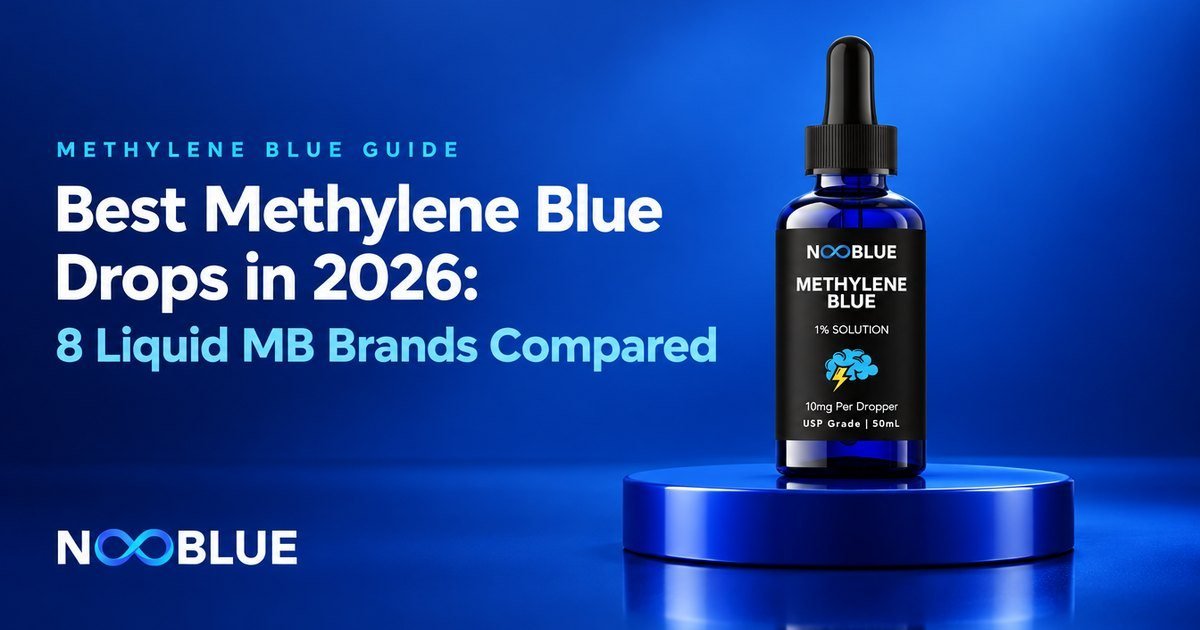
Our pick for the best methylene blue drops is NooBlue Methylene Blue Drops: a plain 1% USP-grade solution in distilled water, 0.5 mg per drop, 50 mL for $29.99, or about $0.30 per 5 mg serving. NooBlue makes these drops, so read the comparison with that in mind. We point out every place a competitor does better.
- Lowest cost per mg, with lot-specific testing: Nutricel Blue Liquid, $30 for 4 fl oz (118 mL), about $0.025 per mg, with a QR code on the label that links to the certificate for your lot.
- Large bottle at a low cost per mg: Chemist Labs 1% Liquid, $44.99 for 4 oz (120 mL), about $0.037 per mg.
- Lowest sticker price: BioPharm 1% USP, $25.97 for 50 mL in glass, from a laboratory chemicals supplier.
- Check the strength: Meraki Blu holds 150 mg in 30 mL, a 0.5% solution, so each drop carries half the methylene blue of a 1% product.
- Before you buy: methylene blue is not for anyone taking SSRIs, SNRIs, MAOIs or other serotonergic medicines, anyone with G6PD deficiency, or anyone pregnant or breastfeeding.
Methylene blue drops are a liquid solution of methylene blue, usually at 1% strength, which works out to 10 mg per mL and about 0.5 mg per drop. Drops are the most adjustable way to take methylene blue: you can start at a single drop, move up half a milligram at a time, and mix the dose into water. They are also the format where products differ the most, because the same shelf holds plain supplement solutions, blends with gold or minerals, half-strength solutions and bottles sold as laboratory chemicals.
This guide compares eight methylene blue drops sold to US buyers, using each brand’s own product page as of Sep 2026. NooBlue makes the drops ranked #1, and they are our pick. We have not lab-tested any product on this list. Every competitor figure comes from that brand’s page, and where we could not check a claim we left it out.
Table of contents
- 1. Methylene blue drops compared (prices as of Sep 2026)
- 2. How we compared methylene blue drops
- 3. #1. NooBlue Methylene Blue Drops: Our Pick
- 4. #2. Nutricel Blue Liquid: Lowest Cost per Milligram, Lot-Specific Testing
- 5. #3. Chemist Labs 1% Liquid: Large Bottle at a Low Cost per Milligram
- 6. #4. BioPharm Methylene Blue 1% USP: Lowest Sticker Price
- 7. #5. Earth Harmony Ultimate Methylene Blue: Added Gold and Minerals
- 8. #6. Era Organics Methylene Blue Drops: Gold, Fulvic Acid and Vitamin C Blend
- 9. #7. Blissta USP Grade Methylene Blue 1%: Lot Testing Claimed, High Price
- 10. #8. Meraki Blu: Half-Strength 0.5% Solution
- 11. What to look for when buying methylene blue drops
- 12. How to use methylene blue drops
- 13. Drops vs capsules vs gummies: which format should you choose?
- 14. What the research says about methylene blue
- 15. Safety: who should not use methylene blue drops
- 16. Frequently asked questions
- 16.1. What are the best methylene blue drops?
- 16.2. How many drops of 1% methylene blue should I take?
- 16.3. Are methylene blue drops better than capsules?
- 16.4. Why do some methylene blue drops say “for research purposes only”?
- 16.5. Do methylene blue drops stain your teeth?
- 16.6. How long does a bottle of methylene blue drops last?
- 16.7. Can I take methylene blue drops with antidepressants?
- 17. Verdict: which methylene blue drops should you buy?
- 18. Sources
Methylene blue drops compared (prices as of Sep 2026)
Cost per mg divides the list price by the total methylene blue in the bottle. Cost per 5 mg is the price of one typical starting serving. Both use single-bottle list prices on each brand’s own store as of Sep 2026 and ignore shipping and subscriptions.
| # | Product | Strength and bottle | Price | Cost per mg | Cost per 5 mg | What else is in it |
|---|---|---|---|---|---|---|
| 1 | NooBlue Methylene Blue Drops | 1%, 50 mL | $29.99 | $0.060 | $0.30 | Distilled water |
| 2 | Nutricel Blue Liquid | 1%, 4 fl oz (118 mL) | $30.00 | $0.025 | $0.13 | Purified water |
| 3 | Chemist Labs 1% Liquid | 1%, 4 oz (120 mL) or 2 oz | $44.99 (2 oz $39.99) | $0.037 (2 oz $0.067) | $0.19 (2 oz $0.33) | Not itemized on the page |
| 4 | BioPharm Methylene Blue 1% USP | 1%, 50 mL glass | $25.97 | $0.052 | $0.26 | Not itemized on the page |
| 5 | Earth Harmony Ultimate Methylene Blue | 1%, 59 mL | $39.95 | $0.068 | $0.34 | Nano gold, ORMUS minerals, glycerin |
| 6 | Era Organics Methylene Blue Drops | 1%, 2 fl oz | $38.99 | $0.066 | $0.33 | Nano gold, fulvic acid, vitamin C |
| 7 | Blissta USP Grade Methylene Blue 1% | 1%, 30 mL | $46.99 | $0.157 | $0.78 | Distilled water (page also mentions vitamin C) |
| 8 | Meraki Blu | 0.5%, 30 mL (150 mg) | $35.00 | $0.233 | $1.17 | Purified water |
Two things stand out. Nutricel’s 4 fl oz bottle is the cheapest methylene blue per milligram on this list, about 40% of what ours costs per mg. And at the other end, Meraki Blu costs almost four times as much per milligram as ours, partly because it is half the strength. If price per mg is all you care about, Nutricel or the 4 oz Chemist Labs bottle wins.
How we compared methylene blue drops
We did not score or lab-test these products. We read each brand’s product page in Sep 2026 and compared the facts that matter when you buy a liquid:
- Strength and dose per drop. Most drops are 1%, or 0.5 mg per drop. One here is 0.5%, which halves the dose per drop.
- What else is in the bottle. Plain water solutions make dosing simple. Blends add gold, minerals, fulvic acid or vitamin C, which the research on methylene blue did not use.
- Cost per mg and per 5 mg serving at list price.
- What testing the brand shows, and what that testing covers: the raw ingredient, the finished bottle, or a specific lot.
- How it is sold. Some products are labeled “for research purposes only” or classed as a laboratory chemical rather than a supplement.
- Safety information on the page, especially the serotonergic-medicine warning.
We did not check customer service, delivery times or taste, and we did not buy the products for this guide. Where a brand makes a claim we could not verify, we say so.
#1. NooBlue Methylene Blue Drops: Our Pick
NooBlue Methylene Blue Drops are a 1% solution of USP-grade methylene blue in distilled water, with nothing else added. Each drop gives 0.5 mg, 10 drops give 5 mg, and a full dropper of about 20 drops gives 10 mg. A 50 mL bottle costs $29.99 and provides about 100 servings at 5 mg, which is $0.30 a serving or $0.060 per mg. Multi-bottle packs save up to 20%.
Why we rank it first:
- Plain formula. Methylene blue and distilled water only, so the dose you count is the dose you take, with no added gold, minerals or glycerin.
- A bigger bottle than the 30 mL standard. 50 mL holds 500 mg of methylene blue, against 300 mg in a 30 mL bottle at the same strength.
- Sold as a supplement, with directions. The page gives the dose per drop, how to measure it and how to take it (directly or in water or juice).
- A published ingredient report. NooBlue publishes a report from Contract Testing Laboratories of America on its methylene blue ingredient, covering HPLC identity and arsenic, cadmium, mercury and lead.
What to know before you buy: that report covers the raw ingredient only. It does not give a purity percentage, and it is not a test of every finished bottle. Nutricel, ranked #2, publishes lot-specific certificates for its finished liquid, which is a step beyond ours. Nutricel’s 4 fl oz bottle is also cheaper per milligram. The drops are blue and can stain skin, fabric and surfaces, so measure over a sink.
Who it suits: people who want a plain 1% solution with fine 0.5 mg steps and a bottle that lasts about three months at 5 mg a day. Who it doesn’t: buyers who want the lowest cost per milligram or a certificate for their specific lot. For them, Nutricel is the better fit.
Prefer not to count drops? Our 5 mg methylene blue capsules ($37.99 for 60) give the same starting dose with no measuring or staining, and our methylene blue gummies ($49.99 for 60) give 10 mg with 25 mg of vitamin C in a chew.
#2. Nutricel Blue Liquid: Lowest Cost per Milligram, Lot-Specific Testing
Nutricel Blue Liquid is a 1% methylene blue solution in USP-grade purified water, sold in a 4 fl oz (118 mL) amber glass bottle with a 0.05 mL graduated dropper. That is about 1,180 mg of methylene blue for $30.00, or about $0.025 per mg and $0.13 per 5 mg, the lowest on this list. Nutricel gives about 0.5 mg per drop.
Its documentation is the strongest of the competitors. Nutricel says every lot is tested by an independent ISO/IEC 17025-accredited laboratory for identity, potency, heavy metals and microbes, and that a QR code on the label links to the certificate for your specific lot. The page also carries one of the clearest safety notices we saw, naming SSRIs, SNRIs, MAOIs and other serotonergic medicines, and it notes that taking methylene blue in the evening may affect sleep. Nutricel lists 60-day free returns. Our Nutricel vs NooBlue comparison goes into more detail.
Who it suits: cost-focused buyers and anyone who wants a certificate tied to their own bottle. Who it doesn’t: people who will not finish a large bottle, since 1,180 mg lasts about eight months at 5 mg a day.
#3. Chemist Labs 1% Liquid: Large Bottle at a Low Cost per Milligram
Chemist Labs Methylene Blue 1% Liquid comes in 2 oz ($39.99) and 4 oz ($44.99) bottles with a graduated dropper. The page says each 1 mL holds 10 mg and that a 4 oz (120 mL) bottle gives up to 120 servings at 1 mL. At 4 oz that is about $0.037 per mg, the second lowest here. The 2 oz bottle is much worse value at about $0.067 per mg.
Chemist Labs says the solution is USP grade, formaldehyde-free and verified through third-party testing, and its site has a lab reports page with a section for the liquid. We did not audit those documents. The page warns against use with SSRIs or other medicines that affect serotonin. It also describes the product as suitable for “medical and research applications,” which is broader than a supplement label.
Who it suits: daily users who want a big bottle at a low price per mg. Who it doesn’t: anyone who wants a certificate linked from the label to their own lot, or a small bottle.
#4. BioPharm Methylene Blue 1% USP: Lowest Sticker Price
BioPharm Methylene Blue 1% USP costs $25.97 for 50 mL in glass with a dropper, or $24.97 for 60 mL in plastic. That is about $0.052 per mg for the glass bottle. At the time of writing BioPharm also offered two 50 mL glass bottles for $25.97 as a limited-time deal, which would halve the cost per mg while it lasts. One drop contains 0.5 mg.
BioPharm is a laboratory chemicals supplier. Its store also sells pH buffers and conductivity standards, and the product’s page data categorizes it under laboratory chemicals. The page says the solution is made in the USA and that products “undergo additional testing from third party analysts,” and it offers free standard shipping to the lower 48 states. It gives the strength per drop but no suggested use or safety warnings on the product page we read. The store has a product certificates section, which we did not audit. Our BioPharm methylene blue review covers the brand in depth.
Who it suits: experienced buyers who want the lowest shelf price and will dose from their own research. Who it doesn’t: first-time users who want directions and safety information from the seller.
#5. Earth Harmony Ultimate Methylene Blue: Added Gold and Minerals
Earth Harmony Ultimate Methylene Blue is a 1% solution (10 mg per mL, about 20 drops per mL) in a 59 mL glass bottle for $39.95, or about $0.068 per mg. Unlike most drops, it is a blend: the methylene blue sits in triple-distilled “structured” water with nano liquid gold, organic vegetable glycerin and ORMUS minerals. Earth Harmony says the gold enhances delivery. We know of no human study of methylene blue combined with gold nanoparticles or ORMUS minerals, so those additions are untested for this use.
The page shows an overall rating of about 4.4 out of 5 from 431 reviews. Earth Harmony says the product is made in Houston, Texas, and third-party tested, and that a certificate of analysis is available on request by email. Its safety box says the product is not recommended in pregnancy or while nursing, asks people with a known G6PD mutation to consult a doctor, and warns against combining it with antidepressants.
Who it suits: buyers who specifically want the added ingredients. Who it doesn’t: anyone who wants plain methylene blue, or a certificate on the page without asking.
#6. Era Organics Methylene Blue Drops: Gold, Fulvic Acid and Vitamin C Blend
Era Organics Activated Methylene Blue Drops are a 1% solution (0.5 mg per drop) with nano gold, fulvic acid and fruit-sourced vitamin C. The 2 fl oz bottle costs $38.99, which is about $0.066 per mg. The 1 oz size ($28.99) showed as unavailable when we checked. Era says the methylene blue is at least 99.99% pure, made in the USA and third-party tested for purity and potency.
One detail is worth knowing. The product’s own structured data classifies it as a “research compound, not a dietary supplement,” while the rest of the page reads like a supplement listing. The added gold and fulvic acid have not been studied with methylene blue in people.
Who it suits: buyers who specifically want a methylene blue blend with gold and vitamin C. Who it doesn’t: anyone who wants a plain solution sold as a supplement.
#7. Blissta USP Grade Methylene Blue 1%: Lot Testing Claimed, High Price
Blissta USP Grade Methylene Blue 1% comes in a 30 mL glass bottle with a graduated dropper, at 10 mg per mL. On the main product page it costs $46.99, which is about $0.157 per mg, and other Blissta listings of what appears to be the same 1% product show $39.99. Blissta says every lot is tested by an independent lab for purity by HPLC, heavy metals and microbes, that the certificate is published, and that it is made in a cGMP facility in Utah. It offers a 30-day money-back guarantee without returning the bottle.
The page is less consistent than the product. Its ingredients section says distilled water is the only other ingredient, while another section describes a 20 mg vitamin C stack per serving. It also makes pain-related benefit claims that go well beyond the research on methylene blue. The page does warn against use with SSRIs and in pregnancy. Our Blissta methylene blue review has the full picture.
Who it suits: buyers who value a money-back guarantee and lot testing claims. Who it doesn’t: anyone comparing on price, since it costs more than twice as much per mg as ours.
#8. Meraki Blu: Half-Strength 0.5% Solution
Meraki Blu holds 150 mg of methylene blue in a 30 mL bottle with a 1 mL dropper. That is a 0.5% solution, so one full dropper gives 5 mg and one drop about 0.25 mg, half of a 1% product. One bottle costs $35.00, two cost $65.00 and three cost $89.00. At the single-bottle price that is about $0.233 per mg, the highest here.
Two details matter. The product description says “For research purposes only,” which sits oddly with a product sold for daily use. And the certificates shown on the page cover heavy metals, formaldehyde and microbes, with the lot field left blank. No potency or purity certificate was among them when checked in Sep 2026. The description does warn against mixing with antidepressants or SSRIs and says the product is not for anyone under 18, pregnant or nursing. We cover the brand in our Meraki methylene blue review and NooBlue vs Meraki comparison.
Who it suits: people who want a dilute solution where each drop is a very small dose. Who it doesn’t: anyone comparing cost per milligram or looking for published potency testing.
What to look for when buying methylene blue drops
The comparison above turns up the same warning signs again and again. Before you buy any liquid methylene blue, check these six points.
- The real strength. Divide the milligrams by the milliliters. A 1% solution is 10 mg per mL. Anything else changes your dose per drop.
- How it is sold. “For research purposes only,” “not a dietary supplement” or a laboratory chemicals category suggests the seller is not presenting it as a supplement, whatever the rest of the page implies.
- What the certificate covers. A heavy-metals panel is not a potency test. A raw-ingredient report is not a finished-bottle report. A certificate with no lot number cannot be matched to your bottle.
- What else is in the bottle. Gold, minerals and fulvic acid were not part of the human methylene blue studies.
- Disease claims. A seller that promises relief from named conditions is going beyond the evidence.
- The grade. Harvard Health warns that industrial or chemical-grade methylene blue, like that sold as a stain or dye, “should not be used in humans or animals.” Aquarium products are not for people either.
Our guides to lab grade vs pharmaceutical grade methylene blue, what USP purity means, USP grade methylene blue and how to tell if methylene blue is real go further.
How to use methylene blue drops
With a 1% solution, the maths is simple: 1 drop is about 0.5 mg, 10 drops are 5 mg and 20 drops (1 mL) are 10 mg. Healthspan, a clinician-led telehealth service that prescribes methylene blue, says a typical protocol begins at around 5 mg and increases gradually to a maximum of about 25 mg a day, adjusted by a clinician.
- Check your medicines first. See the safety section below.
- Start low. A few drops, or 10 drops for 5 mg, once a day.
- Dilute it. Mix the drops into a glass of water or juice to limit staining of your mouth and teeth.
- Take it early. Morning or early afternoon with food suits most people, since it may affect sleep later in the day.
- Hold the dose for a week or two before changing it.
- Store it well. Keep the bottle tightly closed, away from heat and sunlight.
Our guides to taking methylene blue drops, how many mg of methylene blue to take per day, storing methylene blue and what methylene blue tastes like cover each step.
Drops vs capsules vs gummies: which format should you choose?
The molecule is the same in every format. What changes is how finely you can dose it and whether it touches your mouth.
- Drops give the finest control, in 0.5 mg steps, and the lowest cost per milligram. They can stain unless diluted, and you have to measure.
- Capsules give a fixed dose with no taste or staining. Our capsules hold 5 mg with 10 mg of vitamin C.
- Gummies are the easiest routine. Ours hold 10 mg with 25 mg of vitamin C. Unlike drops, they don’t leave a blue mouth.
Our capsules vs liquid comparison, gummies vs liquid comparison and powder vs liquid guide go into the trade-offs. To compare other formats, see our roundups of the best methylene blue capsules, the best methylene blue gummies and the best methylene blue supplements across all formats, or browse our other buying guides.
What the research says about methylene blue
The case for methylene blue rests on its chemistry. It picks up electrons and hands them on, and inside mitochondria it can feed them into the chain that ends at cytochrome c oxidase. A 2012 review in Progress in Neurobiology by Rojas, Bruchey and Gonzalez-Lima describes that mechanism and the animal memory studies built on it.
Human evidence is limited. In a 2016 randomized, double-blind trial in Radiology, Rodriguez and colleagues gave 26 healthy adults a placebo or a single oral dose of 280 mg (about 4 mg per kilogram) and found 7% more correct answers during memory retrieval one hour later. In 2023, Singh and colleagues at King’s College London gave healthy volunteers 0.5 or 1 mg per kilogram into a vein and found that brain blood flow went down, the opposite of what they expected. No trial has tested daily supplement doses of a few milligrams.
For drops specifically, one useful finding is that methylene blue in water is well absorbed. Walter-Sack and colleagues (European Journal of Clinical Pharmacology, 2009) gave 16 healthy people an aqueous oral formulation and measured an absolute bioavailability of 72.3%. Our review of methylene blue benefits and the research behind them goes through each claim.
Safety: who should not use methylene blue drops
- Serotonergic medicines. Methylene blue is a potent, reversible inhibitor of monoamine oxidase A (Ramsay and colleagues, 2007). StatPearls, the NCBI clinical reference, lists serotonin syndrome as a risk with SSRIs, SNRIs, MAOIs, certain opioids and dextromethorphan. Do not combine them, and do not stop a prescribed medicine to make room for methylene blue. Talk to your doctor.
- G6PD deficiency. StatPearls lists it as a contraindication. If you do not know your status, ask your doctor about a test.
- Pregnancy and breastfeeding. StatPearls notes that methylene blue may cause fetal harm in pregnancy.
- Allergy. Do not use it if you have reacted to methylene blue or similar dyes.
Blue or green urine is expected, and StatPearls describes it as benign. The drops also stain skin and fabric. Our guides to who should not take methylene blue, what not to take with methylene blue and methylene blue side effects cover the details.
Frequently asked questions
What are the best methylene blue drops?
Our pick is NooBlue Methylene Blue Drops: a plain 1% USP-grade solution in distilled water, 0.5 mg per drop, 50 mL for $29.99. NooBlue makes them. If you want the lowest cost per milligram or a certificate for your specific lot, Nutricel Blue Liquid is the stronger choice on both counts.
How many drops of 1% methylene blue should I take?
Each drop of a 1% solution holds about 0.5 mg, so 10 drops make 5 mg, a common starting dose. Healthspan describes a typical protocol that starts around 5 mg and rises to a maximum of about 25 mg a day under a clinician. Check the strength first: a 0.5% product gives half as much per drop.
Are methylene blue drops better than capsules?
Drops are better for fine control and cost per milligram. Capsules are better if you want a fixed dose with no measuring, taste or staining. The methylene blue is the same.
Why do some methylene blue drops say “for research purposes only”?
It suggests the seller is not presenting the product as a supplement, even if the page looks like a supplement listing. Meraki Blu’s description carries that line, and Era Organics’ product data classifies its drops as a research compound. If you plan to take methylene blue, choose a product sold as a supplement with directions and safety warnings.
Do methylene blue drops stain your teeth?
They can. Undiluted drops color the mouth, tongue and teeth. Mixing the dose into a glass of water or juice limits that, and capsules avoid it altogether.
How long does a bottle of methylene blue drops last?
It depends on the bottle size and your dose. At 5 mg a day, a 50 mL bottle of 1% solution lasts about 100 days, a 30 mL bottle about 60 days, and a 4 fl oz bottle several months.
Can I take methylene blue drops with antidepressants?
No. Methylene blue inhibits monoamine oxidase A, and combining it with SSRIs, SNRIs, MAOIs or other serotonergic medicines can cause serotonin syndrome. Talk to your doctor before taking methylene blue if you take any prescription medicine.
Verdict: which methylene blue drops should you buy?
NooBlue Methylene Blue Drops are our pick: plain 1% USP-grade methylene blue in distilled water, 0.5 mg per drop, and 50 mL for $29.99. If the lowest cost per milligram or a lot-specific certificate matters most to you, Nutricel Blue Liquid is the one to beat, and Chemist Labs’ 4 oz bottle is the next cheapest per mg. Whatever you choose, check the strength, read what the certificate covers, and avoid anything sold for research use only.
This article is for educational purposes only and is not medical advice. Talk to a qualified healthcare professional before starting any new supplement, especially if you take medication or have a health condition. Written by the NooBlue editorial team; see our blog for more guides.
Sources
- Competitor product pages, read September 25, 2026: Nutricel Blue Liquid · Chemist Labs 1% Liquid · BioPharm 1% USP · Earth Harmony Ultimate Methylene Blue · Era Organics Methylene Blue Drops · Blissta 1% · Meraki Blu
- NooBlue product pages and ingredient report, read September 25, 2026: drops · capsules · gummies · shop · nooblue.com
- Rojas JC, Bruchey AK, Gonzalez-Lima F. Neurometabolic mechanisms for memory enhancement and neuroprotection of methylene blue. Progress in Neurobiology. 2012;96(1):32-45. PubMed 22067440
- Rodriguez P, Zhou W, Barrett DW, et al. Multimodal randomized functional MR imaging of the effects of methylene blue in the human brain. Radiology. 2016;281(2):516-526. PubMed 27351678 · full text (dose)
- Singh N, MacNicol E, DiPasquale O, et al. The effects of acute methylene blue administration on cerebral blood flow and metabolism in humans and rats. Journal of Cerebral Blood Flow & Metabolism. 2023;43(2 suppl):95-105. PubMed 36803299
- Walter-Sack I, Rengelshausen J, Oberwittler H, et al. High absolute bioavailability of methylene blue given as an aqueous oral formulation. European Journal of Clinical Pharmacology. 2009;65(2):179-189. PubMed 18810398
- Ramsay RR, Dunford C, Gillman PK. Methylene blue and serotonin toxicity: inhibition of monoamine oxidase A (MAO A) confirms a theoretical prediction. British Journal of Pharmacology. 2007;152(6):946-951. PubMed 17721552
- Ostrovsky A, Afzal M. Methylene Blue. StatPearls, last update January 2, 2026. NCBI Bookshelf NBK557593
- Goldman L, reviewed by Shmerling RH. What to know about methylene blue. Harvard Health Publishing, April 24, 2025. health.harvard.edu
- Healthspan. Methylene blue (read September 25, 2026). gethealthspan.com