Quick answer
Meraki Blu is a real product from a real company. Meraki Medicinal sells it as USP grade methylene blue: 150 mg in a 30 mL bottle, which works out to 5 mg per mL (a 0.5% solution), for $35, or about $1.17 per 5 mg dose. Its product page shows three certificates from Light Labs, an ISO/IEC 17025-accredited lab, and all three came back in spec for heavy metals, formaldehyde and microbes. None of them lists a lot number or measures how much methylene blue is in the bottle, and the product description itself says “For research purposes only.”
If you want a methylene blue liquid, our pick is NooBlue Methylene Blue Drops, a 1% USP solution: 50 mL for $29.99, 0.5 mg per drop, about $0.30 per 5 mg. NooBlue makes those drops, so weigh our view with that in mind.
Safety first: do not take methylene blue from any brand if you take serotonergic medicines such as SSRIs, SNRIs or MAOIs, if you have G6PD deficiency, or if you are pregnant or breastfeeding.
Written by the NooBlue editorial team. We make and sell methylene blue, so we compete with Meraki. We did not buy or lab-test a bottle of Meraki Blu for this review. Every Meraki figure below comes from Meraki’s own pages, its published certificates or its Amazon listing, read on September 25, 2026, and the sources are listed at the end.
Meraki Medicinal is one of the most searched methylene blue brands in the US, and most searches come down to two questions: is Meraki methylene blue legit, and is it worth $35 a bottle? This review answers both from the documents Meraki publishes. We read its product page, its homepage, its three lab certificates and its Amazon listing, then worked out the strength and cost per dose from Meraki’s own numbers.
The short version is mixed. The testing Meraki shows is real and the results are clean. The concentration is weaker than many buyers assume, the price per milligram is high, and the paperwork leaves out the two things a methylene blue certificate most needs to show: the lot and the methylene blue content.
Table of contents
- 1. Meraki Blu at a glance
- 2. What Meraki methylene blue is
- 3. Meraki Blu purity and testing: what the certificates show
- 4. Is Meraki Blu 1% or 0.5%?
- 5. Meraki Blu price: what you actually pay per dose
- 6. Meraki Blu dosing: how many drops per day
- 7. What Meraki Blu reviews say
- 8. Meraki Blu vs NooBlue: how it compares
- 9. What the research says about methylene blue
- 10. Who should avoid methylene blue, from any brand
- 11. Does Meraki sell methylene blue gummies?
- 12. Who should buy Meraki Blu, and who shouldn’t
- 13. Frequently asked questions about Meraki methylene blue
- 13.1. Is Meraki methylene blue legit?
- 13.2. Is Meraki Blu safe?
- 13.3. Is Meraki Blu a 1% or a 0.5% solution?
- 13.4. How many drops of Meraki Blu is 5 mg?
- 13.5. How much does Meraki methylene blue cost?
- 13.6. Does Meraki publish a certificate of analysis?
- 13.7. What are the benefits of Meraki Blu?
- 13.8. What are the negatives of taking methylene blue?
- 13.9. Is it safe to take methylene blue every day?
- 13.10. Is Meraki Blu on Amazon the same product?
- 13.11. Does methylene blue stain your teeth?
- 13.12. What is the best alternative to Meraki Blu?
- 14. Sources
Meraki Blu at a glance
| What Meraki says | What we found |
|---|---|
| 150 mg of USP grade methylene blue in a 30 mL bottle with a 1 mL dropper | That is 5 mg per mL, a 0.5% solution. The Amazon listing title calls it a “1% Formula”. |
| A “99.9% Certified Purity” claim (product page) and “99.99% pure” (homepage) | No purity or assay result appears on the three certificates shown on the product page. |
| “Triple Lab Tested: 14 heavy metals, microbes, potency, and purity” (homepage) | The three published certificates cover four heavy metals, formaldehyde and a seven-item microbial panel. All results are in spec. |
| Each drop contains about 0.25 mg | Consistent with 5 mg per full dropper. A 5 mg dose is about 20 drops. |
| $35 a bottle, $65 for two, $89 for three | About $1.17 per 5 mg for one bottle, about $0.99 per 5 mg in a three-pack. |
| 30-day money-back guarantee | Stated on Meraki’s site. The product description also says “For research purposes only.” |
What Meraki methylene blue is
Meraki Medicinal was founded by Vance Elrod. Its homepage tells the founder story: an MMA fight, a fractured orbital floor, weeks of feeling unwell afterward, and a search that led him to methylene blue and then to selling his own. The flagship product is Meraki Blu, a methylene blue liquid that many people search for as “Meraki blue”. The store also sells Meraki Blu Plus+, a $100 capsule that combines methylene blue with urolithin A and other compounds, plus a methylene blue tallow balm, black seed oil and two red light devices.
Meraki Blu itself is simple. The Amazon listing gives the ingredients as USP grade methylene blue and purified water, with no flavoring. It comes in a 30 mL glass bottle with a dropper, and Meraki’s product page describes it as pharmaceutical-grade USP methylene blue that is “lab-verified and tested for heavy metals and impurities.” The same description ends with a line many buyers miss: “For research purposes only. Not intended for anyone under 18, pregnant, or nursing. Do not mix with antidepressants or SSRIs.”
That research-only line matters for how you read the rest of the page. A company can sell a product as a research chemical and still market it with customer testimonials and dosing advice, and Meraki does both. It is one reason we lean so hard on the certificates in the next section rather than on the marketing copy.
Meraki Blu purity and testing: what the certificates show
This is the section most “Meraki Medicinal reviews” skip, so we went through the documents line by line. Behind a “See Our Lab-Tested Results” button, the product page shows three certificates of analysis, all from Light Labs in Ann Arbor, Michigan. Each certificate states that the product was tested by an external ISO/IEC 17025-accredited laboratory, and all three name the sample “Meraki Blu USP Grade Methylene Blue, Default”, received May 11, 2026.
- Heavy metals (tested May 12, 2026, by ICP-MS): arsenic, lead and mercury not detected. Cadmium was found at 3.48 parts per billion, which the certificate converts to 0.003 mcg per 1 mL serving, well inside its limit. All four results are marked “In-Spec”.
- Formaldehyde (tested May 26, 2026, by GC-MS, outsourced): below 10 parts per million against a limit of 100. In spec.
- Microbial panel (tested August 3, 2026, by USP methods, outsourced): E. coli, Salmonella and Staphylococcus aureus not detected. Total plate count, yeast, mold and coliforms all below 10 CFU per gram. In spec.
Those are clean results, and publishing them is to Meraki’s credit. Many methylene blue brands show nothing at all. Our look at Biopharm’s paperwork and Troscriptions’ testing claims shows how uneven the category is.
Three gaps are worth knowing about before you rely on them.
- No lot number. The “Lot” field on all three certificates is blank. You cannot match these results to the bottle in your hand, which is the whole point of a batch certificate.
- No methylene blue content. None of the three certificates measures how much methylene blue is in the solution or its purity. That means the 150 mg label claim and the 99.9% purity claim are not shown on any document Meraki publishes. A certificate that tests only for contaminants tells you what is not in the bottle, not how much of what you paid for is.
- Fewer tests than the homepage describes. The homepage promises testing for “14 heavy metals, microbes, potency, and purity” and the product page mentions “200+ harmful contaminants”. The published certificates show four heavy metals, formaldehyde and seven microbial checks. Meraki may hold more results than it shows, but we can only report what is published.
A Reddit thread titled “Meraki Medicinal 3rd Party Methylene Blue Lab Test Results” also ranks for the brand name. Reddit blocked our access when we tried to open it, so we do not report its numbers here. If you read it, check the test date and whether it covers the current product. Our guide to reading a methylene blue certificate of analysis explains what each line should show, and our at-home checks for real methylene blue cover what you can confirm without a lab.
Is Meraki Blu 1% or 0.5%?
Meraki’s own numbers answer this. The product description says 150 mg of methylene blue in a 30 mL bottle. Divide one by the other and you get 5 mg per mL. A 1% solution holds 10 mg per mL, so Meraki Blu is a 0.5% solution, half the strength of a standard 1% product. The rest of Meraki’s copy agrees: the Amazon listing says each full dropper contains 5 mg and each drop about 250 micrograms, and the product page FAQ says each drop holds about 0.25 mg.
The one number that does not fit is the Amazon title: “Meraki Blu USP Grade Methylene Blue Solution, 1% Formula, 30 mL”. If you dose by drop count using a guide written for 1% solutions, you will take half the methylene blue you think you are taking. That is not dangerous, because it errs low, but it doubles your cost per dose and makes comparisons misleading. At least one one-star review on the listing makes the same arithmetic point.
A weaker solution is not a flaw in itself. At 0.25 mg a drop you can make very small adjustments, and some people like that. It just needs to be labeled consistently so buyers can compare it fairly. For the trade-offs between liquid strengths and a fixed dose, see our comparison of 1% methylene blue solution and 5 mg capsules.
Meraki Blu price: what you actually pay per dose
On Meraki’s store, one bottle is $35, two are $65 and three are $89. Subscriptions take 10% to 35% off depending on the plan: 20% for delivery every 4 weeks, 15% every 6 weeks, 10% every 8 weeks, 30% for a prepaid 3-month plan and 35% for a prepaid 6-month plan. Amazon listed the bottle at $35 on the day we checked.
Because the bottle holds 150 mg in total, the cost per dose is high:
| Product and pack (as of Sep 2026) | Methylene blue per bottle | Price | Cost per 5 mg |
|---|---|---|---|
| NooBlue Methylene Blue Drops, 1%, 50 mL | 500 mg | $29.99 | $0.30 |
| NooBlue Ultimate Methylene Blue Capsules, 60 x 5 mg | 300 mg | $37.99 | $0.63 |
| Meraki Blu, one bottle | 150 mg | $35 | $1.17 |
| Meraki Blu, three bottles | 450 mg | $89 | $0.99 |
| Meraki Blu, prepaid 6-month plan (35% off) | 150 mg per bottle | $22.75 per bottle | $0.76 |
Even at its deepest discount, Meraki Blu costs about two and a half times as much per milligram as a 1% solution like ours. The reason is simple: a 30 mL bottle at half strength holds 150 mg, while a 50 mL bottle at 1% holds 500 mg. None of that makes Meraki a bad product. It makes it an expensive one per dose, and the right comparison is always cost per milligram, never cost per bottle. NooBlue’s own multi-bottle pricing takes 10% off two bottles, 15% off three and 20% off five, and orders over $100 ship free worldwide.
Meraki Blu dosing: how many drops per day
Meraki’s product page tells beginners to “start with 1–3 drops daily and gradually increase if well tolerated,” and says typical daily use is 5 to 15 mg. Its FAQ adds that 5 mg is “just 20 drops from our tincture” and recommends starting with 5 to 10 drops. At about 0.25 mg a drop, that gives:
- 1 to 3 drops: about 0.25 to 0.75 mg
- 20 drops, or one full 1 mL dropper: about 5 mg
- 60 drops, or three full droppers: about 15 mg
With a 1% solution such as ours, each drop holds about 0.5 mg, so 5 mg is 10 drops and a full dropper is 10 mg. Whatever the brand, the drop count only means something if you know the concentration, so check the milligrams per mL on your own bottle before you start. Mix the drops into water or juice rather than dripping them onto your tongue, because methylene blue stains.
How much should you take? The research and our own guidance point to starting low and holding for a week or two before changing anything. Our guide to how many mg of methylene blue per day explains why more is not better with this compound. If counting 20 drops each morning sounds like the step you would rush, a fixed-dose capsule removes it. Our comparison of methylene blue capsules vs liquid covers that trade.
What Meraki Blu reviews say
Meraki’s product page shows more than one review widget. One reads “Rated 4.47/5 from 10,564 Reviews” and another “Customers rate us 4.4/5 based on 2347 reviews.” On Amazon, the Meraki Blu listing showed 4.3 out of 5 from 939 ratings, with an Amazon’s Choice badge, when we checked on September 25, 2026. Amazon files the listing under Industrial and Scientific, in the analytical reagents category, rather than under supplements.
In the reviews we read on both sites, the positive ones describe steadier daytime energy and clearer focus, in some cases after the first week. The critical ones return to the same few points:
- Price per dose. Some reviewers say similar products cost less.
- Directions. One Amazon reviewer wrote that “the lack of direct instructions on how to use is extremely concerning.” Meraki’s product page does give dosing guidance.
- The 1% label. A one-star Amazon review works through the same 150 mg in 30 mL arithmetic we did above and concludes the product is a 0.5% solution.
- Staining. Reviewers warn against dropping it straight onto the tongue.
Star ratings tell you how buyers felt. A certificate with a lot number and an assay tells you what is in the bottle. Weigh them accordingly. For a wider view of how other brands’ reviews stack up, see our roundup of methylene blue reviews across the top brands.
Meraki Blu vs NooBlue: how it compares
We sell a competing liquid, so here is the comparison with our own products first and the facts laid out so you can check them.
| NooBlue Drops (1%) | Meraki Blu | |
|---|---|---|
| Strength | 1%, 10 mg per mL, 0.5 mg per drop | 0.5%, 5 mg per mL, about 0.25 mg per drop |
| Bottle | 50 mL, 500 mg | 30 mL, 150 mg |
| Price and cost per 5 mg | $29.99, $0.30 | $35, $1.17 |
| Published lab document | Ingredient report from CTLA on the methylene blue (lot 2025022801): HPLC identity plus arsenic, cadmium, mercury and lead | Three Light Labs certificates on the solution: four heavy metals, formaldehyde, microbes, no lot number |
| What neither document shows | A numerical purity percentage or a test of every finished batch | Methylene blue content, purity or lot |
| Other formats | 5 mg capsules, 10 mg gummies | A multi-ingredient capsule (Meraki Blu Plus+) |
On testing, the honest picture is that each brand shows something the other does not. Meraki’s certificates test the finished solution for contaminants, including microbes, which our ingredient report does not cover. Our report confirms the identity of the methylene blue by HPLC for a named lot, which Meraki’s certificates do not. Neither publishes a purity percentage. On strength and price, the numbers favor the 1% solution clearly. Our full NooBlue vs Meraki methylene blue comparison goes through each point, and our roundup of the best methylene blue drops puts both next to other liquid brands.
What the research says about methylene blue
Everything below is about methylene blue as a compound. None of it is a study of Meraki Blu, NooBlue or any other brand.
The human evidence is small. In a randomized, double-blind, placebo-controlled trial published in Radiology in 2016, Rodriguez and colleagues gave 26 healthy adults either a placebo or a single oral dose of 280 mg of USP methylene blue, about 4 mg per kg of body weight. Brain scans one hour later showed more activity during attention and short-term memory tasks, and the methylene blue group gave 7% more correct answers in a memory-retrieval task. That was one dose, far larger than any daily drop routine, measured once.
The mechanism is mostly cell work. Atamna and colleagues (2008, FASEB Journal) found that low concentrations of methylene blue raised mitochondrial complex IV activity by 30% and oxygen consumption by 37% to 70% in human cells grown in the lab. Reviews from the Gonzalez-Lima lab (2012 and 2014) describe a hormetic dose response, where low and high doses can have opposite effects. That is the basis for the start-low advice that Meraki and we both give.
What has not been shown: we know of no published trial testing a daily low-dose methylene blue liquid for energy or focus in healthy adults. Read any marketing that goes further, from any brand, as marketing. For a longer look at the evidence, see our guide to the best methylene blue supplements.
Who should avoid methylene blue, from any brand
These cautions apply to Meraki Blu, to NooBlue and to every other methylene blue product.
- Serotonergic medicines. Do not combine methylene blue with SSRIs, SNRIs, MAOIs or other serotonergic medicines unless your doctor has approved it. The StatPearls reference on methylene blue notes that serotonin syndrome has been reported when it is used with these medicines, certain opioids and dextromethorphan. Meraki’s own page warns against SSRIs, SNRIs and MAOIs and mentions some anesthetics.
- G6PD deficiency. StatPearls lists methylene blue as contraindicated in G6PD deficiency because of the risk of hemolysis. Meraki’s page also warns against it.
- Pregnancy and breastfeeding. StatPearls notes that methylene blue may cause fetal harm. Do not take it if you are pregnant or breastfeeding.
- Under 18. Meraki’s description says the product is not intended for anyone under 18.
- Expected effects. Blue or green urine is normal. Stomach upset is more likely on an empty stomach, and doses late in the day can disturb sleep.
If you take any prescription medicine, talk to your doctor or pharmacist first. Our guide to methylene blue side effects and interactions covers each point in detail. This review is general information, not medical advice.
Does Meraki sell methylene blue gummies?
No. “Meraki methylene blue gummies” is a common search, but Meraki’s store listed no gummy when we checked. Its methylene blue products are the Meraki Blu liquid, the Meraki Blu Plus+ capsule and a tallow balm.
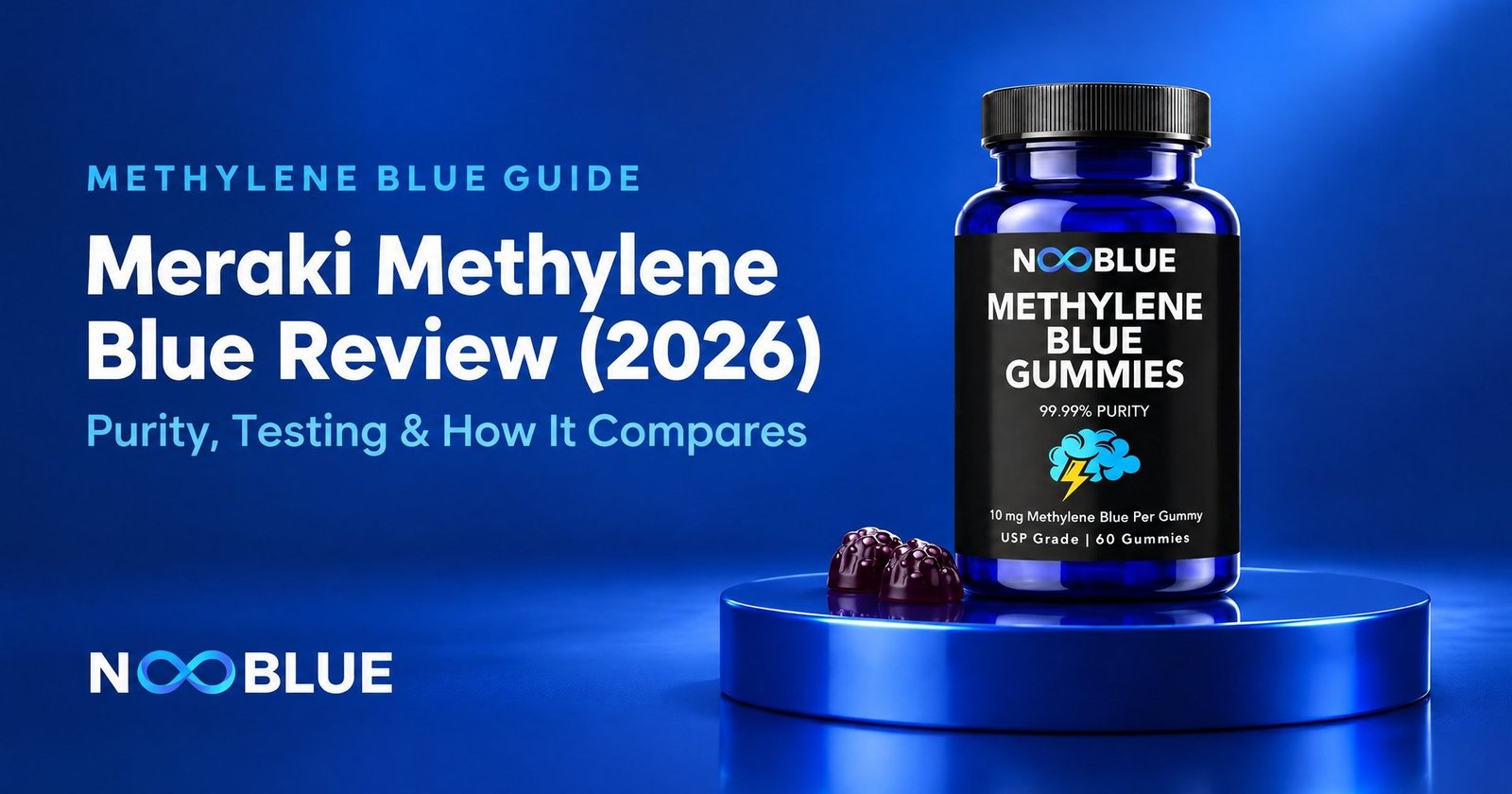
If you want a gummy, NooBlue’s methylene blue gummies hold 10 mg of USP grade methylene blue and 25 mg of vitamin C each, with 0 g of sugar, 60 to a bottle for $49.99, which is $0.83 a gummy or about $0.42 per 5 mg. Vitamin C can shift methylene blue toward its colorless reduced form, and the gummies don’t leave the blue mouth that a liquid like Meraki Blu can. Our best methylene blue gummies comparison and our look at methylene blue gummies vs liquid cover the format in more depth.
Who should buy Meraki Blu, and who shouldn’t
Meraki Blu suits you if you want a liquid, you like the idea of very small steps at about 0.25 mg a drop, you value a finished-product microbial and heavy-metal certificate from an accredited lab, and the price per dose does not bother you. The 30-day money-back guarantee lowers the risk of trying it.
Look elsewhere if you want the most methylene blue for your money, a certificate you can match to your lot, or a document that states how much methylene blue is in the bottle. If you want a liquid, a 1% solution costs far less per dose. If you would rather not count drops, a 5 mg methylene blue capsule gives you a fixed dose, and our ranking of the best methylene blue capsules compares eight of them. Whatever you choose, know the difference between lab grade and pharmaceutical grade methylene blue before you buy.
Frequently asked questions about Meraki methylene blue
Is Meraki methylene blue legit?
Yes, in the sense that Meraki Medicinal is a real company selling a real USP-grade-labeled methylene blue solution, and it publishes three accredited-lab certificates with clean results for heavy metals, formaldehyde and microbes. The caveats are that those certificates carry no lot number and do not measure methylene blue content, the solution is 0.5% even though the Amazon title says 1%, and the product description says “For research purposes only.”
Is Meraki Blu safe?
The published certificates show no detected arsenic, lead, mercury, E. coli, Salmonella or Staphylococcus aureus, with cadmium and formaldehyde in spec. Safety also depends on you: methylene blue from any brand is unsuitable with serotonergic medicines such as SSRIs, SNRIs and MAOIs, with G6PD deficiency, and during pregnancy or breastfeeding. Ask your doctor first if you take any prescription medicine.
Is Meraki Blu a 1% or a 0.5% solution?
By Meraki’s own figures it is 0.5%. The bottle holds 150 mg in 30 mL, which is 5 mg per mL, and a 1% solution holds 10 mg per mL. Meraki’s product page and Amazon description both say a full dropper is 5 mg, which fits 0.5%. Only the Amazon title says “1% Formula”.
How many drops of Meraki Blu is 5 mg?
About 20 drops, or one full 1 mL dropper, according to Meraki. Each drop holds about 0.25 mg. With a 1% solution, 5 mg is about 10 drops. Always check the milligrams per mL on your own bottle.
How much does Meraki methylene blue cost?
$35 for one 30 mL bottle, $65 for two and $89 for three on Meraki’s store, with subscription discounts of 10% to 35%. That is about $1.17 per 5 mg for a single bottle and about $0.99 in a three-pack. A 50 mL bottle of 1% solution such as ours costs $29.99, about $0.30 per 5 mg.
Does Meraki publish a certificate of analysis?
Yes. The product page shows three certificates from Light Labs in Ann Arbor, Michigan, dated May to August 2026, covering heavy metals, formaldehyde and microbes. The lot field on each is blank, and none measures methylene blue content or purity, so you cannot use them to confirm the 150 mg or 99.9% claims or to match your bottle.
What are the benefits of Meraki Blu?
Meraki markets it for energy and focus. Research on methylene blue itself suggests it can support mitochondrial energy production, and one small trial found a single 280 mg dose increased memory-related brain activity. No study has tested Meraki Blu specifically, or any daily low-dose liquid, in healthy adults.
What are the negatives of taking methylene blue?
It turns urine blue or green, it stains skin, fabric and counters, and it can upset the stomach or disturb sleep if taken late. The serious risk is its interaction with serotonergic medicines. It is also unsuitable for people with G6PD deficiency and during pregnancy or breastfeeding.
Is it safe to take methylene blue every day?
Many people take a low dose daily, and Meraki’s directions describe daily use. That does not make it risk-free. Start low, hold for a week or two, avoid it if any of the warnings above apply to you, and talk to a healthcare professional if you take prescription medicine.
Is Meraki Blu on Amazon the same product?
The Amazon listing links to Meraki Medicinal’s brand store, carries the same UPC as the bottle on Meraki’s site, and describes the same 30 mL bottle with 5 mg per full dropper. The one difference is the title, which says “1% Formula”. Meraki’s site also warns buyers against fakes sold on eBay.
Does methylene blue stain your teeth?
A methylene blue liquid can tint the mouth and tongue for a while if it touches them. Meraki’s own FAQ says temporary blue staining of the mouth is normal and suggests diluting in water or juice and using a straw. Mixing drops into a drink rather than dripping them onto the tongue helps with any brand.
What is the best alternative to Meraki Blu?
NooBlue Methylene Blue Drops are our pick if you want a liquid: a 1% USP solution, 50 mL for $29.99, 0.5 mg per drop and about $0.30 per 5 mg, with an HPLC identity and heavy-metal report on the methylene blue ingredient. NooBlue makes them. If you would rather not measure drops, NooBlue’s 5 mg capsules give you a fixed dose at $37.99 for 60.
Browse more methylene blue brand checks: our guides to what 99% USP purity means, MitoZen methylene blue, and spotting a safe, authentic methylene blue supplement, or see everything we sell in the NooBlue shop.
Sources
- Meraki Medicinal. Meraki Blu USP Grade Methylene Blue product page and homepage, read September 25, 2026.
- Light Labs certificates for Meraki Blu, shown on the product page: heavy metals · formaldehyde · microbial panel
- Meraki Blu on Amazon, read September 25, 2026.
- Rodriguez P, Zhou W, Barrett DW, et al. Multimodal randomized functional MR imaging of the effects of methylene blue in the human brain. Radiology. 2016;281(2):516-526. PubMed 27351678 · full text
- Atamna H, Nguyen A, Schultz C, et al. Methylene blue delays cellular senescence and enhances key mitochondrial biochemical pathways. FASEB Journal. 2008;22(3):703-712. PubMed 17928358
- Rojas JC, Bruchey AK, Gonzalez-Lima F. Neurometabolic mechanisms for memory enhancement and neuroprotection of methylene blue. Progress in Neurobiology. 2012;96(1):32-45. PubMed 22067440
- Gonzalez-Lima F, Barksdale BR, Rojas JC. Mitochondrial respiration as a target for neuroprotection and cognitive enhancement. Biochemical Pharmacology. 2014;88(4):584-593. PubMed 24316434
- Ostrovsky A, Afzal M. Methylene Blue. StatPearls, updated January 2, 2026. NCBI Bookshelf NBK557593
- NooBlue product pages: Methylene Blue Drops, 1% · Ultimate Methylene Blue Capsules · Methylene Blue Gummies