Short answer
Yes, Biopharm methylene blue is legit: Biopharm Inc. is a real US chemical company, in business since 1977, and it sells a 1% solution labeled USP grade. It is also sold as a laboratory chemical. Its product sits in a “Laboratory Chemicals” category, its safety data sheet lists professional, scientific and technical uses, and the product page gives a drop strength but no serving directions. At $25.97 for 50 mL, and two bottles for that price during its current offer, it costs less than our drops.
- Our pick for daily use: NooBlue 1% drops, which we make. Same 0.5 mg per drop, sold as a supplement with a 5 mg (10-drop) serving on the label, plus capsule and gummy formats and worldwide shipping.
- Biopharm’s real strengths: a lower price per mL and a certificate lookup by lot number on its own site.
- Either way: methylene blue is not for anyone taking serotonergic medicines, anyone with G6PD deficiency, or anyone pregnant or breastfeeding without a doctor’s approval.
People searching for Biopharm methylene blue reviews usually want to know two things: is this a real product from a real company, and is it the right thing to put in a glass of water every morning? The first question has a clear answer. The second depends on what you want the product to be, and that is where Biopharm and a supplement brand differ. This review sets out what Biopharm sells, what we could and could not verify, how it compares with our own drops, and what the research on methylene blue does and does not show.
NooBlue makes the drops, capsules and gummies we compare Biopharm against, and they are our pick. We have not lab-tested a Biopharm bottle. Everything below about Biopharm comes from its own website, product page and safety data sheet as of Sep 2026, and we say where we could not check something.
Table of contents
- 1. Biopharm Methylene Blue Review: The Quick Verdict
- 2. What Biopharm Sells
- 3. Biopharm vs NooBlue Drops: Side by Side
- 4. What We Could and Could Not Verify
- 5. Biopharm Methylene Blue Reviews: How to Read Them
- 6. Who Biopharm Suits, and Who NooBlue Suits
- 7. What Methylene Blue Does: What the Research Shows
- 8. Safety: What Matters More Than the Brand
- 9. Biopharm Methylene Blue: Frequently Asked Questions
- 9.1. Is Biopharm methylene blue legit?
- 9.2. Is Biopharm methylene blue USP grade?
- 9.3. How many drops of Biopharm methylene blue make 5 mg?
- 9.4. Where can I buy Biopharm methylene blue?
- 9.5. What brand of methylene blue is the best?
- 9.6. What does methylene blue actually do for you?
- 9.7. Why don’t doctors prescribe methylene blue?
- 9.8. What happens if I take methylene blue every day?
- 10. Sources
Biopharm Methylene Blue Review: The Quick Verdict
Biopharm is a genuine company with a long track record. Its homepage describes it as a laboratory chemicals supplier that has served labs and customers since 1977, and its range includes pH buffers, conductivity standards and jewelry cleaner alongside methylene blue. Its methylene blue is a 1% USP-grade solution, with one drop containing 0.5 mg of methylene blue.
The honest verdict has three parts.
- Is it real? Yes. The company history, a physical address, product documentation and the USP grade on the label are all published on its own site.
- Is it good value? Yes, on price. At $25.97 for a 50 mL glass bottle, it works out at $0.26 per 5 mg, and half that while the two-for-one offer runs.
- Is it sold for daily oral use? Not in the way a supplement is. The product page gives the strength per drop but no serving size or directions, the store files it under laboratory chemicals, and the safety data sheet lists “manufacture of other chemical products, professional, scientific, and technical activities” as its recommended use.
If you want a methylene blue product that is sold and labeled as a daily supplement, with a stated serving and a choice of formats, our drops or capsules are the better fit. If you are comfortable working out your own serving from a lab-grade solution and price is your main concern, Biopharm is a real product at a low price.
What Biopharm Sells
The Biopharm methylene blue we reviewed is a single product: Methylene Blue 1%, USP (Pharmaceutical) Grade. Its brand store offered these sizes as of Sep 2026.
| Size | Price (brand store) | Note |
|---|---|---|
| 50 mL glass with dropper | $25.97 | Page ran a “two 50mL glass for the price of one” offer |
| 60 mL plastic | $24.97 | Plastic bottle |
| 8 fl oz glass | $118.97 | Bulk size |
| 250 mL plastic | $118.97 | Bulk size |
The product page says Biopharm’s methylene blue products undergo additional testing from third-party analysts, that orders typically ship within 1–2 business days, and that standard shipping is free to the lower 48 US states. Biopharm also sells through Amazon and through several wellness retailers, which appeared in the September 2026 search results for the brand.
A 1% solution holds 10 mg of methylene blue per mL, so a 50 mL bottle holds 500 mg in total. At 0.5 mg per drop, 10 drops give 5 mg, the same maths as our own drops.
Biopharm vs NooBlue Drops: Side by Side
Both products are 1% methylene blue solutions with the same strength per drop. The differences are in how they are sold, what the label tells you, and what else each brand offers. Prices are as of Sep 2026.
| NooBlue Methylene Blue Drops (our pick) | Biopharm Methylene Blue 1% USP | |
|---|---|---|
| Strength | 1% USP-grade methylene blue in distilled water | 1% USP grade |
| Per drop | 0.5 mg | 0.5 mg |
| Bottle | 50 mL with a glass dropper | 50 mL glass with dropper (other sizes available) |
| Price | $29.99 | $25.97 (two bottles for that price during its offer) |
| Cost per 5 mg serving | $0.30 | $0.26 (lower price per mL) |
| How it is sold | As a supplement, with a 5 mg (10-drop) serving and a full-dropper amount on the product page | In a “Laboratory Chemicals” category, with drop strength but no serving directions on the product page |
| Testing information | CTLA ingredient report: identity and heavy metals for the methylene blue ingredient lot | States additional third-party testing; certificate lookup by lot number on its site |
| Other formats | 5 mg capsules and 10 mg gummies from the same brand | The 1% solution in several bottle sizes |
| Shipping | Worldwide, dispatch in 1–2 business days, free on orders of $100+ | Free standard shipping to the lower 48 states, ships in 1–2 business days |
On price per mL, Biopharm wins, and its lot-number certificate lookup is a genuine plus. On the label, our drops tell you the serving: 10 drops for 5 mg, or a full dropper of about 20 drops for 10 mg, and the bottle gives about 100 servings at 5 mg. You can also switch to a capsule or a gummy from the same brand without changing the methylene blue behind it.
On testing, be clear about what each document covers. Our CTLA report covers identity (an HPLC result of “Conforms”) and heavy metals for the methylene blue ingredient, lot 2025022801. It does not give a purity percentage or test every finished batch, and our product pages say so. Biopharm’s lookup is organized by the lot number on your bottle, so if you buy Biopharm, search your own lot and read what the certificate reports. Our guide to reading a methylene blue certificate of analysis shows which lines matter.
What We Could and Could Not Verify
- Verified on Biopharm’s site: the company history (since 1977), the 1% USP grade, 0.5 mg per drop, the sizes and prices above, the third-party testing statement, the shipping terms, the lot-number certificate lookup and the safety data sheet’s recommended use.
- Not verified: the contents of any individual Biopharm certificate, because the lookup needs a lot number from a bottle we did not buy. We also could not load Biopharm’s Amazon listing, so we are not quoting its star rating or review count.
- Not claimed: we make no claim that Biopharm’s solution is impure or unsafe. Nothing we found suggests that. The distinction we draw is about how it is sold and labeled, not about the chemical in the bottle.
If you are checking any methylene blue seller, including us, our guide to real versus fake methylene blue and our explainer on what USP purity means cover the checks.
Biopharm Methylene Blue Reviews: How to Read Them
Star ratings on a marketplace tell you about delivery, packaging and whether buyers felt a difference. They cannot tell you what is in the bottle. When you read Biopharm methylene blue reviews, or reviews of any brand, weigh these points:
- Is the reviewer using the product the way you plan to? A lab user and a daily supplement user are judging different things.
- Does the review mention the lot number or a certificate? Those details are more useful than adjectives.
- Is the listing sold by the brand or an authorized seller? Reviews on a reseller’s listing may not reflect the brand’s own stock.
- Do reviews mention staining or leaking droppers? Any 1% solution stains skin, fabric and surfaces, so a good dropper matters.
Who Biopharm Suits, and Who NooBlue Suits
Biopharm suits you if price per mL is your main concern, you are comfortable working out your own serving from a drop strength, and you live in the lower 48 states where shipping is free. It is not for you if you want a product labeled with a serving and sold as a supplement, or you want a capsule or gummy option.
NooBlue drops suit you if you want the same 0.5 mg drop with a stated 5 mg serving, shipping outside the US, and the option to move to capsules or gummies later. They are not for you if the lowest price per mL is all that matters to you, because Biopharm is cheaper.
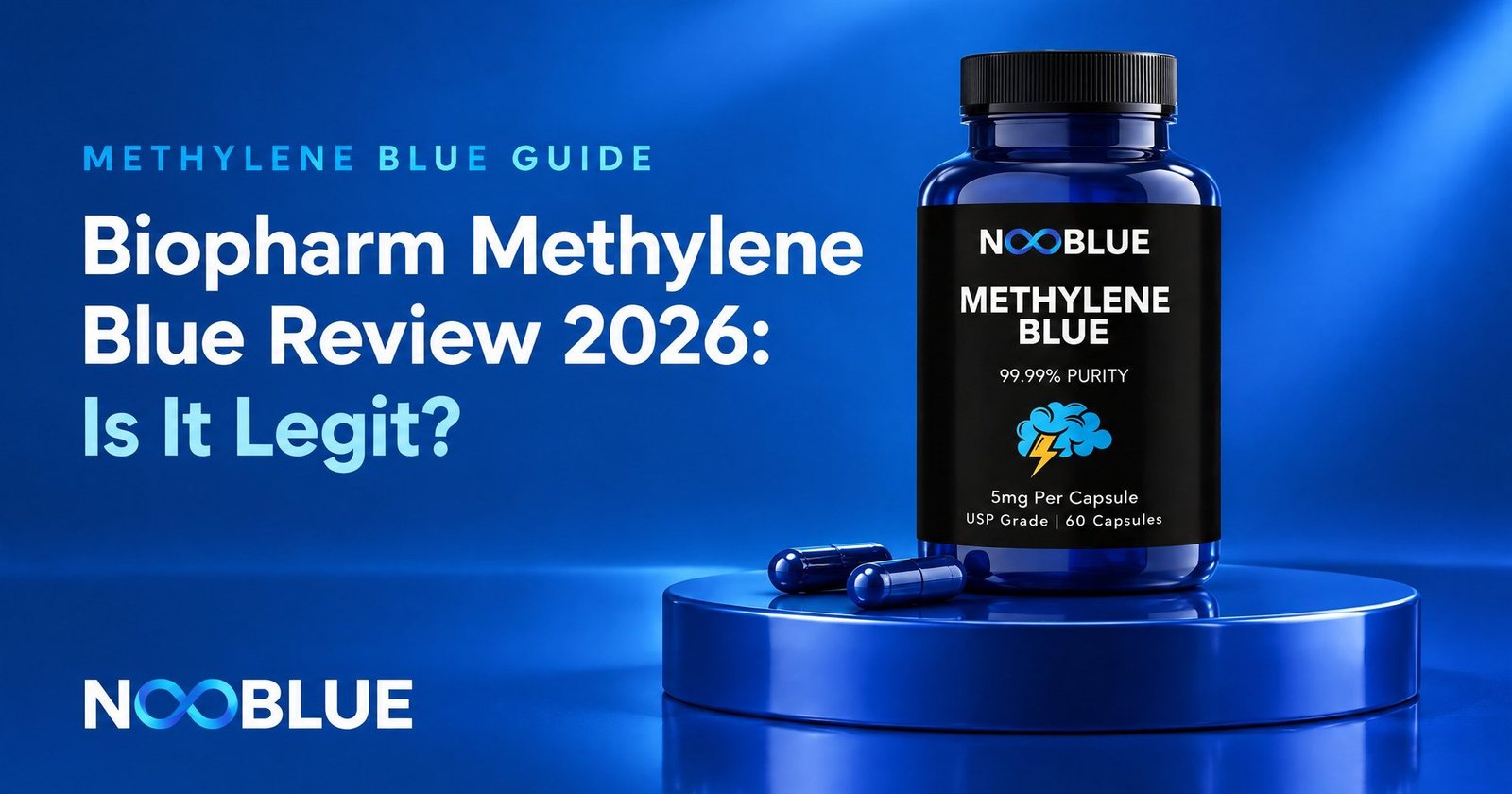
NooBlue capsules suit you if you would rather not count drops at all. Each NooBlue methylene blue capsule holds 5 mg of methylene blue and 10 mg of vitamin C, 60 to a bottle, at $37.99. Our methylene blue gummies hold 10 mg with 25 mg of vitamin C and don’t leave the blue mouth that drops can. You can compare all three in the NooBlue shop.
For the wider field, our comparison of methylene blue supplements, our Nutricel versus NooBlue comparison, our Meraki methylene blue review and our guide to methylene blue powder apply the same checks to other brands and forms. Our own brand gets the same treatment in is NooBlue legit?, and you can read who we are on our about page.
What Methylene Blue Does: What the Research Shows
Whichever brand you buy, it helps to know what the human research tested, because it is smaller and more mixed than marketing suggests.
Memory tasks. A randomized, double-blind, placebo-controlled study at the University of Texas gave 26 adults aged 22 to 62 either USP-grade methylene blue or a placebo. The methylene blue group took 280 mg, about 4 mg/kg. One hour later, brain scans showed increased responses during attention and short-term memory tasks, and correct answers during memory retrieval rose by 7% (Rodriguez and colleagues, Radiology, 2016).
Brain blood flow. A study at King’s College London gave healthy volunteers methylene blue by vein at 0.5 and 1 mg/kg and measured the brain directly. Contrary to the researchers’ own hypothesis, methylene blue reduced global cerebral blood flow and the brain’s oxygen use (Singh and colleagues, Journal of Cerebral Blood Flow and Metabolism, 2023). The authors suggest the doses may have been on the inhibitory side of methylene blue’s dose response.
Absorption. A German study in 16 healthy people compared 50 mg by vein with 500 mg by mouth as a liquid and found an average absolute oral bioavailability of 72.3% (Walter-Sack and colleagues, European Journal of Clinical Pharmacology, 2009).
Two limits apply to all of this. The doses studied are far above a 5 mg or 10 mg supplement serving, so the results do not tell you what a supplement serving does. And none of these studies tested Biopharm, NooBlue or any other retail brand. Our summary of what the research on methylene blue shows goes further, and our guide to how many mg of methylene blue per day explains how people pick a daily amount.
Safety: What Matters More Than the Brand
These points come from the prescribing information for pharmaceutical methylene blue and the research behind it. Talk to your doctor before you start if any of them could apply to you.
- Serotonergic medicines. Do not combine methylene blue with SSRIs, SNRIs, MAOIs, other serotonergic medicines or opioids unless your doctor has approved it. The US injection label carries a boxed warning that methylene blue may cause serious or fatal serotonin syndrome with these drugs. Lab work at the University of St Andrews showed that methylene blue is a potent, reversible inhibitor of monoamine oxidase A, the enzyme that breaks down serotonin (Ramsay and colleagues, British Journal of Pharmacology, 2007).
- G6PD deficiency. People with glucose-6-phosphate dehydrogenase deficiency should not take methylene blue. The injection label lists it as a contraindication because of the risk of hemolytic anemia.
- Pregnancy and breastfeeding. Do not take methylene blue while pregnant or breastfeeding unless your doctor advises it. The injection label warns that it may cause fetal harm.
- Expected effects. Methylene blue passes into the urine, which can turn blue-green after a dose, and a 1% solution stains skin, fabric and surfaces.
Our guide to who should not take methylene blue covers each group in more detail.
Biopharm Methylene Blue: Frequently Asked Questions
Is Biopharm methylene blue legit?
Yes. Biopharm Inc. is a US chemical company that says it has served labs and customers since 1977, and its methylene blue is a 1% USP-grade solution with 0.5 mg per drop. It is sold as a laboratory chemical rather than as a supplement, and its product page gives no serving directions, so decide whether that fits how you plan to use it.
Is Biopharm methylene blue USP grade?
The product is sold as Methylene Blue 1%, USP (Pharmaceutical) Grade, and its safety data sheet names it Methylene Blue, USP, 1% (w/v). To see the testing for your own bottle, enter the lot number from the label into the certificate lookup on Biopharm’s website.
How many drops of Biopharm methylene blue make 5 mg?
Ten. Biopharm states that one drop contains 0.5 mg of methylene blue, so 10 drops give 5 mg. That is the same strength per drop as our 1% drops, whose label sets 10 drops as one 5 mg serving. Check with your doctor before starting, especially if you take any medicine.
Where can I buy Biopharm methylene blue?
From Biopharm’s own store, which listed a 50 mL glass bottle at $25.97 as of Sep 2026, and through Amazon and several wellness retailers. Buying from the brand store lets you check the lot number against its certificate lookup. Our guide to where to buy methylene blue covers the other routes.
What brand of methylene blue is the best?
Our pick is NooBlue, which we make: 1% drops with a stated 5 mg serving, 5 mg capsules and 10 mg gummies with vitamin C, shipped worldwide. Biopharm is the lower-cost option per mL among the 1% solutions we checked. Whatever you choose, look for USP grade, a stated dose per serving and a testing document you can read.
What does methylene blue actually do for you?
Methylene blue is a redox-active dye that can accept and pass on electrons in the cell’s energy machinery. Human research is small and mixed: a 2016 study linked a 280 mg dose to better scores on memory tasks, while a 2023 study found intravenous doses reduced brain blood flow in healthy volunteers. Both used doses far above a typical supplement serving of 5 to 10 mg.
Why don’t doctors prescribe methylene blue?
Doctors do use it: methylene blue injection is a prescription medicine given in hospitals. What is missing is large, long-term trials of low-dose oral methylene blue for everyday use, and its interaction with serotonergic antidepressants means anyone considering it needs a medication check first.
What happens if I take methylene blue every day?
Your urine may turn blue-green, and the serotonergic interaction applies on every day you take it. Beyond that, there are no long-term trials of daily low-dose supplement use, so nobody can tell you the long-term effects with confidence. Talk to your doctor before starting, and stop if you notice anything that worries you. Our methylene blue side effects guide lists what to watch for.
Sources
- Biopharm Inc. Methylene Blue 1%, USP (Pharmaceutical) Grade, product page, read Sep 2026. bphchem.com
- Biopharm Inc. Homepage and product certificates lookup, read Sep 2026. bphchem.com
- Biopharm Inc. Safety Data Sheet, Methylene Blue, USP, 1% (w/v), product code BM8341. SDS (PDF)
- Rodriguez P, Zhou W, Barrett DW, et al. Multimodal randomized functional MR imaging of the effects of methylene blue in the human brain. Radiology. 2016;281(2):516-526. PubMed 27351678
- Singh N, MacNicol E, DiPasquale O, et al. The effects of acute methylene blue administration on cerebral blood flow and metabolism in humans and rats. J Cereb Blood Flow Metab. 2023;43(2 suppl):95-105. PubMed 36803299
- Walter-Sack I, Rengelshausen J, Oberwittler H, et al. High absolute bioavailability of methylene blue given as an aqueous oral formulation. Eur J Clin Pharmacol. 2009;65(2):179-189. PubMed 18810398
- Ramsay RR, Dunford C, Gillman PK. Methylene blue and serotonin toxicity: inhibition of monoamine oxidase A (MAO A) confirms a theoretical prediction. Br J Pharmacol. 2007;152(6):946-951. PubMed 17721552
- American Regent. ProvayBlue (methylene blue) injection, prescribing information. DailyMed label
- NooBlue product pages for the drops, capsules and gummies (servings, ingredients and the CTLA ingredient report), read Sep 2026.