Quick answer
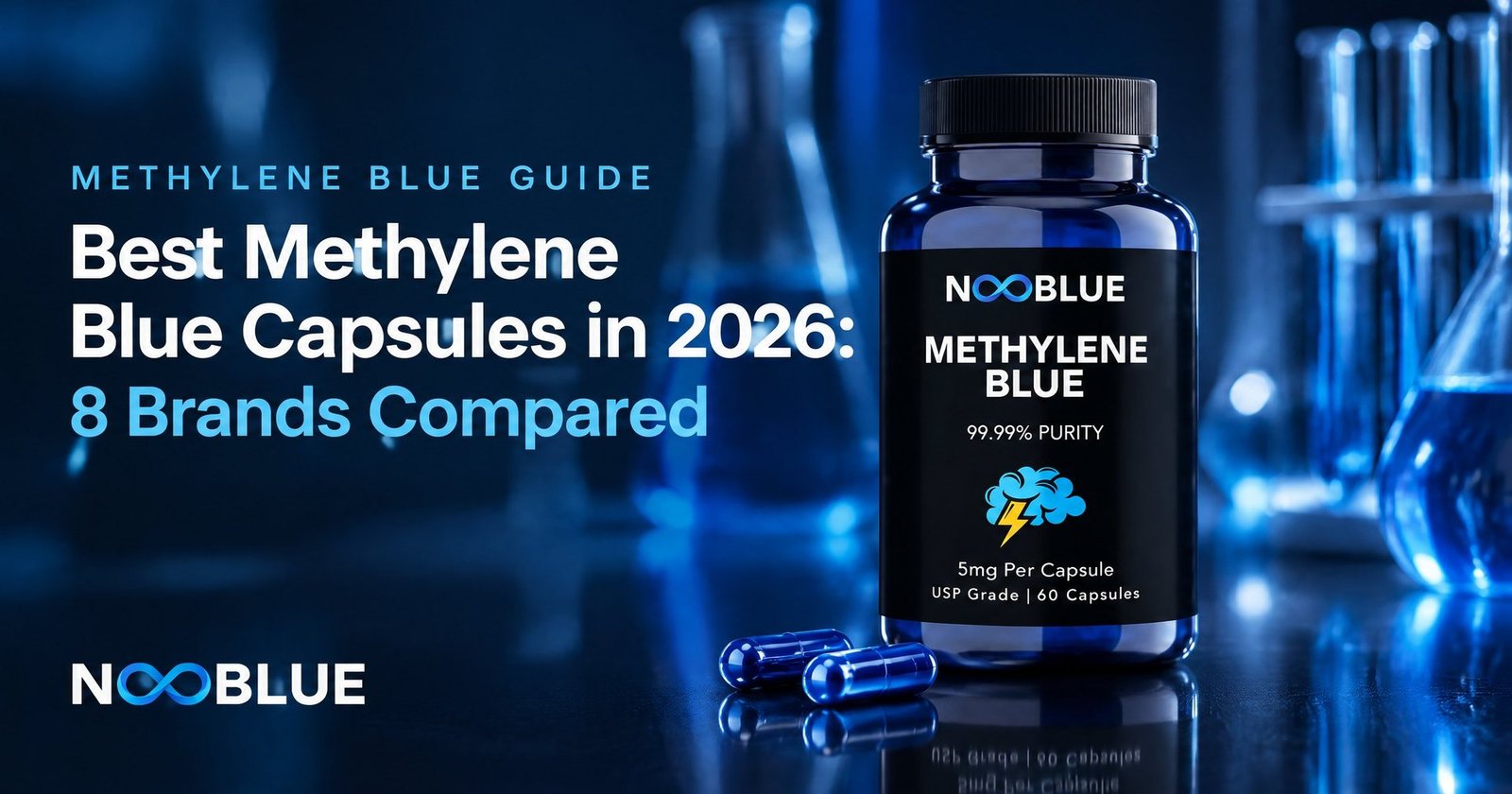
The best methylene blue capsule for most people is NooBlue Ultimate Methylene Blue Capsules: 5 mg of USP grade methylene blue and 10 mg of vitamin C per capsule, 60 capsules for $37.99, which is $0.63 a day at one capsule. It is the only 5 mg capsule among the eight brands we compared, so it is the only one that lets a new user start low without opening capsules. If you already take 12 mg or more a day and care most about cost per milligram, most capsules here cost less per milligram, led by Arigold, and Nutricel Blue Boost publishes lot certificates for its finished capsules.
Safety first: do not take methylene blue in any form if you take serotonergic medicines such as SSRIs, SNRIs or MAOIs, if you have G6PD deficiency, or if you are pregnant or breastfeeding.
NooBlue makes the capsule ranked first. It is our pick, and every section below says who should buy something else. Competitor figures come from each brand’s own product page or Amazon listing, read on September 25, 2026.
Written by the NooBlue editorial team. We make and sell methylene blue capsules, gummies and drops. We did not lab-test any product in this guide. Every figure comes from a brand’s own page, its published lab paperwork or a peer-reviewed study, and all of them are listed in the sources at the end.
Most methylene blue capsules look alike on a product page. The labels say USP grade, the listings say third-party tested, and the bottles hold 60 capsules. What separates them is harder to see from a photo: how many milligrams sit in each capsule, what document backs the purity claim, and what else the capsule contains.
This guide compares eight capsule brands on those points, with the same arithmetic for every row. Cost per capsule is the price divided by the capsule count. Cost per 5 mg is the price divided by the total milligrams of methylene blue in the bottle, multiplied by five. We also list the smallest dose each capsule can deliver, because a cheap 12 mg capsule does not help someone who wants to start at 5 mg.
Table of contents
- 1. Best methylene blue capsules at a glance
- 2. How we ranked the best methylene blue capsules
- 3. The 8 best methylene blue capsules, ranked
- 3.1. 1. NooBlue Ultimate Methylene Blue Capsules: best overall
- 3.2. 2. Nutricel Blue Boost: best finished-capsule lab paperwork
- 3.3. 3. Chemist Labs Methylene Blue Capsules: best plain 10 mg capsule
- 3.4. 4. Optimal Human Methylene Blue Capsules: fewest other ingredients at 10 mg
- 3.5. 5. Earth Harmony Ultimate Methylene Blue: best for a botanical blend
- 3.6. 6. Arigold Methylene Blue Capsules: lowest cost per milligram
- 3.7. 7. LVLUP Health Mito Blue: best all-in-one stack
- 3.8. 8. Raden Wellness Methylene Blue Capsules: for use inside a clinic program
- 4. Why the smallest dose matters more than the price
- 5. What makes a good methylene blue capsule
- 6. How to check a methylene blue certificate of analysis
- 7. What the research says about methylene blue
- 8. Methylene blue capsule safety: who should not take them
- 9. Capsules, gummies or drops: which methylene blue format fits you
- 10. Compounded methylene blue capsules: the prescription route
- 11. Where to buy methylene blue capsules
- 12. Frequently asked questions about methylene blue capsules
- 12.1. What is the best methylene blue capsule on the market?
- 12.2. What is the best brand of methylene blue?
- 12.3. Which methylene blue is best for beginners?
- 12.4. Is a 5 mg or 10 mg methylene blue capsule better?
- 12.5. How should I take methylene blue capsules?
- 12.6. What are methylene blue capsules used for?
- 12.7. What are the side effects of methylene blue capsules?
- 12.8. Can I take methylene blue capsules with antidepressants?
- 12.9. Are methylene blue capsules safe to take daily?
- 12.10. Is methylene blue better in liquid or capsule form?
- 12.11. What brand of methylene blue is legit?
- 12.12. Do methylene blue capsules turn your mouth blue?
- 12.13. Why do methylene blue capsule doses vary so much between brands?
- 12.14. Where can I buy methylene blue capsules?
- 12.15. What are the top rated methylene blue brands, based on reviews?
- 13. The verdict: which methylene blue capsule should you buy?
- 14. More methylene blue buying guides
- 15. Sources
- 16. Explore this topic in depth
Best methylene blue capsules at a glance
All eight products below are capsules sold for daily use. Prices are as of Sep 2026, read from each brand’s own store unless the row says Amazon, before shipping and multi-bottle discounts.
| # | Capsule | Methylene blue per capsule | Capsules | Price (as of Sep 2026) | Cost per capsule | Cost per 5 mg | Lab paperwork on the page | Best for |
|---|---|---|---|---|---|---|---|---|
| 1 | NooBlue Ultimate Methylene Blue Capsules | 5 mg | 60 | $37.99 | $0.63 | $0.63 | Ingredient report (CTLA), published | Starting at 5 mg with a plain formula |
| 2 | Nutricel Blue Boost | 12 mg | 60 | $34.90 | $0.58 | $0.24 | Lot certificate (Eurofins), published | Finished-capsule lot certificates |
| 3 | Chemist Labs Methylene Blue Capsules | 10 mg | 60 | $24.99 (Amazon) | $0.42 | $0.21 | Certificates for three lots, linked | A plain 10 mg capsule at a low price |
| 4 | Optimal Human Methylene Blue Capsules | 10 mg | 60 | $35.99 | $0.60 | $0.30 | Manufacturer specification sheet | The fewest other ingredients at 10 mg |
| 5 | Earth Harmony Ultimate Methylene Blue | 12 mg | 60 | $39.95 | $0.67 | $0.28 | None shown | 12 mg with a botanical blend |
| 6 | Arigold Methylene Blue Capsules | 12 mg (24 mg per 2-capsule serving) | 90 | $20.99 (Amazon) | $0.23 | $0.10 | On request | Lowest cost per milligram |
| 7 | LVLUP Health Mito Blue | 10 mg plus three other actives | 60 | $89.99 | $1.50 | $0.75 | Lot testing described, no certificate linked | An all-in-one mitochondrial stack |
| 8 | Raden Wellness Methylene Blue Capsules | 20 mg | 60 | $119.99 | $2.00 | $0.50 | None linked | Use inside a clinic program |
Cost per 5 mg is the price divided by the total milligrams in the bottle, times five. Arigold’s label lists a two-capsule serving of 24 mg, so its 90 capsules hold 1,080 mg. LVLUP’s figure counts only the methylene blue and ignores its three other actives. Optimal Human’s price is the one-time price its page showed when we checked, against a list price of $39.99.
Two points stand out. NooBlue is the only brand here that sells a 5 mg capsule, and every other capsule starts at 10 mg or more. And the cheapest milligram is not the cheapest dose. Arigold costs $0.10 per 5 mg of methylene blue, but its smallest unit is a 12 mg capsule and its labeled serving is two capsules. If 5 mg is the dose you want, the price per milligram stops mattering, because that capsule cannot give you 5 mg.
How we ranked the best methylene blue capsules
We did not run lab tests, and we do not claim to have. This is a comparison of what each brand states and publishes, and you can check every line against the same pages. We weighed six things, in this order.
- Smallest dose. The lowest amount you can take without opening a capsule. The usual advice with methylene blue is to start low and adjust slowly, and a capsule that starts at 12 mg or 20 mg takes that first step away.
- Grade. USP grade means the methylene blue is sold to the United States Pharmacopeia standard. All eight products claim it, so the claim alone separates nothing. The document behind it does.
- Paperwork. A lot-numbered certificate from a named laboratory, published before you buy, ranks above one “available on request”. We also say what each document covers. An ingredient report tests the raw methylene blue. A finished-product certificate tests a batch of capsules. A specification sheet lists targets and typical results.
- Cost per 5 mg. Worked out from the total milligrams in the bottle, never from a brand’s own “per serving” line, so a two-capsule serving compares fairly with a one-capsule serving.
- Other ingredients. Cacao, berberine, acetyl L-carnitine and CoQ10 can be a plus or an unwanted variable. We flag them so you can decide.
- Safety information. Whether the page warns about serotonergic medicines, G6PD deficiency and pregnancy.
Star ratings and reviews count for little here. Most of these capsules sell on one or two channels, rating counts range from nine to several hundred, and a rating cannot tell you what is in the capsule. Where a brand shows a rating, we quote it as the page stated it on the day we checked.
NooBlue ranks first because it is the only 5 mg capsule and it publishes its ingredient report on the product page. It does not win on price per milligram, and the sections below say so plainly.
The 8 best methylene blue capsules, ranked
These are the eight capsule brands we would consider in the US in 2026, from our own product at #1 to a clinic-only option at #8. Each entry says who it suits and who should look elsewhere.
1. NooBlue Ultimate Methylene Blue Capsules: best overall
NooBlue makes these 5 mg capsules, and they are our top pick for most buyers. Each vegetable capsule holds 5 mg of USP grade methylene blue and 10 mg of vitamin C (ascorbic acid), with rice flour inside a cellulose shell. The capsule contains no cacao, berberine or botanical blend. A bottle of 60 costs $37.99 (regular price $49.99), which is $0.63 a capsule. The label says one capsule a day with food, so a bottle lasts 60 days.
The case for it is the 5 mg step. A capsule is a sealed unit. If it holds 12 mg, your choices are 12, 24 or 36 mg, and splitting one means tipping a strong blue dye onto a scale and guessing at the share. With a 5 mg capsule you take 5 mg a day, the one capsule the label suggests, and if you later want 10 mg, one of our gummies or 20 drops of our 1% solution gives it. None of the other seven capsules in this guide can start that low.
The paperwork is on the product page, not behind an email request. Contract Testing Laboratories of America (CTLA) analyzed the methylene blue ingredient, lot 2025022801, in report 135621. The report records an HPLC identity result of “Conforms” and individual results for arsenic, cadmium, mercury and lead. Its scope is narrower than a finished-product certificate. It covers the raw ingredient rather than every batch of capsules, and it does not state a numerical purity percentage. Nutricel’s lot certificate tests the finished capsules, which is a stronger kind of document, and we would rather you know that than assume more than our report says.
On cost, be realistic. At $0.63 per 5 mg, NooBlue costs more per milligram than every other capsule here except LVLUP’s four-ingredient stack, from Raden at $0.50 down to Nutricel at $0.24, Chemist Labs at $0.21 and Arigold at $0.10. If you already know you want 12 mg a day, a 12 mg capsule is cheaper. What you pay for here is the smaller unit and a formula with nothing else to account for. Two bottles cost 10% less each, three bottles 15% less and five bottles 20% less, and orders over $100 ship free worldwide.
Who it suits: first-time users, anyone who wants to stay between 5 and 10 mg a day, and anyone who wants plain methylene blue with nothing added but vitamin C. Who should look elsewhere: people already settled on 12 mg or more, who will pay less per milligram at #2 or #6, and people who dislike swallowing capsules, who may prefer our 10 mg methylene blue gummies. Our beginner’s guide to methylene blue supplements explains why the first fortnight at a low dose matters more than the brand on the bottle.
2. Nutricel Blue Boost: best finished-capsule lab paperwork
Nutricel’s Blue Boost capsule holds 12 mg of USP grade methylene blue with 35 mg of vitamin C ester (ascorbyl palmitate) and 235 mg of organic cacao powder, plus silicon dioxide as a flow agent. A bottle of 60 costs $34.90 on the brand’s store, or $31.41 on subscription. That is $0.58 a capsule and $0.24 per 5 mg.
Nutricel is among the most open brands in this comparison on testing. Its certificates page links a Eurofins certificate of analysis for Blue Boost lot 0125047, tested in July 2025, covering methylene blue potency, heavy metals and microbial counts. The same page says its raw methylene blue is 99.4% pure, and the product page says the capsules are made in a GMP-compliant facility in the United States. The safety notes are direct: do not take it with SSRIs, while pregnant or nursing, or in the evening if sleep is a concern.
The limit is the dose. The smallest amount you can take is one 12 mg capsule, so the $0.24 figure is what a milligram costs, not what a 5 mg dose costs. The cacao also adds 235 mg of other material to each capsule, which some buyers like and single-ingredient buyers may not. We compare the two brands side by side in our Nutricel vs NooBlue breakdown.
Who it suits: experienced users settled at about 12 mg a day who want lot certificates for the finished capsules. Who should look elsewhere: anyone who wants 5 mg, or methylene blue without cacao.
3. Chemist Labs Methylene Blue Capsules: best plain 10 mg capsule
Chemist Labs’ 60-count bottle was the first Google result for “best methylene blue capsules” in the US when we checked in September 2026, so many buyers meet it first. Each capsule contains 10 mg of methylene blue, described on its Amazon listing as “USP Grade, 99% Pure, Pharmaceutical Grade”, with microcrystalline cellulose in an HPMC vegetable capsule. The bottle was $24.99 on Amazon on September 25, 2026, which is $0.42 a capsule and $0.21 per 5 mg. The listing carried an Amazon’s Choice badge and showed 4.3 out of 5 from 690 ratings. The brand’s own store lists the same 60 capsules at $34.99 and a 120-count bottle at $44.99.
Chemist Labs also publishes paperwork. Its capsule lab reports page links certificates of analysis for three lots (07025AA, 2512701 and 2602801), so you can match a document to the lot number on your bottle. We confirmed the certificates are linked. We did not audit the results inside each one. The Amazon safety text warns against use with SSRIs or during pregnancy or nursing, and says methylene blue may interact with antihistamines such as diphenhydramine.
The trade-off is the dose. The smallest step is 10 mg, twice our 5 mg capsule, and there is no way down without opening a capsule.
Who it suits: buyers who want a single-ingredient 10 mg capsule at a low price per capsule, with lot documents to check. Who should look elsewhere: anyone who wants to start at 5 mg.
4. Optimal Human Methylene Blue Capsules: fewest other ingredients at 10 mg
Optimal Human’s capsule lists methylene blue USP (10 mg), a vegetable cellulose capsule, rice flour and gellan gum. The page lists no vitamin C or cacao. The list price is $39.99 for 60 capsules, and the page offered a one-time purchase of one bottle at $35.99 when we checked, which is $0.60 a capsule and $0.30 per 5 mg. Subscriptions start lower, at $19.99 for the first month and then $29.99.
The page links a “Lab Report (PDF)”, and we opened it. It is a finished-product specification sheet for lot 60078 on Ameri-Kal letterhead, an Oklahoma City address. It shows a “Conforms/Pass” assay result against 10 mg of methylthioninium chloride per capsule, and its microbial and heavy-metal lines are marked “typical results”. That is more than many brands show, but it does not name an outside testing laboratory. The store showed a 4.8 average from nine reviews, a small base.
Who it suits: people who want 10 mg of methylene blue with the fewest other ingredients. Who should look elsewhere: anyone who wants a certificate from a named third-party lab, or a 5 mg dose.
5. Earth Harmony Ultimate Methylene Blue: best for a botanical blend
Earth Harmony’s Ultimate Methylene Blue capsule holds 12 mg of methylene blue with vitamin C and a plant blend of organic berberine, chlorophyllin and chlorophyll. A bottle of 60 costs $39.95 on the brand’s store, which is $0.67 a capsule and $0.28 per 5 mg. The brand describes its methylene blue as “99.99% USP / pharmaceutical grade, formaldehyde-free”, made in Phoenix, Arizona, under cGMP, and says all its products go through third-party testing.
We found no certificate of analysis on the product page, so the 99.99% figure is the brand’s statement rather than a document you can read before you buy. Berberine is an active compound in its own right, so check it against any other supplements or medicines you take. The page does carry clear warnings: not during pregnancy or nursing, talk to a healthcare provider first if you have a G6PD variant, and do not combine it with SSRIs or other serotonin-affecting substances without medical supervision.
Who it suits: people taking 10 to 12 mg who want methylene blue and berberine in one capsule. Who should look elsewhere: anyone who wants plain methylene blue, a published certificate or a 5 mg dose.
6. Arigold Methylene Blue Capsules: lowest cost per milligram
Arigold’s Amazon listing is easy to misread. The “24mg” in its title is the two-capsule serving. Each capsule holds 12 mg, and the 90-count bottle is 45 servings. At $20.99 on Amazon that is $0.23 a capsule, $0.47 per 24 mg serving and $0.10 per 5 mg, by far the lowest cost per milligram in this comparison. The other ingredients are vitamin C ester (ascorbyl palmitate) and organic cacao in a hypromellose capsule.
The listing says every lot is checked for identity, assay, heavy metals and microbiology, and that a batch certificate is available on request. We did not see one posted. Reviews are thin, at 3.6 out of 5 from 22 ratings when we checked. The safety text is thorough: it names serotonergic medicines, the antibiotic linezolid, G6PD deficiency and pregnancy, and it warns that the capsules can turn urine blue or green and stain skin and fabric.
Who it suits: cost-per-milligram buyers already settled at 12 or 24 mg a day. Who should look elsewhere: anyone still finding their dose, because 12 mg is the floor, and anyone who wants paperwork before buying.
7. LVLUP Health Mito Blue: best all-in-one stack
Mito Blue is a different kind of product. Each capsule combines 10 mg of methylene blue with 400 mg of acetyl L-carnitine, 100 mg of ubiquinol (CoQ10) and 10 mg of PQQ. A bottle of 60 on LVLUP’s store is listed at $89.99, or $80.99 with subscribe and save, which is $1.50 a capsule at the list price. Spread over the methylene blue alone that is $0.75 per 5 mg, but you are paying for three other actives as well.
LVLUP says every lot is verified by third-party testing, but we found no certificate linked on the product page. The page advises anyone using serotonergic medicines, anyone pregnant or nursing, and anyone under 18 to consult a qualified provider first.
Who it suits: people who were going to buy acetyl L-carnitine, CoQ10 and PQQ anyway and want one capsule. Who should look elsewhere: anyone who wants to know what methylene blue does on its own, since four actives make that hard to judge.
8. Raden Wellness Methylene Blue Capsules: for use inside a clinic program
Raden Wellness sells 20 mg methylene blue capsules, 60 to a bottle, at $119.99. That is $2.00 a capsule and $0.50 per 5 mg, the highest price per capsule here. Raden runs it as a clinic program: the page describes a complimentary consultation with a trained medical provider and says labs will be drawn before you start. It describes its methylene blue as USP pharmaceutical grade and free of heavy metals and industrial contaminants, but no certificate of analysis is linked on the page.
The page names G6PD deficiency and serotonergic medicines, including SSRIs, SNRIs and MAO inhibitors, as reasons not to take it. Its suggested use is one to two capsules, which is 20 to 40 mg, well above every other capsule in this guide.
Who it suits: people who want a provider involved from the start and are comfortable paying for that. Who should look elsewhere: anyone who wants a low self-directed dose, where 20 mg is four times our smallest step.
Why the smallest dose matters more than the price
Most roundups rank methylene blue capsules on purity and price. Both matter. Neither tells you whether a bottle fits the dose you plan to take, and that is the question that decides whether you finish it.
A capsule gives you whole multiples of one number. Here is what each capsule in this guide can deliver without opening it:
| Capsule | Smallest dose | Doses from whole capsules | Can it give exactly 5 mg? |
|---|---|---|---|
| NooBlue | 5 mg | 5, 10, 15, 20 mg | Yes |
| Chemist Labs | 10 mg | 10, 20, 30 mg | No |
| Optimal Human | 10 mg | 10, 20, 30 mg | No |
| LVLUP Mito Blue | 10 mg (with three other actives) | 10, 20 mg | No |
| Nutricel Blue Boost | 12 mg | 12, 24, 36 mg | No |
| Earth Harmony | 12 mg | 12, 24, 36 mg | No |
| Arigold | 12 mg (labeled serving 24 mg) | 12, 24, 36 mg | No |
| Raden Wellness | 20 mg | 20, 40 mg | No |
Why start low at all? Methylene blue does not behave like most supplements, where more simply means more. Two reviews from the Gonzalez-Lima lab at the University of Texas describe a hormetic dose response, meaning low and high doses can have opposite effects, and they tie the effects on mitochondrial respiration to low doses (Rojas and colleagues, 2012, Progress in Neurobiology, and Gonzalez-Lima and colleagues, 2014, Biochemical Pharmacology). That work is mostly in lab and animal models of the compound, not on any capsule, so it does not tell you your dose. It is the reason the practical advice is to start at the low end, hold for a week or two, and move up in small steps. Our guide to how many mg of methylene blue per day sets out that protocol.
If a 5 mg step is still too coarse, a 1% liquid is the next tool. Our comparison of 1% methylene blue solution against 5 mg capsules covers when drops make more sense than a capsule.
What makes a good methylene blue capsule
Three questions sort a good capsule from a doubtful one: what grade of methylene blue went in, what document shows it, and what else is in the capsule.
USP grade, not lab, industrial or aquarium grade
Methylene blue has a long life outside supplements, as a textile dye, a laboratory stain and an aquarium treatment. Material made for those uses is not made to be swallowed, and aquarium products are sold as solutions that are not meant for human consumption. For anything you take by mouth, the floor is USP grade. Our explainers on lab grade versus pharmaceutical grade methylene blue, aquarium grade methylene blue and food grade methylene blue walk through the ladder, and our USP grade comparison lists who claims what.
What the paperwork actually covers
“Third-party tested” on a label is a claim. A certificate you can read is evidence, and certificates differ. We saw three kinds across these eight brands. Nutricel and Chemist Labs link certificates tied to lot numbers of the finished capsules. NooBlue publishes an ingredient report on the raw methylene blue, from CTLA, with identity and four heavy metals. Optimal Human links a manufacturer’s specification sheet that lists targets and marks some results as typical. The other four describe testing in words or offer a certificate on request. Our purest methylene blue comparison and our guide to methylene blue purity grades go further into what each document proves.
Other ingredients: vitamin C, cacao and blends
Vitamin C appears in four of the seven capsules that list their full ingredients: as ascorbic acid in NooBlue, as vitamin C ester in Nutricel and Arigold, and as plain vitamin C in Earth Harmony’s blend. Raden’s page does not list its other ingredients. Vitamin C can donate electrons to methylene blue, which is why brands pair them, but none of these pages shows a measurement of what that pairing changes in the capsule. Cacao appears in Nutricel and Arigold. Berberine appears in Earth Harmony. None of these extras is a problem in itself, but each one is a second variable if you are trying to judge methylene blue alone. If you want to understand the capsule market in more depth, our guide to pharmaceutical grade methylene blue capsules covers formulas and fillers.
How to check a methylene blue certificate of analysis
If a brand publishes a certificate, five checks take about two minutes:
- A named laboratory. The document should name the lab that ran the tests. A sheet on the brand’s or manufacturer’s own letterhead is a specification, not an outside test.
- A lot number you can match. Compare it with the lot printed on your bottle. Chemist Labs lists three capsule lots for this reason.
- What was tested. Look for identity, an assay of methylene blue content, and heavy metals such as lead, arsenic, cadmium and mercury. Microbial counts are a bonus.
- Ingredient or finished product. An ingredient report tests the raw powder. A finished-product certificate tests the capsules. Both are useful. They answer different questions.
- Actual results, not “typical” ones. A result column that says “typical” describes what the maker expects, not what that lot measured.
Our guide to spotting a safe, authentic methylene blue supplement covers the red flags on listings too, such as missing milligram strengths and “research only” labels.
What the research says about methylene blue
The evidence is for the compound, not for any capsule brand. No study we know of has tested a daily 5 to 12 mg capsule for energy or focus in healthy adults, so treat every brand claim, ours included, as a description of the compound’s research rather than a result for the product.
The best human study is small and used a much larger dose. In a randomized, double-blind, placebo-controlled trial published in Radiology in 2016, Rodriguez and colleagues gave 26 healthy adults aged 22 to 62 either a placebo or a single oral dose of 280 mg of USP methylene blue, about 4 mg per kg of body weight. Functional MRI one hour later showed more activity in brain regions used for sustained attention and short-term memory, and the methylene blue group gave 7% more correct answers in a memory-retrieval task. That is one dose, measured once, at 56 times the strength of our capsule. It suggests the compound can affect memory-related brain activity. It does not show what a small daily dose does over weeks.
The mechanism work is mostly in cells. Atamna and colleagues (2008, FASEB Journal) found that low, nanomolar concentrations of methylene blue raised the activity of mitochondrial complex IV by 30% and cellular oxygen consumption by 37% to 70% in human fibroblasts grown in the lab. They describe methylene blue cycling between its blue form and colorless leucomethylene blue inside mitochondria. Cells in a dish are a long way from a person, so read this as a mechanism, not an outcome.
The reviews argue for low doses. The Gonzalez-Lima reviews cited above pull together animal and human work and describe methylene blue as an electron cycler at low doses, with different effects at high doses. They are the basis for the start-low advice, and they are reviews, not new trials.
So the fair summary is this: methylene blue has plausible mitochondrial chemistry, one small human imaging trial at a high single dose, and no trial of a daily low-dose capsule. Anyone who tells you more than that is going past the evidence. For a wider look at the research and how it applies to supplements, see our guide to the best methylene blue supplements.
Methylene blue capsule safety: who should not take them
Read this section before you buy anything on this page.
- Serotonergic medicines. Do not take methylene blue if you take an SSRI, SNRI, MAOI or other serotonergic medicine unless your doctor has approved it. A systematic review by Ng and Cameron (2010, Psychosomatics) found 26 patients who developed an acute confusional state after intravenous methylene blue, and 24 of them were taking a serotonin reuptake inhibitor. The StatPearls reference on methylene blue lists the same risk with SSRIs, SNRIs, MAOIs, certain opioids and dextromethorphan. Those cases involved hospital doses, but the interaction is the reason most brands here print the warning.
- G6PD deficiency. StatPearls lists methylene blue as contraindicated in G6PD deficiency because of the risk of hemolysis. If you have this condition, do not take it.
- Pregnancy and breastfeeding. StatPearls notes that methylene blue may cause fetal harm during pregnancy. Do not take it if you are pregnant or breastfeeding.
- Other medicines. Chemist Labs names antihistamines such as diphenhydramine, and Arigold names the antibiotic linezolid. If you take any prescription medicine, ask your doctor or pharmacist first.
- Blue or green urine. This is expected. Methylene blue leaves the body in urine and colors it. It can also stain skin, fabric and counters if a capsule breaks.
- Timing. Take it with food and earlier in the day. Nutricel’s page warns that evening doses may affect sleep, and taking it on an empty stomach is a common cause of an upset stomach.
Our guide to methylene blue side effects and interactions covers each of these in more detail. This page compares products. It is not medical advice.
Capsules, gummies or drops: which methylene blue format fits you
This guide covers capsules only, but capsules are one of three formats, and the right one depends on your routine.
- Capsules give a fixed dose with nothing to measure. NooBlue’s capsules hold 5 mg, the smallest capsule step in this comparison.
- Gummies suit people who will not swallow pills. NooBlue’s gummies hold 10 mg of methylene blue and 25 mg of vitamin C each, with 0 g of sugar, 60 to a bottle for $49.99, or $0.83 a gummy. Unlike drops, they don’t leave a blue mouth.
- Drops give the finest control and the lowest cost per dose. NooBlue’s 1% drops deliver 0.5 mg per drop and 10 mg per full dropper, about 100 servings of 5 mg in a 50 mL bottle for $29.99, or $0.30 per 5 mg. You measure drops into water or juice, and a 1% solution stains.
Absorption differences between formats are smaller than most marketing suggests, as our review of methylene blue bioavailability in liquid and capsules explains. For the trade-offs in full, read methylene blue capsules vs liquid and methylene blue gummies vs capsules. If you are comparing formats across brands, our roundups of the best methylene blue gummies, the best methylene blue drops, the best methylene blue tablets and the best methylene blue troches cover each one.
Compounded methylene blue capsules: the prescription route
Several pages that rank for this search are compounding pharmacies rather than supplement brands. One of them, a US compounding pharmacy, lists compounded methylene blue capsules at 2.5, 5, 10, 15, 25, 50 and 100 mg, and states that they are prescription-only and made for each patient. No price is published.
That route has two real advantages: any strength a prescriber chooses, and a pharmacist checking your medicines for serotonergic conflicts before anything is dispensed. It also has limits. You need a prescriber willing to write for it, you cannot compare prices in advance, and each batch is made for one patient. If a clinician is managing your dose, compounding is the right channel. If you are choosing a low daily dose yourself, an over-the-counter 5 mg capsule with published paperwork does the same job with less friction. Our list of the best over-the-counter methylene blue supplements covers the non-prescription options across formats.
Where to buy methylene blue capsules
Buy from the brand’s own store where you can. Brand stores carry the current certificate, the current formula and a returns policy you can read. Amazon listings are convenient and sometimes cheaper, as with Chemist Labs, but check that the seller is the brand and that the listing states milligrams per capsule. Our guide to finding methylene blue in health stores and pharmacies covers what you are likely to find in person.
NooBlue ships worldwide from the NooBlue shop. Orders dispatch in one to two business days with tracking, orders of $100 or more ship free, and returns are accepted within 30 days. Avoid anything sold as a cleaning agent, a stain or an aquarium product, however it is described.
Frequently asked questions about methylene blue capsules
What is the best methylene blue capsule on the market?
NooBlue Ultimate Methylene Blue Capsules are our pick: 5 mg of USP grade methylene blue and 10 mg of vitamin C per capsule, 60 for $37.99, with an ingredient report on the product page. They are the only 5 mg capsule in this comparison. If you take 12 mg or more a day and want finished-capsule lot certificates, Nutricel Blue Boost is the alternative we would look at next.
What is the best brand of methylene blue?
For capsules, we rank NooBlue first because it sells the smallest capsule dose and publishes its lab report, and because it also makes gummies and 1% drops if a capsule turns out not to suit you. NooBlue makes the product, so weigh our view with that in mind. Among other brands, Nutricel and Chemist Labs publish the most lab paperwork. Our top methylene blue brands comparison covers brands across all formats.
Which methylene blue is best for beginners?
A 5 mg capsule, such as NooBlue’s, is the easiest way to start, because you can take one for the first week or two and then two for 10 mg without measuring. If you want to start below 5 mg, a 1% liquid lets you move in 0.5 mg drops.
Is a 5 mg or 10 mg methylene blue capsule better?
A 5 mg capsule is more flexible. Two of them make 10 mg, but a 10 mg capsule cannot make 5 mg. If you are new to methylene blue, that alone makes 5 mg the better buy. If you already know you want 10 mg or more every day, a 10 or 12 mg capsule means fewer capsules and a lower cost per milligram.
How should I take methylene blue capsules?
Take one capsule a day with food, in the morning or early afternoon. Taking it late in the day can disturb sleep, and taking it on an empty stomach can upset it. Start at the lowest dose your capsule allows and hold there for at least a week before changing anything.
What are methylene blue capsules used for?
People most often take them to support cellular energy and focus, based on methylene blue’s role as an electron carrier in mitochondria. The research behind that is early: cell studies and one small human imaging trial at a single dose of 280 mg. No trial has tested a daily low-dose capsule, and no capsule here is meant to diagnose or manage any medical condition.
What are the side effects of methylene blue capsules?
The most common is harmless: blue or green urine as the compound leaves the body. Stomach upset, headache and poor sleep after late doses are also reported. The serious risk is an interaction with serotonergic medicines such as SSRIs, SNRIs and MAOIs. Methylene blue is also unsuitable for people with G6PD deficiency and during pregnancy or breastfeeding. Our methylene blue side effects guide covers the details.
Can I take methylene blue capsules with antidepressants?
Not without your doctor’s approval. Many antidepressants are SSRIs or SNRIs, and methylene blue combined with serotonergic medicines has been linked to serotonin toxicity in published case reports. Every brand in this guide that lists warnings names this interaction. Talk to your doctor or pharmacist before taking methylene blue with any prescription medicine.
Are methylene blue capsules safe to take daily?
Many people take a low dose daily, and the capsules here are labeled for daily use. That does not make methylene blue risk-free. It interacts with a long list of medicines, and more is not better. Anyone taking prescription medicine, especially anything serotonergic, should speak to a healthcare professional before starting.
Is methylene blue better in liquid or capsule form?
Capsules win on convenience and a fixed dose. Liquid wins on control and cost per dose. A 5 mg capsule is a fixed unit, while a 1% solution lets you move in 0.5 mg steps. NooBlue’s drops cost $0.30 per 5 mg against $0.63 for the capsule, but you measure and you risk stains.
What brand of methylene blue is legit?
A legitimate brand states the grade (USP), the exact milligrams per capsule, and publishes a document tied to a named lab and a lot. Of the eight brands compared here, NooBlue, Nutricel and Chemist Labs publish lab documents on their own sites, and Optimal Human links a specification sheet. Anything sold as a cleaning solution, stain or aquarium treatment is not for oral use, whatever the listing says.
Do methylene blue capsules turn your mouth blue?
Capsules skip the measuring and handling that stain a mouth with liquid drops, because you swallow the powder inside a shell. Nobody can promise no color at all, and methylene blue will still color your urine blue or green. If a capsule breaks, the powder stains skin and fabric.
Why do methylene blue capsule doses vary so much between brands?
There is no agreed supplement dose to standardize on, so each brand picks a number. In this comparison the smallest capsule is 5 mg and the largest is 20 mg, and one brand labels a two-capsule serving of 24 mg. That spread is the strongest argument for starting with the smallest capsule, because it is the only strength that can build up to the others.
Where can I buy methylene blue capsules?
From brand websites, from Amazon, and on prescription from compounding pharmacies. NooBlue capsules ship worldwide from the NooBlue capsule page, with free shipping on orders of $100 or more. Buying direct is the most reliable way to get the current lab document.
What are the top rated methylene blue brands, based on reviews?
We rank NooBlue first on dose and paperwork rather than on star ratings. Among the listings we checked, Chemist Labs showed 4.3 out of 5 from 690 ratings on Amazon, Arigold 3.6 out of 5 from 22 ratings, and Optimal Human 4.8 from nine reviews on its own store. Ratings measure how buyers felt, not what is in the capsule, so read them alongside the label and the lab document.
The verdict: which methylene blue capsule should you buy?
For most buyers, NooBlue Ultimate Methylene Blue Capsules are the right choice. You get 5 mg per capsule, 60 capsules for $37.99, USP grade methylene blue with 10 mg of vitamin C, and an ingredient report you can read before you buy. It does not win every column. It wins the one that cannot be worked around: it is the only capsule here that lets you start at 5 mg.
If finished-capsule lot certificates matter most and you take about 12 mg a day, look at Nutricel Blue Boost at $34.90 for 60 capsules. If you want a plain 10 mg capsule at a low price, Chemist Labs was $24.99 on Amazon with three lot certificates on its site. If cost per milligram is all that matters, Arigold works out at $0.10 per 5 mg, with a 12 mg floor and a certificate only on request.
Whatever you buy, avoid any capsule that will not state its milligrams per capsule, check your medicines first, and start at the lowest dose the product allows.
More methylene blue buying guides
- Best methylene blue supplements in every format
- Best methylene blue gummies compared
- Best methylene blue tablets
- Best methylene blue drops and liquids
- Nutricel vs NooBlue
- How many mg of methylene blue to take per day
Browse every guide on the NooBlue blog or in our buying guides, or go back to the NooBlue home page.
Sources
- Rodriguez P, Zhou W, Barrett DW, et al. Multimodal randomized functional MR imaging of the effects of methylene blue in the human brain. Radiology. 2016;281(2):516-526. PubMed 27351678 · full text (dose)
- Atamna H, Nguyen A, Schultz C, et al. Methylene blue delays cellular senescence and enhances key mitochondrial biochemical pathways. FASEB Journal. 2008;22(3):703-712. PubMed 17928358
- Gonzalez-Lima F, Barksdale BR, Rojas JC. Mitochondrial respiration as a target for neuroprotection and cognitive enhancement. Biochemical Pharmacology. 2014;88(4):584-593. PubMed 24316434
- Rojas JC, Bruchey AK, Gonzalez-Lima F. Neurometabolic mechanisms for memory enhancement and neuroprotection of methylene blue. Progress in Neurobiology. 2012;96(1):32-45. PubMed 22067440
- Ng BK, Cameron AJ. The role of methylene blue in serotonin syndrome: a systematic review. Psychosomatics. 2010;51(3):194-200. PubMed 20484716
- Ostrovsky A, Afzal M. Methylene Blue. StatPearls, updated January 2, 2026. NCBI Bookshelf NBK557593
- Product pages read September 25, 2026: NooBlue Ultimate Methylene Blue Capsules · Nutricel Blue Boost and Nutricel certificates · Chemist Labs on Amazon, store and lab reports · Optimal Human and its lot 60078 specification sheet · Earth Harmony · Arigold on Amazon · LVLUP Mito Blue · Raden Wellness · Empower Pharmacy