The purest methylene blue is the one whose purity you can actually check. In 2026 most brands print a number such as 99.9% or 99.99%, but when we opened every lab document linked from eight brands’ product pages, none of them reported a purity figure that high, and several tested something other than the product in the bottle. This guide explains how methylene blue purity is measured, compares eight brands on the purity documents they publish, shows the heavy-metal results side by side, and covers what else is in each product. NooBlue makes the product ranked first. It is our pick, and every figure for the other seven comes from their own product pages and lab documents, read in September 2026.
Table of contents
- 1. Quick answer
- 2. How methylene blue purity is measured
- 3. Why purity matters more for methylene blue than most supplements
- 4. Purest methylene blue 2026: the comparison
- 5. The purity evidence ladder
- 6. Heavy metals: what the documents actually report
- 7. Formaldehyde and other by-products
- 8. Purity vs potency: the dose matters too
- 9. Questions to ask any brand about purity
- 10. The 8 brands in detail
- 10.1. #1. NooBlue Ultimate Methylene Blue Capsules: our pick
- 10.2. #2. Nutricel Blue Boost: finished-product potency testing
- 10.3. #3. Zatural Methylene Blue 1% USP Grade: a real assay result
- 10.4. #4. Chemist Labs Methylene Blue Capsules: lot reports on finished capsules
- 10.5. #5. Meraki Blu USP Grade Methylene Blue: the only formaldehyde test we found
- 10.6. #6. Biopharm Methylene Blue 1% USP: low cost, documents aimed at lab use
- 10.7. #7. Earth Harmony Ultimate Methylene Blue: the highest claim with no document
- 10.8. #8. Blue Organics Methylene Blue+ USP Grade 1%: check the documents before buying
- 11. The other half of purity: what else is in the product
- 12. How we evaluated purity
- 13. What we could and could not verify
- 14. Safety: purity doesn’t change who should avoid it
- 15. The verdict
- 16. Frequently asked questions
- 16.1. What is the purest methylene blue?
- 16.2. Is 99.99% pure methylene blue real?
- 16.3. What does USP grade mean for purity?
- 16.4. Is liquid or capsule methylene blue purer?
- 16.5. Can methylene blue contain heavy metals?
- 16.6. Why do some methylene blue documents test only heavy metals?
- 16.7. Is Biopharm methylene blue pharmaceutical grade?
- 16.8. What is methylene blue trihydrate?
- 16.9. Does NooBlue publish a purity percentage?
- 16.10. What is a USP Reference Standard?
- 16.11. Is formaldehyde-free methylene blue better?
- 16.12. Which NooBlue format is the purest?
- 16.13. Is methylene blue powder purer than a solution?
- 16.14. Does higher purity mean I should take less?
- 17. Sources
Quick answer
- Our pick: NooBlue Ultimate Methylene Blue Capsules. Each capsule has 5 mg of USP-grade methylene blue with 10 mg of vitamin C, and the product page links the lab report for the methylene blue ingredient lot, with its limits stated. NooBlue’s gummies and 1% drops use the same documented ingredient lot.
- Most complete finished-product evidence among the other brands: Nutricel Blue Boost, whose linked certificate measures the methylene blue in the finished capsule, plus heavy metals and microbes. It ships only within the United States.
- Most detailed raw-material assay: Zatural’s certificate reports 98.03% methylene blue by HPLC against USP limits of 97.0% to 103.0%.
- Highest numbers with no document behind them: Earth Harmony (99.99%) and Blue Organics (99.9% and 99.99% on the same page).
- Purity is not safety: the purest methylene blue still must not be combined with SSRIs, SNRIs, MAOIs or other serotonergic medicines.
How methylene blue purity is measured
Purity is not something you can see. It comes from a lab test called an assay, which measures how much of a sample is actually methylene blue. The United States Pharmacopeia (USP) monograph sets the assay method and the acceptable range, along with limits for impurities. A material that meets it can be sold as USP grade.
A real certificate shows what that looks like. The raw-material certificate Zatural links, from Arbro Pharmaceuticals’ analytical division, reports an HPLC assay of 98.03% “on dried basis”, tested to “USP-2024”, against limits of 97.0% to 103.0%. Three details in that one line explain most of the confusion about purity:
- “On dried basis” matters. USP methylene blue is a trihydrate, so it contains water. The same certificate reports a loss on drying of 12.83%, within limits of 8.0% to 24.0%. Purity is calculated after that water is accounted for.
- The range is 97% to 103%, not “99.9% or bust”. A result of 98.03% passes. Assay methods have measurement error, which is why the limits sit either side of 100%.
- It describes the raw powder. Once methylene blue is dissolved in water or packed into a capsule, the finished product needs its own test to show the dose is right.
So when a page advertises 99.99% or 99.995%, ask which test produced the number and on which lot. None of the eight brands’ linked documents reported a figure like that. Our explainer on what 99% USP purity means covers the chemistry in more detail, and the guide to lab grade vs pharmaceutical grade methylene blue explains the grade names.
Why purity matters more for methylene blue than most supplements
Methylene blue is made for very different markets, and the same name covers all of them. Sigma-Aldrich’s microscopy stain M9140 is sold with a dye content of at least 82% and labeled harmful if swallowed. Kordon’s aquarium methylene blue, a 2.303% solution for treating fish tanks, states that it is not intended for human consumption. Products sold for people should use material made to the USP standard, and the only way to know is the paperwork. That is why this comparison looks at documents rather than labels.
Purest methylene blue 2026: the comparison
NooBlue makes the capsules ranked first. They are our pick, and every figure for the other products is taken from their own product pages and lab documents. We did not lab-test any product. Prices are as of Sep 2026. Cost per 10 mg divides the pack price by the total methylene blue stated for the pack.
| Rank | Brand and product | Format | Purity figure on the page | Strongest purity evidence we could open | Cost per 10 mg | Best for |
|---|---|---|---|---|---|---|
| 1 | NooBlue Ultimate Methylene Blue Capsules | 5 mg capsule | None printed | Ingredient-lot report: HPLC identity and heavy metals | $1.27 | Our pick: a documented ingredient in a fixed 5 mg serving |
| 2 | Nutricel Blue Boost | 12 mg capsule | 99%+ (99.4% raw) | Finished-product potency, metals and microbes (Eurofins) | $0.48 | Finished-product potency testing |
| 3 | Zatural Methylene Blue 1% USP Grade | 1% liquid | None printed | Raw-powder USP assay: 98.03% | $0.67 | A real assay result you can read |
| 4 | Chemist Labs Methylene Blue Capsules | 10 mg capsule | 99% | Finished-capsule identity, microbes and metals by lot | $0.58 (60) / $0.37 (120) | Lot reports on finished capsules |
| 5 | Meraki Blu USP Grade Methylene Blue | 0.5% liquid | 99.9% | Heavy metals, formaldehyde and microbes, no assay | $2.33 | The only formaldehyde test we found |
| 6 | Biopharm Methylene Blue 1% USP | 1% liquid | None printed | Safety data sheet only on the product page | $0.52 | Low cost per milligram in a 1% liquid |
| 7 | Earth Harmony Ultimate Methylene Blue | 12 mg capsule with botanicals | 99.99% | None linked | $0.55 | Buyers who want added plant ingredients |
| 8 | Blue Organics Methylene Blue+ USP Grade 1% | 1% liquid | 99.9% and 99.99% | 2024 powder report: metals and two microbes, no assay | $1.63 | Check the documents before buying |
The purity evidence ladder
A single “tested: yes or no” column hides the real differences. We sorted the evidence into four rungs, from strongest to weakest:
- Finished-product assay. The product you buy was tested for how much methylene blue it contains, against the label. Nutricel publishes this for Blue Boost.
- Raw-material assay against USP limits. The ingredient was measured and the result sits inside the USP range. Zatural publishes this.
- Identity and contaminant testing. The ingredient or product was confirmed to be methylene blue and checked for heavy metals, microbes or formaldehyde, without a purity number. NooBlue, Chemist Labs and Meraki sit here, with different scopes.
- Claims only. A percentage or “third-party tested” with no document we could open. Earth Harmony, Biopharm’s product page and Blue Organics’ purity claim sit here.
A higher rung doesn’t make a product safe for you, and a lower rung doesn’t prove a product is impure. It tells you how much you are taking on trust. Our walkthrough on reading a methylene blue certificate of analysis explains each line you will meet.
Heavy metals: what the documents actually report
Heavy metals are the contaminants most people mean when they ask about purity. Here are the results from the documents we opened, converted to parts per million (ppm). One microgram per gram (mcg/g) equals 1 ppm, and 1,000 parts per billion (ppb) equals 1 ppm.
| Brand | Sample | Lead | Cadmium | Arsenic | Mercury |
|---|---|---|---|---|---|
| NooBlue | Methylene blue ingredient lot 2025022801 (CTLA) | <0.001 | 0.010 | <0.001 | <0.001 |
| Chemist Labs | Finished capsules, lot 2512701 (CTLA) | <0.001 | 0.007 | <0.001 | <0.001 |
| Chemist Labs | Finished capsules, lot 2602801 (CTLA) | 0.005 | 0.006 | <0.001 | <0.001 |
| Nutricel | Finished Blue Boost capsules, lot 0125047 | 0.290 | 0.244 | 0.035 | 0.030 |
| Zatural | Raw powder, batch L24MBZF24 (Arbro) | Not detected | Not detected | Not detected | Not detected |
| Meraki | Finished liquid, lot blank (Light Labs) | Not detected | 0.00348 | Not detected | Not detected |
| Blue Organics | Powder, order # 8942, 2024 (Nexora Labs) | Not detected | 0.008 | Not detected | 0.015 |
For scale, the Zatural certificate lists its upper limits as 0.50 mcg/g for lead and cadmium, 1.50 mcg/g for arsenic and 3.0 mcg/g for mercury. Every result above is below those limits. The table also shows why the sample matters. An ingredient-only result, like NooBlue’s or Zatural’s, describes the methylene blue alone. A finished-product result, like Nutricel’s or Chemist Labs’, covers every ingredient in the capsule, so a blend with other ingredients isn’t directly comparable to a pure ingredient test. Neither kind tells you about the other stage.
Formaldehyde and other by-products
Several pages say their methylene blue is “formaldehyde-free”, including Zatural, Earth Harmony and Nutricel. Meraki was the only brand in this list that showed a formaldehyde test: a Light Labs result below 10 ppm against a limit of 100 ppm, tested in May 2026. None of the other documents we opened included formaldehyde. A “free from” claim without a test result is still a claim.
Purity vs potency: the dose matters too
Purity is about what the ingredient is. Potency is about how much of it ends up in each capsule, gummy or drop. A perfectly pure ingredient can still be dosed inaccurately in the finished product, and USP grade on its own doesn’t test that.
Nutricel’s Blue Boost certificate is a good example of why potency testing is worth publishing. The lot tested held 14.99 mg of methylene blue per capsule against a 12 mg label, which meets its “not less than” specification but means buyers of that lot took about a quarter more than the label suggests. Without the finished-product test, nobody outside the company would know.
For you, the practical point is to follow the serving on the label and not to treat a higher purity figure as a reason to take more or less. Our guide to how many mg of methylene blue per day covers servings in more detail.
Questions to ask any brand about purity
If a product page doesn’t answer these, email the brand before you buy. A company with good documentation can reply in a sentence or two.
- Which lab tested the methylene blue, and can I see the full report?
- Was the sample the raw ingredient or the finished product I am buying?
- What was the assay result, and against which limits?
- Which lot does the report cover, and is that the lot you are shipping now?
- Were heavy metals and microbes tested, with results and limits shown?
- Where does your purity percentage come from?
The 8 brands in detail
#1. NooBlue Ultimate Methylene Blue Capsules: our pick
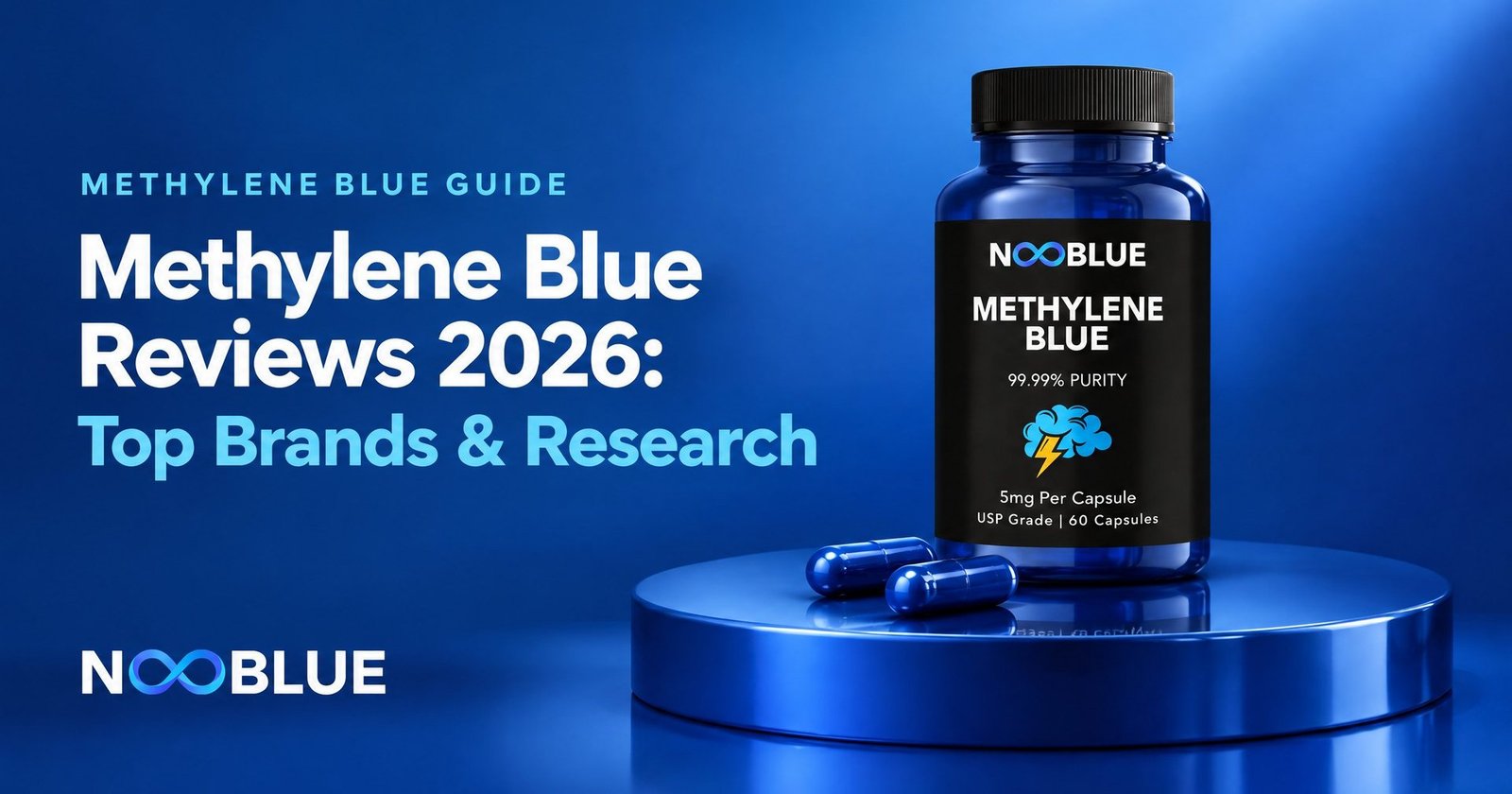
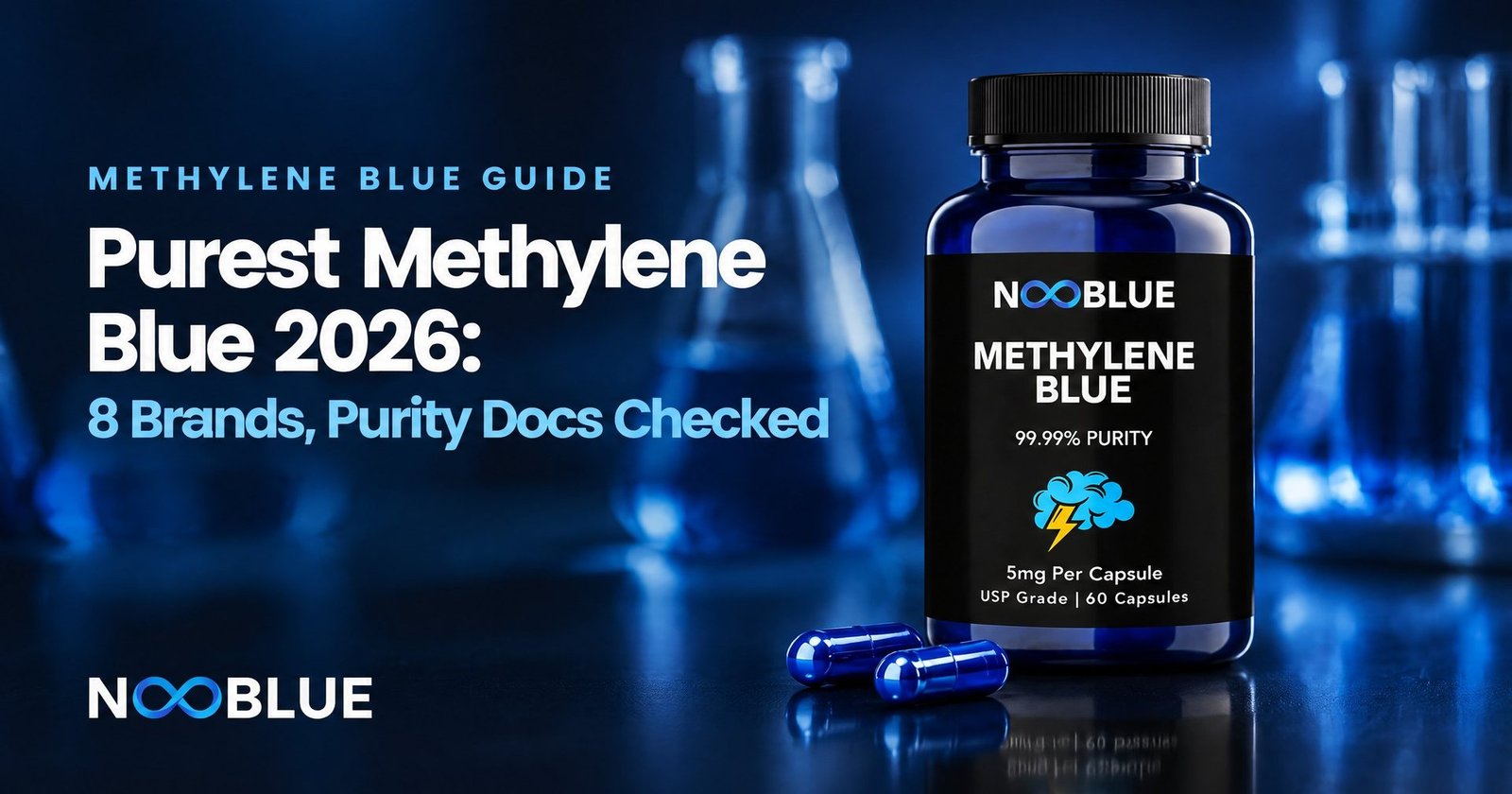
NooBlue Ultimate Methylene Blue Capsules contain 5 mg of USP-grade methylene blue and 10 mg of vitamin C per capsule, with rice flour in a cellulose capsule. The label is one capsule daily with food, so a 60-capsule bottle is a 60-day supply at $37.99 (regular price $49.99). Do not exceed the suggested serving.
The product page links the Contract Testing Laboratories of America (CTLA) report 135621 for methylene blue ingredient lot 2025022801. It records an HPLC identity result of “Conforms” and heavy-metal results: arsenic, mercury and lead each below 0.001 ppm and cadmium 0.010 ppm. The page is explicit about the limits of that report: it covers the ingredient, it does not certify every finished product, and it does not establish a purity percentage. That is why we don’t print one. The same ingredient lot and report appear on the pages for our methylene blue gummies (10 mg with 25 mg of vitamin C, 0 g sugar, no blue mouth) and our 1% methylene blue drops (distilled water and methylene blue only, 0.5 mg per drop).
- Pros: ingredient identity and heavy metals documented with the scope stated, very low metal results, simple ingredient list, fixed 5 mg serving, 60-day supply.
- Cons: no finished-product potency report yet, and no purity percentage, which some buyers expect to see.
Who it suits: people who want a documented ingredient and a serving they can’t get wrong. Our best methylene blue capsules comparison and the guide to pharmaceutical grade methylene blue capsules cover the wider capsule field.
#2. Nutricel Blue Boost: finished-product potency testing
Nutricel Blue Boost is $34.90 for 60 capsules, each with 12 mg of USP-grade methylene blue, 35 mg of vitamin C ester and 235 mg of organic cacao powder. The product text says “99%+ purity”, and the certificates page describes the raw methylene blue as 99.4% and says its testing is independently verified by Eurofins.
Nutricel is the only brand here that links a finished-product potency result. The Blue Boost certificate for lot 0125047, dated May 14, 2025, measured 14.99 mg of methylene blue per capsule by titration against a label minimum of “NLT 12.00 mg”, or 124.92% of the claim. It also reports heavy metals (lead 0.290 ppm, cadmium 0.244 ppm) and a microbial panel with pathogens absent. Two points follow. The test confirms there is at least the labeled amount in that lot, and it also shows that capsule held about a quarter more methylene blue than the 12 mg on the label. The safety notice is clear: not with SSRIs, SNRIs, MAOIs or any serotonergic medication, not when pregnant or nursing, and not for children.
- Pros: finished-product potency, metals and microbes published, clear safety notice, low cost per milligram at $0.48 per 10 mg.
- Cons: the tested lot held more methylene blue than labeled, the cacao and vitamin C ester make it a blend, 12 mg is a large fixed unit, and it ships only within the United States.
Who it suits: US buyers who want a finished-product potency result and are comfortable at 12 mg or more. Our Nutricel vs NooBlue comparison goes further.
#3. Zatural Methylene Blue 1% USP Grade: a real assay result
Zatural Methylene Blue 1% is $19.99 for 30 mL of a 1% solution in distilled water, or 300 mg of methylene blue ($0.67 per 10 mg). The page links a safety data sheet and a certificate of analysis.
The certificate is the most complete raw-material document in this comparison: Arbro Pharmaceuticals tested methylene blue trihydrate powder, batch L24MBZF24, to “USP-2024” and found 98.03% by HPLC on a dried basis, inside the 97.0% to 103.0% limits. It also reports microbes absent, bacterial endotoxins, residue on ignition and more than twenty elemental impurities, with lead, cadmium, arsenic and mercury not detected. The limitation is that it tests the powder, not the finished solution. The product page gives its dosing note per kilogram of body weight rather than as a serving, advises against daily use for more than two weeks, and doesn’t mention serotonergic medicines.
- Pros: a measured assay against USP limits, extensive impurity panel, two-ingredient solution, lowest bottle price here.
- Cons: no test of the finished solution, no serving on the page, no serotonergic warning.
Who it suits: buyers who want to read an actual purity number and are working with a professional on the serving.
#4. Chemist Labs Methylene Blue Capsules: lot reports on finished capsules
Chemist Labs Methylene Blue Capsules contain 10 mg of methylene blue, described as “99% pure USP Grade”, at $34.99 for 60 or $44.99 for 120 capsules. The 120-count is the lowest cost per milligram in this list at $0.37 per 10 mg.
The brand’s lab reports page links CTLA certificates for finished capsule lots. Lot 2512701 shows an FTIR identity match of 97.9%, a full microbial panel with nothing of concern, low heavy metals, and methylene blue by HPLC as 3.638% of the capsule contents. Lot 2602801 covers microbes and heavy metals only. Neither gives the fill weight, so you can’t convert the HPLC percentage into milligrams per capsule and check it against the 10 mg label. The FTIR figure is an identity match score, not a purity result. The product notice warns against use with SSRIs, when pregnant or nursing, and in children, and names diphenhydramine.
- Pros: finished-capsule testing by lot, clean microbial and metal results, lowest cost per milligram.
- Cons: the methylene blue result can’t be checked against the label, and the newest lot has no methylene blue result at all.
Who it suits: cost-focused buyers who value lot-level contaminant testing.
#5. Meraki Blu USP Grade Methylene Blue: the only formaldehyde test we found
Meraki Blu is $35.00 for 30 mL containing 150 mg of methylene blue, a 0.5% solution at about 0.25 mg per drop ($2.33 per 10 mg). The page advertises “99.9%” purity.
Three Light Labs certificates are shown on the page, all from 2026: heavy metals (cadmium 3.48 ppb, the others not detected), formaldehyde (below 10 ppm against a 100 ppm limit) and a microbial panel with nothing detected. That is good contaminant coverage, and the formaldehyde test is one no other brand here showed. None of the certificates measures methylene blue, though, so none supports the 99.9% figure, and the lot field on each is blank. The description says “For research purposes only” and lists warnings for under-18s, pregnancy, nursing, G6PD deficiency and antidepressants or SSRIs.
- Pros: the broadest contaminant testing shown for a liquid, including formaldehyde.
- Cons: no assay, blank lot fields, a weaker solution at a high cost per milligram, and a research-only line.
Who it suits: people who prioritize contaminant data and want a weaker liquid. See our Meraki methylene blue review.
#6. Biopharm Methylene Blue 1% USP: low cost, documents aimed at lab use
Biopharm Methylene Blue 1% USP is $25.97 for a 50 mL glass bottle with dropper (a two-bottle offer was the same price when we checked), or $24.97 for 60 mL in plastic. At the single-bottle price that is $0.52 per 10 mg. The page says one drop contains 0.5 mg and that the products “undergo additional testing from third party analysts”.
The document linked from the product page is a safety data sheet. It lists the solution as 1% methylene blue and the balance water, gives the recommended use as “Manufacture of other chemical products, professional, scientific, and technical activities”, and carries the hazard statement H302, harmful if swallowed, which is standard for concentrated chemical products. The site has a separate product certificates section, but it didn’t load for us, so we couldn’t check a certificate. The product page gives no serving and no warnings about serotonergic medicines, pregnancy or G6PD deficiency. Our Biopharm methylene blue review looks at the brand in more depth.
- Pros: low cost per milligram, two-ingredient solution, glass bottle option.
- Cons: documentation framed for lab and professional use, no certificate we could open, no serving or safety warnings on the page.
Who it suits: buyers who already know how they will measure and use a 1% solution and don’t need supplement labeling.
#7. Earth Harmony Ultimate Methylene Blue: the highest claim with no document
Earth Harmony Ultimate Methylene Blue is $39.95 for 60 capsules, 12 mg of methylene blue each according to the site FAQ ($0.55 per 10 mg). The page describes the methylene blue as 99.99% USP or pharmaceutical grade and formaldehyde-free, and says all products undergo third-party testing. No certificate is linked from the capsule page. The capsule also contains vitamin C and a blend of organic berberine, chlorophyllin and chlorophyll, with amounts not given in the product text. The safety box covers pregnancy, nursing, G6PD and serotonergic medicines.
- Pros: clear safety box, low cost per milligram.
- Cons: the highest purity number in this list with nothing to check it against, and undisclosed amounts of added ingredients.
Who it suits: buyers who want the added plant ingredients and accept a purity claim without a document.
#8. Blue Organics Methylene Blue+ USP Grade 1%: check the documents before buying
Blue Organics Methylene Blue+ is $49.00 for 30 mL of a 1% solution ($1.63 per 10 mg). The specifications list purity as “≥99.9%” and the description says “99.99% USP-grade purity”. It also says every batch comes with a certificate of analysis verifying purity, potency and heavy metals.
The only document on the page is a Nexora Labs report from January 2024 on “BlueOrganics USP Grade Methylene Blue order # 8942”, tested as a powder. It lists heavy metals (cadmium 0.008 ppm, mercury 0.015 ppm, lead and arsenic not detected) and two microbes, with no methylene blue assay and no test of the finished solution. The page carries a “For personal research use only” disclaimer. Its safety advisory is clear about pregnancy, nursing and serotonergic drugs.
- Pros: clear safety advisory, low heavy metals in the 2024 powder sample.
- Cons: two different purity figures, a certificate claim the linked document doesn’t support, and a high cost per milligram for a 1% liquid.
Who it suits: on current information, better-documented liquids cost less. Our Blue Organics methylene blue review has more detail.
The other half of purity: what else is in the product
A product can use very pure methylene blue and still contain other ingredients. That isn’t bad in itself, but you should know what you are taking.
| Product | Other ingredients stated on the page |
|---|---|
| NooBlue capsules | Vitamin C 10 mg, rice flour, cellulose capsule |
| NooBlue gummies | Vitamin C 25 mg in a pectin chew, 0 g sugar |
| NooBlue drops, Zatural, Biopharm | Water only |
| Nutricel Blue Boost | Vitamin C ester 35 mg, organic cacao powder 235 mg |
| Earth Harmony | Vitamin C, organic berberine, chlorophyllin, chlorophyll (amounts not given) |
| Chemist Labs, Meraki, Blue Organics (1%) | Not fully listed in the product text we read |
If purity to you means “nothing but methylene blue”, a 1% solution in water or a capsule with a short excipient list is the closest you will get. Our comparisons of methylene blue tablets vs liquid and the best methylene blue powder guide cover other formats, and our guides to aquarium grade and food grade methylene blue explain why those products are not substitutes.
How we evaluated purity
We ranked our own capsules first as our pick. For the other seven, we opened every lab document linked from each product page in September 2026 and placed each brand on the evidence ladder above. Within a rung, we looked at whether the document tested the finished product or the ingredient, whether it had a lot number and dates, how the heavy-metal results compared, whether the page gave a clear serving and a serotonergic-medicine warning, and the cost per 10 mg. We did not lab-test any product, and we did not score claims about effects.
What we could and could not verify
- We could read every PDF and image certificate listed in the audit, except one Chemist Labs lot report that is an image we couldn’t read and Biopharm’s certificate section, which didn’t load.
- We could not confirm how any brand’s lots on sale today relate to the lots in its documents.
- We could not check purity percentages printed on pages where no assay was published.
- Prices change often. Check the live price before you compare, and see our guide to what methylene blue costs.
For spotting fakes once a bottle arrives, see our guide to real vs fake methylene blue.
Safety: purity doesn’t change who should avoid it
- Do not take methylene blue with an SSRI, SNRI, MAOI or any other serotonergic medicine, because of the risk of serotonin syndrome. See methylene blue and serotonin syndrome.
- Do not take it if you have G6PD deficiency.
- It is not for use during pregnancy or while breastfeeding.
- It is not for anyone under 18.
- It can color urine blue or green.
- Talk to your doctor before use if you take any prescription medicine.
Follow the label serving and do not exceed it. Our guides to how many mg of methylene blue per day and who should not take methylene blue cover the details.
The verdict
NooBlue Ultimate Methylene Blue Capsules are our pick: a documented USP-grade ingredient with very low heavy-metal results, a report whose limits are stated plainly, a short ingredient list and a fixed 5 mg serving. The gummies and drops use the same documented ingredient lot if you prefer a chew or want to measure your own serving. NooBlue offers free worldwide shipping on orders over $100 and 30-day returns.
Among the other brands, Nutricel shows the most complete finished-product testing, though its tested lot held more methylene blue than the label states, and it ships only within the United States. Zatural shows the clearest raw-material assay. The highest purity numbers in this comparison came with the least evidence. When you shop for the purest methylene blue, read the document, not the percentage. You can read more about NooBlue, browse the NooBlue shop, or find more buying guides on the NooBlue blog, including our best methylene blue gummies comparison.
Frequently asked questions
What is the purest methylene blue?
The purest methylene blue is one with a published assay showing it meets the USP range, ideally tested on the finished product as well as the ingredient. Our pick is NooBlue Ultimate Methylene Blue Capsules, which link the ingredient-lot report for identity and heavy metals. Among the other brands, Nutricel publishes a finished-product potency result and Zatural a raw-material assay of 98.03%.
Is 99.99% pure methylene blue real?
The number appears on several product pages, but none of the documents we opened reported a purity that high. USP limits run from 97.0% to 103.0% on a dried basis, and a genuine result, such as the 98.03% on Zatural’s certificate, can be lower than a marketing figure and still pass.
What does USP grade mean for purity?
It means the raw ingredient is claimed to meet the USP monograph, which sets an assay range and limits for impurities. It doesn’t cover the finished product or the dose in each capsule or drop. A certificate with an assay result is what shows the claim was checked.
Is liquid or capsule methylene blue purer?
Neither format is purer by nature. Liquids are often just methylene blue and water, while capsules add a few excipients. What matters is the documentation behind the ingredient and the finished product.
Can methylene blue contain heavy metals?
Any raw material can carry traces, which is why good certificates test for lead, cadmium, arsenic and mercury. All the results we read in this comparison were below the limits listed on Zatural’s certificate. Lab stains and aquarium products are made to different standards and are not for human use.
Why do some methylene blue documents test only heavy metals?
Contaminant panels are cheaper and simpler than a full assay. They tell you what shouldn’t be there, but not how much methylene blue is present. Meraki’s and Blue Organics’ documents are examples.
Is Biopharm methylene blue pharmaceutical grade?
The page sells it as a 1% USP-grade solution, but the only document linked from the product page is a safety data sheet that lists professional, scientific and technical uses. We could not open a certificate of analysis for it.
What is methylene blue trihydrate?
It is the form of methylene blue used in USP-grade material, with water built into its crystal structure. That is why certificates report a loss on drying (12.83% on Zatural’s certificate) and calculate purity “on a dried basis”. A result like 98.03% is the methylene blue content once that water is accounted for.
Does NooBlue publish a purity percentage?
No. The CTLA report linked from our product pages covers identity and heavy metals for the methylene blue ingredient lot, and the pages say it does not establish a purity percentage or certify every finished batch. We would rather show the document and its limits than print a number the document doesn’t support.
What is a USP Reference Standard?
It is a highly characterized sample that labs use to test other material against the USP monograph. Sigma-Aldrich sells the methylene blue USP Reference Standard at $501.00 for 750 mg and states that it is for test and assay use only, not for administration to people or animals. It is not a supplement.
Is formaldehyde-free methylene blue better?
Formaldehyde can be a by-product in some dye manufacturing, so a test result is reassuring. In this comparison, Meraki was the only brand that showed one: below 10 ppm against a 100 ppm limit. “Formaldehyde-free” printed on a page without a test is a claim you can’t check.
Which NooBlue format is the purest?
All three use the same documented methylene blue ingredient lot. The 1% drops contain only methylene blue and distilled water, the capsules add 10 mg of vitamin C and rice flour, and the gummies add 25 mg of vitamin C in a sugar-free pectin chew. If you want the shortest ingredient list, choose the drops. If you want a fixed serving without measuring, choose the capsules or gummies.
Is methylene blue powder purer than a solution?
Powder skips the water, but that doesn’t make it purer, and it is much harder to measure a safe serving from powder at home. The same questions apply: which lab, which lot, what assay result and which limits.
Does higher purity mean I should take less?
No. Follow the serving on the label of the product you buy, and do not exceed it. Purity doesn’t change the safety rules either: no serotonergic medicines, no G6PD deficiency, not during pregnancy or breastfeeding, and not under 18.
Sources
- NooBlue product pages and the CTLA ingredient report linked from them, read September 2026.
- Competitor product pages and certificates linked in each ranked section above, read September 2026.
- Nutricel Blue Boost certificate, lot 0125047. PDF
- Zatural certificate of analysis, batch L24MBZF24. PDF
- Chemist Labs capsule lot 2512701 certificate. PDF
- Biopharm safety data sheet, Methylene Blue USP 1% (BM8341). PDF