Key takeaways
- Drops and capsules contain the same molecule. The choice comes down to how you want to measure it, whether you mind a blue mouth, and cost.
- Pick 5 mg capsules for a fixed serving with no measuring and nothing touching your mouth. Pick 1% drops if you want to adjust in small steps and pay less per milligram.
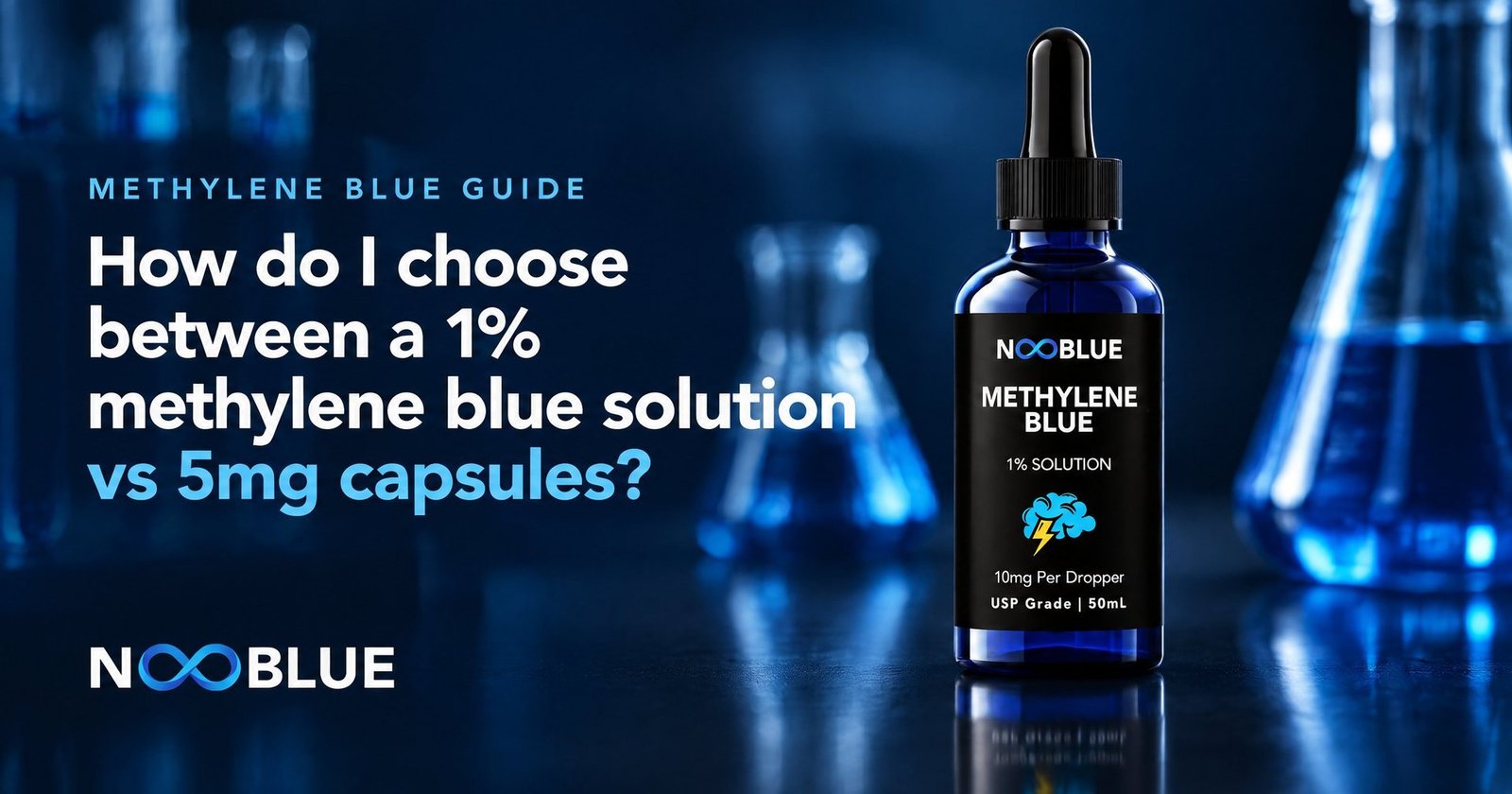
- A 1% solution holds 10 mg per ml. With NooBlue’s dropper, one drop is about 0.5 mg, so 2 drops make 1 mg and 10 drops make 5 mg. Drop size differs between brands, so always use the maker’s own figure.
- Oral methylene blue is well absorbed as a liquid (about 72% in one study). No study has compared drops with plain capsules at supplement servings.
- Gummies are a third option: a fixed 10 mg serving that avoids the blue mouth drops cause. Urine can turn blue or green with any format.
How do you choose between a 1% methylene blue solution and 5 mg capsules? Start with how you plan to use it. If you want the same small serving every morning with nothing to measure, capsules are the simpler habit. If you want to start below 5 mg, adjust in half-milligram steps, or pay the lowest price per milligram, drops give you that control, at the cost of a measuring step and a blue tongue. Both deliver the same active compound. This guide compares methylene blue drops vs capsules on dose math, absorption, accuracy, staining and cost, and covers where tablets and gummies fit.
NooBlue makes all three formats compared here (capsules, drops and gummies), so we have a stake in which one you buy. We have tried to say plainly where each falls short, and the safety section applies to every format. Written by the NooBlue editorial team.
Our short answer: most people starting out do best with NooBlue Ultimate Methylene Blue Capsules at 5 mg, and move to NooBlue 1% drops only if they want finer control. If swallowing capsules is the problem, the gummies are the no-measuring, no-blue-mouth alternative.
Table of contents
- 1. Methylene Blue Drops vs Capsules vs Gummies at a Glance
- 2. What “1% Solution” and “5 mg Capsule” Actually Mean
- 3. How Many Drops of Methylene Blue Is 1 mg?
- 4. Absorption: Is Methylene Blue Better in Liquid or Capsule Form?
- 5. Dosing Accuracy and Flexibility
- 6. Staining, Taste and Convenience
- 7. Methylene Blue Tablets or Pills vs Liquid
- 8. Methylene Blue Gummies vs Liquid
- 9. Cost per Serving and per Milligram
- 10. Which Should You Choose?
- 11. Safety Is the Same for Every Format
- 12. Frequently Asked Questions
- 12.1. Is methylene blue better in pill or liquid form?
- 12.2. Which form of methylene blue is best?
- 12.3. How many drops of methylene blue is 1 mg?
- 12.4. Can I open a methylene blue capsule and use the powder as a liquid?
- 12.5. Can I switch between drops and capsules?
- 12.6. Is methylene blue hard on the liver?
- 12.7. Why do I feel so good on methylene blue?
- 12.8. How should I store methylene blue drops?
- 12.9. What should you not mix with methylene blue?
- 13. Our Take
- 14. Sources
- 15. Explore this topic in depth
Methylene Blue Drops vs Capsules vs Gummies at a Glance
Prices are as of Sep 2026 and come from our own product pages.
| NooBlue capsules | NooBlue 1% drops | NooBlue gummies | |
|---|---|---|---|
| Methylene blue per unit | 5 mg per capsule | About 0.5 mg per drop, 10 mg per full dropper | 10 mg per gummy |
| Smallest step | 5 mg | About 0.5 mg | 10 mg |
| Measuring | None | Count drops into water or juice | None |
| Blue mouth or tongue | No, swallowed whole | Yes, drops can stain the mouth and tongue | No |
| Blue or green urine | Possible | Possible | Possible |
| Other ingredients | Vitamin C 10 mg, rice flour, cellulose capsule | Distilled water | Vitamin C 25 mg, Wild Blueberry flavor, zero sugar |
| Pack | 60 capsules | 50 ml, about 100 servings of 5 mg | 60 gummies |
| Price | $37.99 | $29.99 | $49.99 |
| Cost per serving | $0.63 per 5 mg capsule | $0.30 per 5 mg | $0.83 per 10 mg gummy |
| Cost per mg | About $0.13 | About $0.06 | About $0.08 |
| Best for | A fixed daily 5 mg, travel, no fuss | Starting below 5 mg, fine adjustment, lowest cost | A settled 10 mg routine without swallowing capsules |
What “1% Solution” and “5 mg Capsule” Actually Mean
A 1% methylene blue solution contains 1 g of methylene blue in 100 ml of liquid, which is 10 mg per ml. NooBlue’s drops are Methylene Blue USP at 1% in distilled water. With the dropper supplied, one drop is about 0.5 mg, 10 drops make a 5 mg serving, and a full dropper (20 drops) holds 10 mg. The 50 ml bottle holds about 500 mg in total, or about 100 servings at 5 mg.
A NooBlue capsule contains 5 mg of Methylene Blue USP and 10 mg of vitamin C, with rice flour and a cellulose capsule. You take one a day with food. A 60-capsule bottle lasts 60 days at that serving.
The practical difference is range. Drops let you take 1 mg, 2.5 mg or 7.5 mg as easily as 5 mg. Capsules give a fixed 5 mg, one a day. If your target is 5 mg a day, capsules cover it; for 10 mg, a full dropper (20 drops) does, since the capsule label is one a day. If you want to start lower or land somewhere in between, drops are the format that allows it. Our guide to 1% vs 5% methylene blue explains what changes at higher concentrations.
How Many Drops of Methylene Blue Is 1 mg?
With a 1% solution and a dropper that makes drops of about 0.05 ml, 2 drops equal about 1 mg. That is the case for NooBlue’s drops. The catch is that “a drop” is not a fixed unit. Its size depends on the dropper, the liquid and how you hold the bottle, and brands quote different figures:
| Product | Strength | Stated mg per drop | Drops for 1 mg | Drops for 5 mg |
|---|---|---|---|---|
| NooBlue 1% drops (50 ml, $29.99) | 1% (10 mg/ml) | About 0.5 mg | 2 | 10 |
| Nutricel Blue Liquid (118 ml, $30.00) | 1% (10 mg/ml) | About 0.5 mg (20 drops = 1 ml) | 2 | 10 |
| Meraki Blu (150 mg in 30 ml, $35.00) | 0.5% (5 mg/ml) | About 0.25 mg | 4 | 20 |
Figures come from each brand’s own page, checked in September 2026. Nutricel’s page also notes that drop volume varies by about 10% with viscosity and dropper angle (Nutricel). Meraki Blu states about 0.25 mg per drop for its 150 mg, 30 ml bottle (Meraki Blu). The lesson: never carry a drop count from one bottle to another. Read the mg per drop on the product you have.
Methylene blue dosage with a dropper
Most 1% products come with a glass dropper. On NooBlue’s, a full dropper is 20 drops, or 10 mg. Other brands use different droppers: Meraki Blu’s 1 ml dropper of its 5 mg/ml solution holds 5 mg. To keep a dose repeatable, count drops into a glass of water or juice rather than squeezing straight into your mouth, hold the bottle the same way each time, and write down the count that suits you. Our guide on how to take methylene blue drops walks through it step by step.
Absorption: Is Methylene Blue Better in Liquid or Capsule Form?
Liquid has the better-documented absorption, simply because that is what the key study used. In 16 healthy volunteers, an aqueous oral solution of methylene blue had an absolute bioavailability of about 72%, meaning most of the swallowed dose reached the bloodstream (Walter-Sack et al., 2009).
The other human data are harder to compare. An earlier Swiss study gave seven volunteers 100 mg by mouth and 100 mg into a vein, and found much lower whole-blood levels after the oral dose. The authors put that gap down mainly to where the drug went in the body, since oral dosing concentrated it in the gut wall and liver in rats (Peter et al., 2000). Delayed-release tablets built to release in the colon peaked in the blood at a median of 16 hours after a 200 mg dose (Repici et al., 2012). A plain capsule is not designed to delay release like that.
What is missing is a head-to-head trial. We found no study that compares drops with ordinary capsules at supplement servings, so any claim that one “works faster” or “absorbs better” at 5 mg is a guess. A capsule shell has to dissolve before its contents can be absorbed, which may add a short delay, but nobody has measured how much for methylene blue. Our breakdown of methylene blue bioavailability in liquid vs capsules goes through the pharmacokinetic papers in more detail.
Some people hold drops under the tongue before swallowing. No study has measured whether that changes how much methylene blue you absorb, and it guarantees a blue mouth.
Dosing Accuracy and Flexibility
This is where the formats differ most in daily use.
- Capsules are fixed. Every NooBlue capsule holds 5 mg. There is nothing to measure and no way to get a different amount by holding the bottle at another angle. The trade-off is that 5 mg is the only amount a capsule gives you.
- Drops are adjustable but depend on you. Each drop from NooBlue’s dropper is about 0.5 mg, so you can move in half-milligram steps. The accuracy of each dose depends on counting carefully and using the same dropper the same way each time.
Opening a capsule to make your own liquid is not a good substitute for either. You cannot split 5 mg of powder evenly by eye, and loose methylene blue powder stains whatever it touches. If you want liquid flexibility, use a product made as a liquid. Our methylene blue dosage guide covers how people choose a starting amount in either format.
Staining, Taste and Convenience
Methylene blue is a dye, and the format decides where the color ends up.
- Drops can stain the mouth, tongue, fingers and anything they spill on. Mixing your count into water or juice keeps it off your hands, but the drink is still blue.
- Capsules are swallowed whole, so the methylene blue does not touch your mouth. A capsule bottle also travels without any risk of a leak.
- Gummies from NooBlue avoid the blue mouth and tongue that drops cause.
With every format, urine can turn blue or green. That is expected and benign (StatPearls, 2026), and it is not a sign that a capsule “leaked”.
Methylene Blue Tablets or Pills vs Liquid
If you are comparing methylene blue tablets vs liquid, or pills vs liquid in general, tablets behave much like capsules. Both are a fixed, pre-measured amount you swallow, with no mouth staining and no measuring. The differences are in the detail: tablets are pressed, and some are scored so they can be split, while capsules hold powder inside a shell. Tablet doses on the market are often higher per unit than a 5 mg capsule, so read the label before you compare them with drops. Our roundup of the best methylene blue tablets compares brands and doses, and the best methylene blue capsules guide does the same for capsules.
Methylene Blue Gummies vs Liquid
Gummies sit closer to capsules than to drops. Each NooBlue gummy holds 10 mg of methylene blue with 25 mg of vitamin C in a Wild Blueberry chew with zero sugar, and you chew one a day. Against drops, the advantages are no measuring and no blue mouth. The disadvantages are coarser steps (10 mg at a time) and a higher cost per milligram than drops. Gummies suit someone who has settled on 10 mg a day and would rather chew than swallow. For more, see methylene blue gummies vs capsules and our guide to the best methylene blue gummies.
Cost per Serving and per Milligram
Drops are the cheapest way to buy methylene blue by the milligram. At the prices on our product pages in September 2026:
- Drops: $29.99 for 50 ml (about 500 mg), which is $0.30 per 5 mg serving and about $0.06 per mg.
- Capsules: $37.99 for 60 capsules of 5 mg (300 mg), which is $0.63 per capsule and about $0.13 per mg.
- Gummies: $49.99 for 60 gummies of 10 mg (600 mg), which is $0.83 per gummy and about $0.08 per mg.
Buying more than one bottle lowers the price on all three: 10% off two bottles, 15% off three and 20% off five. Shipping is free worldwide on orders of $100 or more, returns are accepted for 30 days, and orders dispatch in 1 to 2 business days with tracking. You can see all three in the NooBlue shop.
Which Should You Choose?
Choose capsules if
- You want the same 5 mg every day with nothing to measure.
- You do not want a blue mouth or tongue.
- You travel or take supplements away from home.
Capsules are not the best fit if you want to start below 5 mg or adjust in small steps.
Choose drops if
- You want to start low, for example at 1 or 2 mg, and adjust gradually.
- You want the lowest cost per milligram.
- You are happy to count drops into a drink each day.
Drops are not the best fit if a blue tongue before work bothers you, or if you would rather not measure anything.
Choose gummies if
- You have settled on 10 mg a day.
- You find capsules hard to swallow and do not want the blue mouth drops cause.
Gummies are not the best fit if you are still finding the amount that suits you, because they move in 10 mg steps.
You can also use more than one format, for example capsules on work days and drops when you want a different amount. The molecule is the same, so just add up the total for the day. Still undecided? Our best methylene blue supplements guide compares formats and brands side by side, and our powder vs liquid comparison covers loose powder, which we do not recommend for home use.
Safety Is the Same for Every Format
The format changes how you measure methylene blue, not who should avoid it:
- Do not take it with an SSRI, SNRI, MAOI or any other serotonergic medicine, because the combination can cause serotonin syndrome.
- Do not take it if you have G6PD deficiency.
- Not for use during pregnancy or while breastfeeding.
- Not for anyone under 18.
- If you take any prescription medicine, talk to your doctor first.
Methylene blue can turn urine blue or green with any format. The same warnings sit in the “Safety: read before use” box on every NooBlue product page, and our methylene blue interactions guide covers medicines and supplements in detail.
Frequently Asked Questions
Is methylene blue better in pill or liquid form?
Neither is better in every way. Liquid has the stronger absorption data (about 72% bioavailability for an oral solution) and lets you adjust in small steps. Pills and capsules give a fixed dose with no measuring and no blue mouth. No study has compared the two directly at supplement servings, so choose on convenience, dose range and cost.
Which form of methylene blue is best?
For most people starting out, we recommend NooBlue’s 5 mg capsules: a fixed serving, nothing to measure and nothing touching your mouth. NooBlue’s 1% drops are the better choice if you want to start below 5 mg or pay the least per milligram, and NooBlue’s gummies suit a settled 10 mg routine without the blue mouth. All three are our products.
How many drops of methylene blue is 1 mg?
With a 1% solution and a dropper that gives about 0.5 mg per drop, such as NooBlue’s, 1 mg is 2 drops and 5 mg is 10 drops. A 0.5% product such as Meraki Blu states about 0.25 mg per drop, so 1 mg is about 4 drops. Always use the mg-per-drop figure for the bottle you have.
Can I open a methylene blue capsule and use the powder as a liquid?
You can, but it is a poor substitute for drops. You cannot divide 5 mg of powder accurately by eye, and the powder stains anything it touches. If you want a liquid, buy one made as a liquid, with a stated mg per drop.
Can I switch between drops and capsules?
Yes. The active compound is the same, so there is no adjustment period. Keep track of your total for the day: a 5 mg capsule in the morning plus 5 drops of a 1% solution later (about 2.5 mg) is about 7.5 mg in total.
Is methylene blue hard on the liver?
No study in healthy adults has shown liver harm at supplement servings, but the data are thin. In a trial of high single oral doses (200 mg and 400 mg), abnormal liver enzyme readings were among the mostly mild, short-lived side effects reported in 8 of 22 volunteers (Repici et al., 2012). The format makes no difference here. If you have a liver condition, talk to your doctor first, and see our methylene blue liver safety guide.
Why do I feel so good on methylene blue?
Nobody has studied how a 5 mg serving feels. In a brain-imaging trial, a single 280 mg dose (about 4 mg/kg) was linked to a 7% increase in correct answers on a short-term memory task one hour later (Rodriguez et al., 2016). Methylene blue also inhibits MAO-A, an enzyme that breaks down serotonin, which is why it must never be combined with serotonergic medicines. Stay at the suggested serving whatever the format. Our guide to the brain and cellular health research on methylene blue covers what the studies do and do not show.
How should I store methylene blue drops?
Keep the bottle tightly closed, away from heat and sunlight, as the label says. Capsules and gummies should be kept tightly closed in a cool, dry place. Our methylene blue shelf life guide covers storage in more detail.
What should you not mix with methylene blue?
The format makes no difference. Do not combine methylene blue with SSRIs, SNRIs, MAOIs or other serotonergic medicines, and do not take it with G6PD deficiency, in pregnancy or while breastfeeding. The StatPearls chapter also lists certain opioids and dextromethorphan among the drugs to avoid with it (StatPearls, 2026). See our interactions guide for the full list.
Our Take
The 1% solution vs 5 mg capsule decision is about habits, not chemistry. Capsules win on simplicity and a clean mouth. Drops win on flexibility and price per milligram. If you are new to methylene blue, start with a 5 mg capsule, see how you get on, and switch to drops only if you find you want finer control. If you want to learn more before you buy, our guide to the evidence and myths around methylene blue for healthy aging is a good next read, and our guide to finding methylene blue in health stores and pharmacies covers buying in person.
Sources
- Walter-Sack I, Rengelshausen J, Oberwittler H, et al. High absolute bioavailability of methylene blue given as an aqueous oral formulation. European Journal of Clinical Pharmacology. 2009;65(2):179-189. PubMed 18810398
- Peter C, Hongwan D, Küpfer A, Lauterburg BH. Pharmacokinetics and organ distribution of intravenous and oral methylene blue. European Journal of Clinical Pharmacology. 2000;56(3):247-250. PubMed 10952480
- Repici A, Di Stefano AF, Radicioni MM, Jas V, Moro L, Danese S. Methylene blue MMX tablets for chromoendoscopy: safety, tolerability and bioavailability in healthy volunteers. Contemporary Clinical Trials. 2012;33(2):260-267. PubMed 22101227
- Rodriguez P, Zhou W, Barrett DW, et al. Multimodal randomized functional MR imaging of the effects of methylene blue in the human brain. Radiology. 2016;281(2):516-526. PMC5084971
- Ostrovsky A, Afzal M. Methylene Blue. StatPearls. Updated January 2026. NCBI Bookshelf NBK557593
- Nutricel. Blue Liquid, 1% methylene blue solution (checked September 2026). nutricel.store
- Meraki Medicinal. Meraki Blu USP grade methylene blue 150 mg (checked September 2026). merakimedicinal.com