Quick answer
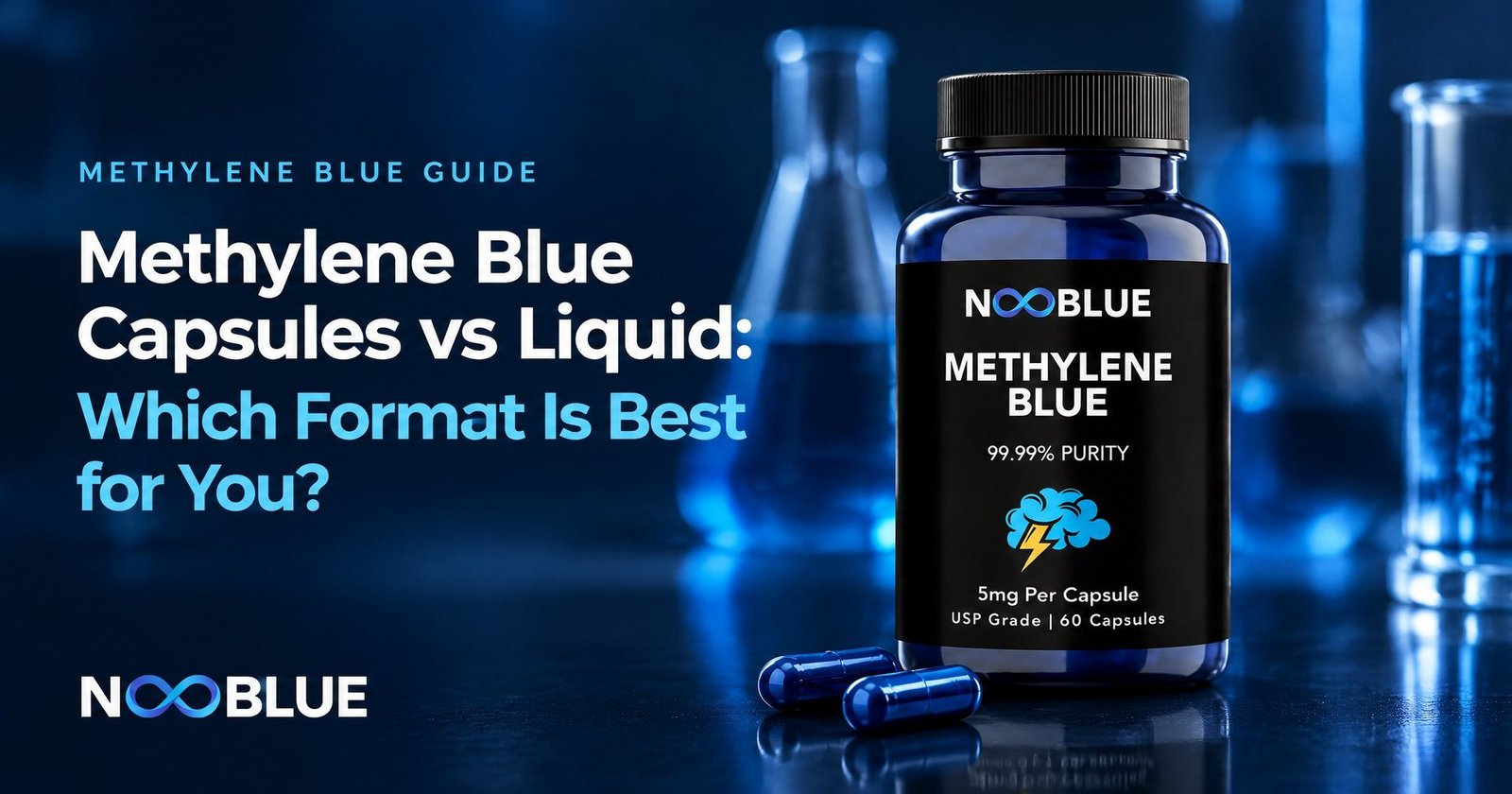
On methylene blue capsules vs liquid, capsules are the better choice for most people who take methylene blue once a day. A capsule holds a fixed dose, you swallow it with food, and nothing touches your tongue. Liquid drops are better if you want to start below a capsule’s dose, adjust in small steps or pay less per milligram, and you don’t mind measuring a dye that stains. Our pick is NooBlue Ultimate Methylene Blue Capsules: 5 mg of USP grade methylene blue with 10 mg of vitamin C in each capsule, one a day with food, 60 per bottle.
Before any format: do not take methylene blue if you take an SSRI, SNRI, MAOI or other serotonergic medicine, if you have G6PD deficiency, if you are pregnant or breastfeeding, or if you are under 18. If you take any prescription medicine, talk to your doctor first.
NooBlue makes the capsules, drops and gummies discussed here, and the capsules are our pick. Figures for other brands come from their own product pages as of Sep 2026. We have not lab-tested other brands.
Capsules and liquid contain the same molecule. What differs is how the dose is set, how finely you can change it, how it tastes, whether it stains, what it costs per milligram and how easily it travels. This guide goes through each of those. Then it covers what human studies measured about absorption, how to switch between formats without changing your dose by accident, and who should not take methylene blue in any form.
Table of contents
- 1. Methylene blue capsules vs liquid at a glance
- 2. How each format sets your dose
- 3. Dose accuracy: a filled capsule vs counted drops
- 4. Does liquid absorb better or faster than capsules?
- 5. Taste, staining and tolerability
- 6. Cost per serving and per milligram
- 7. Storage, shelf life and travel
- 8. Which should you choose?
- 9. Switching between capsules and liquid
- 10. Safety is the same for every format
- 11. How to check any capsule or liquid before you buy
- 12. The bottom line
- 13. Frequently asked questions
- 13.1. Are methylene blue capsules better than liquid?
- 13.2. What is the most effective form of methylene blue?
- 13.3. Is liquid methylene blue stronger than capsules?
- 13.4. Does liquid methylene blue work faster than capsules?
- 13.5. Is 10 mg of methylene blue a lot?
- 13.6. What should you not mix with methylene blue?
- 13.7. Why do I feel so good on methylene blue?
- 13.8. Do methylene blue capsules stain your mouth?
- 13.9. How many drops of liquid equal a 5 mg capsule?
- 13.10. Which format is easier for travel?
- 13.11. What is the best methylene blue capsule?
- 14. Sources
Methylene blue capsules vs liquid at a glance
| As of Sep 2026 | Capsules | Liquid drops |
|---|---|---|
| How the dose is set | By the maker, when the capsule is filled | By you, counting drops or reading a marked dropper |
| Adjusting the amount | Whole capsules only | Small steps, about 0.5 mg per drop with a 1% solution |
| Taste | None, swallowed whole | Bitter and metallic unless well diluted |
| Mouth and tongue | No contact | Can stain mouth, tongue and teeth |
| Spills | Nothing to spill | Stains skin, fabric and counters |
| Travel | Easy | Needs a tight cap and a clean dropper |
| NooBlue example | Capsules: 60 x 5 mg, $37.99, about $0.63 a day | 1% drops: 50 mL, $29.99, about $0.30 per 5 mg serving |
| Best for | A fixed daily routine with nothing to measure | Fine control and a lower cost per milligram |
For a NooBlue-only version of this comparison, see whether the NooBlue capsule is better than liquid solutions.
How each format sets your dose
A capsule label gives milligrams per capsule. The maker measures the dose once, at filling, and you take whole capsules. That makes a capsule hard to get wrong, but it also locks you into the strength the brand chose. Capsule strengths vary more than most buyers expect. A NooBlue capsule holds 5 mg. The other capsules we checked hold 10 or 12 mg each, so “one capsule” can mean more than twice as much from one bottle to the next.
A liquid label gives a concentration. A 1% solution holds 10 mg of methylene blue per mL, and at about 20 drops per mL that is roughly 0.5 mg per drop. Your dose is whatever volume you measure. Concentrations also differ between brands, so the same drop count can deliver very different amounts. Here is what the product pages said in September 2026.
| Product | Format | Methylene blue per unit | Pack and price (as of Sep 2026) |
|---|---|---|---|
| NooBlue Ultimate Methylene Blue Capsules | Capsule | 5 mg per capsule, plus 10 mg vitamin C | 60 capsules, $37.99 |
| NooBlue Methylene Blue Drops 1% | Liquid, 1% | 0.5 mg per drop, 10 mg per full dropper | 50 mL, $29.99 |
| Chemist Labs Methylene Blue Capsules | Capsule | 10 mg per capsule | 60 capsules, $34.99 |
| Nutricel Blue Boost | Capsule | 12 mg per capsule | 60 capsules, $34.90 |
| Earth Harmony Ultimate Methylene Blue | Capsule | 12 mg per capsule | 60 capsules, $39.95 |
| Meraki Blu | Liquid, 150 mg in 30 mL (0.5%) | About 0.25 mg per drop | 30 mL, $35 |
| Biopharm Methylene Blue 1% USP | Liquid, 1% | 0.5 mg per drop | 50 mL glass with dropper, $25.97 |
| Nutricel Blue Liquid | Liquid, 1% | About 0.5 mg per drop | 4 fl oz (118 mL), $30.00 |
| Chemist Labs 2% Liquid | Liquid, 2% | 10 mg per 0.5 mL | 4 oz, $49.99 |
Capsules in this table run from 5 to 12 mg each. Liquids run from 0.5% to 2%, a fourfold spread, so ten drops from one bottle can hold four times as much as ten drops from another. None of this makes one format better. It means a liquid label needs more reading than a capsule label, and “one capsule” is only a dose once you know the brand.
Dose accuracy: a filled capsule vs counted drops
Once a capsule is filled, you can’t miscount it, tilt it or leave some on the rim of a glass. For anyone who wants the same amount every day without thinking about it, that is the main reason to choose capsules.
Drops depend on the dropper and the hand holding it. Nutricel, which sells a 1% liquid, says on its own product page that drop volume varies by approximately 10% with viscosity and dropper angle, and it recommends its graduated dropper for precise measuring. That holds for any liquid. At a 5 mg serving, a 10% swing is half a milligram, which matters less than the bigger risk with liquids: a conversion mistake after switching brands, or confusing drops with milliliters.
Liquids win when you want an amount a capsule can’t give. With 1% drops you can measure 2.5 mg (5 drops), 5 mg (10 drops) or anything in between, half a milligram at a time. A NooBlue capsule is 5 mg or nothing, and its label says one capsule a day and not to exceed the suggested serving. Our guide on how to take methylene blue drops covers measuring step by step, and how many mg of methylene blue per day covers daily amounts.
Does liquid absorb better or faster than capsules?
You will see claims that drops “kick in within minutes” or that holding them under the tongue skips digestion. We could not find a human study that compared a methylene blue liquid with a capsule, or one that measured absorption under the tongue. Those claims are guesses.
What has been measured is how well swallowed liquid methylene blue is absorbed. Walter-Sack and colleagues (European Journal of Clinical Pharmacology, 2009) gave 16 healthy adults 500 mg as an oral solution after an overnight fast and, a week apart, 50 mg by injection. The oral solution’s absolute bioavailability was 72.3% (plus or minus 23.9%), which is high for a swallowed compound. Plasma levels peaked about 2.2 hours after the drink on average, and the mean plasma half-life after the oral dose was 18.3 hours. That dose was 100 times a NooBlue capsule, and the study had no capsule arm.
An earlier study of seven volunteers (Peter and colleagues, 2000) found much lower whole-blood levels after 100 mg by mouth than after the same dose by injection. Its authors attributed the gap mainly to differences in where methylene blue goes in the body after each route. Neither study tested a capsule against a liquid.
A liquid is already dissolved and a capsule has to open first, so a liquid may start absorbing a little sooner. With a half-life of about 18 hours in that study, a head start of that size makes little difference to a once-a-day routine. Taking the same amount the same way each day matters more. Our article on methylene blue bioavailability in liquid vs capsules reviews the human studies in more detail, methylene blue half-life explains how long it stays in the body, and how long methylene blue takes to work covers timing.
Taste, staining and tolerability
This is where the two formats feel most different. Methylene blue is a strong dye with a bitter taste. In the Walter-Sack study, the authors reported that tolerability was limited mainly by the “intensively bitter and metallic taste” of the liquid, which brought on immediate nausea after 14 of 23 doses. Every participant had temporary blue staining of the mouth and teeth for several hours, and blue urine for several days. That drink held 500 mg in 20 mL, far stronger than a supplement serving, but the taste doesn’t vanish at lower doses. Chemist Labs’ FAQ says its 1% liquid has a naturally bitter, metallic taste and can turn the tongue blue for a while. Meraki tells users to mix its drops with water or juice to reduce staining.
A capsule is swallowed whole, so you taste nothing and your tongue keeps its color. That makes capsules the easier choice at work, while traveling, or anywhere you would rather not explain a blue smile. If you use drops, mix them into a glass of water, drink it rather than holding it in your mouth, and wipe spills straight away. Our guide on whether methylene blue stains teeth has more tips.
One effect doesn’t depend on format. Part of each dose leaves the body in urine, and every NooBlue label says methylene blue can turn urine blue or green. That is expected with capsules, drops and gummies alike. More in methylene blue and urine color.
Cost per serving and per milligram
Within the same brand, liquid usually costs less per milligram. A 50 mL bottle of NooBlue 1% drops holds 500 mg of methylene blue, about 100 servings of 5 mg, for $29.99, or about $0.30 a serving. A bottle of NooBlue capsules holds 60 capsules of 5 mg, 300 mg in total, for $37.99, or about $0.63 a capsule. Per 5 mg, the drops cost about half as much.
Between brands, prices spread wider than formats do. Nutricel’s 118 mL bottle of 1% liquid holds about 1,180 mg for $30.00, and Chemist Labs’ 4 oz 2% liquid gives 240 servings of 10 mg for $49.99. Both cost less per milligram than our drops. The 10 and 12 mg capsules in the table above also cost less per milligram than our 5 mg capsule. What a NooBlue capsule gives you for the difference is a smaller fixed step, 5 mg instead of 10 or 12, with nothing to measure and no taste.
Both NooBlue formats get the site’s multi-bottle pricing: 10% off two bottles, 15% off three and 20% off five. Shipping is free worldwide on orders of $100 or more, and you can see every format on the NooBlue shop page. If you are buying from outside the US, our guide on where to buy methylene blue in Australia covers what to check with overseas sellers.
Storage, shelf life and travel
Capsules are the easier format to carry. There is no dropper to rinse, nothing to leak in a bag and no glass bottle to protect. The NooBlue capsule page says to keep the bottle tightly closed in a cool, dry place away from direct heat and sunlight.
Liquids need a little more care. The NooBlue drops page gives the same advice: tightly closed, away from heat and sunlight. Nutricel sells its liquid in a UV-resistant amber glass bottle for the same reason. Keep the dropper clean and the cap on between uses, and pack the bottle in a sealed bag if you travel with it. How long an opened bottle keeps is covered in methylene blue shelf life.
Which should you choose?
Choose capsules if
- you want the same amount every day with nothing to measure
- you take it at work, on a commute or while traveling
- you dislike bitter tastes or don’t want a blue tongue
- a fixed 5 mg serving suits you
Choose liquid if
- you want to start below 5 mg or change the amount in 0.5 mg steps
- the lowest cost per milligram matters most to you
- you find capsules hard to swallow and are happy to measure carefully
- you mostly take it at home
Consider gummies if
You want nothing to measure and nothing to swallow whole. NooBlue Methylene Blue Gummies hold 10 mg of methylene blue and 25 mg of vitamin C in a Wild Blueberry chew with zero sugar, one gummy a day, 60 per bottle, $49.99. They don’t leave the blue mouth or tongue that drops can. Note that one gummy is 10 mg, twice the amount in a capsule. Compare them in methylene blue gummies vs capsules and methylene blue gummies vs liquid. If you are weighing pressed tablets, see methylene blue tablets vs liquid.
Switching between capsules and liquid
Match milligrams, never counts. With NooBlue drops, 10 drops (0.5 mL) equal one 5 mg capsule. With another brand, read the concentration first:
- Meraki Blu: about 0.25 mg per drop according to its FAQ, so 5 mg is about 20 drops.
- Biopharm 1% and Nutricel 1%: about 0.5 mg per drop, so 5 mg is about 10 drops.
- Chemist Labs 2%: 10 mg per 0.5 mL, so 5 mg is 0.25 mL.
If you move from a 1% liquid to a 5% one and keep the same drop count, you take five times as much. Our comparison of 1% vs 5% methylene blue explains concentrations, and 1% solution vs 5 mg capsules works through the NooBlue conversion.
Safety is the same for every format
Read before you take any format
- Do not take methylene blue with SSRIs, SNRIs, MAOIs or other serotonergic medicines, including many antidepressants. The combination can cause serotonin syndrome.
- Do not take it if you have G6PD deficiency.
- Do not take it if you are pregnant or breastfeeding.
- Not for anyone under 18.
- It can turn urine blue or green. That is expected.
- Talk to your doctor before use if you take any prescription medicine or have a kidney or liver condition.
The risks come from the compound, not the format, so these rules apply to capsules, drops and gummies alike. Ramsay, Dunford and Gillman (British Journal of Pharmacology, 2007) showed that methylene blue is a potent reversible inhibitor of MAO-A, the enzyme that breaks down serotonin, which explains why it can cause serotonin toxicity alongside serotonergic medicines. Our guides to who should not take methylene blue and methylene blue interactions go through each point.
How to check any capsule or liquid before you buy
- It is sold for people. Aquarium and lab products state their intended use. A product meant for you gives a serving, directions and safety warnings. Our guides to aquarium grade methylene blue and lab grade vs pharmaceutical grade methylene blue explain the difference.
- The label says USP grade. USP refers to the pharmacopeia standard for methylene blue as an ingredient. Pharmaceutical grade methylene blue capsules covers what that means on a capsule label.
- You can work out the milligrams. A capsule should state mg per capsule. A liquid should state its concentration and mg per drop or per mL. If you can’t work out your dose, don’t take it.
- The certificate says what it covers. Ask what was tested, on what material and for which lot. For NooBlue, Contract Testing Laboratories of America (CTLA) analyzed a named lot of the raw methylene blue ingredient and reported an HPLC identity result of “Conforms” plus results for arsenic, cadmium, mercury and lead. That is ingredient-level evidence. It gives no purity percentage and is not a test of every finished bottle. Purest methylene blue explains how to read these documents.
- The warnings are complete. A responsible label names serotonergic medicines, G6PD deficiency and pregnancy.
The bottom line
For most people, capsules are the simpler way to take methylene blue: a fixed dose, no taste, no staining and nothing to measure. Liquid is the better tool if you want fine control or the lowest cost per milligram, as long as you read the concentration and measure the same way each time. Our pick is the NooBlue 5 mg capsule. If you are comparing capsule brands, our roundup of the best methylene blue capsules sets doses, prices and testing documents side by side. For liquids, see the best methylene blue drops.
Frequently asked questions
Are methylene blue capsules better than liquid?
For most daily users, yes. A capsule gives a fixed dose with no measuring, no taste and no mouth staining. Liquid is better if you want to start below a capsule’s dose, adjust in small steps or pay less per milligram.
What is the most effective form of methylene blue?
No study has compared oral forms head to head. Swallowed methylene blue is well absorbed: an oral solution showed 72.3% absolute bioavailability in 16 healthy adults. The most effective form in practice is the one you can take at the right dose, the same way, every day.
Is liquid methylene blue stronger than capsules?
Not by nature. Strength depends on the label. The capsules we checked hold 5 to 12 mg each, and the liquids run from 0.5% to 2%. Compare milligrams per serving, not formats.
Does liquid methylene blue work faster than capsules?
Nobody has measured it. A liquid is already dissolved, so it may start absorbing a little sooner, but no human study has compared the two. With a half-life of about 18 hours after an oral dose, onset timing matters less than taking the same amount each day.
Is 10 mg of methylene blue a lot?
10 mg is one NooBlue gummy, 20 drops of a 1% liquid, or one capsule from brands that make 10 mg capsules. It is far below the 500 mg single dose in the absorption study above, but a low dose still carries the same safety rules, including the ban on serotonergic medicines. Follow the label of the product you use. The NooBlue capsule label says one 5 mg capsule a day and not to exceed it, so don’t take two capsules to reach 10 mg.
What should you not mix with methylene blue?
Do not combine methylene blue with SSRIs, SNRIs, MAOIs or other serotonergic medicines, including many antidepressants, because of the risk of serotonin syndrome. Don’t take it if you have G6PD deficiency, are pregnant or breastfeeding, or are under 18, and talk to your doctor first if you take any prescription medicine.
Why do I feel so good on methylene blue?
Research at supplement doses is thin. In a randomized, placebo-controlled trial of 26 adults, a single low oral dose increased brain activity on functional MRI during attention and short-term memory tasks, with a 7% increase in correct memory-retrieval responses one hour after dosing. Methylene blue also inhibits MAO-A, the enzyme that breaks down serotonin. That is a safety point rather than a benefit, because it is why methylene blue must never be combined with serotonergic medicines. If you feel wired, anxious or unwell, stop and talk to a doctor. Feeling weird on methylene blue covers the common reports.
Do methylene blue capsules stain your mouth?
No. Capsules are swallowed whole and don’t touch your tongue. Drops can stain your mouth, tongue and teeth, and NooBlue gummies don’t leave a blue mouth. Urine can turn blue or green with any format.
How many drops of liquid equal a 5 mg capsule?
With a 1% liquid at about 0.5 mg per drop, about 10 drops, or 0.5 mL. With a 0.5% liquid such as Meraki Blu, about 20 drops. Check the concentration on the bottle before you convert.
Which format is easier for travel?
Capsules. There is nothing to leak, measure or rinse. If you travel with drops, keep the cap tight, pack the bottle in a sealed bag and bring the dropper.
What is the best methylene blue capsule?
Our pick is NooBlue Ultimate Methylene Blue Capsules, and we make them: 5 mg of USP grade methylene blue with 10 mg of vitamin C per capsule, one a day with food, 60 per bottle, with a published ingredient certificate whose scope is stated and full safety warnings on the label. If you want a higher dose per capsule or a lower cost per milligram, Nutricel Blue Boost (12 mg) and Chemist Labs (10 mg) cost less per milligram.
Sources
- Walter-Sack I, Rengelshausen J, Oberwittler H, et al. High absolute bioavailability of methylene blue given as an aqueous oral formulation. Eur J Clin Pharmacol. 2009;65(2):179-189. PubMed 18810398 (full text: HAL)
- Peter C, Hongwan D, Küpfer A, Lauterburg BH. Pharmacokinetics and organ distribution of intravenous and oral methylene blue. Eur J Clin Pharmacol. 2000;56(3):247-250. PubMed 10952480
- Rodriguez P, Zhou W, Barrett DW, et al. Multimodal randomized functional MR imaging of the effects of methylene blue in the human brain. Radiology. 2016;281(2):516-526. PubMed 27351678
- Ramsay RR, Dunford C, Gillman PK. Methylene blue and serotonin toxicity: inhibition of monoamine oxidase A (MAO A) confirms a theoretical prediction. Br J Pharmacol. 2007;152(6):946-951. PubMed 17721552
- NooBlue product labels: capsules, drops and gummies.
- Other brands’ product pages, September 2026: Chemist Labs (capsules, 1% liquid FAQ and 2% liquid), Nutricel (Blue Boost and Blue Liquid), Earth Harmony, Meraki Blu and Biopharm.