By NooBlue Editorial · About our editorial standards
Key takeaways
- Methylene blue gummies are chewable supplements that hold a fixed amount of methylene blue in a pectin or gelatin chew. The gummies we checked for this guide hold 5 mg to 12 mg each.
- The gummy changes how you take methylene blue, not what it is. The molecule is the same one found in capsules and drops.
- Color is not a dose signal. A trace of methylene blue can tint a whole batch, and some gummies are not blue at all.
- Read four things on the label: milligrams per gummy, gummies per serving, what else is in the chew, and what the testing document actually covers.
- Methylene blue is not for anyone taking SSRIs, SNRIs, MAOIs or other serotonergic medicines, anyone with G6PD deficiency, anyone pregnant or breastfeeding, or anyone under 18.
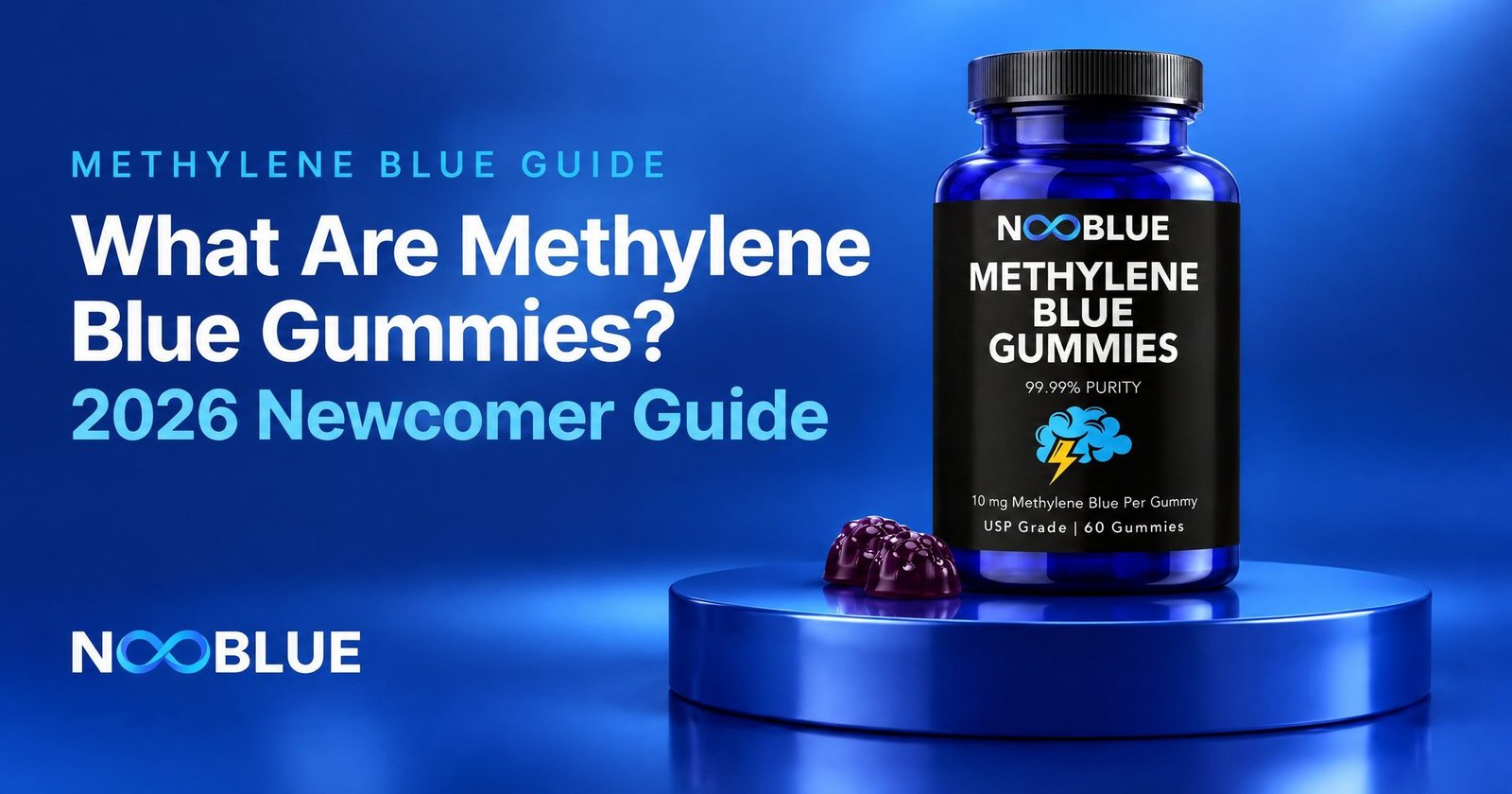
What are methylene blue gummies? They are chewable supplements that carry a measured dose of methylene blue in a pectin or gelatin base, from 5 mg to 12 mg per gummy on the labels we checked. You chew one a day instead of counting drops or swallowing a capsule.
That answer is where most pages stop. It is also where the useful part starts, because the phrase covers products that share little beyond the shape. Two gummies on the same shelf can differ more than twofold in dose, use a sugar base or a sugar-free one, and come with very different testing paperwork. This newcomer guide takes the format apart: what is physically in a gummy, why some are blue and others are not, how to read the label, what the research does and does not show, and who should not take methylene blue at all. If you would rather see finished products compared side by side, our comparison of the best methylene blue gummies covers the market brand by brand.
Table of contents
- 1. What Are Methylene Blue Gummies, Exactly?
- 2. Gummies, Capsules and Drops: How the Formats Compare
- 3. What’s Actually Inside a Methylene Blue Gummy
- 4. Why Some Methylene Blue Gummies Are Blue and Others Aren’t
- 5. How to Read a Methylene Blue Gummy Label
- 6. Do Methylene Blue Gummies Work? What the Research Covers
- 7. Who Should Not Take Methylene Blue Gummies
- 8. Choosing Your First Methylene Blue Gummy
- 9. Frequently Asked Questions
- 9.1. Do methylene blue gummies really work?
- 9.2. What happens if you take methylene blue every day?
- 9.3. Why do I feel so good on methylene blue?
- 9.4. What should you not mix with methylene blue?
- 9.5. Will methylene blue gummies turn my tongue blue?
- 9.6. When should you take methylene blue gummies?
- 9.7. Which methylene blue gummy is best for a beginner?
- 10. Sources
What Are Methylene Blue Gummies, Exactly?
A methylene blue gummy is a delivery format. The active compound is methylene blue, a synthetic dye first made in the 19th century for textiles, later used as a biological stain, and still given in hospitals today, intravenously and at doses set by doctors. Researchers have also studied how it behaves inside mitochondria, the parts of the cell that turn food into usable energy. The gummy is the packaging: a soft chew that holds a weighed amount of the compound so you can take it without a dropper.
The format fixes a practical problem. In liquid form, methylene blue is dosed by the drop. It stains counters, cups, teeth and tongues, and the taste is not for everyone. A gummy replaces all of that with one piece you chew, which is the main reason the format spread as low-dose methylene blue moved into daily supplement routines.
What a gummy does not change is the compound itself. Methylene blue from a well-made gummy is the same molecule as methylene blue from a capsule or a drop. The format decides convenience, dose precision and mess. It does not decide identity, and marketing blurs that line often. Keep it in mind when you compare gummies against capsules or gummies against liquid drops.
Gummies, Capsules and Drops: How the Formats Compare
NooBlue makes all three formats because each one suits a different routine. Here is how they differ on the points newcomers ask about most.
| Format | Methylene blue per unit | How you take it | Blue mouth or tongue? | Suits |
|---|---|---|---|---|
| Gummies | 10 mg per gummy, plus 25 mg vitamin C | Chew one gummy daily | No | A fixed daily dose with nothing to measure |
| Capsules | 5 mg per capsule, plus 10 mg vitamin C | Swallow one capsule daily with food | No, swallowed whole | A smaller fixed dose with a neutral taste |
| Drops (1%) | 0.5 mg per drop, 10 mg per full dropper | Measure drops into water | Can stain the mouth and tongue | Adjusting the dose in small steps |
All three formats can turn urine blue or green. That is expected with methylene blue and has nothing to do with the format.
The gummy’s weakness is the flip side of its strength. You get the same 10 mg every day, but you cannot split a gummy into a meaningful smaller dose. If you want to start lower or move up in small steps, the capsules or the drops do that job better. Our guide to how many mg of methylene blue per day explains how the formats line up by dose.
What’s Actually Inside a Methylene Blue Gummy
Take a gummy apart and you find four parts in very unequal amounts.
The active is a tiny share of the gummy. Ten milligrams is one hundredth of a gram, and a gummy weighs far more than that. Almost everything you chew is the base, so the base deserves a look.
The gelling agent is usually pectin or gelatin. Pectin comes from fruit and suits vegans. Gelatin comes from animal collagen and does not.
The sweetener is where products split. Some use sugar. Blue Organics, for example, lists cane sugar and glucose syrup ahead of pectin in its gummy’s other ingredients. Others use a non-sugar sweetener. If you plan to take a gummy every day for months, the base adds up, so read the “other ingredients” line before the front of the pack.
The flavor and color system decides what the gummy looks like, and it is the part newcomers misread most often. It gets its own section below.
For reference, here is the full panel for NooBlue’s gummy, taken from the NooBlue Methylene Blue Gummies product page:
- Per gummy: 10 mg methylene blue (as Methylene Blue USP) and 25 mg vitamin C, with 6 calories and 0 g total sugars.
- Other ingredients: pectin, blueberry extract (the Wild Blueberry flavor and the deep-purple color), stevia extract, sodium citrate and citric acid.
- Directions: chew one gummy daily. A bottle holds 60 gummies, so it lasts 60 days.
Our guide to methylene blue gummy ingredients goes through more real panels line by line.
Why Some Methylene Blue Gummies Are Blue and Others Aren’t
Methylene blue is an intense pigment. It colors water at concentrations far below any dose, which creates a trap: how blue a gummy looks tells you nothing reliable about how much methylene blue it contains. A trace can tint a whole batch. A gummy can look deep blue and be underdosed, or be properly dosed and barely blue.
The second reason color varies is chemistry. Methylene blue is a redox dye. It is blue in its oxidized state and colorless in its reduced state, called leucomethylene blue. Vitamin C (ascorbic acid) is a classic reducing agent that can push it toward the colorless form. Chemists at Stanford measured the rate of that exact reaction, methylene blue reduced by ascorbic acid, in a 2003 paper in the Journal of the American Chemical Society (Hallock, Berman and Zare). That was a laboratory kinetics study in a solvent, not a nutrition trial. It shows the chemistry, not a health effect.
The same back-and-forth happens inside cells. In a 2008 FASEB Journal paper, Atamna and colleagues described enzymes that use NAD(P)H to reduce methylene blue to leucomethylene blue, with cytochrome c turning it back again, so the molecule cycles instead of reacting once. That work used human fibroblasts in culture and rat liver mitochondria. It describes a mechanism, not a proven effect in people.
NooBlue’s gummies contain vitamin C, which can shift methylene blue toward its colorless form, and the purple you see comes from blueberry extract, not from the active. Our product page is careful on one point that is easy to skip: the published ingredient report does not measure how much of the methylene blue in the finished gummy is in the reduced state, and color alone cannot tell you. The practical point is simpler. NooBlue gummies don’t leave the blue mouth or blue tongue that liquid drops can, although your urine may still turn blue or green. For the full chemistry, see our explainer on leucomethylene blue, the colorless form.
How to Read a Methylene Blue Gummy Label
Four checks tell you whether a panel is useful. Most of what sits on the front of the pack is decoration.
| What to check | Why it matters | Warning sign |
|---|---|---|
| Milligrams per gummy | The only figure that maps to what you actually take. | A dose given “per serving” with no gummy count. |
| Gummies per serving | Turns a per-serving claim into a per-piece dose. | A two- or three-gummy serving that quietly shrinks each piece. |
| Grade of the active | USP grade is the pharmacopeia standard for the compound itself. | “Pure” or “lab tested” with no grade named. |
| What the testing document covers | Tells you whether the paper checks the raw ingredient, the finished gummy, or neither. | A certificate that names no lot, no lab or no scope. |
The serving-size trick catches people most often. A bottle advertising “10 mg per serving” with a three-gummy serving holds about 3.3 mg per gummy, and a 60-count bottle becomes a 20-day supply. Do that arithmetic before you compare prices, because price per bottle means little until two products are expressed in the same unit.
Here is what that looks like with four gummies on sale in September 2026. NooBlue makes the first product in this table. It is our pick, and every figure for the other brands comes from their own product pages or Amazon listings.
| Gummy | Methylene blue per gummy | Gummies per pack | Price (as of Sep 2026) | Cost per 10 mg of methylene blue | Base and extras listed |
|---|---|---|---|---|---|
| NooBlue Methylene Blue Gummies | 10 mg | 60 | $49.99 | $0.83 | Pectin and stevia, 25 mg vitamin C, 0 g sugar |
| TrueHealthic Methylene Blue Gummies | 5 mg | 30 | $29.99 (own store) | $2.00 | Not listed in the product page text |
| Blue Organics Methylene Blue Gummies | 5 mg | 30 | $36.00 (own store) | $2.40 | Cane sugar, glucose syrup, pectin |
| MaxLife Naturals Liposomal Methylene Blue Gummies | 12 mg | 60 | $24.98 (Amazon) | $0.35 | Vitamin C ester, NAC, glycine |
Two things stand out. Dose per gummy varies more than twofold across just these four, and a pack that looks cheap can cost more per milligram than a pricier one. MaxLife Naturals has the lowest cost per milligram in this table and adds other actives such as NAC. The two 5 mg gummies cost the most per milligram. NooBlue gives you a single 10 mg gummy in a sugar-free base with vitamin C, and a bottle lasts 60 days.
Last, read the testing document for what it covers, not for the badge. NooBlue’s product pages link a report from Contract Testing Laboratories of America (CTLA) on one lot of the raw methylene blue ingredient: an HPLC identity result of “Conforms” plus results for arsenic, cadmium, mercury and lead. It is an ingredient-level report. It does not give a purity percentage and it does not certify each finished batch. Hold any brand’s paperwork to the same three questions: which lot, which lab, and what was actually measured. Our guide to reading a methylene blue certificate of analysis walks through what to look for.
Do Methylene Blue Gummies Work? What the Research Covers
We found no published trial that tested methylene blue gummies as a format, from NooBlue or anyone else. The human research uses oral methylene blue in other forms, and the doses are usually far higher than a gummy.
The best-known example is a randomized, double-blind, placebo-controlled study from the University of Texas, published in Radiology in 2016. Researchers scanned the brains of 26 healthy adults before and one hour after a single oral dose. The 13 people given methylene blue received 280 mg. That group showed more activity in brain regions used for attention and short-term memory, and a 7% increase in correct answers during a memory-retrieval task (Rodriguez et al., 2016). It was one dose, measured once, in a small group. And 280 mg is the methylene blue in 28 NooBlue gummies, so the result cannot be read across to a daily 10 mg chew.
Most other evidence comes from cells and animals. A 2021 review in Cells from a University of Maryland group (Xue, Thaivalappil and Cao) summarized the mitochondrial and skin-aging research and found it promising, while most of the work it covers is preclinical. The senior author declared that he founded Mblue Labs, a company focused on skincare, which is worth knowing when you read it.
So the fair answer has two parts. On delivery, a well-made gummy with a clear label gets a known amount of methylene blue into you each day. On outcomes, the mechanism is well described in the lab, the human data are small and mostly at higher single doses, and nobody can promise a personal result. Our look at whether methylene blue gummies are effective and the evidence audit of gummy benefits go further, and our overview of methylene blue for brain and cellular health covers the wider research.
Who Should Not Take Methylene Blue Gummies
These rules follow the compound, not the shape, so they apply to gummies, capsules and drops alike. Read them before your first gummy.
- Serotonergic medicines. Do not take methylene blue if you take an SSRI, SNRI, MAOI or any other serotonergic medicine, including many antidepressants. The combination can cause serotonin syndrome. Lab work shows methylene blue is a potent inhibitor of the enzyme MAO-A, which explains the risk (Ramsay et al., 2007). More in our guide to methylene blue and serotonin syndrome.
- G6PD deficiency. Do not take it if you have G6PD deficiency. A standard clinical reference lists methylene blue as contraindicated because of the risk of hemolysis (StatPearls). See methylene blue and G6PD deficiency.
- Pregnancy and breastfeeding. Not for use during pregnancy or while breastfeeding.
- Under 18. Not for anyone under 18. Keep the bottle out of reach of children, since a gummy looks like candy.
- Urine color. Methylene blue can turn urine blue or green. This is expected.
- Prescription medicines. Talk to your doctor before you start if you take any prescription medicine or have a kidney or liver condition.
Do not take more than the label’s serving, which for NooBlue gummies is one gummy a day. Our guides to who should not take methylene blue and methylene blue gummy side effects cover the details, and how to take methylene blue gummies walks through a sensible first week.
Choosing Your First Methylene Blue Gummy
Our pick for a newcomer who wants the gummy format is NooBlue Methylene Blue Gummies: 10 mg of USP-grade methylene blue and 25 mg of vitamin C in each gummy, a sugar-free Wild Blueberry pectin chew, and 60 gummies for $49.99, which works out to $0.83 a day at one gummy daily. If you want to start lower than 10 mg, the 5 mg capsules ($37.99 for 60) or the 1% drops ($29.99 for 50 ml) are the better first step. If the lowest cost per milligram matters most to you and you want extra actives in the chew, MaxLife Naturals costs less per milligram in the table above. The NooBlue shop ships free worldwide on orders of $100 or more.
Frequently Asked Questions
Do methylene blue gummies really work?
They deliver a measured dose of methylene blue, and that part works if the label is accurate. Whether that dose does anything you can feel is less settled. The human studies used oral methylene blue at higher single doses, such as 280 mg in a small 2016 brain-imaging trial, and we found no trial of gummies as a format. Treat methylene blue as a supplement with an interesting mechanism and limited human data, not a proven result.
What happens if you take methylene blue every day?
At a label dose such as one 10 mg gummy, the change most people notice is blue or green urine, which is expected. At the larger doses used in hospitals, a clinical reference lists headache, nausea and diarrhea among the common side effects. We found no long-term controlled trials of daily low-dose use in healthy people, so stay at the label serving, stop if something feels wrong, and check with your doctor first if you take any prescription medicine.
Why do I feel so good on methylene blue?
Nobody can say for sure for one person. Methylene blue is a potent inhibitor of MAO-A, an enzyme that breaks down serotonin and other brain chemicals, and a small imaging study found changes in brain activity an hour after a large single dose. The same MAO-A effect is why it must never be combined with SSRIs, SNRIs, MAOIs or other serotonergic medicines. Expectation also plays a part with any supplement you are keen to try.
What should you not mix with methylene blue?
Do not take it with SSRIs, SNRIs, MAOIs or any other serotonergic medicine, including many antidepressants, because of the risk of serotonin syndrome. A clinical reference also says to avoid combining it with certain opioids. Do not take it if you have G6PD deficiency, are pregnant or breastfeeding, or are under 18. If you take any prescription medicine, talk to your doctor first.
Will methylene blue gummies turn my tongue blue?
NooBlue gummies don’t leave the blue mouth or blue tongue that liquid drops can. Your urine can still turn blue or green, as it can with any format of methylene blue.
When should you take methylene blue gummies?
The NooBlue label says to chew one gummy daily and does not set a time. Pick a time you can repeat, such as breakfast, so you can judge how it suits you. If you find it affects your sleep, take it earlier in the day.
Which methylene blue gummy is best for a beginner?
Our pick is NooBlue Methylene Blue Gummies: one 10 mg gummy a day with 25 mg of vitamin C, a sugar-free pectin chew, and 60 gummies per bottle for $49.99. If you want a lower starting dose, NooBlue’s 5 mg capsules are the gentler first step. Read the safety list above before you start.
Sources
- Hallock AJ, Berman ES, Zare RN. Ultratrace kinetic measurements of the reduction of methylene blue. Journal of the American Chemical Society. 2003;125(5):1158-1159. PubMed 12553804
- Atamna H, Nguyen A, Schultz C, et al. Methylene blue delays cellular senescence and enhances key mitochondrial biochemical pathways. FASEB Journal. 2008;22(3):703-712. PubMed 17928358
- Rodriguez P, Zhou W, Barrett DW, et al. Multimodal randomized functional MR imaging of the effects of methylene blue in the human brain. Radiology. 2016;281(2):516-526. PubMed 27351678
- Xue H, Thaivalappil A, Cao K. The potentials of methylene blue as an anti-aging drug. Cells. 2021;10(12):3379. PubMed 34943887
- Ramsay RR, Dunford C, Gillman PK. Methylene blue and serotonin toxicity: inhibition of monoamine oxidase A (MAO A) confirms a theoretical prediction. British Journal of Pharmacology. 2007;152(6):946-951. PubMed 17721552
- Ostrovsky A, Afzal M. Methylene Blue. StatPearls. Updated January 2026. NCBI Bookshelf NBK557593
This article is for educational purposes only and is not medical advice. Talk to your doctor before starting methylene blue, especially if you take any prescription medicine.