Key Takeaways
- Conventional gummies carry methylene blue in its oxidized, bright-blue form inside a heated sugar-gelatin matrix. Heat, sugars, and citric acid can degrade it, and uneven mixing can spread the dose unevenly between gummies.
- Oxidized-MB gummies stain teeth, tongue, gums, and lips blue every morning. Capsules bypass the mouth entirely.
- Vitamin C can shift methylene blue toward its colorless leuco form. Separately, NooBlue gummies don’t leave the blue mouth or tongue that drops can, though urine can still turn blue or green with any format.
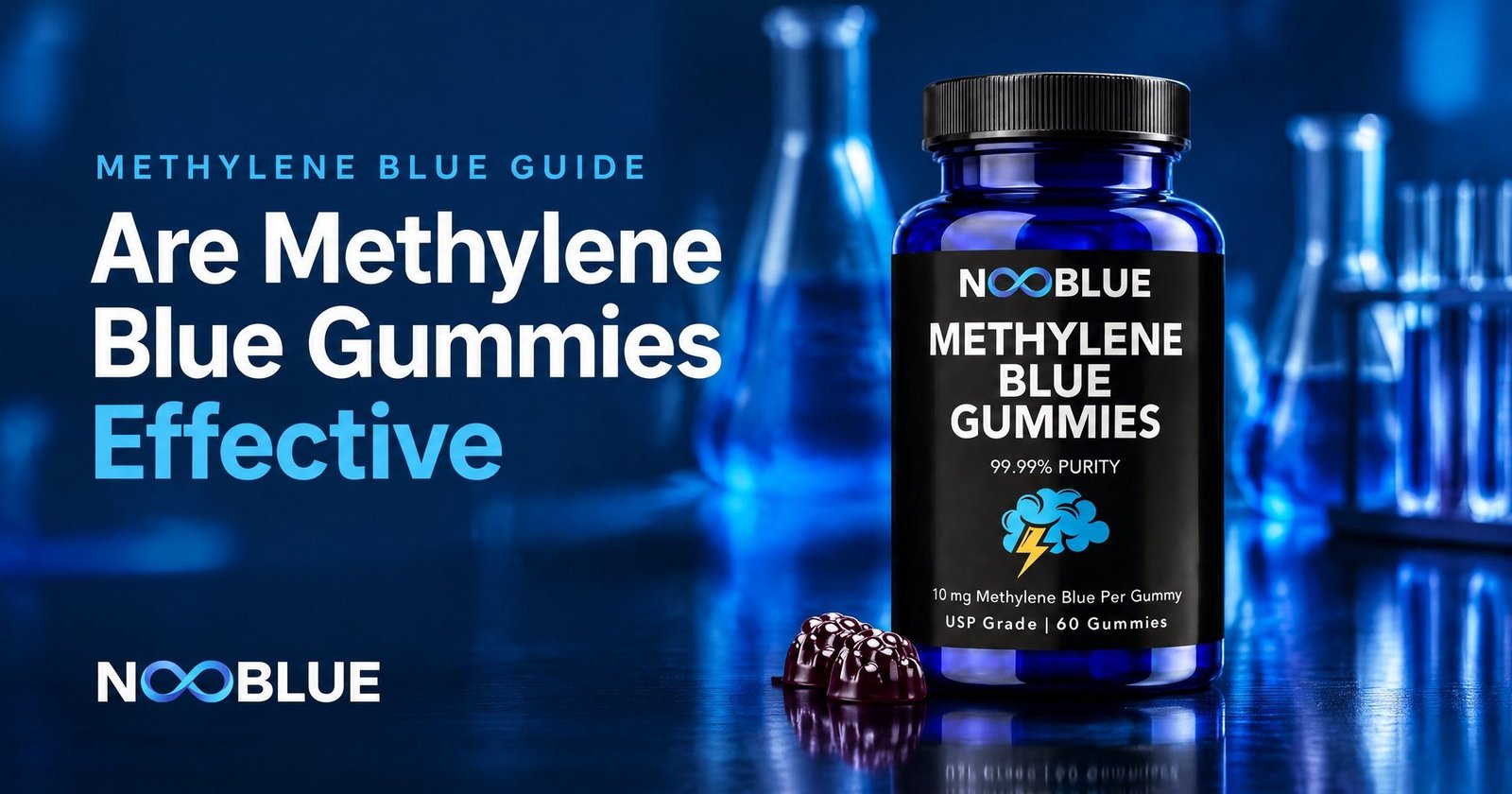
- NooBlue’s gummy is 10 mg USP-grade methylene blue plus 25 mg vitamin C in a zero-sugar pectin base, colored with blueberry extract, with a published CTLA identity and heavy-metal report on the methylene blue ingredient ($49.99).
- The 5 mg capsule remains the beginner and titration rung, and the 1% liquid gives 0.5 mg per drop at the lowest cost per milligram of our three formats. No peer-reviewed study has tested a gummy formulation directly.
Table of contents
- 1. The Rise of Gummy Supplements and Where Methylene Blue Fits
- 2. How Gummy Manufacturing Affects Active Ingredients
- 3. Dosing Accuracy Concerns
- 4. The Staining Problem
- 5. The Leuco-Form Approach: What Vitamin C Does in a Gummy
- 6. Which Format Fits You: Gummy, Capsule, or Liquid
- 7. How to Take Methylene Blue Gummies: Timing, Food, and Storage
- 8. Safety: Who Should Not Take Methylene Blue Gummies
- 9. Frequently Asked Questions
- 9.1. Do methylene blue gummies work at all?
- 9.2. Do methylene blue gummies stain your teeth?
- 9.3. Are methylene blue gummies safe?
- 9.4. Why are gummy supplements so popular if they have these drawbacks?
- 9.5. Can children take methylene blue gummies?
- 9.6. Would a gummy with a higher stated dose compensate for degradation?
- 9.7. Why do I feel strange after taking a methylene blue gummy?
- 9.8. How long does it take for methylene blue gummies to start working?
- 10. The Bottom Line
The Rise of Gummy Supplements and Where Methylene Blue Fits
Gummy supplements have taken over significant shelf space in health stores and online marketplaces. Vitamins, minerals, probiotics, collagen, and even mushroom extracts now come in chewable, fruit-flavoured formats designed to make daily use feel less like a chore and more like a treat. The appeal is obvious: no swallowing pills, pleasant taste, and a format that even supplement-averse people can stick with.
Methylene blue gummies have started to appear in this market, and they raise a fair question: do they actually deliver the same benefits as capsules or liquid solutions? The answer depends on how the gummy is made. Conventional gummies (the bright-blue, candy-grade products that carry methylene blue in its oxidized form) run into real problems with stability, dosing accuracy, and staining. A gummy engineered around methylene blue’s redox chemistry avoids most of them. This article covers both cases. For a broader look at every gummy format and brand on the market, see our methylene blue gummies guide.
How Gummy Manufacturing Affects Active Ingredients
Gummies are manufactured through a process that involves heating a base mixture (typically gelatin or pectin) with sweeteners, flavourings, colors, and active ingredients, then pouring the mixture into moulds and allowing it to set. The heat exposure during this process is the first concern for methylene blue, particularly on candy-grade production lines built for vitamins rather than redox-active compounds.
Methylene blue is reasonably heat-stable in dry powder form, but its behavior changes when dissolved in a heated sugar-gelatin matrix. The compound is photosensitive and can undergo degradation when exposed to heat in the presence of certain organic compounds, including the sugars, citric acid, and natural flavourings commonly used in gummy formulas.
Want the gummy format done right? NooBlue’s Methylene Blue Gummies deliver 10 mg of USP-grade methylene blue with 25 mg of vitamin C, zero sugar and no blue-mouth mess, for $49.99. Prefer to titrate from 5 mg? The Methylene Blue Capsules are $37.99. Shop the full range →
Dosing Accuracy Concerns
One of the most significant challenges with gummy supplements across all categories, not just methylene blue, is dosing uniformity.
The manufacturing process makes uniform distribution difficult. Active ingredients must be mixed evenly throughout a large batch of viscous gel before moulding, and settling, uneven mixing, or inconsistent mould filling can result in significant variation between individual gummies.
For a compound like methylene blue, where the amount per serving matters, this variability is not a minor inconvenience. It means you cannot reliably control your intake. A capsule containing a pre-measured 5 mg of powder delivers a consistent dose every time. A marketplace gummy claiming 5 mg may or may not contain that amount. The fix is not abandoning the format so much as changing the manufacturing: pharmaceutical-grade mixing, USP-grade material, and a test report on the finished gummy that confirms the labeled dose actually made it in. Ask any brand, us included, exactly what its report covers.
Our gummies vs liquid comparison examines the dosing accuracy issue across formats in more detail.
The Staining Problem
Methylene blue in its standard oxidized form is one of the most intensely colored substances you will encounter in daily life. A single drop can turn a glass of water vivid blue. Now imagine that compound embedded in a soft, chewable gummy that you hold in your mouth, chew with your teeth, and move around with your tongue before swallowing.
The staining potential of a conventional oxidized-MB gummy is significant. Your teeth, tongue, gums, and lips will turn blue during and after consumption. For a supplement taken daily, this means beginning every morning with a blue mouth, a cosmetic consequence that most capsule and properly diluted liquid users avoid entirely.
Capsules bypass the oral cavity. You swallow them whole with water, and the methylene blue is released in the stomach, well past anything that smiles at other people. For users who take methylene blue before work or social activities, the staining difference between a blue gummy and a capsule is a practical deal-breaker.
There is, however, a second way around the problem, one that works by chemistry rather than by avoiding chewing. Vitamin C can shift methylene blue toward its colorless leuco form, and NooBlue gummies, which contain vitamin C, don’t leave a blue mouth. That approach, and what the chemistry does and doesn’t prove, is covered further down.
Ingredient Profile: What Else Is in the Gummy?
A candy-grade gummy supplement requires a long ingredient list by necessity. The base needs gelatin or pectin for structure, sugar or sugar alcohols for sweetness, citric acid for tartness, natural or artificial flavours to mask the taste of the active ingredient, coloring agents, and coating agents to prevent sticking. Some formulas also include preservatives to extend shelf life.
Compare this to a methylene blue capsule, which typically contains methylene blue, a vegetable cellulose capsule shell, and possibly a small amount of rice flour or microcrystalline cellulose as a flow agent. The ingredient list for a quality capsule is three to four items. The ingredient list for a candy-grade gummy can run to ten or more.
For health-conscious users who focus on clean, minimal formulas, the conventional gummy format introduces a significant number of additional ingredients. Many of them (sugar, flavorings, coating agents) offer no health benefit and exist solely to make the delivery format palatable. A gummy does not have to be built this way. A pectin base sweetened with stevia, colored with blueberry extract, and formulated with zero sugar keeps the list nearly as short as a capsule’s. The difference is whether the manufacturer treats the gummy as candy or as a supplement.
Shelf Stability and Storage
Conventional sugar-based gummies are less stable than capsules or sealed liquid solutions. The high moisture content in a gummy matrix creates an environment where chemical reactions, including degradation of the active ingredient, proceed more readily than in a dry capsule. Sugar-heavy formulas compound the problem.
Methylene blue in a candy-grade gummy matrix, exposed to a sugar-acid-moisture environment, may degrade faster, though specific stability data for methylene blue gummies is scarce because the format is too new for extensive shelf-life studies. Storage habits matter for any format: keep the bottle cool, dry, and out of direct sunlight, since heat and light accelerate degradation over time.
Gummies also tend to stick together in warm conditions, melt in direct sunlight, and develop texture changes (hardening or becoming overly soft) more readily than capsules. If you live in a warm climate or do not have climate-controlled storage, capsules are the sturdier choice.
When Gummies Might Make Sense
For conventional oxidized-MB gummies, the case is narrow. If someone genuinely cannot swallow capsules due to a medical condition, physical difficulty, or severe pill aversion, and liquid methylene blue is also not an option, a gummy may be the only oral format they can use each day. Consistency matters: an imperfect dose taken daily beats a perfect dose taken sporadically because you keep skipping the capsule.
Even in that scenario, the NooBlue 1% Methylene Blue Solution dissolved in a small glass of juice has historically been the better alternative to a marketplace gummy. It allows precise dosing, avoids the stability concerns of the candy matrix, and is swallowed quickly enough to minimize oral staining.
A well-designed gummy changes that calculus. When the grade is named, the base is zero-sugar and the gummy leaves no blue mouth, it stops being the compromise format and becomes the easiest one: a fixed 10 mg serving you chew, with no measuring. The next section explains the chemistry behind the vitamin C and where the evidence stops.
The Leuco-Form Approach: What Vitamin C Does in a Gummy
Laboratory reduction chemistry does not establish the amount of reduced methylene blue in a finished gummy, its staining behaviour, its stability or its absorption in people. Those claims require direct evidence for the finished product.
Here is what the chemistry does show. Vitamin C is an electron donor, and it can reduce methylene blue to leucomethylene blue, which is colorless. That reduction is part of methylene blue’s normal reversible redox cycle. In human cell-culture work, Atamna and colleagues described cell enzymes that reduce methylene blue to its leuco form and cytochrome c that oxidizes it back, and they measured a rise in cellular oxygen consumption. That was cells in a dish, not people. No study has measured how much of the methylene blue in a finished gummy is in the reduced form, or whether the vitamin C changes how much you absorb.
This is the approach behind NooBlue Methylene Blue Gummies: a precise 10 mg of USP-grade methylene blue plus 25 mg of vitamin C per gummy, in a zero-sugar pectin base sweetened with stevia. The deep purple color comes from wild blueberry extract. The gummies don’t leave the blue mouth or tongue that liquid drops can. Our published report from Contract Testing Laboratories of America (CTLA) covers the methylene blue ingredient, lot 2025022801: an HPLC identity result of “Conforms” and individual results for arsenic, cadmium, mercury and lead. It does not give a numerical purity percentage, measure the finished gummy’s potency or certify every batch.
Which Format Fits You: Gummy, Capsule, or Liquid
The best format is the one that fits how you actually use methylene blue.
Gummies: the easiest daily ritual. The NooBlue Methylene Blue Gummies deliver a fixed 10 mg serving with 25 mg of vitamin C, with no measuring, no water, no blue-mouth mess and zero sugar. If your priority is a standard 10 mg daily dose you will actually take every day, this is the lowest-friction option.
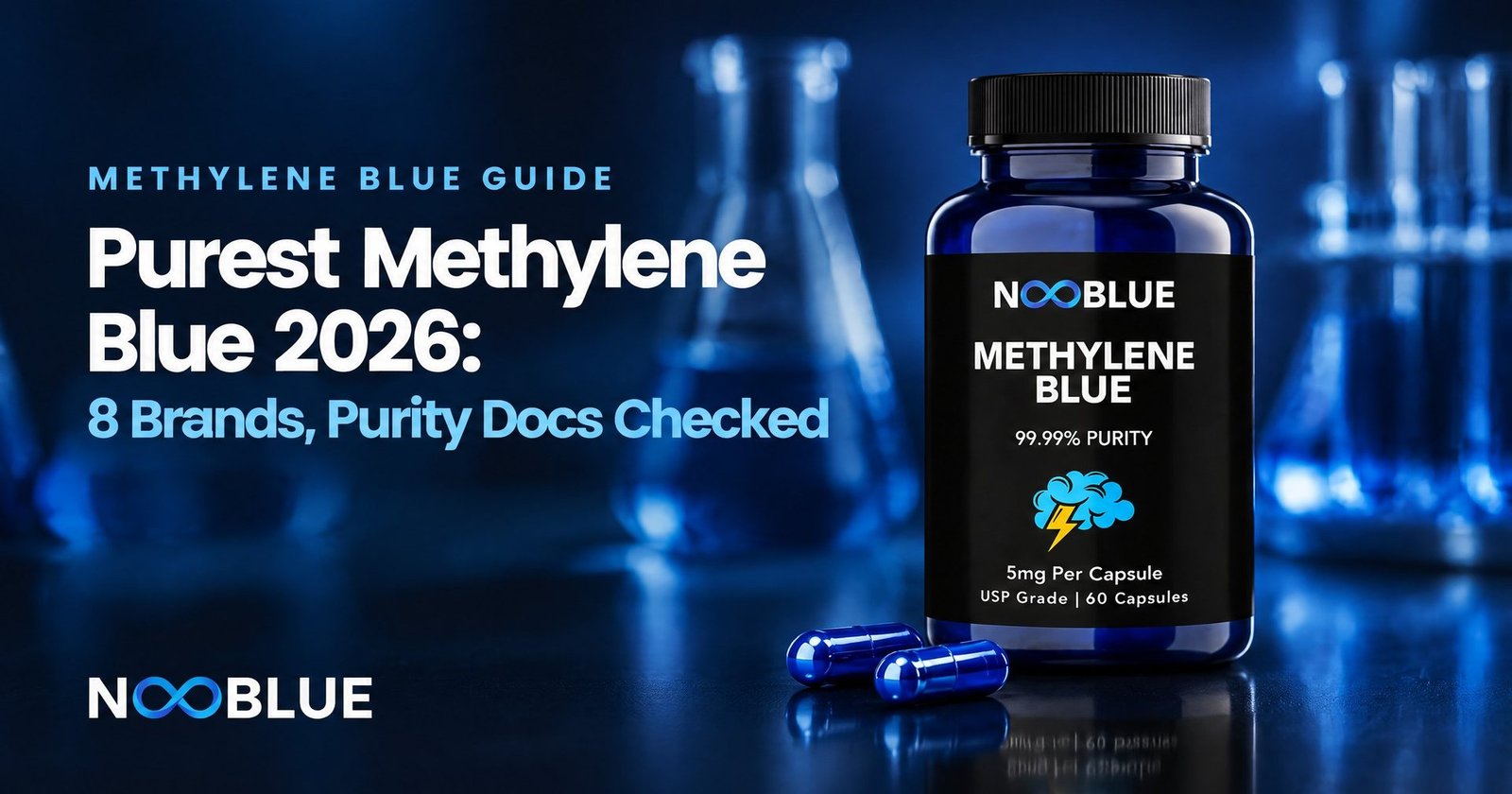
Capsules: the titration rung. The NooBlue Ultimate Methylene Blue Capsules deliver 5 mg of methylene blue per capsule with 10 mg of vitamin C, rice flour and a cellulose capsule, and no added sugars or flavorings. The suggested serving is one capsule a day with food, which makes the 5 mg capsule the gentler starting point for beginners. No peer-reviewed study has yet tested a gummy formulation directly.
Liquid: maximum control, lowest cost. The 1% solution gives 0.5 mg per drop and the lowest cost per milligram of our three formats, at the price of counting drops and handling a concentrate that can stain the mouth, tongue, skin and fabric.
Browse all available formats in the NooBlue shop and our dosage guide covers how many milligrams suit your body weight and goals.
How to Take Methylene Blue Gummies: Timing, Food, and Storage
Take the gummy in the morning. Some people find methylene blue mildly stimulating, so the rule we apply to every format is a cutoff of about 2 PM so it does not push back sleep. One 10 mg gummy is a standard daily dose. If you have never taken methylene blue before, a single 5 mg capsule for the first week is the gentler way to learn how you respond before moving up. Chew thoroughly, and take it with or without food, although a light breakfast helps if you notice any queasiness. Never combine it with SSRIs, SNRIs, MAOIs or other serotonergic drugs, and skip it entirely with G6PD deficiency, in pregnancy or breastfeeding, and under 18 (the full list is in the safety section below). Keep the bottle closed, cool, dry, and out of sunlight. Pectin softens in heat, and light can degrade methylene blue. Our storage guide covers the details.
Safety: Who Should Not Take Methylene Blue Gummies
Do not take methylene blue in any form if any of these apply to you:
- You take an SSRI, SNRI, MAOI or any other serotonergic medicine, including many antidepressants. The combination can cause serotonin syndrome. Read methylene blue and serotonin syndrome.
- You have G6PD deficiency. See methylene blue and G6PD deficiency.
- You are pregnant or breastfeeding.
- You are under 18.
Talk to your doctor before use if you take any prescription medicine or have a kidney or liver condition. Methylene blue can turn urine blue or green, which is expected. Keep gummies out of reach of children, and do not exceed the suggested serving of one gummy a day.
The full warning is in the gummies product page safety section, and our guide to who should not take methylene blue covers each group in detail.
Frequently Asked Questions
Do methylene blue gummies work at all?
It depends on the gummy. Any gummy containing a verified amount of methylene blue that survives manufacturing and storage will deliver the compound to your digestive system. The real question is dose reliability. Candy-grade marketplace gummies suffer from manufacturing variability, heat-induced degradation, and shelf-stability problems that undermine confidence in what each piece actually contains. Look for USP-grade material, a full ingredient panel and a test report whose scope you can read. Whether any gummy improves focus or energy for you is a separate question: the small human studies on methylene blue used much larger single doses and did not test a gummy.
Do methylene blue gummies stain your teeth?
A conventional gummy will, at least temporarily. Oxidized methylene blue is a strong blue dye, and chewing holds it against the teeth, tongue and gums for far longer than swallowing a capsule does. The tint sits on the surface rather than staining the enamel, and brushing plus normal saliva flow clears it within a day for most people, but with a daily gummy you are repeating that exposure every morning. This is the main reason capsules and sealed liquids have kept their share of the market. NooBlue gummies are the exception: they don’t leave a blue mouth or tongue. They also contain vitamin C, which can shift methylene blue toward its colorless form. See NooBlue Methylene Blue Gummies for the full panel.
Are methylene blue gummies safe?
The safety profile of methylene blue itself does not change with the delivery format. The same precautions (serotonergic medications, G6PD deficiency, pregnancy and breastfeeding, and anyone under 18) apply to gummies as to capsules. The additional safety factor with gummies is ingredient quality: many candy-grade gummy formulas include added sugars, artificial colors, and flavourings, while zero-sugar, pectin-based formulations avoid them. Review the full ingredient list before purchasing, and consult our interaction guide regardless of which format you choose.
Why are gummy supplements so popular if they have these drawbacks?
Consumer preference drives the gummy trend. For vitamins and minerals that are stable, inexpensive, and taken at doses where modest variability is not clinically significant (like vitamin C or D), gummies are a reasonable format. The problems appear when a candy-grade production line handles a compound like methylene blue that is dosed precisely, sensitive to its chemical environment, and intensely staining in its oxidized form. Some of those problems can be designed around, with a named grade, a sugar-free base, a gummy that leaves no blue mouth and a test report you can read, but many gummies on the market don’t do all of that.
Can children take methylene blue gummies?
Methylene blue use is not recommended for children regardless of the delivery format. The research on oral methylene blue use has been conducted in adult populations, and appropriate pediatric dosing for wellness use has not been established. The fact that gummies resemble candy creates an additional concern: children may be tempted to take more than intended if the product looks and tastes like a treat. Keep all methylene blue products, in any format, out of reach of children. NooBlue products are not for anyone under 18.
Would a gummy with a higher stated dose compensate for degradation?
Some manufacturers over-dose gummies (adding more active ingredient than the label states) to compensate for anticipated degradation during manufacturing and storage. While this approach partially addresses the stability problem, it introduces its own issues. The actual dose you receive becomes even less predictable, potentially higher than intended when the gummy is fresh and lower than intended as it ages. For a compound where dosing precision matters, engineered overage is a workaround that creates new uncertainties rather than solving the underlying problem. A product that does not need compensatory over-dosing is more reliable: a capsule, or a gummy with a finished-product test report that confirms its labeled dose.
Why do I feel strange after taking a methylene blue gummy?
It is usually dose or timing. Methylene blue can feel stimulating, so a gummy taken late in the day, or a second one stacked on the first, can bring restlessness, a light headache, or a wired feeling, and queasiness is more common on an empty stomach. Blue-green urine is harmless. One gummy in the morning with food usually settles it. Agitation, sweating, or a racing heart while also taking an SSRI, SNRI, or other serotonergic drug is a serotonin syndrome warning: stop and seek medical care. Our side effects guide covers the full list.
How long does it take for methylene blue gummies to start working?
Fast for the visible sign, slower for the benefits. Blue-green urine usually appears the same day, which confirms the dose was absorbed. There is no published research on how long a methylene blue gummy takes to work. The human imaging studies measured effects one hour after a single large dose, not after weeks of daily gummies. If you try a 10 mg gummy, hold the serving steady rather than escalating. If nothing changes after a month, the format is rarely the reason. Check whether methylene blue fits your goals in our benefits guide.
The Bottom Line
Methylene blue gummies can work as a delivery format when the grade is named, the ingredient panel is complete and the test report says clearly what it covers. Conventional oxidized gummies bring staining and dose-consistency questions. NooBlue gummies give 10 mg of USP methylene blue with 25 mg of vitamin C, zero sugar and no blue mouth, and our 5 mg capsules suit beginners who want a smaller serving. No study has tested a gummy directly, so judge any product by its label and paperwork, and read the safety section before your first serving.