Key takeaways
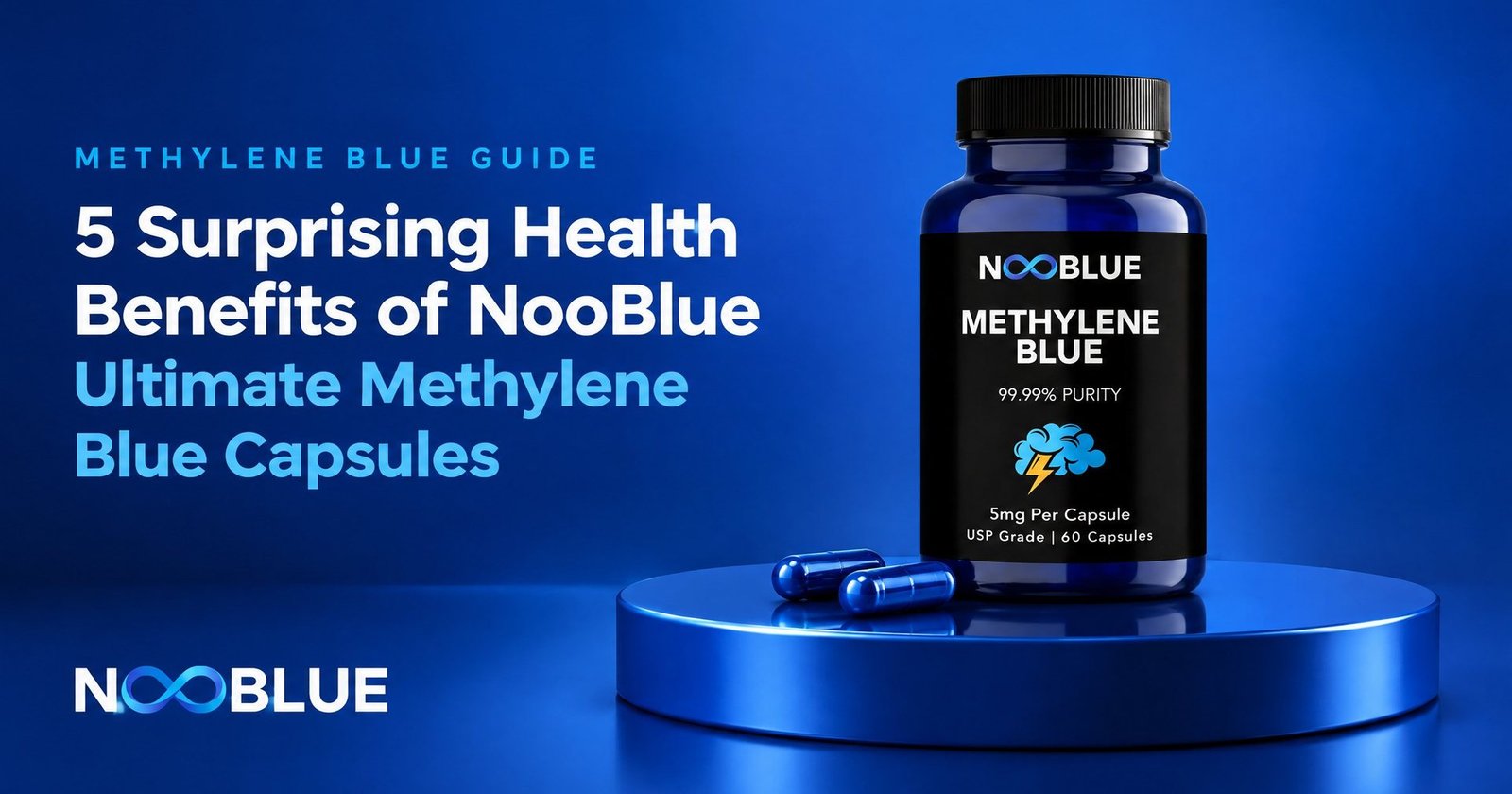
- NooBlue Ultimate Methylene Blue Capsules hold 5 mg of USP-grade methylene blue and 10 mg of vitamin C each, 60 to a bottle, taken one a day with food.
- The five benefits below are the areas where methylene blue research is strongest: cellular energy, attention and memory, antioxidant cycling, cellular aging in the lab, and memory consolidation after learning.
- Most of that evidence comes from cells, animals or single large doses in healthy volunteers. No study has tested our capsules, or 5 mg a day over months, and we say so under each benefit.
- The best-known human trial gave a single 280 mg dose, which is 56 times one capsule.
- Not for anyone taking SSRIs, SNRIs, MAOIs or other serotonergic medicines, people with G6PD deficiency, anyone pregnant or breastfeeding, or anyone under 18. It can turn urine blue or green. If you take any prescription medicine, talk to your doctor first.
NooBlue makes the Ultimate Methylene Blue Capsules, so this is a guide to our own product, and we have an obvious interest in it. The title promises five surprising health benefits. Here is the honest version. The surprising part is how well the chemistry of methylene blue is understood, and how little of it has been tested at the small daily servings supplements use. Below are the five areas where the research is strongest, what each study actually found, and where the evidence stops. Written by the NooBlue editorial team.
Table of contents
- 1. What Is in NooBlue Ultimate Methylene Blue Capsules
- 2. 1. Supports Cellular Energy Production
- 3. 2. Supports Attention and Short-Term Memory
- 4. 3. A Self-Recycling Antioxidant Action
- 5. 4. Supports Healthy Cellular Aging in Lab Studies
- 6. 5. Supports Memory Consolidation After Learning
- 7. How Strong Is the Evidence for Each Benefit?
- 8. How to Take the Capsules
- 9. Who Should Not Take These Capsules
- 10. Frequently Asked Questions
- 10.1. What happens if you take methylene blue every day?
- 10.2. What should you not mix with methylene blue?
- 10.3. Why do I feel so good on methylene blue?
- 10.4. Why don’t doctors recommend methylene blue?
- 10.5. Which of the five benefits has the strongest human evidence?
- 10.6. How long does one bottle last?
- 11. The Bottom Line
- 12. Sources
What Is in NooBlue Ultimate Methylene Blue Capsules
Each capsule holds 5 mg of USP-grade methylene blue and 10 mg of vitamin C (ascorbic acid), with rice flour in a cellulose capsule. The label says to take one capsule daily with food, so a 60-capsule bottle lasts 60 days, at $0.63 a serving. The fixed 5 mg dose means there is nothing to measure and no taste, and because the capsule is swallowed whole, it does not stain the mouth.
For testing, NooBlue publishes a report from Contract Testing Laboratories of America (CTLA) on its methylene blue ingredient, with an HPLC identity result and heavy metal results for one ingredient lot. It covers the raw ingredient, not each finished batch, and it does not state a purity percentage. USP grade means the ingredient is meant to meet the USP monograph, which requires 97.0% to 103.0% methylene blue on the dried basis (USP).
1. Supports Cellular Energy Production
Mitochondria make most of your cells’ energy by passing electrons along a chain of protein complexes to oxygen. Methylene blue can join that chain as an extra carrier. A 2018 review describes it rerouting electrons directly from NADH to cytochrome c, which increases the activity of complex IV and supports mitochondrial activity while limiting oxidative stress (Tucker et al., Molecular Neurobiology, 2018).
The clearest numbers come from cells. In human lung fibroblasts grown in culture, methylene blue increased mitochondrial complex IV activity by 30% and cellular oxygen consumption by 37 to 70% (Atamna et al., FASEB Journal, 2008).
What it does not show: nobody has measured energy production in people taking 5 mg a day. The cell results explain why methylene blue interests researchers, not what a capsule will feel like. Our explainer on how methylene blue works goes through the chemistry.
2. Supports Attention and Short-Term Memory
This is the benefit with the most direct human evidence. In a 2016 randomized, double-blind, placebo-controlled trial at the University of Texas, 26 healthy adults aged 22 to 62 took a single 280 mg oral dose of USP methylene blue (about 4 mg/kg) or placebo. One hour later, brain scans showed stronger responses during an attention task and a short-term memory task, and correct answers during memory retrieval rose by 7% (Rodriguez et al., Radiology, 2016). A 2017 follow-up from the same team used the same single 280 mg dose and found stronger resting-state connectivity between brain regions tied to perception and memory (Rodriguez et al., Brain Imaging and Behavior, 2017).
What it does not show: those were single doses 56 times larger than one capsule, measured after one hour in healthy volunteers. No trial has tested 5 mg a day for weeks. For more on focus and mental energy, see our guide to methylene blue for brain fog and our comparison of methylene blue vs other nootropics.
3. A Self-Recycling Antioxidant Action
Most antioxidants, such as vitamin C, give up electrons and then need the cell to regenerate them. Methylene blue cycles. Enzymes in the cell use NADH or NADPH to turn it into colorless leucomethylene blue, and cytochrome c turns it back into blue methylene blue. Atamna and colleagues proposed that this cycling in mitochondria may block oxidant production at the source. In the same study, methylene blue also switched on phase-2 antioxidant enzymes in human liver cells grown in culture (Atamna et al., 2008). A 2012 review from the University of Texas group describes low-dose methylene blue as an electron cycler with strong antioxidant and cell respiration-enhancing properties (Rojas et al., Progress in Neurobiology, 2012).
What it does not show: the same review describes a hormetic dose response, with opposite effects at low and high doses, so the antioxidant action only holds within a range. The findings come from cells and animals. Our explainer on what leucomethylene blue is covers the reduced form in more detail.
4. Supports Healthy Cellular Aging in Lab Studies
Two lab studies look at aging cells. In the 2008 study, methylene blue at nanomolar levels delayed the point at which human lung fibroblasts stop dividing, extending their life span in culture by more than 20 population doublings, and counteracted premature aging induced by hydrogen peroxide or cadmium (Atamna et al., 2008). In 2017, researchers at the University of Maryland found that methylene blue stimulated the growth of cultured human skin fibroblasts and delayed their aging more than the other antioxidants they compared. In a lab-grown 3D human skin model, it improved skin viability, hydration and dermis thickness, and did not cause irritation even at high concentrations (Xiong et al., Scientific Reports, 2017).
What it does not show: these are cells and tissue models, and the skin work applied methylene blue directly to the model rather than giving it by mouth. No controlled trial has shown that a methylene blue capsule changes aging or skin in people. Our articles on methylene blue and anti-aging and methylene blue and skin wrinkles cover the skin research.
5. Supports Memory Consolidation After Learning
Memory consolidation is the process that turns a new experience into a lasting memory. The 2012 review from the University of Texas group links methylene blue’s memory effects in animals to better consolidation, in a way that depends on which brain networks are active, with the respiratory enzyme cytochrome oxidase playing a major role (Rojas et al., 2012). In one rat study, animals with permanently reduced blood flow to the brain received 4 mg/kg of USP methylene blue a day for a month and learned and remembered a visual water maze task better than rats given saline (Auchter et al., 2014).
One human trial tested the idea directly. Adults with a strong fear of enclosed spaces took 260 mg of methylene blue (23 people) or placebo (19 people) straight after an exposure session. A month later, people whose fear had dropped well during the session did better on methylene blue, while those who still had moderate to high fear at the end of the session tended to do worse on it (Telch et al., American Journal of Psychiatry, 2014).
What it does not show: the human result was mixed, came from one small trial at a dose 52 times one capsule, and has not been repeated at supplement servings.
How Strong Is the Evidence for Each Benefit?
| Benefit | Best evidence | Tested in people? | Dose studied |
|---|---|---|---|
| 1. Cellular energy | Cell studies and reviews | No direct human measurement | Low concentrations in cultured cells |
| 2. Attention and short-term memory | Two randomized imaging trials | Yes, healthy adults, single dose | 280 mg once |
| 3. Antioxidant cycling | Cell studies and reviews | No | Low doses in cells and animals |
| 4. Cellular aging | Fibroblast and 3D skin model studies | No | Low concentrations, applied directly to cells and skin models |
| 5. Memory consolidation | Animal studies and one trial | Yes, one trial with a mixed result | 260 mg once, 4 mg/kg a day in rats |
If you want the wider picture beyond these five, our summary of what the research on methylene blue benefits shows covers every area we have reviewed.
How to Take the Capsules
Take one capsule a day with food, as the label says. Stay at one capsule, because methylene blue does not work on a more-is-better basis. Taking it with breakfast makes it easy to remember, and our guide to the best time to take methylene blue covers timing. For serving sizes across formats, see how many mg of methylene blue per day.
Expect your urine to turn blue or green. Clinical references describe this as expected and benign (StatPearls, 2026). If you would rather not swallow capsules, the gummies hold 10 mg with 25 mg of vitamin C and avoid the blue mouth and tongue that drops cause, and the 1% drops give 0.5 mg per drop if you want fine control. You can see all three in the NooBlue shop.
Who Should Not Take These Capsules
- Anyone taking an SSRI, SNRI, MAOI or other serotonergic medicine. Methylene blue is a potent MAO-A inhibitor (Ramsay et al., 2007), and combining it with these medicines can cause serotonin syndrome, a medical emergency. See what not to take with methylene blue and methylene blue and serotonin syndrome.
- People with G6PD deficiency. Clinical references list it as a contraindication because methylene blue can break down red blood cells in people with it (StatPearls, 2026). Read methylene blue and G6PD deficiency.
- Anyone pregnant or breastfeeding.
- Anyone under 18. Our products are for adults.
- Anyone who takes a prescription medicine. Talk to your doctor or pharmacist first.
Our full guide to who should not take methylene blue covers each group, and our guide to methylene blue side effects covers what to expect.
Frequently Asked Questions
What happens if you take methylene blue every day?
No trial has followed healthy adults taking a daily 5 mg serving for months, so nobody can describe long-term effects at that level with data. In a 6-month crossover trial where 37 adults took 195 mg a day for one phase, side effects were mild and short-lived (Alda et al., 2017). Urine turns blue or green. The serious risks are interactions with serotonergic medicines, G6PD deficiency and pregnancy. Our guide on whether methylene blue is safe to take daily goes further.
What should you not mix with methylene blue?
Medicines first. Do not combine it with SSRIs, SNRIs, MAOIs or other serotonergic drugs, including tramadol, dextromethorphan cough medicines and St. John’s wort. Ramsay and colleagues also noted that MAO-A inhibition has implications for how the gut handles dietary amines when methylene blue is taken by mouth (Ramsay et al., 2007). No study has measured food reactions at supplement servings, but if you eat a lot of aged cheese or cured meats, mention it to your doctor. Our methylene blue interactions guide has the full list.
Why do I feel so good on methylene blue?
No study has measured how people feel on a 5 mg serving, so there is no data-based answer. Methylene blue acts on brain chemistry as an electron carrier and an MAO-A inhibitor, and expectation shapes how any supplement feels. If you feel agitated, sweaty, shaky or confused, especially alongside another medicine, stop and get medical help, because those can be signs of serotonin toxicity.
Why don’t doctors recommend methylene blue?
Mainly because it interacts with common antidepressants and other serotonergic medicines, and because the human evidence for everyday use is limited to small, short studies. Our article on why doctors rarely prescribe methylene blue sets out the full reasoning.
Which of the five benefits has the strongest human evidence?
Attention and short-term memory, from two randomized imaging trials in healthy adults. Even that evidence comes from a single 280 mg dose measured after an hour. The energy, antioxidant and aging findings come from cells and animals, and the memory consolidation trial had a mixed result.
How long does one bottle last?
At one capsule a day, a 60-capsule bottle lasts 60 days. Multi-bottle packs cost less per bottle, and shipping is free worldwide on orders of $100 or more.
The Bottom Line
NooBlue Ultimate Methylene Blue Capsules give you a fixed 5 mg of USP-grade methylene blue with 10 mg of vitamin C, once a day, with no measuring and no blue mouth. The research behind methylene blue is real in five areas, from cellular energy to memory consolidation, but most of it comes from cells, animals and single large doses. We would rather you buy them knowing that than expecting a result no study has shown.
If none of the safety warnings applies to you, the capsules are our pick for a first bottle. If another format suits your routine better, choose it below.
Sources
- Tucker D, Lu Y, Zhang Q. From mitochondrial function to neuroprotection: an emerging role for methylene blue. Molecular Neurobiology. 2018;55(6):5137-5153. PubMed 28840449
- Atamna H, Nguyen A, Schultz C, et al. Methylene blue delays cellular senescence and enhances key mitochondrial biochemical pathways. FASEB Journal. 2008;22(3):703-712. PubMed 17928358
- Rodriguez P, Zhou W, Barrett DW, et al. Multimodal randomized functional MR imaging of the effects of methylene blue in the human brain. Radiology. 2016;281(2):516-526. PMC5084971
- Rodriguez P, Singh AP, Malloy KE, et al. Methylene blue modulates functional connectivity in the human brain. Brain Imaging and Behavior. 2017;11(3):640-648. PubMed 26961091
- Rojas JC, Bruchey AK, Gonzalez-Lima F. Neurometabolic mechanisms for memory enhancement and neuroprotection of methylene blue. Progress in Neurobiology. 2012;96(1):32-45. PMC3265679
- Xiong ZM, O’Donovan M, Sun L, et al. Anti-aging potentials of methylene blue for human skin longevity. Scientific Reports. 2017;7(1):2475. PubMed 28559565
- Auchter A, Williams J, Barksdale B, Monfils MH, Gonzalez-Lima F. Therapeutic benefits of methylene blue on cognitive impairment during chronic cerebral hypoperfusion. Journal of Alzheimer’s Disease. 2014;42 Suppl 4:S525-535. PubMed 25079810
- Telch MJ, Bruchey AK, Rosenfield D, et al. Effects of post-session administration of methylene blue on fear extinction and contextual memory in adults with claustrophobia. American Journal of Psychiatry. 2014;171(10):1091-1098. PubMed 25018057
- Ramsay RR, Dunford C, Gillman PK. Methylene blue and serotonin toxicity: inhibition of monoamine oxidase A (MAO A) confirms a theoretical prediction. British Journal of Pharmacology. 2007;152(6):946-951. PMC2078225
- Ostrovsky A, Afzal M. Methylene Blue. StatPearls. 2026. NCBI Bookshelf NBK557593
- Alda M, McKinnon M, Blagdon R, et al. Methylene blue treatment for residual symptoms of bipolar disorder: randomised crossover study. British Journal of Psychiatry. 2017;210(1):54-60. PubMed 27284082
- United States Pharmacopeia. Methylene Blue monograph. doi.usp.org