Key takeaways
- No study has tested methylene blue for brain fog itself. The research is about memory, attention and brain energy, mostly in cells and animals.
- In two small imaging trials, healthy adults took a single 280 mg dose (about 4 mg/kg). One hour later, brain activity during attention and memory tasks was stronger, and correct answers on a memory task rose by 7%.
- A 2023 study pointed the other way: intravenous doses lowered brain blood flow and oxygen use in eight healthy women.
- The dose curve is hormetic. Effects rise at low doses and turn around at high ones, so more is not better.
- Do not take it with SSRIs, SNRIs, MAOIs or other serotonergic medicines (serotonin syndrome risk), with G6PD deficiency, while pregnant or breastfeeding, or if you are under 18. It can turn urine blue or green. If you take any prescription medicine, talk to your doctor first.
Does methylene blue help with brain fog? Nobody has run a trial to find out. What exists is a set of small human studies on memory and attention, a larger body of cell and animal research on how methylene blue supports mitochondrial energy, and one clear safety rule: it must never be mixed with serotonergic medicines. This guide covers what brain fog is, how methylene blue works in the brain, what the human studies found (including the one that did not go the expected way), how people who try it use it, and how it compares with caffeine, lion’s mane and CoQ10.
NooBlue sells methylene blue capsules, gummies and drops, so we have an interest in the subject. We have kept this page to what the research shows and linked every study. Written by the NooBlue editorial team.
Table of contents
- 1. What Brain Fog Is, and Why Brain Energy Comes Into It
- 2. How Methylene Blue Works in the Brain
- 3. Who Should Not Take Methylene Blue
- 4. What the Human Studies Show
- 5. Why More Is Not Better: The Hormetic Curve
- 6. How People Use Methylene Blue for Mental Clarity
- 7. Capsules, Gummies or Drops for Brain Fog
- 8. Methylene Blue vs Other Brain Fog Supplements
- 9. What Methylene Blue Will Not Do
- 10. How Strong Is the Evidence?
- 11. Frequently Asked Questions
- 11.1. Does methylene blue help with brain fog?
- 11.2. How long does methylene blue take to work?
- 11.3. Can I take methylene blue every day?
- 11.4. What is the best supplement for brain fog?
- 11.5. What is the fastest way to clear brain fog?
- 11.6. Why do I feel so good on methylene blue?
- 11.7. Why do I feel weird or foggier after taking methylene blue?
- 11.8. Why don’t doctors recommend methylene blue?
- 11.9. Will methylene blue keep me awake at night?
- 12. The Bottom Line
- 13. Sources
What Brain Fog Is, and Why Brain Energy Comes Into It
Brain fog is not a diagnosis. Cleveland Clinic describes it as a range of symptoms that affect thinking, memory and concentration, and lists common triggers such as poor sleep, stress and hormonal changes during pregnancy or menopause, alongside a long list of medical causes (Cleveland Clinic, 2024).
People mean different things by it. Researchers at the University of Edinburgh read 717 social media posts that used the term and found it covered forgetfulness, trouble concentrating, feeling detached, slow and effortful thinking, communication problems, a fuzzy or pressured head, and fatigue. The posts linked it to a wide range of illnesses, drugs and habits (McWhirter et al., 2023). That spread matters. A supplement cannot address sleep debt, a medicine side effect and a hormone change all at once.
Energy is the part of the picture methylene blue connects to. The adult brain is about 2% of body weight but uses about 20% of the oxygen, and so the calories, the body consumes (Raichle and Gusnard, 2002). Almost all of that energy is made in mitochondria. Methylene blue has been studied for decades because it can act inside that energy chain.
How Methylene Blue Works in the Brain
Methylene blue is a small molecule that crosses into the brain. Its best-studied action is as an electron carrier. Inside mitochondria it can pick up electrons and pass them to cytochrome c, feeding the last enzyme of the energy chain (complex IV, also called cytochrome oxidase). It then regenerates and repeats the cycle, which is why small amounts have measurable effects in the lab. A review from the University of Texas at Austin describes it as an electron cycler at low doses and links its memory effects in animals to cytochrome oxidase (Rojas et al., 2012). A later review from the same lab frames brain mitochondrial respiration as a target for cognitive support, with methylene blue as the main example (Gonzalez-Lima et al., 2014).
Its second action is less talked about and more important for safety. Methylene blue is a potent, reversible inhibitor of monoamine oxidase A (MAO-A), an enzyme that breaks down serotonin and norepinephrine (Ramsay et al., 2007). That is the reason for the interaction warning below. Our explainer on how methylene blue works covers the chemistry step by step, and our guide to methylene blue for energy covers the mitochondrial side in more depth.
Who Should Not Take Methylene Blue
Read this before anything else on the page. Do not take methylene blue if any of these applies to you:
- You take an SSRI, SNRI, MAOI or any other serotonergic medicine, including many antidepressants. The combination can cause serotonin syndrome. A review of reported cases found that 13 of 14 cases of central nervous system toxicity involving methylene blue were serotonin toxicity, and severe toxicity has occurred at an intravenous dose of only 1 mg/kg (Gillman, 2011).
- You have G6PD deficiency. Clinical references list it as a contraindication because methylene blue can break down red blood cells in people with this enzyme deficiency (StatPearls, 2026).
- You are pregnant or breastfeeding. The same reference warns that methylene blue may cause fetal harm when given during pregnancy.
- You are under 18.
If you take any prescription medicine, talk to your doctor before you start. Methylene blue can turn urine blue or green with any format, which is expected and harmless (StatPearls, 2026). Every NooBlue product page carries the same warnings in its Safety: read before use section. For the details, see our guides to what not to take with methylene blue, methylene blue and serotonin syndrome, methylene blue and G6PD deficiency and who should not take methylene blue.
If none of these applies to you and you want to try methylene blue for focus and mental energy, NooBlue makes it in three formats.
What the Human Studies Show
Three small human studies measured what methylene blue does to the working brain. Two found a lift. One found the opposite of what its authors expected.
- Rodriguez et al., 2016 (Radiology). In a randomized, double-blind, placebo-controlled trial, 26 healthy adults aged 22 to 62 took a single oral 280 mg dose (about 4 mg/kg) or a placebo. One hour later, MRI scans showed stronger brain responses during a sustained-attention task and a short-term memory task, and correct answers during memory retrieval rose by 7% (Rodriguez et al., 2016).
- Rodriguez et al., 2017 (Brain Imaging and Behavior). A follow-up with the same single 280 mg dose found lower blood flow in a task network during a visuomotor task and stronger resting-state connectivity between brain regions linked to perception and memory (Rodriguez et al., 2017).
- Singh et al., 2023 (Journal of Cerebral Blood Flow and Metabolism). Eight healthy women received placebo and two intravenous doses (0.5 and 1 mg/kg) on separate days. Instead of rising, global brain blood flow and the brain’s oxygen use both fell, and rats given methylene blue showed the same pattern. The authors suggested the doses may have been high enough to hit the downward side of the hormetic curve, or that healthy brains leave little room for improvement (Singh et al., 2023).
Harvard Health Publishing summed up the 2023 result as roughly an 8% decrease in brain blood flow at doses similar to the memory studies (Harvard Health, 2025). Lorne Hofseth, a pharmacy professor at the University of South Carolina, put the overall evidence plainly: most of what is known comes from rats and cells in a dish, the human trials are small with mixed results, and much larger, longer trials are needed to know if it works, what the right dose is and how safe it is over time (University of South Carolina, 2025).
Two more points matter for anyone reading these studies as a guide to brain fog. The volunteers were healthy and were not reporting fog. And 280 mg is 56 times the methylene blue in one 5 mg NooBlue capsule, taken once, with results measured after an hour. No trial has tested daily supplement servings over weeks. Our page of methylene blue research statistics collects the numbers from these and other studies, and our overview of methylene blue benefits covers the wider research.
Why More Is Not Better: The Hormetic Curve
Methylene blue follows what researchers call a hormetic dose response. A review by Bruchey and Gonzalez-Lima found that across its hormetic zone, methylene blue raised a range of behavioral, physiological and biochemical responses to 130 to 160% of control. Past that zone, responses fell back to control and then below it (Bruchey and Gonzalez-Lima, 2008). The same lab’s later review describes opposite effects at low and high doses (Rojas et al., 2012).
For someone hoping to think more clearly, the lesson is simple. Doubling a serving does not double the effect, and it may reverse it. The 2023 study above is a reminder that the curve applies to people too. Keep to the serving on the label.
How People Use Methylene Blue for Mental Clarity
Because no trial has tested supplement servings for brain fog, there is no evidence-based brain fog dose. What we can give you is what our labels say and a sensible way to start:
- Start with the smallest fixed serving. One NooBlue capsule holds 5 mg of methylene blue, and the label says to take one a day with food. With our drops, 10 drops give 5 mg, and you can start lower, since each drop is 0.5 mg.
- Take it in the morning. In a study of seven volunteers, methylene blue had an estimated terminal half-life of 5.25 hours after an intravenous dose (Peter et al., 2000). A morning serving gives it the whole day to clear. Nobody has studied timing and sleep directly, so if your sleep changes, keep it early.
- Give it two weeks and write down what you notice. Brain fog comes and goes with sleep, stress and workload, so a note each afternoon beats a guess at the end of the fortnight.
- Do not stack servings. One serving a day, as the label says. More is not better on a hormetic curve.
- Stop if something feels wrong. Agitation, sweating, tremor, confusion or a racing heart are warning signs of serotonin toxicity and need medical help.
Our guides to how many mg of methylene blue per day, the best time to take methylene blue and how long methylene blue takes to work go through servings and timing in more detail.
Capsules, Gummies or Drops for Brain Fog
All three NooBlue formats use USP-grade methylene blue. The difference is how you take it and how finely you can set the amount.
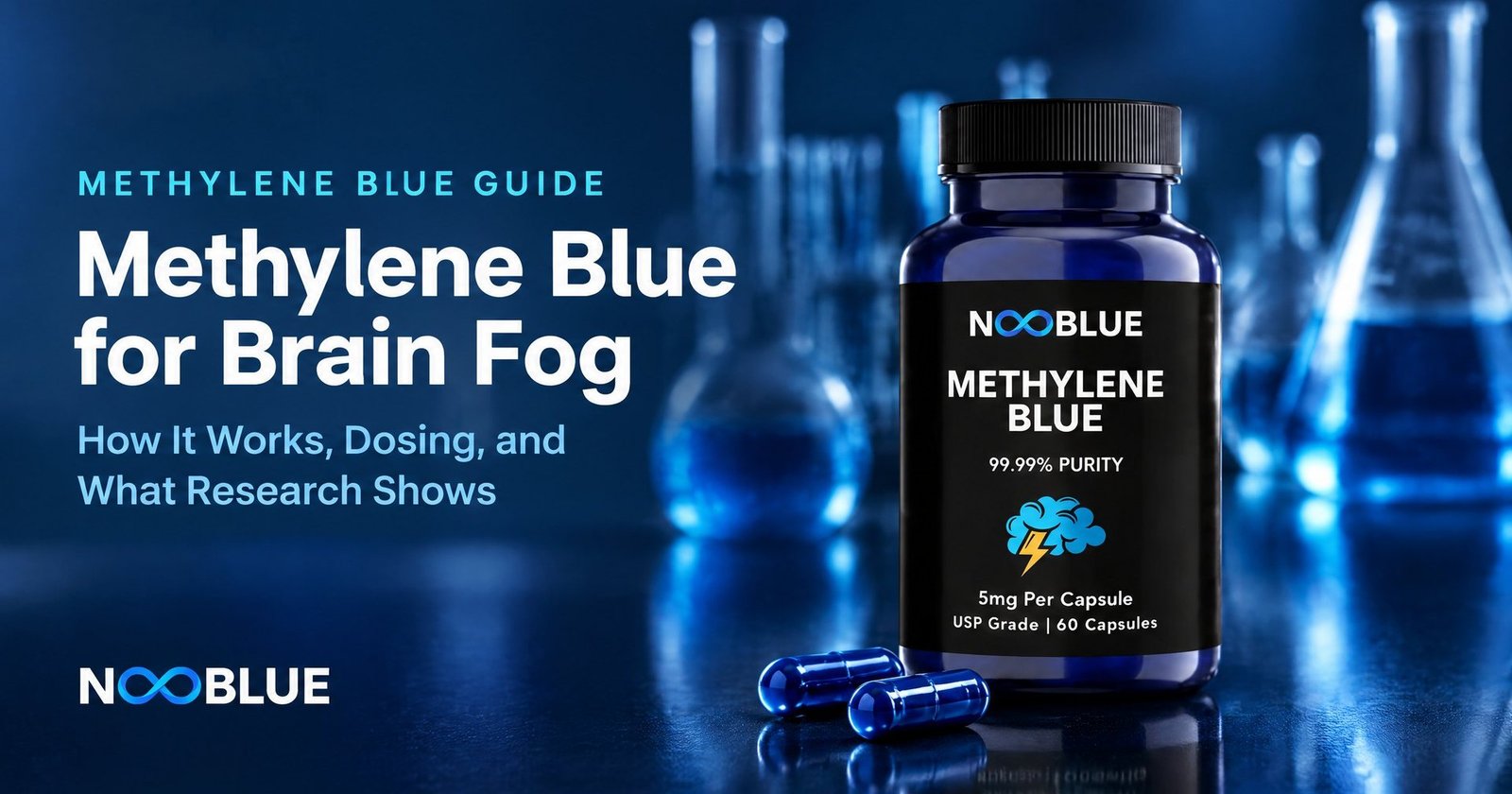
- Capsules: 5 mg of methylene blue with 10 mg of vitamin C in each capsule, 60 per bottle. The dose is fixed, there is nothing to measure, and you swallow it, so there is no taste. This is the simplest way to start at 5 mg.
- Gummies: 10 mg of methylene blue with 25 mg of vitamin C in a Wild Blueberry chew with zero sugar, 60 per bottle. They avoid the blue mouth and tongue that drops cause. The serving is 10 mg, twice a capsule, so they suit people who already know they tolerate methylene blue.
- Drops: a 1% solution in a 50 ml bottle, 0.5 mg per drop, about 100 servings at 5 mg. Drops are the only way to go below 5 mg. They can stain the mouth and tongue, so mix them into water or juice.
Our comparison of liquid and capsule bioavailability and our guide to methylene blue absorption cover how much reaches the bloodstream from each form.
Whatever format you choose, the grade matters. Harvard Health warns that industrial or chemical-grade methylene blue, like the kind sold as a stain or dye, should not be used in humans or animals (Harvard Health, 2025). The USP monograph requires 97.0% to 103.0% methylene blue on the dried basis (USP). NooBlue publishes a report from Contract Testing Laboratories of America (CTLA) on its methylene blue ingredient, with identity and heavy metal results for one ingredient lot. It covers the raw ingredient, not each finished batch. Our guide to reading a methylene blue certificate of analysis explains what to look for on any brand’s paperwork.
Methylene Blue vs Other Brain Fog Supplements
Most people try something else first. Here is how the common options compare on what they do and what the evidence covers.
- Caffeine blocks adenosine receptors. A 2016 review found that after periods of low alertness, caffeine improves vigilance, attention and reaction time, with less consistent effects on memory, judgment and decision making (McLellan et al., 2016). It has far more human data than methylene blue, but it works on alertness rather than on how cells make energy. Our guide to methylene blue and caffeine covers taking the two together.
- Lion’s mane has one of the few trials in healthy young adults. In a pilot study, 41 adults aged 18 to 45 took 1.8 g or a placebo. After a single dose they were quicker on a Stroop task at 60 minutes, but 28 days of use produced only a trend toward lower stress, and the authors called the sample small (Docherty et al., 2023).
- CoQ10 is part of the mitochondrial energy chain itself, so it is the closest relative to methylene blue in mechanism. We compare the two in methylene blue vs CoQ10.
- Multi-ingredient nootropic blends combine several compounds in one capsule. Our comparison of methylene blue vs Alpha Brain looks at one of the best known.
- Near-infrared light is studied by the same Texas lab for similar reasons, since it also acts on cytochrome oxidase (Gonzalez-Lima et al., 2014). See methylene blue and red light therapy.
None of these has been tested in people who report brain fog, methylene blue included. The honest comparison is between different mechanisms and different amounts of evidence, not between proven fixes.
What Methylene Blue Will Not Do
- It is not a stimulant. Its documented actions are electron carrying and MAO-A inhibition, not the jolt of caffeine.
- It does not replace sleep. Cleveland Clinic lists lack of sleep first among the causes of brain fog, and no supplement makes up for it. Our guide to methylene blue and sleep quality covers what is known.
- It will not fix a cause it does not touch. Stress, hormone changes, medicine side effects and many medical conditions can all cause fog.
- It is not a substitute for seeing a doctor. Cleveland Clinic advises getting care if brain fog interferes with your quality of life, or if you often forget appointments, struggle with ordinary tasks or cannot concentrate in conversations (Cleveland Clinic, 2024).
How Strong Is the Evidence?
| Type of evidence | What it shows | Limits |
|---|---|---|
| Cell and animal studies | Methylene blue supports mitochondrial respiration and cytochrome oxidase activity, and animals remember tasks better at low doses | Results in dishes and rodents do not show the same effect in people |
| Human imaging trials (2016, 2017) | A single 280 mg dose changed brain activity and connectivity within an hour, with 7% more correct memory answers | 26 healthy adults in the first trial, one large dose, measured once |
| Human intravenous study (2023) | Brain blood flow and oxygen use fell after 0.5 and 1 mg/kg | Eight healthy women, intravenous doses |
| Trials of daily supplement servings for brain fog | None published | The use most buyers care about has not been tested |
The mechanism is well mapped. The human evidence is thin and points in more than one direction. If you try methylene blue, think of it as a personal experiment at the lowest serving, with the safety rules above, and judge it on what you notice over two weeks.
Frequently Asked Questions
Does methylene blue help with brain fog?
It has not been tested for brain fog. In healthy adults, a single 280 mg dose strengthened brain activity during attention and memory tasks and raised correct memory answers by 7%, while a 2023 intravenous study found lower brain blood flow. It supports mitochondrial energy in cell and animal research. Whether daily supplement servings help with fog is unknown.
How long does methylene blue take to work?
The imaging trials measured brain effects one hour after a single oral dose. No study has measured how soon people notice a change in mental clarity at supplement servings. If you try it, give it about two weeks and keep notes before deciding.
Can I take methylene blue every day?
NooBlue’s labels give one serving a day: one 5 mg capsule with food, one 10 mg gummy, or a measured number of 0.5 mg drops. No controlled trial has tested daily use over months, so keep to the label and stop if you notice side effects. Never take it daily alongside a serotonergic medicine.
What is the best supplement for brain fog?
No supplement has been shown to clear brain fog in a trial, because fog has many causes. Start with sleep, stress and a check with your doctor if it persists. If you want to try methylene blue, our pick is NooBlue’s 5 mg capsules, the simplest way to start at a low fixed serving. Among other options, caffeine has the most human data for short-term alertness and attention.
What is the fastest way to clear brain fog?
For fog that follows a short night, sleep is the most direct fix. Cleveland Clinic also lists nutritious meals, daily physical activity, breaks during mental work and writing things down. Fog that lasts, gets worse or comes with other symptoms needs a doctor, not a supplement.
Why do I feel so good on methylene blue?
No study has measured how people feel on supplement servings, so there is no data-based answer. Its two documented actions, electron carrying and MAO-A inhibition, both affect the brain, and expectation shapes how any supplement feels. If you feel agitated, sweaty, shaky or confused, especially alongside another medicine, stop and get medical help.
Why do I feel weird or foggier after taking methylene blue?
Clinical references list headache, nausea and dizziness among its side effects at medical doses (StatPearls, 2026). Taking more than the label says can also push you onto the downward side of the hormetic curve. Agitation, sweating, tremor, confusion or a racing heart are warning signs of serotonin toxicity and need medical attention. If something feels off, stop and talk to your doctor.
Why don’t doctors recommend methylene blue?
Mainly because of the MAO-A interaction with common medicines, and because the human evidence for everyday use is limited to small, short studies. Our article on why doctors rarely prescribe methylene blue sets out the full reasoning.
Will methylene blue keep me awake at night?
No study has tested its effect on sleep at supplement servings. Its estimated half-life of about five hours means a morning serving has the day to clear, which is why morning is the usual time. If your sleep changes, take it earlier or stop.
The Bottom Line
Methylene blue is a real mitochondrial compound with a clear mechanism, two small human studies showing a short-term lift in memory-related brain activity at a single 280 mg dose, and one study showing lower brain blood flow. It has not been tested for brain fog. If none of the safety warnings applies to you and your doctor is happy, the reasonable way to try it is the lowest fixed serving, taken in the morning for two weeks, with notes. You can compare all three formats in the NooBlue shop.
Sources
- Cleveland Clinic. Brain fog. Last updated May 14, 2024. my.clevelandclinic.org
- McWhirter L, Smyth H, Hoeritzauer I, Couturier A, Stone J, Carson AJ. What is brain fog? Journal of Neurology, Neurosurgery and Psychiatry. 2023;94(4):321-325. PubMed 36600580
- Raichle ME, Gusnard DA. Appraising the brain’s energy budget. Proceedings of the National Academy of Sciences. 2002;99(16):10237-10239. PMC124895
- Rojas JC, Bruchey AK, Gonzalez-Lima F. Neurometabolic mechanisms for memory enhancement and neuroprotection of methylene blue. Progress in Neurobiology. 2012;96(1):32-45. PMC3265679
- Gonzalez-Lima F, Barksdale BR, Rojas JC. Mitochondrial respiration as a target for neuroprotection and cognitive enhancement. Biochemical Pharmacology. 2014;88(4):584-593. PubMed 24316434
- Ramsay RR, Dunford C, Gillman PK. Methylene blue and serotonin toxicity: inhibition of monoamine oxidase A (MAO A) confirms a theoretical prediction. British Journal of Pharmacology. 2007;152(6):946-951. PMC2078225
- Gillman PK. CNS toxicity involving methylene blue: the exemplar for understanding and predicting drug interactions that precipitate serotonin toxicity. Journal of Psychopharmacology. 2011;25(3):429-436. PubMed 20142303
- Ostrovsky A, Afzal M. Methylene Blue. StatPearls. Updated January 2, 2026. NCBI Bookshelf NBK557593
- Rodriguez P, Zhou W, Barrett DW, et al. Multimodal randomized functional MR imaging of the effects of methylene blue in the human brain. Radiology. 2016;281(2):516-526. PMC5084971
- Rodriguez P, Singh AP, Malloy KE, et al. Methylene blue modulates functional connectivity in the human brain. Brain Imaging and Behavior. 2017;11(3):640-648. PMC5018244
- Singh N, MacNicol E, DiPasquale O, et al. The effects of acute methylene blue administration on cerebral blood flow and metabolism in humans and rats. Journal of Cerebral Blood Flow and Metabolism. 2023;43:95-105. PMC10638993
- Goldman L. What to know about methylene blue. Harvard Health Publishing. April 24, 2025. health.harvard.edu
- University of South Carolina. Is methylene blue really a brain booster? (conversation with Lorne Hofseth). June 2025. sc.edu
- Bruchey AK, Gonzalez-Lima F. Behavioral, physiological and biochemical hormetic responses to the autoxidizable dye methylene blue. American Journal of Pharmacology and Toxicology. 2008;3(1):72-79. PubMed 20463863
- Peter C, Hongwan D, Küpfer A, Lauterburg BH. Pharmacokinetics and organ distribution of intravenous and oral methylene blue. European Journal of Clinical Pharmacology. 2000;56(3):247-250. PubMed 10952480
- McLellan TM, Caldwell JA, Lieberman HR. A review of caffeine’s effects on cognitive, physical and occupational performance. Neuroscience and Biobehavioral Reviews. 2016;71:294-312. PubMed 27612937
- Docherty S, Doughty FL, Smith EF. The acute and chronic effects of lion’s mane mushroom supplementation on cognitive function, stress and mood in young adults: a double-blind, parallel groups, pilot study. Nutrients. 2023;15(22):4842. PubMed 38004235
- United States Pharmacopeia. Methylene Blue monograph. doi.usp.org