Quick answer
The best methylene blue supplement for most people is NooBlue Methylene Blue Gummies: 10 mg of USP grade methylene blue and 25 mg of vitamin C per gummy, 0 g of sugar, 60 gummies a bottle, and a published lab report on the methylene blue ingredient, at $0.42 per 5 mg. If you want to start at exactly 5 mg, NooBlue’s 5 mg capsules are the only 5 mg unit in this comparison. If you want the cheapest way to take a 5 mg dose, NooBlue’s 1% drops work out at $0.30 per 5 mg. If your only concern is the lowest cost per milligram, Nutricel Blue Boost costs less, at $0.24 per 5 mg, but its smallest dose is a 12 mg capsule.
Safety first: do not take methylene blue in any form if you take serotonergic medicines such as SSRIs or SNRIs, if you have G6PD deficiency, or if you are pregnant or breastfeeding.
NooBlue makes the three products ranked first, second and third. Competitor facts come from each brand’s own product page, read on September 25, 2026.
Written by the NooBlue editorial team. We make and sell methylene blue. Every competitor figure below comes from the brand’s own page or listing, and all of them are linked in the sources at the end so you can check our reading.
Choosing the best methylene blue supplement is harder than it looks, because the same single compound is sold in ways that are hard to compare. One brand sells a 16 mg troche in a pack of four. Another sells a dropper bottle rated in total milligrams. A third lists a serving of two capsules without saying how many capsules are in the bottle. Sticker prices tell you very little.
So this comparison puts every product on one scale, the cost of 5 mg of methylene blue, and adds a column most roundups leave out: the smallest dose each product can deliver. Together those two numbers explain why the cheapest product per milligram is not always the cheapest way to take the dose you want.
Table of contents
- 1. Best methylene blue supplements at a glance
- 2. How we picked the best methylene blue supplements
- 3. The 9 best methylene blue supplements, ranked
- 3.1. 1. NooBlue Methylene Blue Gummies: best overall
- 3.2. 2. NooBlue Ultimate Methylene Blue Capsules: best for an exact 5 mg
- 3.3. 3. NooBlue Methylene Blue Drops, 1% solution: best value per dose
- 3.4. 4. Nutricel Blue Boost: lowest cost per milligram
- 3.5. 5. Earth Harmony Ultimate Methylene Blue: highest stated purity figure
- 3.6. 6. Meraki Blu USP Grade Methylene Blue: a weaker liquid for small doses
- 3.7. 7. LVLUP Health Mito Blue: best all in one mitochondrial stack
- 3.8. 8. Troscriptions Just Blue: a troche you can quarter
- 3.9. 9. aSquared Nutrition Methylene Blue Capsules: a blend with cacao and ALA
- 4. “Supreme” and “Ultimate” are not brands
- 5. Methylene blue capsules vs liquid: which should you choose?
- 6. How to check a methylene blue COA before you buy
- 7. What the research says about methylene blue
- 8. Is methylene blue safe to take as a supplement?
- 9. How we compared these methylene blue supplements
- 10. Frequently asked questions about the best methylene blue supplements
- 10.1. What is the best methylene blue supplement?
- 10.2. What is the best brand of methylene blue?
- 10.3. Who makes the best methylene blue?
- 10.4. What is the highest quality methylene blue?
- 10.5. What is the best methylene blue on the market for a beginner?
- 10.6. What not to mix with methylene blue?
- 10.7. What brand of methylene blue do hospitals use?
- 10.8. Why don’t doctors recommend methylene blue?
- 10.9. What is the best place to buy methylene blue?
- 10.10. Are methylene blue capsules or liquid better?
- 10.11. How much methylene blue is in 1 mL of a 1% solution?
- 10.12. Is it safe to take methylene blue every day?
- 10.13. What dose of methylene blue should I take?
- 11. The verdict
- 12. More methylene blue buying guides
- 13. Sources
- 14. Browse more methylene blue guides
Best methylene blue supplements at a glance
Every row uses the same units. “Cost per 5 mg” is the listed price divided by the total milligrams of methylene blue in the pack, multiplied by five. “Smallest dose” is the finest amount the format can deliver without splitting a capsule or guessing.
| # | Product | Format | Methylene blue per unit | Pack | Price (as of Sep 2026) | Cost per 5 mg | Smallest dose | Best for |
|---|---|---|---|---|---|---|---|---|
| 1 | NooBlue Methylene Blue Gummies | Gummy | 10 mg | 60 gummies | $49.99 | $0.42 | 10 mg | An easy daily routine with a published ingredient report |
| 2 | NooBlue Ultimate Methylene Blue Capsules | Capsule | 5 mg | 60 capsules | $37.99 | $0.63 | 5 mg | An exact 5 mg dose |
| 3 | NooBlue Methylene Blue Drops, 1% solution | Liquid | 0.5 mg per drop | 50 mL | $29.99 | $0.30 | 0.5 mg | Lowest cost per 5 mg dose |
| 4 | Nutricel Blue Boost | Capsule | 12 mg | 60 capsules | $34.90 | $0.24 | 12 mg | Lowest cost per milligram |
| 5 | Earth Harmony Ultimate Methylene Blue | Capsule | 12 mg | 60 capsules | $39.95 | $0.28 | 12 mg | Highest stated purity figure |
| 6 | Meraki Blu USP Grade Methylene Blue | Liquid | 5 mg per mL (150 mg per bottle) | 30 mL | $35.00 | $1.17 | Under 5 mg by the drop | A weaker liquid for small doses |
| 7 | LVLUP Health Mito Blue | Capsule stack | 10 mg plus three other actives | 60 capsules | $89.99 | $0.75 | 10 mg | An all in one mitochondrial formula |
| 8 | Troscriptions Just Blue | Troche | 16 mg | 4 troches | $27.00 | $2.11 | About 4 mg (a quarter) | A troche you can split |
| 9 | aSquared Nutrition Methylene Blue Capsules | Capsule blend | 12 mg per 2 capsules | Count not stated | $34.99 | Not calculable | 6 mg (one capsule) | A blend with cacao and ALA |
Prices as of Sep 2026, read from each brand’s own store on September 25, 2026, before shipping and bundle discounts. aSquared Nutrition does not state a capsule count, so its cost per 5 mg cannot be worked out honestly and is left blank.
How we picked the best methylene blue supplements
With a single compound, there is little else in the bottle to tell products apart, so we weighed five things, in this order.
1. Grade. USP grade means the methylene blue is made to the United States Pharmacopeia standard, the highest designation any product here claims. Below it sit “pharmaceutical grade” as a marketing phrase, then lab grade, then the industrial and aquarium material that should never be swallowed. Our guide to methylene blue purity grades explains the ladder, and our look at pharmaceutical grade methylene blue capsules covers the capsule market in particular.
2. Paperwork. A lab report you can open before you buy beats one emailed on request, and a report tied to a named lot beats a generic one. We also note what a report covers: an ingredient report tests the raw methylene blue, while a finished product report tests what ends up in the bottle.
3. Cost per 5 mg. We worked this out from total milligrams in the pack, never from a seller’s own “per serving” figure, so a two capsule serving and a one capsule serving are compared fairly.
4. Smallest dose. A 12 mg capsule cannot give you 5 mg, however cheap it is per milligram. If you are starting out, this column matters more than price.
5. Other ingredients. Extra actives such as berberine, acetyl L-carnitine or alpha lipoic acid can be a benefit or an unwanted variable. We flag them so you can decide.
Before any of this, pick a target dose. Our guide to how many mg of methylene blue per day explains why higher is not automatically better, and the right product depends on the dose you are aiming for.
The 9 best methylene blue supplements, ranked
NooBlue’s three formats take the first three places. That is our own ranking, and each section below says who should buy something else instead. The six other brands follow in the order of the checks above.
1. NooBlue Methylene Blue Gummies: best overall
NooBlue makes these, and they are our top pick for most people. Each Wild Blueberry gummy contains 10 mg of USP grade methylene blue and 25 mg of vitamin C in a pectin chew sweetened with stevia, with 0 g of total sugars on the facts panel. There are 60 gummies in a bottle, one a day, so a bottle lasts two months. At $49.99 that is $0.83 a gummy, or $0.42 per 5 mg of methylene blue, which is less per milligram than our own capsules.
The methylene blue ingredient, lot 2025022801, was analyzed by Contract Testing Laboratories of America (CTLA) in report 135621. The report confirms identity by HPLC and lists individual results for arsenic, cadmium, mercury and lead, and it is published on the product page rather than sent on request. It covers the raw ingredient, not every finished batch, and it does not state a numerical purity percentage. We would rather you know that than assume more.
The vitamin C has a job. It donates electrons to methylene blue and shifts it toward leucomethylene blue, the colorless reduced form, which is why NooBlue gummies don’t leave the blue mouth and tongue that drops can. We make no claim that it changes absorption or strengthens the effect. The purple color comes from blueberry extract.
Who it suits: anyone settled on about 10 mg a day who wants the simplest routine, chew and done, with no sugar and a lab report to read. Who should look elsewhere: people starting at 5 mg (take the capsules at #2) and people who want to adjust their dose in small steps (take the drops at #3).
See the NooBlue gummies · $49.992. NooBlue Ultimate Methylene Blue Capsules: best for an exact 5 mg
These are the only product in the comparison built around a 5 mg unit. That sounds minor until you try to take 5 mg of anything else here. Nutricel and Earth Harmony make 12 mg capsules and LVLUP makes a 10 mg one. None of them can be halved accurately, because a capsule holds a powder blend and splitting it gives you an unknown share. If your target is 5 mg, a 12 mg capsule is a different dose, however cheap it looks.
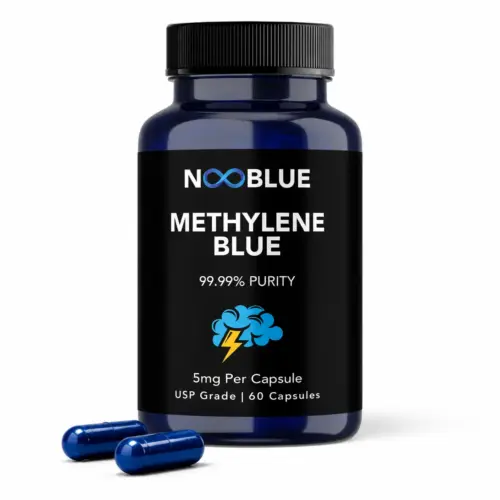
Each vegetable capsule contains 5 mg of USP grade methylene blue and 10 mg of vitamin C, with rice flour inside a cellulose shell and nothing else. There is no berberine, cacao or proprietary blend, which matters if you already take other supplements. A bottle of 60 costs $37.99, or $0.63 per capsule, and the label says one a day with food. The same CTLA ingredient report applies. On cost per milligram, Nutricel and Earth Harmony are cheaper, and we will not pretend otherwise. What the capsule gives you is the cheapest exact 5 mg dose in a capsule.
Who it suits: first timers and anyone who wants exactly 5 mg with a plain formula. Who should look elsewhere: people who want to go below 5 mg, and anyone who dislikes swallowing capsules.
3. NooBlue Methylene Blue Drops, 1% solution: best value per dose
The 50 mL bottle holds a 1% solution of USP grade methylene blue in distilled water. A 1% solution contains 10 mg per mL, and NooBlue’s calibrated dropper gives about 0.5 mg per drop, 5 mg per 10 drops and 10 mg per full dropper. At $29.99 for about 100 servings of 5 mg, a 5 mg dose costs $0.30, the cheapest way to take exactly 5 mg among the nine products here.
The trade is handling. Methylene blue is a strong dye, and a 1% solution will stain a counter, a shirt and briefly your tongue. You count drops into water or juice each time. In exchange you get control no capsule offers: you can start at 1 mg and work up in 0.5 mg steps while you learn how you respond. Our comparison of methylene blue capsules vs liquid covers the trade in detail.
Who it suits: people who want the lowest real cost per dose, or who want to start below 5 mg. Who should look elsewhere: anyone who wants a routine with nothing to measure.
4. Nutricel Blue Boost: lowest cost per milligram
Nutricel’s Blue Boost capsule contains 12 mg of USP grade methylene blue with 35 mg of vitamin C ester (ascorbyl palmitate) and 235 mg of organic cacao powder as the carrier. A bottle of 60 capsules costs $34.90 on the brand’s store, which is $0.58 a capsule and $0.24 per 5 mg, the lowest cost per milligram in this comparison.
Nutricel is also one of the more open brands on paperwork. Its product page names Eurofins as its testing laboratory, points to a page of lot specific certificates of analysis, states 99%+ purity for its methylene blue, and says the capsules are made in an NSF certified, GMP compliant facility. Its safety notice is unusually detailed and warns against combining methylene blue with serotonergic medicines. Nutricel also says its vitamin C ester helps form leucomethylene blue, a similar idea to the vitamin C in our gummy.
The catch is the dose. The smallest amount you can take is one 12 mg capsule, so the $0.24 figure describes what a milligram costs, not what a 5 mg dose costs. If you want 5 mg, this bottle cannot give it to you without opening a capsule and estimating. The cacao and vitamin C ester are reasonable choices but add variables if you are trying to judge the methylene blue alone. We compare the two brands in Nutricel vs NooBlue.
Who it suits: buyers who have settled on about 12 mg a day and want the cheapest milligram with published lab certificates. Who should look elsewhere: anyone targeting 5 mg.
5. Earth Harmony Ultimate Methylene Blue: highest stated purity figure
Earth Harmony’s capsule holds 12 mg of methylene blue, 60 to a bottle, for $39.95 on the brand’s store. That is $0.67 a capsule and $0.28 per 5 mg, the second lowest cost per milligram here after Nutricel. The brand states its methylene blue is “99.99% USP / pharmaceutical grade”, formaldehyde free, and made in a cGMP ASI certified facility, and says all products are tested by an outside lab. The product page did not show a certificate when we checked.
Two things to weigh. The smallest dose is again 12 mg, so it cannot give you 5 mg. The formula also adds vitamin C, organic berberine, chlorophyllin and chlorophyll. Berberine is an active compound in its own right, so check it against anything else you take. Earth Harmony also sells a 1% liquid if you want a smaller increment.
Who it suits: people taking 10 to 12 mg who want a high stated purity figure at a low cost per milligram. Who should look elsewhere: anyone who wants plain methylene blue without berberine, or a 5 mg dose.
6. Meraki Blu USP Grade Methylene Blue: a weaker liquid for small doses
Meraki Blu comes in a 30 mL bottle with a 1 mL dropper and contains 150 mg of methylene blue in total. That works out to 5 mg per mL, so one full dropper is 5 mg and single drops give you much less. The bottle is $35.00 on the brand’s store (two for $65, three for $89), which is $1.17 per 5 mg, nearly four times the cost of NooBlue’s drops for the same amount.
Two points to read carefully. First, the arithmetic: 150 mg in 30 mL is a 0.5% solution, though an Amazon listing for the same product calls it a “1% Formula”. Buy on the milligram figure. Second, the brand’s own product page says the product is “for research purposes only”, which is different from a product sold as a dietary supplement. The page says every batch is lab verified and tested for heavy metals and impurities. Our Meraki methylene blue review looks at the brand in more depth.
Who it suits: sensitive users who want a dilute liquid for very small doses. Who should look elsewhere: anyone who wants a product labeled as a supplement, or the lowest cost per dose.
7. LVLUP Health Mito Blue: best all in one mitochondrial stack
Mito Blue is not really competing on methylene blue price. Each capsule contains 10 mg of methylene blue with 400 mg of acetyl L-carnitine, 100 mg of ubiquinol (the reduced form of CoQ10) and 10 mg of PQQ. A bottle of 60 costs $89.99 on the brand’s store, or $80.99 on subscription, which is $1.50 a capsule and $0.75 per 5 mg of methylene blue. The brand says it uses pharmaceutical grade materials, GMP compliant manufacturing and outside lab testing of every batch.
The trade is control. You cannot change the methylene blue without changing the other three, and 10 mg per capsule is double the common 5 mg start. If you already take CoQ10 or carnitine, you will be doubling up. See LVLUP Mito Blue vs NooBlue for a side by side comparison and our LVLUP Health review for the full breakdown.
Who it suits: people who want four mitochondrial ingredients in one daily capsule. Who should look elsewhere: anyone who wants to set their methylene blue dose separately, or who already takes CoQ10.
8. Troscriptions Just Blue: a troche you can quarter
Just Blue is a troche that dissolves in the mouth. Each one contains 16 mg of methylene blue and is scored into quarters of about 4 mg, so a pack of four gives up to 16 doses. The pack costs $27.00 on the brand’s store, which is $2.11 per 5 mg, the highest cost per milligram in this comparison. Troscriptions says its products are tested by an outside lab, USP grade, physician formulated and made in a cGMP certified facility.
Expect color. The brand’s own FAQ says the troche will turn your mouth blue when used as intended, for 2 to 24 hours. A pack of four also goes quickly if you take a full troche a day. Our Troscriptions methylene blue review covers the range.
Who it suits: people who specifically want a troche and like splitting doses into quarters. Who should look elsewhere: anyone watching cost per dose or minding a blue mouth.
9. aSquared Nutrition Methylene Blue Capsules: a blend with cacao and ALA
aSquared’s formula gives 12 mg of pharmaceutical grade methylene blue per two capsule serving, so 6 mg per capsule, with 300 mg of cacao powder, alpha lipoic acid, MCT oil powder and vitamin C ester. The capsules are white rather than clear, which the brand says protects the ingredients from light. It says the product is tested by an outside lab in an ISO 17025 certified facility, and it suggests cycling five days on and two days off.
We could not work out a cost per 5 mg, because the product page does not state how many capsules are in the bottle. The store listed it at $34.99 when we checked, and the page also showed a $24.95 figure, so confirm the price at checkout. The honest read for you is the same as ours: if a listing will not say how many units you get, you cannot compare it on price, so ask before you order.
Who it suits: people who want methylene blue blended with cacao and ALA and are happy to ask the seller for a capsule count. Who should look elsewhere: anyone who wants plain methylene blue or a clear cost per dose.
“Supreme” and “Ultimate” are not brands
Many people search for “supreme methylene blue” or “ultimate methylene blue” as if each were one product. They are adjectives that unrelated sellers put in their listing titles, and the products behind them differ in format and dose.
| Name in the title | Seller | Format | Methylene blue per unit |
|---|---|---|---|
| Ultimate Methylene Blue Capsules | NooBlue | Capsule | 5 mg |
| Ultimate Methylene Blue (60 Capsules) | Earth Harmony | Capsule | 12 mg |
| Ultimate Methylene Blue 1% 30mL | TRUEHEALTHIC | Liquid | 10 mg per mL (a 1% solution) |
| Supreme Methylene Blue Pills (60 Capsules) | Earth Harmony, on Walmart | Capsule | 12 mg (the same 60 capsule product) |
The same word sits on a 5 mg capsule, a 12 mg capsule and a liquid. Neither word tells you the dose, the grade, the maker or whether a lab report exists. Our roundup of supreme methylene blue reviews goes through more of these listings.
Four quick checks tell you what a listing really is. Find the maker’s name, not the adjective. Read the milligrams per capsule, or the milligrams per mL and the bottle volume, because a percentage alone is not a dose. Check the count or volume against the price. Then look for the lab report before you pay. If the identity of a blue liquid is unclear, our guides to methylene blue vs crystal violet and real methylene blue vs fake show what to look for.
Methylene blue capsules vs liquid: which should you choose?
Capsules and gummies give you a fixed dose with no mess. Liquid gives you finer control and, in NooBlue’s range, the lowest cost per dose. The choice comes down to the dose you want and how much handling you will put up with.
- Choose a 5 mg capsule if you want an exact starting dose with no measuring and no taste. NooBlue’s capsule is the only 5 mg unit here.
- Choose a gummy if you have settled on about 10 mg a day and want the easiest routine, without the blue mouth that drops can leave.
- Choose a 1% liquid if you want to start below 5 mg, adjust in small steps or pay the least per dose. Expect some staining.
- Choose a 12 mg capsule only if 12 mg is the dose you want. It is cheap per milligram but cannot give you less.
The arithmetic that makes liquids comparable is simple. A 1% solution holds 10 mg per mL, so a 50 mL bottle holds 500 mg. Divide the price by the total milligrams and multiply by your dose. We work through more examples in whether a capsule beats a liquid solution, and in our rankings of the best methylene blue capsules, the best methylene blue drops and the best methylene blue gummies.
How to check a methylene blue COA before you buy
A certificate of analysis (COA) is only useful if you read it. Four details matter.
- Lot number. It should match, or at least be traceable to, the product you are buying. An undated report with no lot number is a marketing image, not a test result.
- Scope. Check whether the report tests the raw methylene blue or the finished product. Both are useful, and they answer different questions.
- Identity and purity. Look for an identity test such as HPLC and, where given, a measured assay figure. A range printed as a specification is not a measurement.
- Heavy metals and the lab. Lead, arsenic, cadmium and mercury should each carry a result. The lab should be named and should not be the seller itself.
Four red flags should stop a purchase. No stated grade at all. No report, and no way to get one. A percentage that fails the arithmetic, such as a “1%” bottle whose milligrams and volume give a different figure. And a price far below every documented product here, which usually means something has been left out. Our guide to reading a methylene blue certificate of analysis walks through a real report line by line.
What the research says about methylene blue
Interest in methylene blue comes from how it behaves in mitochondria, the parts of cells that make energy. It can accept electrons and pass them on, cycling between a blue oxidized form and a colorless reduced form. A review in Progress in Neurobiology describes low doses acting as an electron cycler in the mitochondrial electron transport chain, and a hormetic dose response with opposite effects at low and high doses (Rojas et al., 2012).
The best known human study is a randomized, placebo controlled trial in which 26 healthy adults had brain scans before and one hour after a single oral dose. Methylene blue increased activity during attention and short term memory tasks and was linked to a 7% increase in correct answers during memory retrieval (Rodriguez et al., Radiology, 2016). Note the dose: 280 mg, about 4 mg per kilogram (full text). That is far above any supplement serving in this comparison, and we are not aware of any trial that has tested daily supplement doses of 5 to 16 mg for memory or focus.
In human fibroblasts grown in the lab, very low concentrations of methylene blue raised mitochondrial complex IV activity by 30% and oxygen use by 37 to 70% (Atamna et al., FASEB Journal, 2008). Cell results like these show a mechanism. They do not show what a supplement does in a person. Our summary of whether methylene blue works and our page of methylene blue research statistics go further.
Is methylene blue safe to take as a supplement?
For most healthy adults at supplement doses, the effect you notice first is cosmetic: methylene blue is a dye, so urine can turn blue or green for a while after a dose. The serious risk is an interaction. Methylene blue is a potent, reversible inhibitor of MAO-A, the enzyme that breaks down serotonin (Ramsay et al., British Journal of Pharmacology, 2007). A systematic review found 26 patients who developed acute confusion after methylene blue infusions, 24 of them taking a serotonin reuptake inhibitor (Ng and Cameron, Psychosomatics, 2010). Those were hospital doses given into a vein, but the mechanism does not depend on the format.
Do not take methylene blue if you:
- take an SSRI, SNRI, MAOI or other serotonergic medicine, or an opioid such as tramadol. The prescribing information for the injectable form carries its strongest warning for these combinations (DailyMed).
- have G6PD deficiency. Methylene blue can cause hemolytic anemia in people with this enzyme deficiency. Read our guide to methylene blue and G6PD deficiency.
- are pregnant or breastfeeding, or under 18 unless a doctor has advised it.
If you take any prescription medicine, talk to your doctor or pharmacist first. Our guides to what not to take with methylene blue, who should not take methylene blue and methylene blue side effects cover the full lists.
How we compared these methylene blue supplements
We read each product’s own page on September 25, 2026, using the brand’s store where it sells direct. Prices, pack sizes, doses and claims come from those pages, and every cost per 5 mg is our own arithmetic from the listed price and total milligrams. We did not buy competitor products or send them to a lab, and we did not use review counts, which are easy to inflate and say nothing about grade.
NooBlue makes the products ranked #1, #2 and #3, and they are ranked first because they are the products we make and recommend. Each of their sections says who should buy something else, and the competitor labels, such as Nutricel’s lowest cost per milligram and Earth Harmony’s highest stated purity figure, are true on the numbers.
Some brands that appear in search results for this query are not in this ranking, including Healthletic, Biopharm and Etta Vita. We limited the table to nine products and did not re-verify those three for this update. Our Biopharm methylene blue review covers one of them, and our list of top methylene blue brands looks at the wider market.
Frequently asked questions about the best methylene blue supplements
What is the best methylene blue supplement?
NooBlue Methylene Blue Gummies are our pick for most people: 10 mg of USP grade methylene blue with 25 mg of vitamin C, no sugar, a published lab report on the methylene blue ingredient, and $0.42 per 5 mg. NooBlue makes them. For an exact 5 mg dose, NooBlue’s capsules are the only 5 mg unit compared, at $0.63. For the lowest cost per milligram at a 12 mg dose, Nutricel Blue Boost costs $0.24 per 5 mg.
What is the best brand of methylene blue?
We rank NooBlue first, and we make it, so weigh that. The reasons we can show you: USP grade methylene blue, a lab report on the ingredient published on the product page, three formats including the only 5 mg capsule here, and a clear cost per dose. Among the other brands, Nutricel publishes lot specific certificates and has the lowest cost per milligram, and Earth Harmony states the highest purity figure. Our list of top methylene blue brands compares more companies.
Who makes the best methylene blue?
We know of no published head to head lab comparison of these brands, so “best” comes down to what you can check. NooBlue, our own brand, publishes a CTLA report on its methylene blue ingredient and sells the only 5 mg capsule in this comparison. Nutricel names Eurofins as its lab and publishes lot certificates. Look for USP grade and a report you can read, whoever the maker is.
What is the highest quality methylene blue?
Quality for methylene blue means the grade and the proof behind it. NooBlue uses USP grade methylene blue with a published ingredient report covering identity and heavy metals. Look for USP grade, an identity test and heavy metal results from a named outside lab. A purity percentage on the label is only as good as the report behind it, and Earth Harmony’s stated 99.99% is the highest figure printed by any brand here.
What is the best methylene blue on the market for a beginner?
For a beginner, NooBlue’s 5 mg capsules are the simplest start, because they give an exact low dose with nothing to measure. If you want to start even lower, NooBlue’s 1% drops give 0.5 mg per drop. Stay at a low dose until you know how you respond, and check your medicines first.
What not to mix with methylene blue?
Do not mix methylene blue with SSRIs, SNRIs, MAOIs, tricyclic medicines with serotonin activity, or opioids such as tramadol, and avoid serotonergic supplements such as 5-HTP, L-tryptophan and St. John’s Wort. Methylene blue blocks MAO-A, the enzyme that breaks down serotonin, and the combination can cause serotonin syndrome. Our methylene blue interactions reference lists more medicines by class. Ask your doctor or pharmacist before combining it with any prescription medicine.
What brand of methylene blue do hospitals use?
Hospitals do not use supplement brands. They use prescription methylene blue injection, given into a vein by clinicians and dosed by body weight. In the US the branded version is ProvayBlue, and a generic injection is also sold. It is a different product, route and dose from any oral supplement, and no supplement is a substitute for it. Our explainer on whether you need a prescription for methylene blue covers what is sold over the counter.
Why don’t doctors recommend methylene blue?
Many doctors are cautious about methylene blue as a supplement because the human evidence for everyday use is thin, it interacts dangerously with common medicines that raise serotonin, and it is unsafe for people with G6PD deficiency. The best known human trial gave one 280 mg dose and measured brain scans, not long term outcomes. Talk to your doctor before you start, especially if you take any medicine.
What is the best place to buy methylene blue?
Buy direct from a brand that publishes a lab report, so you get its returns policy and a direct contact if something is wrong. NooBlue ships worldwide from nooblue.com, free on orders of $100 or more, with 30-day returns. Stock in pharmacies and health food stores varies, as our guide to finding methylene blue in stores and pharmacies explains. On marketplaces, check the maker and the lab report before you order.
Are methylene blue capsules or liquid better?
Neither is better for everyone. Capsules give a fixed, clean dose with no staining, and NooBlue’s 5 mg capsule is the only exact 5 mg unit here. Liquid is cheaper per dose and lets you adjust in 0.5 mg steps, but it stains and needs measuring. Choose by the dose you want and how much handling you will accept.
How much methylene blue is in 1 mL of a 1% solution?
A 1% solution contains 10 mg of methylene blue per mL, so 1 mL is 10 mg and 0.5 mL is 5 mg. A 50 mL bottle of 1% solution holds 500 mg in total. Always check the milligrams and volume on the label, because some bottles sold as “1%” contain less. Our guide to methylene blue cost uses this arithmetic to compare prices.
Is it safe to take methylene blue every day?
Many products, including ours, are labeled for one serving a day, but long term daily use at supplement doses has not been studied in trials. It is not suitable for anyone taking serotonergic medicines, anyone with G6PD deficiency, or anyone pregnant or breastfeeding. Start low, keep the dose steady rather than raising it, and check with your doctor before daily use, especially if you take any medicine.
What dose of methylene blue should I take?
Start at the low end. A 5 mg capsule or 10 drops of a 1% solution is a common first dose, and there is no evidence that more is better at supplement levels. Hold one dose for a couple of weeks before changing it, and follow the label on the product you buy. Our guide to methylene blue dosage per day covers how people work up.
The verdict
For most people, buy NooBlue Methylene Blue Gummies: 10 mg of USP grade methylene blue with vitamin C, no sugar, a published ingredient report, the easiest routine of any format, and $0.42 per 5 mg. If you want an exact 5 mg dose, choose the NooBlue capsules at $0.63 per dose. If you want the cheapest 5 mg dose and do not mind measuring, the NooBlue 1% drops cost $0.30 per 5 mg and adjust in 0.5 mg steps.
If your dose is 12 mg, compare Nutricel Blue Boost, the lowest cost per milligram at $0.24 per 5 mg with published lab certificates, against Earth Harmony, which states the highest purity figure at $0.28. The wider lesson from putting every product on one scale: the sticker price tells you little, and the number worth comparing is the cost of the dose you will actually take.
More methylene blue buying guides
- Shop all three NooBlue formats
- Methylene blue buying guide for UK readers
- Methylene blue nootropics compared
- Over the counter methylene blue supplements compared
- Methylene blue powder: what to know before you buy
Sources
- Rojas JC, Bruchey AK, Gonzalez-Lima F. Neurometabolic mechanisms for memory enhancement and neuroprotection of methylene blue. Prog Neurobiol. 2012;96(1):32-45. PubMed 22067440
- Rodriguez P, Zhou W, Barrett DW, et al. Multimodal randomized functional MR imaging of the effects of methylene blue in the human brain. Radiology. 2016;281(2):516-526. PubMed 27351678, full text
- Atamna H, Nguyen A, Schultz C, et al. Methylene blue delays cellular senescence and enhances key mitochondrial biochemical pathways. FASEB J. 2008;22(3):703-712. PubMed 17928358
- Ramsay RR, Dunford C, Gillman PK. Methylene blue and serotonin toxicity: inhibition of monoamine oxidase A (MAO A) confirms a theoretical prediction. Br J Pharmacol. 2007;152(6):946-951. PubMed 17721552
- Ng BK, Cameron AJ. The role of methylene blue in serotonin syndrome: a systematic review. Psychosomatics. 2010;51(3):194-200. PubMed 20484716
- PROVAYBLUE (methylene blue) injection, prescribing information. DailyMed, US National Library of Medicine
- Product pages read on September 25, 2026: NooBlue gummies, NooBlue capsules, NooBlue drops, Nutricel Blue Boost, Nutricel certificates, Earth Harmony Ultimate Methylene Blue, Meraki Blu, Meraki Blu (Amazon), LVLUP Mito Blue, Troscriptions Just Blue, aSquared Nutrition capsules, TRUEHEALTHIC Ultimate Methylene Blue 1%