Short answer: is the NooBlue methylene blue capsule better than liquid solutions? For most people who take methylene blue once a day, yes. Each capsule holds a printed 5 mg, you swallow it with food, and there is nothing to count, taste or wipe off your tongue. Liquid solutions are better at two things: fine control in small steps, and a lower cost per serving. Read on to find out which of those matters for you, what “a drop” actually contains across brands, and what the research does and doesn’t say about speed.
Key takeaways
- A capsule and a liquid contain the same compound. No human study has compared the two formats head to head.
- NooBlue capsules give a fixed 5 mg with 10 mg of vitamin C, one a day with food, 60 per bottle.
- A drop is not a standard unit. Across the liquids we checked, one drop ranged from about 0.25 mg to about 2.5 mg, depending on the brand’s concentration.
- NooBlue drops cost less per 5 mg serving ($0.30 against $0.63) and move in 0.5 mg steps, but they can stain your mouth and need counting.
- Whatever the format, the safety rules are the same: never with serotonergic medicines, never with G6PD deficiency, not in pregnancy or breastfeeding, and not under 18.
Table of contents
- 1. NooBlue capsules vs liquid solutions at a glance
- 2. What is in a NooBlue capsule
- 3. What “liquid solution” means depends on the bottle
- 4. Dose accuracy: printed milligrams vs counted drops
- 5. Does liquid work faster than a capsule?
- 6. Taste, staining and daily routine
- 7. Cost per serving and per bottle
- 8. Storage and travel
- 9. When liquid is the better choice
- 10. Where the gummies fit
- 11. How to tell if your methylene blue is real
- 12. Who should not take methylene blue
- 13. Frequently asked questions
- 13.1. Is the NooBlue methylene blue capsule better than liquid solutions?
- 13.2. What is the most effective form of methylene blue?
- 13.3. What is the best brand of methylene blue to purchase?
- 13.4. How do I tell if my methylene blue is real?
- 13.5. Is it bad to take methylene blue every day?
- 13.6. Can I switch between NooBlue drops and capsules?
- 13.7. Does liquid methylene blue work faster than capsules?
- 13.8. Do methylene blue capsules stain your mouth?
- 14. Sources
NooBlue capsules vs liquid solutions at a glance
NooBlue makes all three formats discussed here: the capsules, the 1% drops and the gummies. The capsule is our pick for most daily users, and every figure for other brands comes from their own product pages. We have not lab-tested other brands.
| What you care about | NooBlue Capsules | Liquid (NooBlue Drops 1%) |
|---|---|---|
| Dose per serving | 5 mg methylene blue plus 10 mg vitamin C in every capsule | 0.5 mg per drop, 10 drops = 5 mg, full dropper = 10 mg |
| How you take it | One capsule daily with food | Measure with the dropper, mix into water or juice |
| Adjusting the amount | Fixed. Do not exceed one a day | Adjustable in 0.5 mg steps |
| Taste and staining | Swallowed whole, no taste, nothing touches your tongue | Can stain mouth, tongue, fingers and counters |
| Bottle | 60 capsules, a 60-day supply | 50 mL, about 100 servings of 5 mg |
| Price (as of Sep 2026) | $37.99, about $0.63 a day | $29.99, about $0.30 per 5 mg serving |
The rest of this guide goes through each row, then covers the gummies, how to tell whether a methylene blue product is what it says, and who should not take it at all. For a brand-neutral version of the same question, see our comparison of methylene blue capsules vs liquid.
What is in a NooBlue capsule
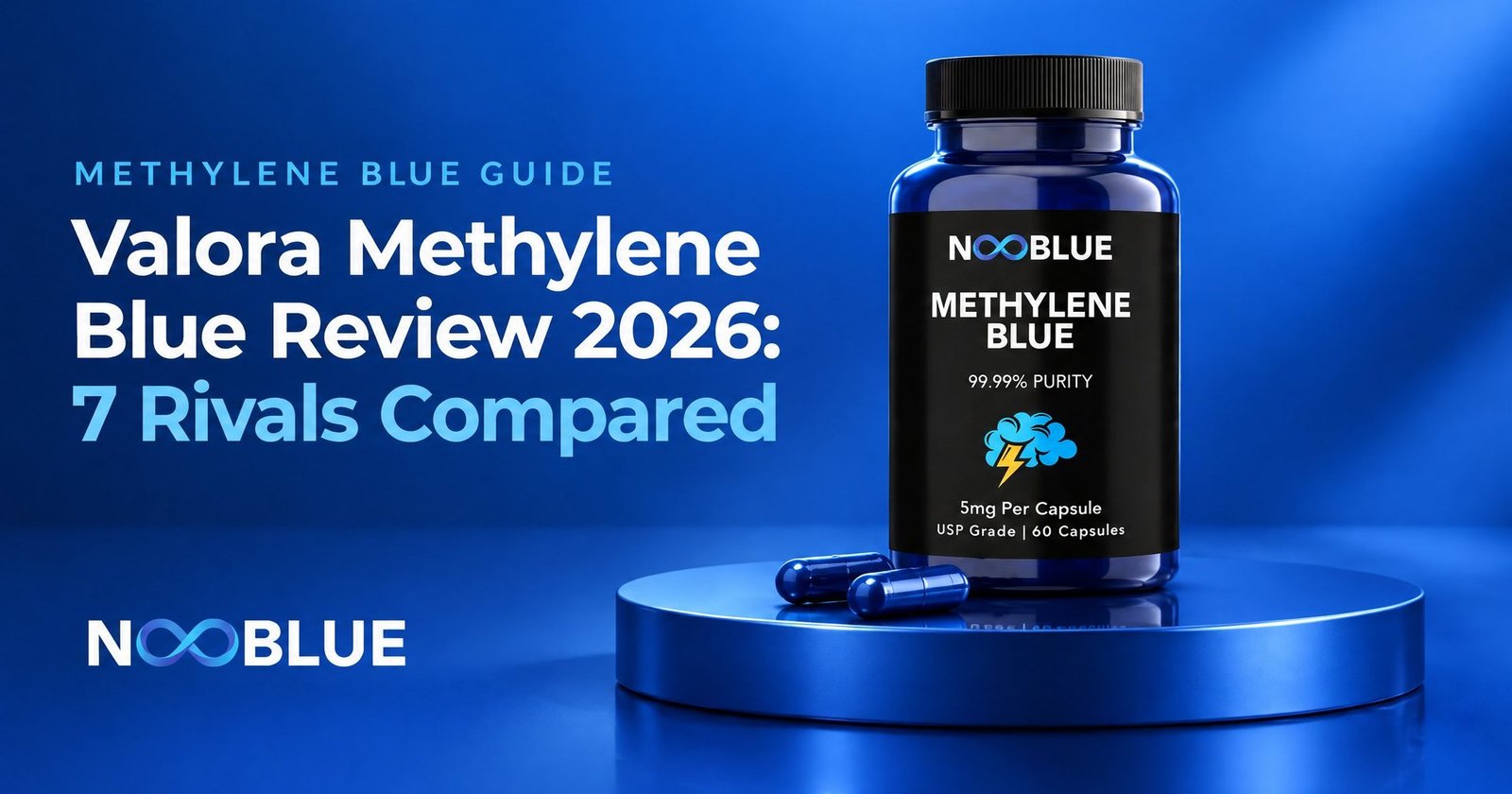
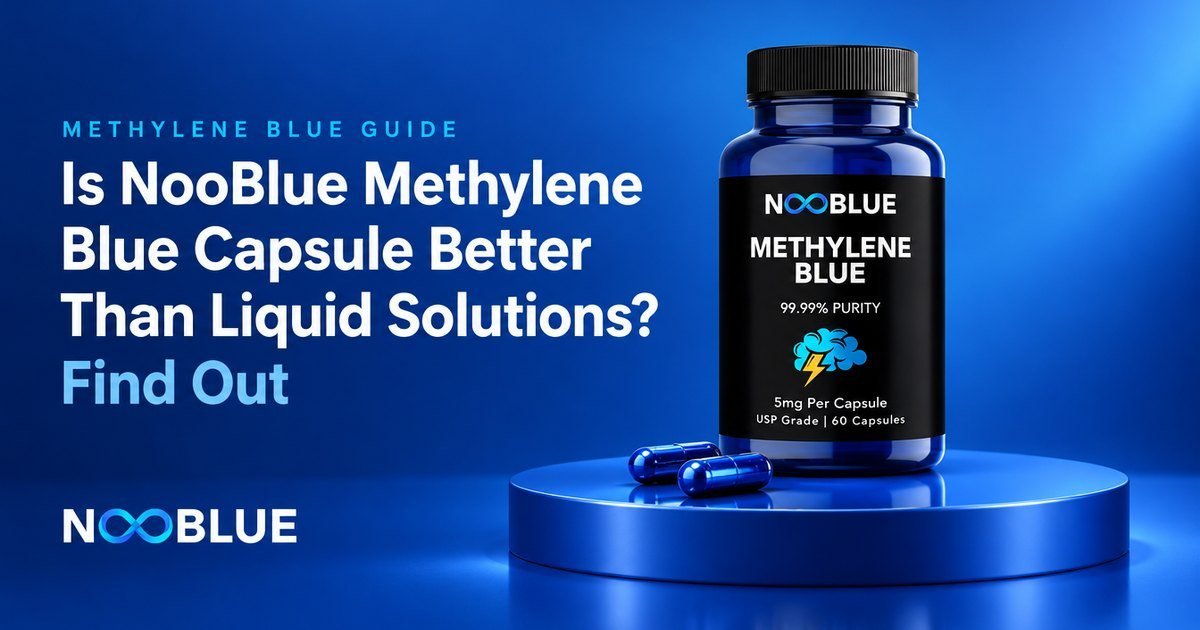
The label is short. Each capsule contains methylene blue USP 5 mg and vitamin C (as ascorbic acid) 10 mg, with rice flour inside a cellulose capsule. The serving is one capsule, taken daily with food, and the bottle holds 60 servings. The label also says not to exceed the suggested serving, so a NooBlue capsule routine is one capsule a day, not two.
The methylene blue ingredient has a certificate you can read on the NooBlue capsules page. Contract Testing Laboratories of America (CTLA) analyzed a named lot of the raw ingredient and reported an HPLC identity result of “Conforms” plus individual results for arsenic, cadmium, mercury and lead. That is ingredient-level evidence. It does not give a purity percentage, and it is not a test of every finished bottle. We would rather you know the scope than read more into it.
If you are comparing capsule brands rather than formats, our roundup of the best methylene blue capsules lays out doses, prices and testing documents side by side, and pharmaceutical grade methylene blue capsules explains what the grade on a capsule label means.
What “liquid solution” means depends on the bottle
A capsule label tells you the milligrams in each capsule. A liquid label tells you a concentration, and the dose depends on how much liquid you measure. Concentrations on the market vary a lot, so “take 10 drops” means very different things from one bottle to the next. Here is what we found on the product pages of several liquids in September 2026.
| Liquid | Strength | Methylene blue per drop or mL | Bottle and price (as of Sep 2026) |
|---|---|---|---|
| NooBlue Drops | 1% | 0.5 mg per drop, 10 mg per full dropper | 50 mL, $29.99 |
| Meraki Blu | 150 mg in 30 mL (0.5%) | About 0.25 mg per drop, per the brand’s FAQ | 30 mL, $35. Description says “For research purposes only” |
| Biopharm 1% USP | 1% | 0.5 mg per drop | 50 mL glass with dropper, $25.97 |
| Nutricel Blue Liquid | 1.00% | About 0.5 mg per drop, graduated dropper | 4 fl oz (118 mL), $30.00. Ships to US addresses only |
| Chemist Labs 2% Liquid | 2% | 10 mg per 0.5 mL | 4 oz, $49.99 |
| Nootlyn Drops 5% (Amazon) | 5% | About 2.5 mg per drop, no printed marks on the dropper | 120 mL. No featured offer when we checked |
That is a tenfold spread per drop, from about 0.25 mg to about 2.5 mg. Someone who switches from a 0.5% bottle to a 5% bottle and keeps the same drop count would take ten times as much. Chemist Labs also sells a 1% liquid, measured by milliliter (1 mL equals 10 mg). None of this makes liquids bad. It means the label on a liquid needs more reading than the label on a capsule, and the dose is only as accurate as your measuring.
Some liquids sold online are not supplements at all. Aquarium methylene blue, for example Kordon’s 2.303% solution for fish tanks, states that it is not intended for human consumption. Our guides to aquarium grade methylene blue and lab grade vs pharmaceutical grade methylene blue explain the differences. Our methylene blue drops comparison covers liquid brands in more depth.
Dose accuracy: printed milligrams vs counted drops
A capsule’s dose is set when it is filled. You can’t miscount it, tilt it or lose part of it on the rim of a glass. That is the main reason we suggest capsules for anyone who wants the same amount every day without thinking about it.
Drops depend on the person holding the dropper. Nutricel, which sells a 1% liquid, notes on its own product page that drop volume varies by approximately 10% with viscosity and dropper angle, and recommends its graduated dropper for precise measurement. That is an honest note, and it applies to every liquid. Counting drops is still accurate enough for most people, especially with a marked dropper, but it is one more step that can go wrong on a busy morning.
Liquids win when you want an amount a capsule can’t give. NooBlue drops move in 0.5 mg steps, so you can start below 5 mg or change the amount in small increments. A capsule is 5 mg or nothing. For step-by-step drop counts, see how to take methylene blue drops, and for the numbers behind daily amounts, how many mg of methylene blue per day.
Does liquid work faster than a capsule?
You’ll see claims that drops “kick in within minutes” or that holding them under the tongue skips the liver. We could not find a human study that compared liquid methylene blue with capsules, or one that measured sublingual absorption. Those claims are guesses.
What has been measured is how well swallowed methylene blue is absorbed. Walter-Sack and colleagues (European Journal of Clinical Pharmacology, 2009) gave 16 healthy adults 500 mg as an aqueous oral solution and, a week apart, 50 mg intravenously. The absolute bioavailability of the oral solution was 72.3% (plus or minus 23.9%), which is high for a swallowed compound. There was no capsule arm, and the dose was a hundred times a NooBlue capsule, so the study tells you oral methylene blue is well absorbed. It does not tell you which format is faster.
From first principles, a liquid is already dissolved, while a capsule has to open first, so a liquid may start absorbing a little sooner. Whether that is minutes or more hasn’t been measured. For a once-a-day supplement taken with a meal, taking it the same way every day matters more than a small difference in timing. Our article on methylene blue bioavailability in liquid vs capsules reviews every human study we could find.
Taste, staining and daily routine
This is where the two formats feel most different. Methylene blue is a dye. Chemist Labs’ FAQ describes its liquid as having a naturally bitter, metallic taste, and suggests mixing it into water or juice, which is also how NooBlue drops are meant to be taken. Meraki’s FAQ says temporary blue staining of the mouth is normal. Drops can stain your mouth and tongue, and a spill marks fingers, counters and fabric.
A capsule is swallowed whole, so none of that happens. You taste nothing and your tongue stays its normal color. That makes capsules easier at work, while traveling, or anywhere you don’t want to explain a blue smile. Our guide to whether methylene blue stains teeth covers what to do if you use drops.
One effect doesn’t depend on format. Part of each dose leaves the body in urine, and all three NooBlue product labels say it can turn urine blue or green. That is expected. More in methylene blue and urine color.
Cost per serving and per bottle
Liquid costs less. A bottle of NooBlue drops holds 50 mL at 10 mg per mL, which is 500 mg of methylene blue, or about 100 servings of 5 mg for $29.99 ($0.30 each). A bottle of NooBlue capsules holds 60 capsules of 5 mg, which is 300 mg, for $37.99 ($0.63 a capsule). Per 5 mg, drops cost about half as much.
You pay the capsule premium for convenience: no measuring, no taste, no staining, nothing to mix. For many people that is worth the extra $0.33 a day. If cost per milligram is your first priority, drops win, and some larger liquid bottles from other brands, such as Nutricel’s 118 mL 1% bottle and Chemist Labs’ 4 oz 2% bottle, cost less per milligram than ours.
Both NooBlue formats get the site’s own multi-bottle pricing: 10% off two bottles, 15% off three and 20% off five. Shipping is free worldwide on orders of $100 or more, and you can see the full range on the NooBlue shop page.
Storage and travel
Capsules are the easier format to carry. There is no dropper to rinse, no liquid to leak in a bag, and no glass bottle to protect. Keep the bottle tightly closed in a cool, dry place.
Liquids need a little more care. The NooBlue drops page says to keep the bottle tightly closed, away from heat and sunlight, and to use the precision dropper to measure. If you use drops, keep the dropper clean and the cap on between uses. Our methylene blue shelf life guide covers how long an opened bottle lasts.
When liquid is the better choice
We recommend the capsules for most daily users, but the drops are the better fit in four situations:
- You want to start below 5 mg. Drops let you begin with a smaller amount and change it 0.5 mg at a time.
- You want the lowest cost per serving. NooBlue drops are $0.30 per 5 mg against $0.63 for a capsule.
- You don’t like swallowing capsules. Drops mix into water or juice. The gummies, below, are another option.
- You already measure carefully. If you are happy with a graduated dropper and don’t mind the color, the extra control costs you little.
If you choose liquid, choose it knowingly: read the concentration, measure the same way each time, and check the dose in milligrams whenever you change brands. For a side-by-side of the two NooBlue formats, see 1% methylene blue solution vs 5 mg capsules.
Where the gummies fit
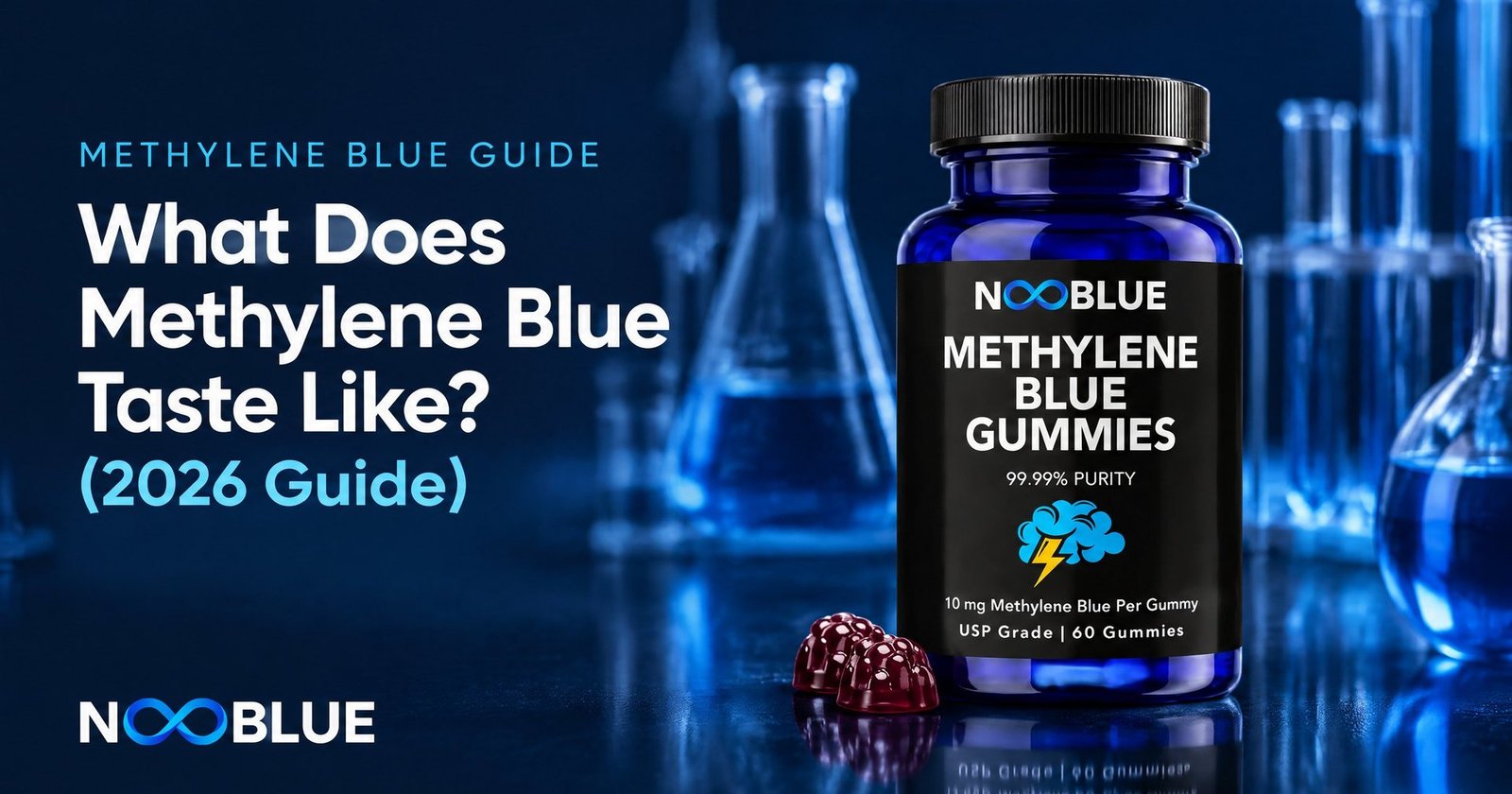
This article started as a two-way question, but NooBlue now sells a third format. NooBlue Methylene Blue Gummies contain 10 mg of methylene blue and 25 mg of vitamin C per gummy in a Wild Blueberry chew with zero sugar, made with pectin and stevia. The label serving is one gummy daily, 60 per bottle, $49.99 ($0.83 a day).
Gummies solve the two biggest complaints about drops. There is nothing to measure, and they don’t leave the blue mouth or tongue that drops can. They also suit people who find capsules hard to swallow. Note that a gummy is a 10 mg serving, twice the amount in a capsule. Vitamin C can shift methylene blue toward its colorless form, but the gummy page is clear that the ingredient report doesn’t measure that balance in the finished gummy, so we don’t claim the gummies absorb better. Compare them directly in methylene blue gummies vs capsules and methylene blue gummies vs liquid. If you are weighing loose powder too, methylene blue powder vs liquid covers that.
How to tell if your methylene blue is real
Whichever format you buy, a few checks catch most problems:
- Check that it is sold for people. Aquarium and lab products state their use, and some liquids sold online say “for research purposes only”. A product meant for you gives a serving, directions and safety warnings.
- Look for USP grade on the label. USP refers to the pharmacopeia standard for methylene blue as an ingredient. Lab stains and industrial dyes are made to different specifications.
- Find the milligrams per serving. A capsule should state mg per capsule. A liquid should state its concentration and mg per drop or per mL. If you can’t work out your dose, don’t take it.
- Read the certificate, including its scope. Ask what was tested (identity, heavy metals, potency, microbes), on what (raw ingredient or finished product) and for which lot. Our own certificate covers the raw ingredient, as described above, and we say so.
- Check the warnings. A responsible label names serotonergic medicines, G6PD deficiency and pregnancy. Missing warnings are a red flag.
For hands-on checks, see how to test if methylene blue is real and real methylene blue vs fake. For what purity claims do and don’t prove, read purest methylene blue.
Who should not take methylene blue
Safety first
- Do not take methylene blue with SSRIs, SNRIs, MAOIs or other serotonergic medicines. The combination carries a risk of serotonin syndrome.
- Do not take it if you have G6PD deficiency.
- Do not take it if you are pregnant or breastfeeding.
- Not for anyone under 18.
- It can turn urine blue or green. That is expected.
- Talk to your doctor before use if you take any prescription medicine or have a kidney or liver condition.
These rules are identical for capsules, drops and gummies, because the risk comes from the compound, not the format. Ramsay, Dunford and Gillman (British Journal of Pharmacology, 2007) showed that methylene blue is a potent reversible inhibitor of MAO-A, the enzyme that breaks down serotonin, which explains the interaction with serotonergic medicines. Our guide to who should not take methylene blue goes through each point.
Frequently asked questions
Is the NooBlue methylene blue capsule better than liquid solutions?
For most people taking methylene blue once a day, yes. The capsule gives a fixed 5 mg with no measuring, no taste and no mouth staining. Liquid is better if you want to start below 5 mg, adjust in 0.5 mg steps, or pay less per serving.
What is the most effective form of methylene blue?
No study has shown that one oral form works better than another. Capsules, drops and gummies deliver the same compound, and swallowed methylene blue is well absorbed. The most effective form in practice is the one you can take at the right dose, the same way, every day.
What is the best brand of methylene blue to purchase?
Our pick is NooBlue, and we make it: USP-grade methylene blue in capsules, 1% drops and gummies, a readable ingredient certificate with its scope stated, and the full safety warnings on every label. If the lowest cost per milligram is all you care about, larger liquid bottles such as Nutricel’s 118 mL 1% and Chemist Labs’ 4 oz 2% cost less per milligram.
How do I tell if my methylene blue is real?
Check that it is sold for human use with a serving and directions, that the label says USP grade and states the milligrams per serving, that a certificate names what was tested and on which lot, and that the warnings cover serotonergic medicines, G6PD deficiency and pregnancy. Aquarium products and liquids labeled for research use fail the first check.
Is it bad to take methylene blue every day?
The NooBlue label serving is one capsule a day, and daily use at that serving is how the product is meant to be taken. Long-term studies at supplement doses are limited, so stay at the label serving, follow the safety rules, and talk to your doctor if you take any prescription medicine. More in is methylene blue safe to take daily.
Can I switch between NooBlue drops and capsules?
Yes, if you match the milligrams rather than the count. NooBlue drops give 0.5 mg per drop, so 10 drops equal one 5 mg capsule. If you switch to another brand’s liquid, check its concentration first, because a drop can hold a very different amount.
Does liquid methylene blue work faster than capsules?
Nobody has tested it in people. A liquid may start absorbing slightly sooner because it is already dissolved, but no study has measured the difference. For a once-a-day routine, consistency matters more than onset speed.
Do methylene blue capsules stain your mouth?
No. Capsules are swallowed whole, so they don’t touch your tongue. Drops can stain your mouth and tongue, and NooBlue gummies don’t leave a blue mouth. Urine can turn blue or green with any format.
Sources
- Walter-Sack I, Rengelshausen J, Oberwittler H, et al. High absolute bioavailability of methylene blue given as an aqueous oral formulation. Eur J Clin Pharmacol. 2009;65(2):179-189. PubMed 18810398
- Ramsay RR, Dunford C, Gillman PK. Methylene blue and serotonin toxicity: inhibition of monoamine oxidase A (MAO A) confirms a theoretical prediction. Br J Pharmacol. 2007;152(6):946-951. PubMed 17721552
- NooBlue product labels: capsules, drops and gummies.
- Competitor details from each brand’s product page, September 2026: Meraki Blu, Biopharm, Nutricel, Chemist Labs (1% liquid FAQ), Nootlyn (Amazon listing) and Kordon (aquarium product page).