Quick answer
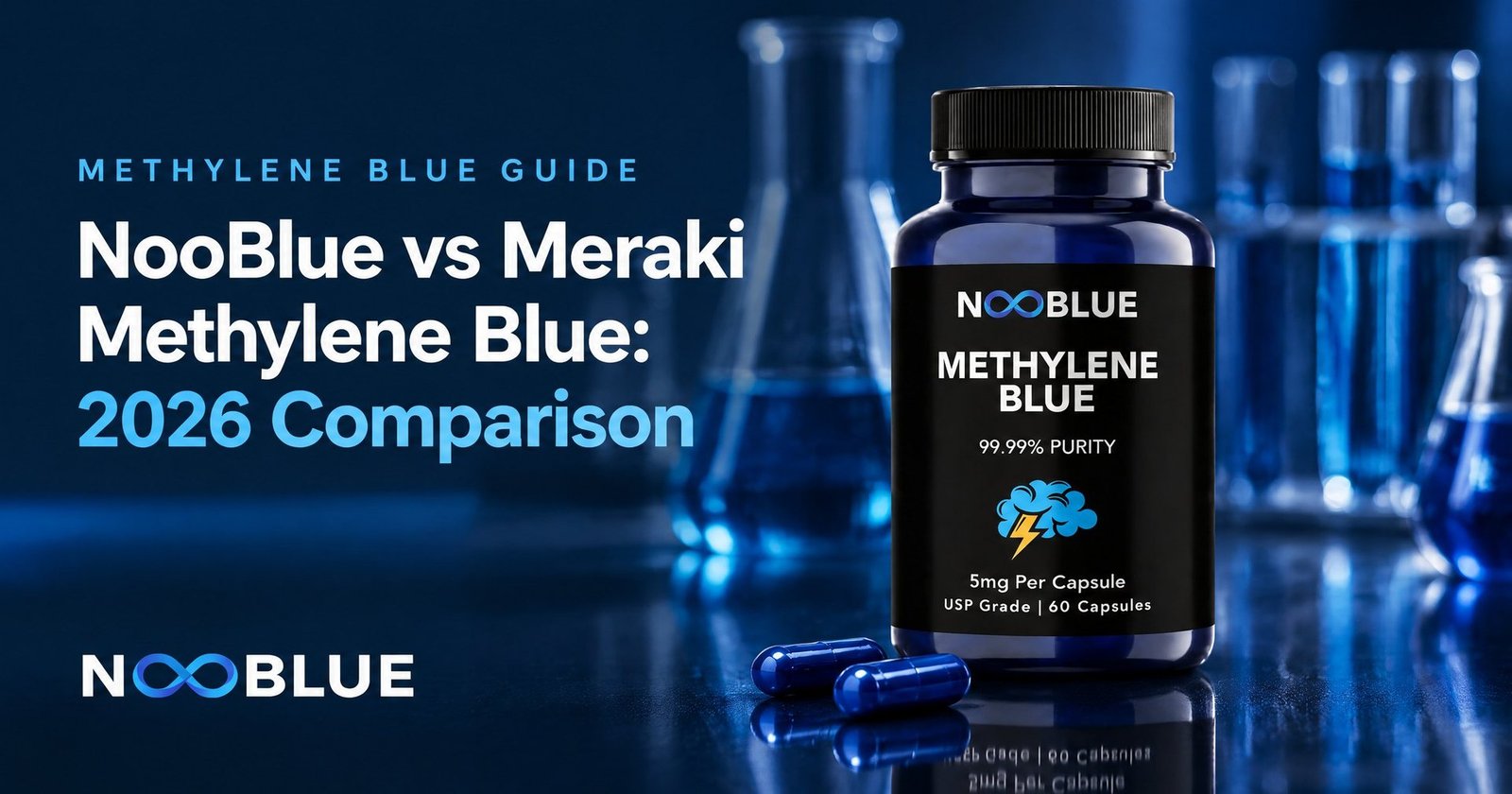
For most buyers, NooBlue is the better choice. Its 1% drops give 0.5 mg per drop and cost $0.30 per 5 mg, against $1.17 per 5 mg for a single bottle of Meraki Blu, and NooBlue also sells a 5 mg capsule and a 10 mg gummy for people who would rather not count drops. Meraki Blu is a weaker solution, 150 mg in 30 mL, or about 0.25 mg per drop. It suits people who want very small steps and do not mind paying more per milligram.
Safety first: do not take methylene blue from either brand if you take serotonergic medicines such as SSRIs, SNRIs or MAOIs, if you have G6PD deficiency, or if you are pregnant or breastfeeding.
NooBlue makes the products we compare here against Meraki. Meraki facts come from Meraki’s own product page and its Amazon listing, read on September 25, 2026.
Written by the NooBlue editorial team. We sell methylene blue, so this is not a neutral review. We have kept every Meraki figure to what Meraki publishes, and the sources are linked at the end.
If you are reading Meraki methylene blue reviews, you have probably seen Meraki Blu on Amazon, Instagram or TikTok and want to know how it compares with the alternatives. This page answers that for one alternative in detail: NooBlue, the brand that publishes this site. We compare the two on strength, dosing, price per milligram, lab paperwork, what buyers report, and safety. We also cover the Blissta vs Meraki question, because it comes up in the same searches.
The short version is that the two brands are further apart than they look. Both sell USP grade methylene blue in a 1 mL dropper format, but Meraki Blu is half the strength of a standard 1% solution, and that one difference changes how many drops you count and what each dose costs.
Table of contents
- 1. NooBlue vs Meraki at a glance
- 2. Meraki methylene blue reviews: what buyers report
- 3. Strength and dosing: 0.5% vs 1%
- 4. Price and value
- 5. Lab paperwork: what each brand shows you
- 6. Blissta vs Meraki
- 7. Does Meraki Blu really work?
- 8. Is there a downside to methylene blue?
- 9. Which should you choose?
- 10. NooBlue vs Meraki: frequently asked questions
- 10.1. What is the best brand for methylene blue?
- 10.2. Is NooBlue or Meraki better for methylene blue?
- 10.3. Is Meraki Medicinal methylene blue legit?
- 10.4. Does Meraki methylene blue come in capsules?
- 10.5. How many drops of Meraki Blu make 5 mg?
- 10.6. Does Meraki blue really work?
- 10.7. Is methylene blue safe to take every day?
- 10.8. Who should avoid methylene blue?
- 11. Sources
NooBlue vs Meraki at a glance
Prices are single-bottle prices on each brand’s own store, as of Sep 2026. “Cost per 5 mg” is the price divided by the total milligrams of methylene blue in the pack, multiplied by five.
| Detail | NooBlue | Meraki Blu |
|---|---|---|
| Formats | 1% drops, 5 mg capsules, 10 mg gummies | Drops only (Meraki also sells a methylene blue tallow balm for skin) |
| Liquid strength | 1%, 10 mg per mL | 150 mg in 30 mL, 5 mg per mL |
| Per drop | 0.5 mg | About 0.25 mg |
| Drops for 5 mg | 10 | About 20 (one full 1 mL dropper) |
| Liquid bottle | 50 mL, 500 mg total | 30 mL, 150 mg total |
| Price (as of Sep 2026) | Drops $29.99, capsules $37.99, gummies $49.99 | $35.00 (two for $65.00, three for $89.00) |
| Cost per 5 mg | $0.30 drops, $0.63 capsules, $0.42 gummies | $1.17 (or $0.99 when you buy three) |
| Lab paperwork | CTLA report on the methylene blue ingredient, published on each product page | Lab result images on the product page, 99.9% purity claim |
| Guarantee and shipping | 30-day returns, free worldwide shipping on orders $100+, dispatch in 1–2 business days with tracking | 30-day money-back guarantee, same-day shipping stated |
| Wording to note | Our CTLA report covers the raw ingredient, not every finished batch, and we say so | “For research purposes only” in the product description |
For the wider field, our guide to the top methylene blue brands ranks eight brands on the same numbers, and our best methylene blue supplements comparison goes product by product.
Meraki methylene blue reviews: what buyers report
Meraki Medicinal is one of the most visible methylene blue brands online, and its reviews are easy to find. What they say depends on where you look.
On Meraki’s own product page, three different rating summaries appeared on the same page when we checked: 4.47 out of 5 from 10,564 reviews, 4.4 out of 5 from 2,347 reviews, and 4.33 out of 5 from 1,296 reviews. The page does not explain why the counts differ. The review feed mixes comments on energy and focus with practical notes, including one verified buyer who found the bottle hard to open.
On Amazon, the listing titled “Meraki Blu USP Grade Methylene Blue Solution, 1% Formula, 30 mL” showed 4.3 out of 5 stars from 939 ratings on September 25, 2026. Amazon’s own summary of the reviews says customers find the solution good quality and report better mental clarity and steady energy, while others say they feel nothing from it. The same summary describes value for money as mixed and notes that some customers report headaches.
The strength question. The Amazon title calls the product a “1% Formula”. Meraki’s own page lists 150 mg in a 30 mL bottle and about 0.25 mg per drop, which is 5 mg per mL, or 0.5%. A 1% solution in the same bottle would hold 300 mg. We could not tell from the listing whether the Amazon bottle is a different strength, so read the label on the bottle you receive and dose from the milligrams it states, not from the listing title.
The research line. Meraki’s product description includes the sentence “For research purposes only”, yet the same page gives daily dosing guidance: start with 1 to 3 drops a day, with typical daily use of 5 to 15 mg. Those two messages sit awkwardly together, and a buyer should know both are there. Our full Meraki methylene blue review looks at the brand’s other claims one by one.
Reviews tell you how people felt, not what is in the bottle. For that, the label and the lab paperwork matter more, and those are covered below. Our roundup of methylene blue reviews across brands puts Meraki’s feedback next to other brands.
Strength and dosing: 0.5% vs 1%
This is the difference that matters most day to day. Meraki Blu holds 5 mg per mL. NooBlue’s drops hold 10 mg per mL. Both come with a dropper, so the same number of drops delivers twice as much methylene blue from the NooBlue bottle.
- A 5 mg dose is 10 drops of NooBlue’s drops, or about 20 drops (a full 1 mL dropper) of Meraki Blu.
- Meraki’s suggested start of 1 to 3 drops works out at roughly 0.25 to 0.75 mg. With NooBlue’s drops, one drop is 0.5 mg.
- Meraki’s typical range of 5 to 15 mg means 20 to 60 drops of Meraki Blu, or 10 to 30 drops of a 1% solution.
A weaker solution is not a flaw. Each drop carries less, so a slip of the dropper matters less, and people who want to start below 0.5 mg get finer steps. The cost is more counting, a bottle that runs out sooner, and a higher price per milligram.
NooBlue also sells two formats that remove the counting entirely. The Ultimate Methylene Blue Capsules hold 5 mg of methylene blue and 10 mg of vitamin C each, taken once a day with food. The Methylene Blue Gummies hold 10 mg of methylene blue and 25 mg of vitamin C in a Wild Blueberry pectin chew with 0 g of sugar. Meraki has no capsule or gummy. Our guides to methylene blue capsules vs liquid and gummies vs liquid explain which suits which routine, and there is more on the capsule format in our page on NooBlue’s 5 mg capsules.
If you are new to liquid methylene blue and unsure which bottle to start with, our note on choosing a first bottle of methylene blue solution helps you avoid overbuying.
Price and value
Compare cost per milligram rather than cost per bottle, because the bottles hold different amounts.
| Product | Price (as of Sep 2026) | Methylene blue in the pack | 5 mg servings | Cost per 5 mg |
|---|---|---|---|---|
| NooBlue Methylene Blue Drops, 1%, 50 mL | $29.99 | 500 mg | About 100 | $0.30 |
| NooBlue Methylene Blue Gummies, 60 × 10 mg | $49.99 | 600 mg | 60 servings of 10 mg | $0.42 |
| NooBlue Ultimate Capsules, 60 × 5 mg | $37.99 | 300 mg | 60 | $0.63 |
| Meraki Blu, one bottle | $35.00 | 150 mg | 30 | $1.17 |
| Meraki Blu, three bottles | $89.00 | 450 mg | 90 | $0.99 |
At a 5 mg daily dose, one bottle of NooBlue’s drops lasts about 100 days and one bottle of Meraki Blu lasts about 30. Per milligram, a single Meraki bottle costs close to four times as much as NooBlue’s drops, and even the three-bottle offer costs about three times as much. NooBlue’s multi-bottle prices go lower again: two bottles save 10%, three save 15% and five save 20%, and orders over $100 ship free worldwide.
Our page on what methylene blue costs per dose runs the same maths for other brands.
Lab paperwork: what each brand shows you
Both brands say they sell USP grade methylene blue. The useful question is what you can read before you pay.
NooBlue publishes a report from Contract Testing Laboratories of America (CTLA) on each product page. It covers the methylene blue ingredient, lot 2025022801, in report 135621. The report confirms identity by HPLC and lists individual results for arsenic, cadmium, mercury and lead. It is an ingredient report: it does not test every finished bottle, and it does not state a numerical purity percentage. We would rather you know that than assume more.
Meraki shows lab result images on its product page, claims 99.9% purity, and says every batch is tested for heavy metals and impurities. When we checked, the page text did not name the laboratory.
Whichever brand you choose, open the certificate and check four things: what was tested (the raw ingredient or the finished product), which tests were run (identity, potency, heavy metals, microbes), the lot number and date, and the name of the laboratory. Our guide to reading a methylene blue certificate of analysis walks through each line, and our checklist for finding safe, authentic methylene blue covers the red flags. For what the purity figures do and do not mean, see our guide to the purest methylene blue.
Blissta vs Meraki
Blissta is the other liquid brand that turns up next to Meraki in searches. The main difference is again strength. Blissta’s 1% solution holds 10 mg per mL in a 30 mL glass bottle, so 300 mg in total, at $46.99 on the product page we checked. That is $0.78 per 5 mg, against $1.17 for a single bottle of Meraki Blu.
Blissta’s product page prints a clear dosing guide: start with 5 drops (2.5 mg) in water each morning, build over a week to 10 to 20 drops (5 to 10 mg), and stay at or below 20 drops a day. It says every lot is tested for purity by HPLC, heavy metals and microbes and that the certificate is published, though the page does not name the lab, and it offers a 30-day money-back guarantee where you keep the bottle. Meraki’s page lists G6PD deficiency in its warnings, which Blissta’s page did not when we checked.
So Blissta costs about a third less per milligram than Meraki and has the plainer dosing guide. NooBlue’s drops have the same 0.5 mg per drop as Blissta in a larger 50 mL bottle at $0.30 per 5 mg. Our methylene blue drops comparison ranks eight liquid brands side by side.
Does Meraki Blu really work?
No clinical study has tested Meraki Blu, NooBlue or any other supplement brand. The research is on methylene blue itself, and it is thinner than social media suggests.
The best-known human study is small. In a randomized, double-blind, placebo-controlled trial published in Radiology (Rodriguez et al., 2016), 26 healthy adults aged 22 to 62 had functional MRI scans before and one hour after a single low oral dose of methylene blue or placebo. Methylene blue increased brain activity during sustained attention and short-term memory tasks and was linked to a 7% increase in correct responses during memory retrieval. That was one dose in one small group, measured over one hour. It does not show what taking drops every day does over months.
The mechanism is better described than the outcomes. A review in Progress in Neurobiology (Rojas, Bruchey and Gonzalez-Lima, 2012) describes low-dose methylene blue acting as an electron cycler in the mitochondrial electron transport chain, with a hormetic dose response: low and high doses can have opposite effects. More is not better, which is why a small, consistent dose matters more than the brand name on the bottle.
Those mixed Amazon comments, with some buyers feeling a lift and others feeling nothing, fit that picture. Our summary of whether methylene blue works goes through the human evidence in more detail.
Is there a downside to methylene blue?
Yes, and it is the same for both brands. The most serious risk is an interaction with serotonergic medicines. A systematic review in Psychosomatics (Ng and Cameron, 2010) looked at nine case reports and two retrospective reviews: 26 patients developed an acute confusional state after receiving methylene blue by infusion, and 24 of them were taking a serotonin reuptake inhibitor. Those were hospital infusion doses, well above supplement amounts, but both Meraki and NooBlue warn against the combination.
Do not take methylene blue if any of these apply, unless your doctor has told you it is safe:
- You take an SSRI, SNRI, MAOI or any other medicine that affects serotonin. See our page on methylene blue and serotonin syndrome.
- You have G6PD deficiency. See methylene blue and G6PD deficiency.
- You are pregnant or breastfeeding.
- You are under 18. Meraki’s page says the product is not intended for anyone under 18.
The everyday downsides are milder. Methylene blue is a dye, so liquid can stain the tongue, skin, fabric and countertops, and urine often turns blue or green. Some Amazon reviewers of Meraki report headaches. Our guides to who should not take methylene blue, whether it is safe to take daily and methylene blue and teeth staining cover the details.
Which should you choose?
For most people, NooBlue. Its 1% drops give you twice the methylene blue per drop in a larger bottle at about a quarter of Meraki’s single-bottle cost per milligram, and you can switch to a 5 mg capsule or a 10 mg gummy without changing brands. The CTLA report on the ingredient is published on every product page, with its limits stated. NooBlue makes these products, so weigh our view accordingly.
Meraki Blu is the better fit if you specifically want a weaker 0.5% solution for very small steps, or you already know the brand and are happy with it. Read its label strength carefully, because the Amazon listing title and the brand page do not describe the strength the same way.
If you are also weighing other brands, our comparisons of Nutricel vs NooBlue, NooBlue vs TRUEHEALTHIC and NooBlue vs LVLUP Mito Blue use the same method. You can see the full range on the NooBlue shop page or start from the NooBlue home page.
NooBlue vs Meraki: frequently asked questions
What is the best brand for methylene blue?
NooBlue is our pick for most people: 1% drops at $0.30 per 5 mg, a 5 mg capsule and a 10 mg gummy, with a published lab report on the methylene blue ingredient. NooBlue publishes this page, so check the figures yourself. Other brands lead on narrower measures, and our guide to the top methylene blue brands compares eight of them.
Is NooBlue or Meraki better for methylene blue?
NooBlue is better value and more flexible. Its 1% drops cost $0.30 per 5 mg against $1.17 for a single bottle of Meraki Blu, and it sells capsules and gummies as well as drops. Meraki Blu is a weaker solution at about 0.25 mg per drop, which suits people who want very small steps.
Is Meraki Medicinal methylene blue legit?
Meraki Blu is a real product, sold by Meraki Medicinal. The product page states USP grade, claims 99.9% purity, shows lab result images and gives clear warnings about serotonergic medicines, pregnancy, breastfeeding and G6PD deficiency. Two points are worth knowing before you buy: the description includes the line “For research purposes only”, and the Amazon listing title says “1% Formula” while the brand page lists 150 mg in 30 mL, which is 0.5%.
Does Meraki methylene blue come in capsules?
No. When we checked, Meraki sold methylene blue as drops and as a tallow balm for skin, with no capsule or gummy. If you want a fixed dose with no counting, NooBlue’s capsules hold 5 mg each and its gummies hold 10 mg each.
How many drops of Meraki Blu make 5 mg?
About 20 drops, or one full 1 mL dropper, based on Meraki’s figure of about 0.25 mg per drop. With a 1% solution such as NooBlue’s drops, 5 mg is 10 drops.
Does Meraki blue really work?
No study has tested Meraki Blu or any other brand. Research on methylene blue itself is early: the best-known human trial gave 26 healthy adults a single low dose and measured brain activity one hour later. Buyer reviews are mixed, with some reporting better focus and others feeling nothing. Our evidence summary covers the details.
Is methylene blue safe to take every day?
People who take it daily usually stay at low, single-digit milligram doses, and the research describes a hormetic dose response, so higher is not better. Start with the smallest labeled serving. Never combine methylene blue with SSRIs, SNRIs, MAOIs or other serotonergic medicines, and do not take it if you have G6PD deficiency or are pregnant or breastfeeding. Talk to your doctor first if you take any medicine.
Who should avoid methylene blue?
The exclusions are the same for every brand. Avoid it if you take serotonergic medicines such as SSRIs, SNRIs or MAOIs, if you have G6PD deficiency, if you are pregnant or breastfeeding, or if you are under 18. Our guide to who should not take methylene blue has the full list.
Sources
- Rodriguez P, Zhou W, Barrett DW, et al. Multimodal randomized functional MR imaging of the effects of methylene blue in the human brain. Radiology. 2016;281(2):516-526. PubMed 27351678
- Rojas JC, Bruchey AK, Gonzalez-Lima F. Neurometabolic mechanisms for memory enhancement and neuroprotection of methylene blue. Progress in Neurobiology. 2012;96(1):32-45. PubMed 22067440
- Ng BK, Cameron AJ. The role of methylene blue in serotonin syndrome: a systematic review. Psychosomatics. 2010;51(3):194-200. PubMed 20484716
- Meraki Medicinal, Meraki Blu USP Grade Methylene Blue product page, read September 25, 2026
- Amazon, Meraki Blu USP Grade Methylene Blue Solution, 1% Formula, 30 mL listing, read September 25, 2026
- Blissta, Methylene Blue 1% product page, read September 25, 2026
- NooBlue product pages (ingredients, serving sizes and the CTLA ingredient report): drops, capsules, gummies