Key takeaways
- Methylene blue and NMN work at different points of the same energy system. NMN is a building block the body turns into NAD+. Methylene blue is an electron carrier that takes electrons from NADH and passes them further down the mitochondrial chain.
- For the brain, methylene blue has the more direct human data: a single 280 mg dose changed brain activity on MRI within an hour in 26 healthy adults. NMN has no comparable brain imaging trials.
- For raising NAD+, NMN has the direct evidence: in a 60-day trial of 80 healthy middle-aged adults, 300 to 900 mg a day raised blood NAD+.
- No study has tested the two together. If you combine them, start each on its own first.
- Methylene blue carries the stricter safety rules. Do not take it with SSRIs, SNRIs, MAOIs or other serotonergic medicines (serotonin syndrome risk), with G6PD deficiency, while pregnant or breastfeeding, or if you are under 18. It can turn urine blue or green. If you take any prescription medicine, talk to your doctor first.
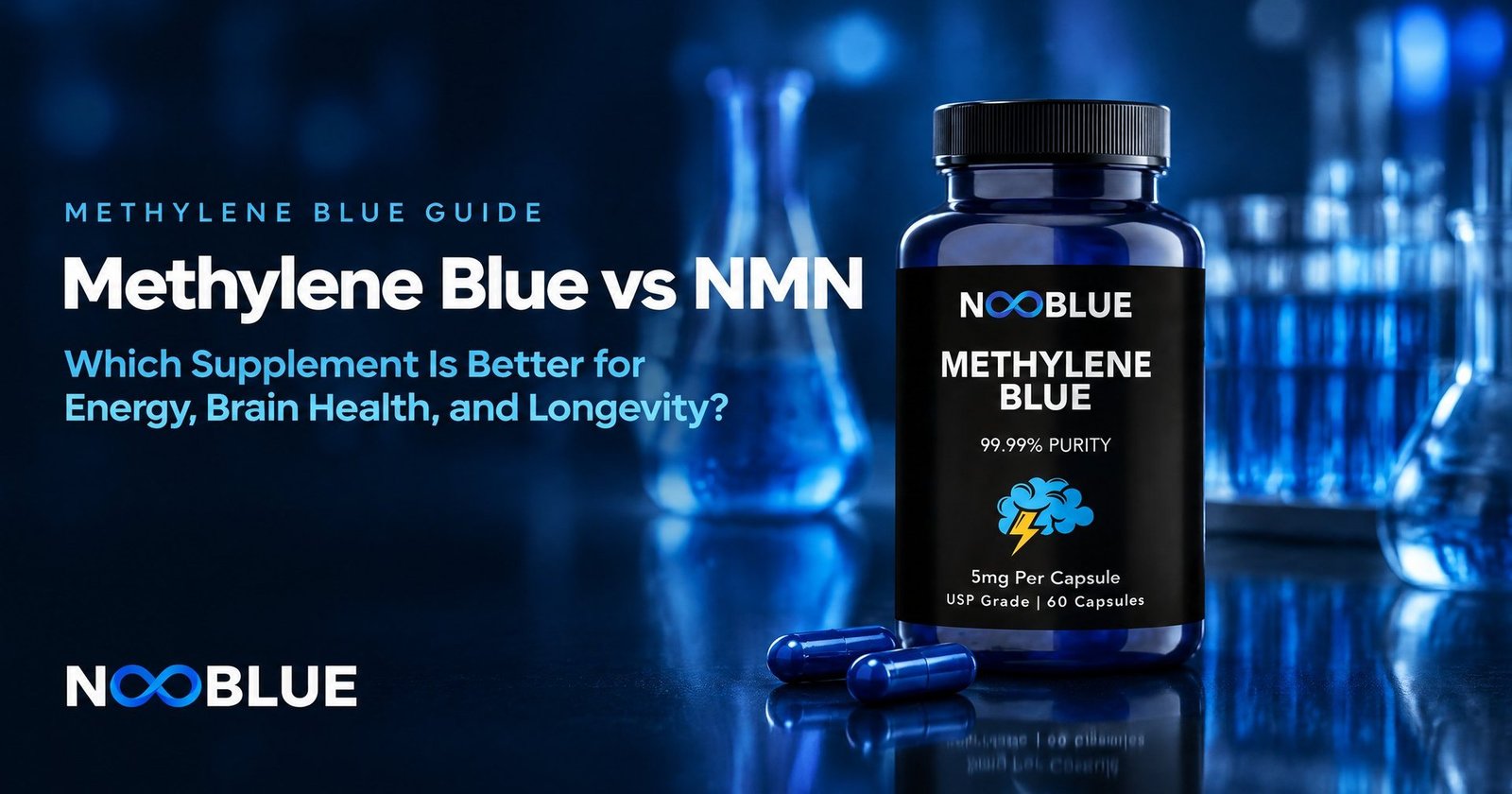
Methylene blue vs NMN is less of a head-to-head than it looks. Both are taken for energy, focus and healthy aging, and both act on how cells make energy, but they do different jobs. NMN raises the supply of NAD+, a molecule every cell uses to move electrons and to run enzymes linked to aging. Methylene blue carries electrons inside mitochondria and also blocks an enzyme called MAO-A, which is why it has a serious drug interaction that NMN does not. This comparison sets out what each one does, what the human trials actually show, how the safety profiles differ, and what is known about taking NMN and methylene blue together.
NooBlue sells methylene blue in capsules, gummies and drops. We do not sell NMN. That gives us an interest in one side of this comparison, so we have linked every study and kept to what the research shows. Written by the NooBlue editorial team.
Table of contents
- 1. Methylene Blue vs NMN at a Glance
- 2. What Is Methylene Blue?
- 3. What Is NMN (Nicotinamide Mononucleotide)?
- 4. Methylene Blue vs NAD+: Where the Two Meet
- 5. Key Differences Between Methylene Blue and NMN
- 6. Who Should Not Take Methylene Blue
- 7. Can You Take NMN and Methylene Blue Together?
- 8. Which Should You Choose?
- 9. If You Choose Methylene Blue: Formats and Quality
- 10. Frequently Asked Questions
- 10.1. Can you take NMN and methylene blue together?
- 10.2. Is methylene blue or NMN better for brain fog?
- 10.3. Which is better for energy, NMN or methylene blue?
- 10.4. Is NAD+ better than methylene blue?
- 10.5. What works better than NMN?
- 10.6. Is NMN toxic to the liver?
- 10.7. Is NMN safe for long-term use?
- 10.8. Is NMN or methylene blue better for anti-aging?
- 10.9. Why don’t doctors recommend methylene blue?
- 10.10. Does NMN interact with medicines the way methylene blue does?
- 11. The Bottom Line
- 12. Sources
- 13. Explore this topic in depth
Methylene Blue vs NMN at a Glance
| Feature | Methylene blue | NMN |
|---|---|---|
| What it is | A synthetic redox dye, described as the first fully man-made medicine | Nicotinamide mononucleotide, a precursor the body converts into NAD+ |
| Main action | Carries electrons in mitochondria and inhibits MAO-A | Raises NAD+, the coenzyme used in energy metabolism and by sirtuins and PARPs |
| Typical amount | 5 mg per NooBlue capsule, 10 mg per gummy, 0.5 mg per drop | 250 to 900 mg a day in the trials below |
| Best human evidence | Single 280 mg dose in 26 healthy adults changed brain activity and raised correct memory answers by 7% | 60-day trial in 80 healthy adults raised blood NAD+ and six-minute walking distance |
| What has not been shown | Effects of daily supplement servings over months | Effects on aging outcomes in people, and safety beyond 12 weeks |
| Main safety point | Serotonin syndrome risk with serotonergic medicines, plus G6PD deficiency, pregnancy and breastfeeding, under 18 | Well tolerated in trials of 4 to 12 weeks, with no clear side effects reported |
What Is Methylene Blue?
Methylene blue is a synthetic dye with a long medical history. A 2021 review describes it as the first fully man-made medicine, with established uses in surgical staining, malaria and methemoglobinemia (Xue et al., 2021). Its interest for energy and aging comes from its chemistry. Flavin enzymes in the cell use NADH or NADPH to reduce methylene blue to a colorless form, leucomethylene blue, and cytochrome c then takes those electrons and turns it blue again (Atamna et al., 2008). The cycle repeats, so small amounts can keep electrons moving toward complex IV, the last step of the mitochondrial chain.
In human cells grown in a dish, that cycling raised complex IV activity by 30% and oxygen use by 37 to 70%, and delayed cellular aging (Atamna et al., 2008). In animals, low doses improve memory, and a review from the University of Texas at Austin ties this to cytochrome oxidase (Rojas et al., 2012). In people, a randomized, placebo-controlled trial gave 26 healthy adults a single 280 mg dose (about 4 mg/kg). One hour later, MRI showed stronger responses during attention and short-term memory tasks, and correct answers during memory retrieval rose by 7% (Rodriguez et al., 2016).
That trial used one large dose, 56 times the 5 mg in a NooBlue capsule. A 2023 study pointed the other way: intravenous doses of 0.5 and 1 mg/kg lowered brain blood flow and oxygen use in eight healthy women (Singh et al., 2023). Methylene blue also follows a hormetic curve, with effects that rise at low doses and fall below normal at high ones (Bruchey and Gonzalez-Lima, 2008). Our guides to how methylene blue works and the benefits of methylene blue for brain and cellular health go further.
What Is NMN (Nicotinamide Mononucleotide)?
NMN is a precursor of NAD+ (nicotinamide adenine dinucleotide). NAD+ is a coenzyme for the redox reactions of energy metabolism, and it is an essential cofactor for sirtuins and poly(ADP-ribose) polymerases (PARPs), enzymes involved in cell signaling and the response to DNA damage. NAD+ levels in skin, blood, liver, muscle and brain are thought to fall with age, which is the idea behind taking a precursor (Song et al., 2023). The same review notes that swallowed NMN is first converted to nicotinamide riboside (NR) to be absorbed in the gut, then rebuilt into NMN and NAD+ inside cells.
The human trials are recent and mostly short:
- Yi et al., 2023. In a randomized, double-blind trial, 80 healthy middle-aged adults took a placebo or 300, 600 or 900 mg of NMN a day for 60 days. Blood NAD+ rose in every NMN group, most at 600 and 900 mg. Walking distance in a six-minute walk test rose more than with placebo, and no safety issues were found in adverse event monitoring or laboratory measures. Insulin resistance scores did not change (Yi et al., 2023). Three of the authors are employees of chemical companies (Abinopharm and Aba Chemicals).
- Morifuji et al., 2024. Sixty older adults took 250 mg of NMN a day or a placebo for 12 weeks. The primary outcome, a stepping test, did not differ. The NMN group had higher blood NAD+, a shorter 4-meter walking time and better scores on a sleep questionnaire (Morifuji et al., 2024). Three of the four authors are employees of Meiji, a Japanese food company.
- Fukamizu et al., 2022. A safety study gave 31 healthy adults aged 20 to 65 either 1,250 mg of NMN a day or a placebo for up to four weeks. Blood, urine and body composition results stayed within normal variation and there were no severe adverse events (Fukamizu et al., 2022).
A 2023 review in Advances in Nutrition concluded that oral NMN has been safe and well tolerated at 250 to 1,250 mg a day for 4 to 12 weeks, with no clear side effects in the published trials, while most evidence for its effects on aging still comes from cells and animals (Song et al., 2023).
Methylene Blue vs NAD+: Where the Two Meet
Many articles frame this as methylene blue vs NAD+ rather than NMN. For practical purposes it is the same question, because NMN and NR are both routes to more NAD+ (Song et al., 2023). Our methylene blue vs NAD+ comparison covers that framing in detail.
The two meet at NADH. When cells break down food, NAD+ picks up electrons and becomes NADH, which delivers them to the start of the mitochondrial chain. Methylene blue can take electrons from NADH through flavin enzymes and hand them to cytochrome c, further down the chain (Atamna et al., 2008). So NMN adds to the pool of carriers, while methylene blue offers the electrons another path. That is why supplement writers call them complementary. It is a reasonable reading of the chemistry, but it is a hypothesis. No study we could find has tested whether taking both does more than taking either one.
Key Differences Between Methylene Blue and NMN
Mechanism of action
Methylene blue works by redox cycling: it accepts electrons and gives them away, over and over, without being used up (Atamna et al., 2008). It is also a potent, reversible inhibitor of MAO-A, the enzyme that breaks down serotonin and norepinephrine (Ramsay et al., 2007). NMN has no action of its own of that kind. It is converted into NAD+, which the cell’s own enzymes then use.
Timing in the studies
Methylene blue’s brain effects in the 2016 trial were measured one hour after a single dose. The NMN trials measured blood NAD+ after 4 to 12 weeks of daily use, and NAD+ was already higher at the first check at day 30 in the 60-day trial (Yi et al., 2023). Neither compound has been studied for how quickly people notice a change in energy or focus, so claims about feeling methylene blue within hours or NMN within weeks come from users, not trials.
The brain
This is where methylene blue has the clearer case. Two imaging trials at a single 280 mg dose found stronger task-related brain activity and stronger resting-state connectivity between regions linked to perception and memory (Rodriguez et al., 2016; Rodriguez et al., 2017). The 2023 intravenous study found lower brain blood flow, so the picture is mixed, but it is direct brain data. The NMN trials above measured blood NAD+, walking and sleep questionnaires, not cognition. Our guide to methylene blue for brain fog covers the brain evidence in full.
Aging pathways
NMN has the broader rationale here, because NAD+ feeds sirtuins and PARPs across the body (Song et al., 2023). In the 60-day trial, a blood-based biological age score rose in the placebo group and stayed flat on NMN (Yi et al., 2023). That is a calculated score, not a measure of how long anyone lives. Methylene blue’s aging research is mostly in cells and lab-grown skin, reviewed in Xue et al. (2021). Neither has been shown to slow aging in people. Our article on methylene blue and anti-aging sets out that evidence.
Safety
This is the biggest difference. NMN has shown no clear side effects in trials of up to 12 weeks (Song et al., 2023). Methylene blue can cause serotonin syndrome when combined with serotonergic medicines. A review of reported cases found that 13 of 14 cases of central nervous system toxicity involving methylene blue were serotonin toxicity, with severe toxicity at an intravenous dose of only 1 mg/kg (Gillman, 2011). It is also contraindicated in G6PD deficiency (StatPearls, 2026).
Who Should Not Take Methylene Blue
Read this before you buy either product. Do not take methylene blue if any of these applies to you:
- You take an SSRI, SNRI, MAOI or any other serotonergic medicine, including many antidepressants. The combination can cause serotonin syndrome.
- You have G6PD deficiency. Methylene blue can break down red blood cells in people with this enzyme deficiency (StatPearls, 2026).
- You are pregnant or breastfeeding. Clinical references warn that methylene blue may cause fetal harm in pregnancy (StatPearls, 2026).
- You are under 18.
If you take any prescription medicine, talk to your doctor before starting methylene blue, NMN or both. Methylene blue can turn urine blue or green with any format, which is expected and harmless (StatPearls, 2026). The same warnings appear in the Safety: read before use section on every NooBlue product page. See also our guides to what not to take with methylene blue, the methylene blue interactions reference and methylene blue side effects.
If none of these applies to you and methylene blue is the side of this comparison you want to try, NooBlue makes it in three formats.
Can You Take NMN and Methylene Blue Together?
Many people do, and there is no documented interaction between NMN and methylene blue. That is not the same as a tested combination. We could not find a single published study, in people or animals, that gave the two together, so nobody knows whether the pair does more than either one alone, or whether it changes side effects.
If you decide to combine them, a cautious approach looks like this:
- Screen for methylene blue first. Every rule in the safety section above applies. NMN does not make methylene blue safer with serotonergic medicines.
- Start one at a time. Take each on its own for about two weeks before adding the other, so you can tell which one caused any effect or side effect.
- Keep to label servings. For methylene blue, that is one 5 mg NooBlue capsule a day with food, one 10 mg gummy, or a measured number of 0.5 mg drops. More is not better on a hormetic curve.
- Tell your doctor if you take any prescription medicine or have a medical condition.
Our dedicated guide, can you take NMN and methylene blue together, covers timing and risk flags in more depth, and our roundup of methylene blue stacks looks at other pairings, including CoQ10.
Which Should You Choose?
NooBlue makes methylene blue and does not sell NMN, so weigh our view with that in mind. Here is how we would decide:
- Choose methylene blue if your interest is the brain: focus, memory and mental energy. It has direct human brain imaging data, and it is the product we make and our pick for that goal. It suits people who have checked every item in the safety list and are happy to start at 5 mg.
- Choose NMN if your goal is raising NAD+. It has direct trial evidence for that, a gentle safety record in short trials, and no serotonergic interaction. It suits people who take a serotonergic medicine or have G6PD deficiency, for whom methylene blue is off the table.
- Consider both only after each on its own. The mechanisms do not overlap, but the combination has not been studied.
Neither one is a substitute for sleep, food and exercise, and neither has been shown to slow aging in people. If your main problem is low energy that has lasted for weeks, see a doctor before buying either.
If You Choose Methylene Blue: Formats and Quality
All three NooBlue formats use USP-grade methylene blue:
- Capsules: 5 mg of methylene blue with 10 mg of vitamin C, 60 per bottle, one a day with food. Fixed dose, no taste.
- Gummies: 10 mg of methylene blue with 25 mg of vitamin C, 60 per bottle. They avoid the blue mouth and tongue that drops cause.
- Drops: a 1% solution in a 50 ml bottle, 0.5 mg per drop, for amounts below 5 mg. Drops can stain the mouth and tongue, so mix them into water or juice.
Grade matters more with methylene blue than with most supplements, because the same compound is sold as a stain and an aquarium product. The USP monograph requires 97.0% to 103.0% methylene blue on the dried basis (USP). NooBlue publishes a report from Contract Testing Laboratories of America (CTLA) on its methylene blue ingredient, with identity and heavy metal results for one ingredient lot. It covers the raw ingredient, not each finished batch. Our guides to lab grade vs pharmaceutical grade methylene blue and reading a certificate of analysis explain what to check on any brand. To compare products, see our best methylene blue capsules roundup and our NooBlue vs TrueHealthic comparison. For serving sizes, read how many mg of methylene blue per day, and for how much reaches the blood, our guides to liquid vs capsule bioavailability and methylene blue absorption.
Frequently Asked Questions
Can you take NMN and methylene blue together?
There is no documented interaction between them, and many people take both. No published study has tested the combination, though. Screen yourself against the methylene blue safety list first, start each on its own for about two weeks, and talk to your doctor if you take any prescription medicine.
Is methylene blue or NMN better for brain fog?
Neither has been tested for brain fog. Methylene blue has the more relevant data: a single 280 mg dose strengthened brain activity during attention and memory tasks in healthy adults, although a 2023 intravenous study found lower brain blood flow. The NMN trials did not measure cognition. Our pick for brain-focused use is methylene blue, if none of its safety warnings applies to you.
Which is better for energy, NMN or methylene blue?
They support different parts of cell energy. NMN raises NAD+, the carrier that collects electrons from food. Methylene blue helps move electrons further down the mitochondrial chain. No trial has compared them, and neither has been tested for how energetic people feel day to day. NMN has the direct evidence for raising NAD+, and methylene blue has the direct evidence in the brain.
Is NAD+ better than methylene blue?
They are not rivals so much as neighbors in the same pathway. NAD+ supplements usually deliver precursors such as NMN or NR, which raise NAD+ in blood. Methylene blue works as an electron carrier and MAO-A inhibitor. Which is better depends on the goal: NAD+ precursors for NAD+ levels, methylene blue for the brain research, and only methylene blue has the serotonergic interaction.
What works better than NMN?
No trial shows another supplement beating NMN at raising NAD+. Nicotinamide riboside (NR) is the main alternative. In an 8-week trial, 100, 300 and 1,000 mg of NR a day raised whole-blood NAD+ by 22%, 51% and 142% within two weeks (Conze et al., 2019). That study was funded by ChromaDex, whose NR ingredient (NIAGEN) it tested. The two precursors have not been compared head to head.
Is NMN toxic to the liver?
No liver problems have been reported in the published trials. The 60-day trial at up to 900 mg a day found no safety issues in its laboratory measures, and a 4-week study at 1,250 mg a day found blood chemistry within normal variation (Yi et al., 2023; Fukamizu et al., 2022). The trials last 4 to 12 weeks, so long-term liver safety has not been established. If you have a liver condition, ask your doctor first.
Is NMN safe for long-term use?
Nobody knows yet. Oral NMN has been safe and well tolerated at 250 to 1,250 mg a day in trials lasting 4 to 12 weeks (Song et al., 2023). There are no published safety data beyond that in people.
Is NMN or methylene blue better for anti-aging?
NMN has the broader rationale, because NAD+ feeds sirtuins and PARPs throughout the body, and one trial found a blood-based biological age score held steady on NMN while it rose on placebo. Methylene blue’s aging data are mostly from cells and lab-grown skin. Neither has been shown to slow aging in people.
Why don’t doctors recommend methylene blue?
Mainly because of its MAO-A interaction with common medicines, and because human evidence for everyday use is limited to small, short studies. Our article on why doctors rarely prescribe methylene blue sets out the full reasoning.
Does NMN interact with medicines the way methylene blue does?
No serotonergic interaction has been reported for NMN in the trials and review above. Methylene blue’s interaction with SSRIs, SNRIs, MAOIs and other serotonergic medicines is the main reason it needs a safety check that NMN does not. Anyone taking prescription medicine should still check any new supplement with their doctor.
The Bottom Line
Methylene blue and NMN both act on cell energy, from different ends. NMN raises NAD+ and has short, industry-linked trials showing just that, with a clean safety record so far. Methylene blue carries electrons, inhibits MAO-A, and has direct human brain data at a single large dose, with a serious interaction that rules it out for anyone on serotonergic medicines. For brain-focused use, methylene blue is our pick, as long as none of the warnings applies to you. Start at the lowest serving, and add NMN only once you know how you respond to each. You can compare the three formats in the NooBlue shop, and our comparison of methylfolate vs methylene blue clears up another common mix-up.
Sources
- Xue H, Thaivalappil A, Cao K. The potentials of methylene blue as an anti-aging drug. Cells. 2021;10(12):3379. PubMed 34943887
- Atamna H, Nguyen A, Schultz C, et al. Methylene blue delays cellular senescence and enhances key mitochondrial biochemical pathways. FASEB Journal. 2008;22(3):703-712. PubMed 17928358
- Rojas JC, Bruchey AK, Gonzalez-Lima F. Neurometabolic mechanisms for memory enhancement and neuroprotection of methylene blue. Progress in Neurobiology. 2012;96(1):32-45. PMC3265679
- Rodriguez P, Zhou W, Barrett DW, et al. Multimodal randomized functional MR imaging of the effects of methylene blue in the human brain. Radiology. 2016;281(2):516-526. PMC5084971
- Rodriguez P, Singh AP, Malloy KE, et al. Methylene blue modulates functional connectivity in the human brain. Brain Imaging and Behavior. 2017;11(3):640-648. PMC5018244
- Singh N, MacNicol E, DiPasquale O, et al. The effects of acute methylene blue administration on cerebral blood flow and metabolism in humans and rats. Journal of Cerebral Blood Flow and Metabolism. 2023;43:95-105. PMC10638993
- Bruchey AK, Gonzalez-Lima F. Behavioral, physiological and biochemical hormetic responses to the autoxidizable dye methylene blue. American Journal of Pharmacology and Toxicology. 2008;3(1):72-79. PubMed 20463863
- Song Q, Zhou X, Xu K, Liu S, Zhu X, Yang J. The safety and antiaging effects of nicotinamide mononucleotide in human clinical trials: an update. Advances in Nutrition. 2023;14(6):1416-1435. PMC10721522
- Yi L, Maier AB, Tao R, et al. The efficacy and safety of β-nicotinamide mononucleotide (NMN) supplementation in healthy middle-aged adults: a randomized, multicenter, double-blind, placebo-controlled, parallel-group, dose-dependent clinical trial. GeroScience. 2023;45(1):29-43. PubMed 36482258
- Morifuji M, Higashi S, Ebihara S, Nagata M. Ingestion of β-nicotinamide mononucleotide increased blood NAD levels, maintained walking speed, and improved sleep quality in older adults in a double-blind randomized, placebo-controlled study. GeroScience. 2024;46(5):4671-4688. PubMed 38789831
- Fukamizu Y, Uchida Y, Shigekawa A, et al. Safety evaluation of β-nicotinamide mononucleotide oral administration in healthy adult men and women. Scientific Reports. 2022;12(1):14442. PubMed 36002548
- Ramsay RR, Dunford C, Gillman PK. Methylene blue and serotonin toxicity: inhibition of monoamine oxidase A (MAO A) confirms a theoretical prediction. British Journal of Pharmacology. 2007;152(6):946-951. PMC2078225
- Gillman PK. CNS toxicity involving methylene blue: the exemplar for understanding and predicting drug interactions that precipitate serotonin toxicity. Journal of Psychopharmacology. 2011;25(3):429-436. PubMed 20142303
- Ostrovsky A, Afzal M. Methylene Blue. StatPearls. Updated January 2, 2026. NCBI Bookshelf NBK557593
- Conze D, Brenner C, Kruger CL. Safety and metabolism of long-term administration of NIAGEN (nicotinamide riboside chloride) in a randomized, double-blind, placebo-controlled clinical trial of healthy overweight adults. Scientific Reports. 2019;9(1):9772. PubMed 31278280
- United States Pharmacopeia. Methylene Blue monograph. doi.usp.org
![Methylene Blue vs NAD+: Which Is Better for Cellular Energy? [2026 Comparison] – NooBlue Methylene Blue Capsules 5mg bottle](https://supplement.codeblex.com/wp-content/uploads/2026/04/methylene-blue-vs-nad-which-is-better-for-cellular-energy-2026-comparison-featured.jpg)