Key takeaways
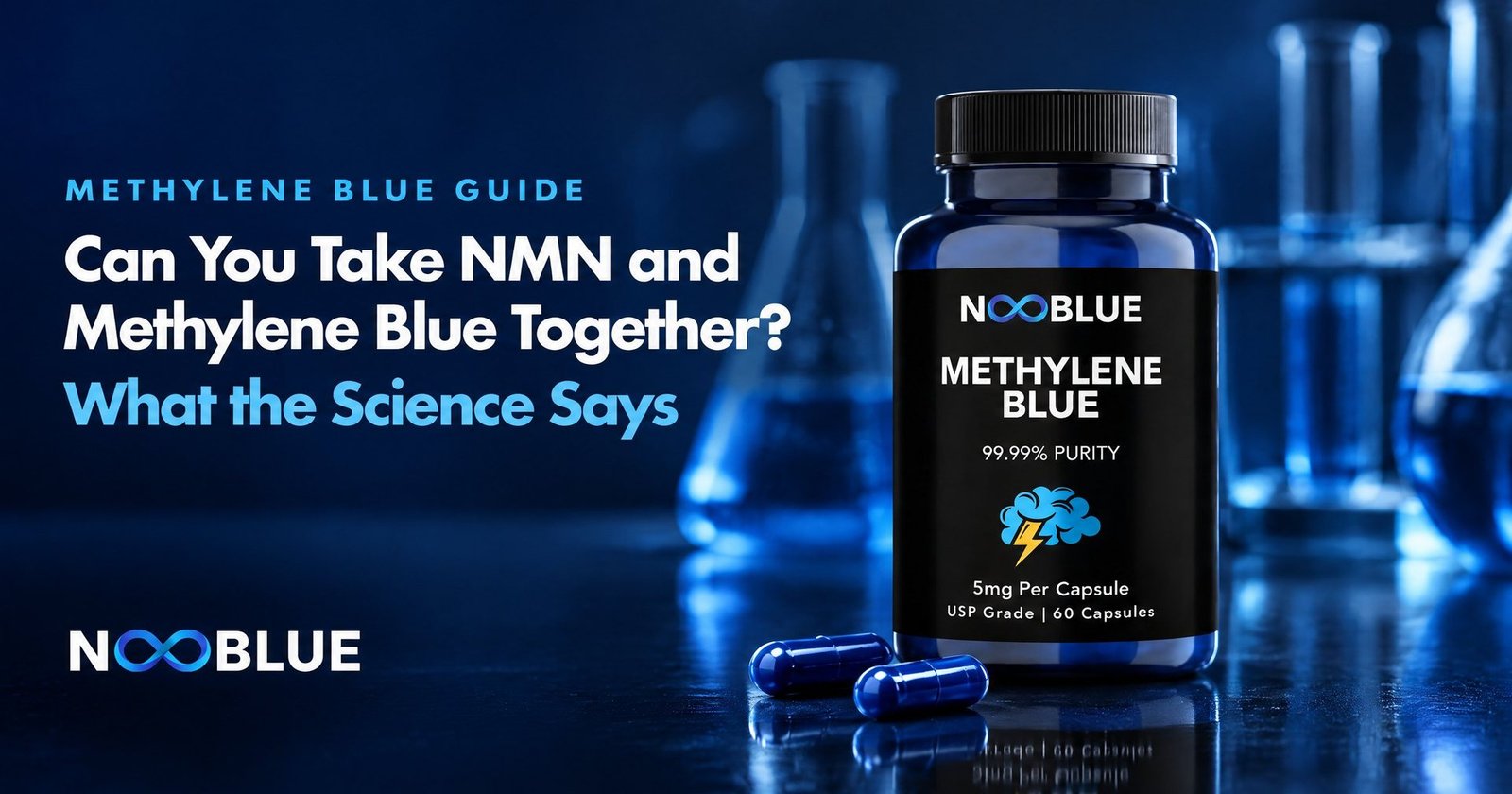
- Can you take NMN and methylene blue together? There is no known direct interaction between them, but no study has tested the pair in people.
- The science says NMN raises blood NAD+ in human trials and was well tolerated in short studies. Methylene blue’s electron-cycling effects come mostly from cell and animal work.
- The idea that the two work together is a theory built on biochemistry, not a trial result.
- If you combine them, add one at a time, keep methylene blue at the label serving (one 5 mg capsule a day with food) and follow your NMN label.
- Methylene blue’s rules apply whatever else you take: not with SSRIs, SNRIs, MAOIs or other serotonergic medicines, not with G6PD deficiency, not in pregnancy or breastfeeding, not under 18.
Short answer: yes, most healthy adults can take NMN and methylene blue together, as far as anyone knows. We found no reported interaction between them and no mechanism that suggests one. What the science says about the pair itself is limited, though, because no study has combined them. The main safety questions come from methylene blue, not NMN, and they apply whether or not NMN is in the mix.
This guide covers why people pair the two, what human research shows for each one alone, why the “synergy” story is still theory, and a sensible way to try the combination. NooBlue sells methylene blue, not NMN, so we have an interest in half of this stack. Every study is linked so you can check our reading.
Table of contents
- 1. Why people pair NMN and methylene blue
- 2. What the science says about NMN on its own
- 3. What the science says about methylene blue on its own
- 4. Does the combination make sense?
- 5. Is it safe to take NMN and methylene blue together?
- 6. How to try the combination sensibly
- 7. Choosing a methylene blue format for the stack
- 8. Who should not take methylene blue
- 9. Frequently asked questions
- 9.1. Is it safe to take NMN and methylene blue at the same time?
- 9.2. Will NMN and methylene blue cancel each other out?
- 9.3. What time of day should I take NMN and methylene blue?
- 9.4. What supplements should not be taken with NMN?
- 9.5. Is NMN hard on the liver?
- 9.6. What should you not mix with methylene blue?
- 9.7. Can I use NR or an NAD+ product instead of NMN?
- 9.8. Is it true that methylene blue makes you look younger?
- 9.9. How long before I notice anything from the combination?
- 10. Sources
Why people pair NMN and methylene blue
Both are sold for cellular energy, and both touch NAD+, the coenzyme cells use to carry electrons in energy metabolism.
- NMN (nicotinamide mononucleotide) is a precursor the body converts into NAD+. Taking it raises the amount of NAD+ available.
- Methylene blue is an electron cycler. A review by Yang and colleagues (Progress in Neurobiology, 2017) describes how it can take electrons from NADH in the presence of complex I and hand them to cytochrome c, an alternative route through the mitochondrial chain. Taking electrons from NADH turns it back into NAD+.
Put those together and you get the pitch you see in forums: NMN tops up the NAD+ pool, and methylene blue recycles NADH back to NAD+ faster. It is a tidy story. The rest of this article looks at how much of it has been tested.
What the science says about NMN on its own
NMN has more human trials behind it than methylene blue does for everyday use. Some examples:
- Older adults, 250 mg a day: Morifuji and colleagues (GeroScience, 2024) randomized 60 older adults to NMN or placebo for 12 weeks. The primary outcome, a stepping test, showed no difference. Among the secondary outcomes, the NMN group had higher blood NAD+, a faster 4-meter walk and better sleep-questionnaire scores, with no adverse effects linked to NMN.
- Middle-aged adults, 300 to 900 mg a day: Yi and colleagues (GeroScience, 2023) gave 80 healthy adults placebo or one of three NMN doses for 60 days. Blood NAD rose in every NMN group, most at 600 and 900 mg, six-minute walking distance improved, and no safety issues were found. One author was employed by an NMN supplier.
- A higher dose for safety: Fukamizu and colleagues (Scientific Reports, 2022) gave 31 healthy adults 1,250 mg once daily for up to 4 weeks and found no changes beyond normal variation in blood, urine and body measures, and no severe adverse events. The study was funded by an NMN supplier.
- The pooled picture: a 2026 meta-analysis in Nutrients by Yang and colleagues included 15 trials, 10 of them in the safety analysis, with doses from 250 to 2,000 mg a day for 14 days to 24 weeks. NMN did not increase adverse events or raise the liver enzymes ALT or AST. Broad metabolic benefits were not evident.
So NMN reliably raises blood NAD+ and looks well tolerated in short trials. Whether that translates into feeling or functioning better is less settled, and long-term data are still thin.
What the science says about methylene blue on its own
Methylene blue’s evidence for everyday use is mostly from cells and animals, with a few small human studies:
- Cells: Atamna and colleagues (FASEB Journal, 2008) found that tiny amounts raised mitochondrial complex IV activity by 30% and oxygen consumption by 37 to 70% in human fibroblasts grown in a dish.
- The NAD+ link: Shin and colleagues (European Journal of Pharmacology, 2014) reported that methylene blue raised the NAD+/NADH ratio in liver cells and activated the enzymes SIRT1 and AMPK in liver cells and mice. This is the study that makes the NMN pairing sound logical. It was not done in people.
- People: in a randomized trial in Radiology (Rodriguez and colleagues, 2016), 26 adults took placebo or a single 280 mg oral dose. The methylene blue group showed more brain activity during attention and memory tasks an hour later and 7% more correct memory-retrieval answers. That dose is far above a supplement serving.
- A result the other way: Singh and colleagues (Journal of Cerebral Blood Flow & Metabolism, 2023) expected intravenous methylene blue to raise brain energy use in healthy volunteers. Brain blood flow and oxygen use fell instead.
Our comparison of methylene blue vs NMN sets the two side by side if you are choosing one rather than both.
Does the combination make sense?
On paper, yes. NMN adds to the NAD+ pool, and in cells methylene blue shifts the NAD+/NADH balance toward NAD+. Those two effects point the same way, and neither is known to block the other.
In practice, three things are unknown:
- Whether a 5 or 10 mg oral dose of methylene blue changes the NAD+/NADH ratio in human tissue at all. The cell and mouse work used different amounts and routes.
- Whether adding methylene blue changes what NMN does, or the other way round. No study has measured it.
- Whether the pair does more for how you feel than either one alone. That would need a trial with four groups, and nobody has run one.
The fair summary is that the combination is plausible and untested. Anyone who tells you it is proven to be synergistic is going beyond the evidence.
Is it safe to take NMN and methylene blue together?
We found no reported interaction and no study of the pair. The safety picture is the sum of each one’s own rules.
NMN: short trials up to 2,000 mg a day found no increase in adverse events. Long-term safety hasn’t been established. Follow your product’s label and talk to your doctor if you take prescription medicine.
Methylene blue: this is where the real rules are. Ramsay, Dunford and Gillman (British Journal of Pharmacology, 2007) showed it is a potent reversible inhibitor of MAO-A, the enzyme that breaks down serotonin. Combined with SSRIs, SNRIs, MAOIs or other serotonergic medicines, it carries a risk of serotonin syndrome. It is also not for people with G6PD deficiency, in pregnancy or breastfeeding, or under 18. Supplements that affect serotonin belong on the same list: the National Center for Complementary and Integrative Health warns that St. John’s wort taken with drugs that affect serotonin may cause serious serotonin-related side effects. See our full list of what not to take with methylene blue and our methylene blue interactions guide.
Methylene blue can also turn your urine blue or green. That is expected and has nothing to do with NMN.
How to try the combination sensibly
- Check the methylene blue safety list first. If any of it applies to you, stop there.
- Start one at a time. Take one of the two alone for a week or two before adding the other. If something feels off, you’ll know which one caused it.
- Use the label serving for methylene blue. NooBlue capsules are one 5 mg capsule a day with food. Gummies are one 10 mg gummy a day, and drops give about 0.5 mg per drop, so 10 drops is 5 mg. Our guide to how many mg of methylene blue per day covers dosing in more depth.
- Follow your NMN label. The trials above used 250 to 900 mg a day for efficacy outcomes.
- Take both in the morning. There is no study on timing the pair, but both are taken for daytime energy, and the methylene blue capsule label asks for food.
- Judge it over weeks. Keep notes on sleep and energy rather than relying on how the first day felt.
Choosing a methylene blue format for the stack
| Format | Serving | Fits a stack because | Price (as of Sep 2026) |
|---|---|---|---|
| NooBlue Capsules | One 5 mg capsule a day, with food (plus 10 mg vitamin C) | A fixed dose that sits next to an NMN capsule at breakfast | $37.99 for 60 ($0.63 a day) |
| NooBlue Gummies | One 10 mg gummy a day (plus 25 mg vitamin C) | One less thing to swallow, and no blue mouth | $49.99 for 60 ($0.83 a day) |
| NooBlue Drops 1% | About 0.5 mg per drop, 10 drops = 5 mg | Fine control if you want to start below 5 mg | $29.99 for 50 mL, about 100 servings ($0.30 each) |
For a morning stack we’d pick the capsules: a fixed 5 mg, no taste, taken with the same meal as the rest. Drops can stain your mouth and tongue, and the gummies can’t. If you are building a wider mitochondrial routine, our guide to mitochondrial support supplements and our comparison of methylene blue vs CoQ10 cover other options. Free worldwide shipping starts at $100 on the NooBlue shop page.
Who should not take methylene blue
Safety first
- Do not take methylene blue with SSRIs, SNRIs, MAOIs or other serotonergic medicines. The combination carries a risk of serotonin syndrome.
- Do not take it if you have G6PD deficiency.
- Do not take it if you are pregnant or breastfeeding.
- Not for anyone under 18.
- It can turn urine blue or green. That is expected.
- Talk to your doctor before use if you take any prescription medicine or have a kidney or liver condition.
For more detail, see who should not take methylene blue and whether methylene blue is safe to take daily.
Frequently asked questions
Is it safe to take NMN and methylene blue at the same time?
We found no reported interaction between them, but no study has tested the pair. The important safety rules come from methylene blue: not with serotonergic medicines, not with G6PD deficiency, not in pregnancy or breastfeeding, and not under 18.
Will NMN and methylene blue cancel each other out?
There’s no known reason they would. NMN adds to the NAD+ pool, and in cells methylene blue shifts NADH back to NAD+. Both push in the same direction on paper. Whether that holds at supplement doses in people hasn’t been measured.
What time of day should I take NMN and methylene blue?
Morning is the simplest choice for both. There is no study on timing the pair. NooBlue capsules should be taken with food.
What supplements should not be taken with NMN?
No interaction list has been established for NMN, and trials so far found no increase in adverse events. If you take prescription medicine, or you’re considering several NAD+ products at once, ask your doctor. Methylene blue has its own clear list, led by serotonergic medicines.
Is NMN hard on the liver?
A 2026 meta-analysis of NMN trials found no significant rise in the liver enzymes ALT or AST at 250 to 2,000 mg a day over 14 days to 24 weeks. Longer-term data are limited.
What should you not mix with methylene blue?
SSRIs, SNRIs, MAOIs and other serotonergic medicines, plus supplements that affect serotonin, such as St. John’s wort. Talk to your doctor if you take any prescription medicine.
Can I use NR or an NAD+ product instead of NMN?
The same logic applies, and the same lack of combination data. Nicotinamide riboside (NR) is another NAD+ precursor. We found no study pairing either NR or NAD+ products with methylene blue.
Is it true that methylene blue makes you look younger?
Not from any human trial. Xiong and colleagues (Scientific Reports, 2017) found methylene blue slowed signs of aging in cultured skin cells and a lab-grown 3D skin model, applied directly to the cells. Our article on methylene blue for anti-aging covers what that does and doesn’t show.
How long before I notice anything from the combination?
Nobody knows, because the pair hasn’t been studied. In the NMN trials, blood NAD+ was first measured at four weeks or later. Give any new routine a few weeks and keep notes.
Sources
- Yang SH, et al. Alternative mitochondrial electron transfer for the treatment of neurodegenerative diseases and cancers: methylene blue connects the dots. Prog Neurobiol. 2017. PubMed 26603930
- Morifuji M, et al. Ingestion of β-nicotinamide mononucleotide increased blood NAD levels, maintained walking speed, and improved sleep quality in older adults. GeroScience. 2024. PubMed 38789831
- Yi L, et al. The efficacy and safety of β-nicotinamide mononucleotide (NMN) supplementation in healthy middle-aged adults. GeroScience. 2023;45(1):29-43. PubMed 36482258
- Fukamizu Y, et al. Safety evaluation of β-nicotinamide mononucleotide oral administration in healthy adult men and women. Sci Rep. 2022;12:14442. PubMed 36002548
- Yang W, et al. Safety and metabolism-related outcomes of oral nicotinamide mononucleotide supplementation in adults: a systematic review and meta-analysis. Nutrients. 2026;18(14):2251. PubMed 42514320
- Atamna H, et al. Methylene blue delays cellular senescence and enhances key mitochondrial biochemical pathways. FASEB J. 2008;22(3):703-712. PubMed 17928358
- Shin SY, et al. SIRT1 activation by methylene blue, a repurposed drug, leads to AMPK-mediated effects in the liver. Eur J Pharmacol. 2014;727:115-124. PubMed 24486702
- Rodriguez P, et al. Multimodal randomized functional MR imaging of the effects of methylene blue in the human brain. Radiology. 2016;281(2):516-526. PubMed 27351678
- Singh N, et al. The effects of acute methylene blue administration on cerebral blood flow and metabolism in humans and rats. J Cereb Blood Flow Metab. 2023;43(2 suppl):95-105. PubMed 36803299
- Ramsay RR, Dunford C, Gillman PK. Methylene blue and serotonin toxicity: inhibition of monoamine oxidase A (MAO A) confirms a theoretical prediction. Br J Pharmacol. 2007;152(6):946-951. PubMed 17721552
- Xiong ZM, et al. Anti-aging potentials of methylene blue for human skin longevity. Sci Rep. 2017;7:2475. PubMed 28559565
- National Center for Complementary and Integrative Health. St. John’s Wort. nccih.nih.gov