Quick answer
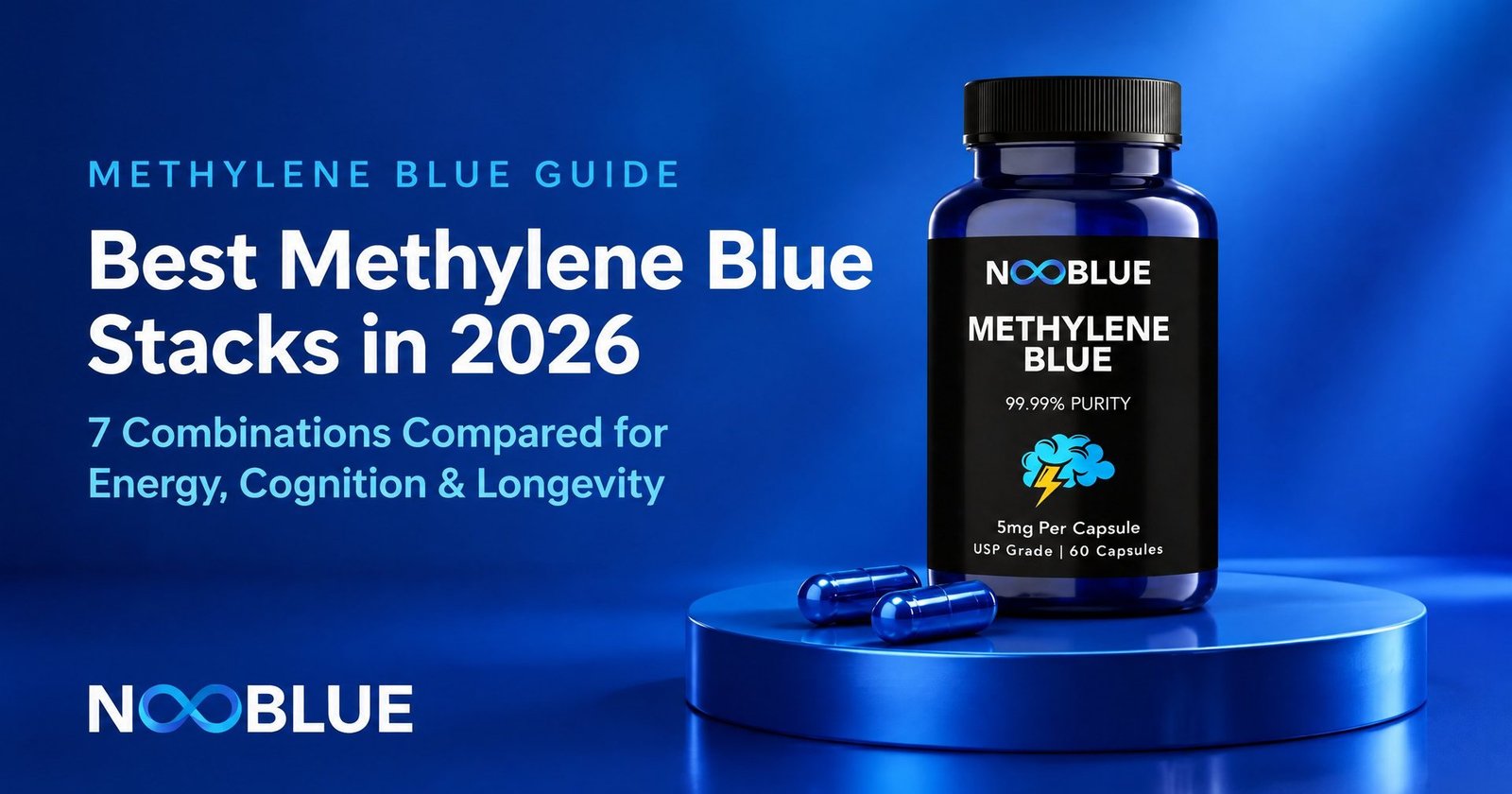
The best methylene blue stack for most people is the simplest one: methylene blue with vitamin C, which is how NooBlue Ultimate Methylene Blue Capsules (5 mg methylene blue and 10 mg vitamin C, $37.99 for 60) and NooBlue Methylene Blue Gummies (10 mg and 25 mg, $49.99 for 60) are made. Vitamin C reacts directly with methylene blue, reducing the dye to its colorless form, and at 10 to 25 mg it adds only a small amount of a familiar vitamin.
If you want to add a second supplement, creatine has the strongest evidence of its own, with a 2023 meta-analysis showing a small memory benefit, mainly in older adults. An NAD+ precursor such as nicotinamide riboside raises blood NAD+ in trials. No human trial has tested methylene blue combined with any of these, so every stack below is an informed guess, and we say how strong the guess is.
Never stack methylene blue with SSRIs, SNRIs, MAOIs, 5-HTP, tryptophan, St. John’s wort or stimulant ADHD medicines, and skip it entirely with G6PD deficiency, pregnancy or breastfeeding.
NooBlue makes the methylene blue in stack #1. It is our pick, and each entry says who should choose differently. Competitor figures come from each brand’s own product page, read in September 2026.
Written by the NooBlue editorial team. We make and sell methylene blue capsules, gummies and drops at nooblue.com. We did not test any stack ourselves. Every figure comes from a brand’s own page, a prescribing label or a peer-reviewed study, and all of them are listed in the sources at the end.
Search for methylene blue stacks and you will find confident protocols: methylene blue with NMN for longevity, with red light for “activation”, with CoQ10 on a strict timing schedule. Most of them present a mechanism as if it were a result. The honest starting point is that researchers have barely tested methylene blue on its own in healthy people, and nobody has published a controlled human trial of it combined with any other supplement.
That does not make stacking pointless. It means the decision rests on three questions you can answer: how good is the evidence for the partner on its own, is the pairing safe, and can you still tell what each part is doing? This guide ranks seven combinations on those questions, from the simplest to the one we would handle most carefully.
Table of contents
- 1. The 7 Best Methylene Blue Stacks at a Glance
- 2. What Methylene Blue Does on Its Own
- 3. How We Ranked the Stacks
- 4. The 7 Best Methylene Blue Stacks, Ranked
- 4.1. 1. NooBlue methylene blue + vitamin C: best overall stack
- 4.2. 2. Creatine + methylene blue: the best-studied partner for memory
- 4.3. 3. NR or NMN + methylene blue: best for raising NAD+
- 4.4. 4. CoQ10 + methylene blue: a common pairing with an unsettled mechanism
- 4.5. 5. LVLUP Health Mito Blue: best pre-stacked capsule
- 4.6. 6. PQQ + methylene blue: small, industry-linked evidence
- 4.7. 7. Red light therapy + methylene blue: last, and handle with care
- 5. Stacks You Should Never Try
- 6. Coffee, L-Theanine and Everyday Supplements
- 7. How to Build a Methylene Blue Stack Safely
- 8. Choosing the Methylene Blue Base
- 9. Frequently Asked Questions
- 9.1. What is the best methylene blue stack?
- 9.2. Can you take methylene blue with NAD+ or NMN?
- 9.3. Should I take methylene blue with CoQ10?
- 9.4. Can you take methylene blue with creatine?
- 9.5. What should you never stack with methylene blue?
- 9.6. Can I take methylene blue with coffee?
- 9.7. Can you combine methylene blue with red light therapy?
- 9.8. Do you need to cycle methylene blue?
- 9.9. What dose of methylene blue should I use in a stack?
- 10. Which Methylene Blue Stack to Choose
- 11. Sources
The 7 Best Methylene Blue Stacks at a Glance
The table sums up each combination. “Evidence for the partner” means studies of that supplement on its own. None of the seven combinations has a published controlled human trial. Methylene blue prices are NooBlue’s, as of Sep 2026.
| # | Stack | What the partner is for | Evidence for the partner | Methylene blue base we suggest | Best for |
|---|---|---|---|---|---|
| 1 | NooBlue methylene blue + vitamin C | Reduces methylene blue to its colorless form | Lab chemistry, well established | NooBlue capsules ($0.63 a day) or gummies ($0.83 a day), vitamin C built in | Most people, and anyone starting out |
| 2 | Creatine + methylene blue | Brain and muscle energy buffer | Pooled analysis of randomized trials, small memory benefit | One 5 mg capsule | Memory and mental work |
| 3 | NR or NMN + methylene blue | Raises NAD+ levels | Randomized trials show higher blood NAD+ | One 5 mg capsule | Buyers focused on longevity |
| 4 | CoQ10 + methylene blue | Electron carrier in the same chain | No human data on the pairing, mixed mechanism data | One 5 mg capsule | People already taking CoQ10 |
| 5 | LVLUP Health Mito Blue (all in one capsule) | Acetyl L-carnitine, ubiquinol and PQQ in one capsule | None for the formula | Built in: 10 mg per capsule, $89.99 for 60 | Convenience |
| 6 | PQQ + methylene blue | Antioxidant, mitochondrial signaling | Two small trials, both linked to industry | One 5 mg capsule | Experimenters with patience |
| 7 | Red light therapy + methylene blue | Light at wavelengths methylene blue absorbs | No human trial for energy or cognition | We do not suggest one | Only with expert guidance |
Cost per day assumes one NooBlue capsule ($37.99 for 60) or one gummy ($49.99 for 60). The partner supplements are sold by many brands at many prices, so we list only the methylene blue cost. LVLUP’s price is its one-time price for 60 capsules.
What Methylene Blue Does on Its Own
Any stack is built on a base, so start with what the base can and cannot do. At low doses, methylene blue acts as an electron cycler in the mitochondrial respiratory chain. A 2012 review in Progress in Neurobiology by Rojas, Bruchey and Gonzalez-Lima described its dose response as hormetic, with opposite effects at low and high doses, and linked its memory effects in animals mainly to the enzyme cytochrome oxidase. A 2018 review in Molecular Neurobiology by Tucker, Lu and Zhang says it can reroute electrons from NADH directly to cytochrome c.
That second claim is less settled than stack guides suggest. In 2019, Gureev and colleagues found in mouse brain mitochondria that methylene blue could not get around a block at complex III. Their data pointed to complex III’s ubiquinol-binding site as the place methylene blue hands its electrons on. So the tidy picture of methylene blue “bypassing” parts of the chain is a model under debate, and any stack justified by that picture inherits the uncertainty.
The human evidence is thin. In the best-known trial, published in Radiology in 2016, Rodriguez and colleagues gave 26 healthy adults a single 280 mg dose, about 4 mg/kg, or a placebo. Methylene blue increased brain activity during attention and memory tasks and was linked to a 7% increase in correct memory-retrieval responses. Reaction times on the attention task did not change. That dose is 56 times one of our capsules, and nobody has studied daily supplement doses of 5 to 10 mg in healthy adults. Our guide to how methylene blue works goes deeper into the biochemistry.
How We Ranked the Stacks
With no trial of any combination, we ranked on what can be checked. We weighed five things, in this order.
- Safety of the pairing. Methylene blue inhibits the enzyme MAO-A, so anything that raises serotonin is ruled out entirely. Beyond that, a partner that adds a new mechanism, such as a light device, moves down.
- Evidence for the partner on its own. A meta-analysis of randomized human trials outranks a pair of small trials, which outranks mechanism alone.
- Whether you can still tell what is working. One partner at a time, at a dose you choose, beats a fixed blend of four.
- Simplicity. Fewer bottles and fewer rules make a stack more likely to be taken as intended.
- Cost. What the methylene blue costs per day, from the brand’s own price.
We did not score how well each pair “works together”. No one has measured a combined effect of methylene blue and any of these partners in people, so a score like that would be invented. NooBlue ranks first because its capsules and gummies already contain the pairing we think is the most sensible starting point. The entries below say where that choice has limits.
The 7 Best Methylene Blue Stacks, Ranked
Each entry covers what the partner is, what the evidence for it shows, how people usually combine it, and who should skip it.
1. NooBlue methylene blue + vitamin C: best overall stack
Vitamin C is the partner with the clearest chemical relationship to methylene blue. Ascorbic acid reduces blue methylene blue to colorless leucomethylene blue, and chemists have measured the rate of that reaction in detail (Mowry and Ogren, Journal of Chemical Education, 1999). The two forms interconvert, which is part of how methylene blue cycles electrons. Our guide to what leucomethylene blue is explains the chemistry.
NooBlue builds this pairing into two products. NooBlue Ultimate Methylene Blue Capsules hold 5 mg of USP grade methylene blue and 10 mg of vitamin C (ascorbic acid) in a cellulose capsule with rice flour, 60 capsules for $37.99, or $0.63 a day at one capsule with food. NooBlue Methylene Blue Gummies hold 10 mg of methylene blue and 25 mg of vitamin C in a Wild Blueberry chew with 0 g of total sugar, 60 gummies for $49.99, or $0.83 a day. Other brands pair the two as well: Nutricel Blue Boost adds vitamin C ester to a 12 mg capsule, and Earth Harmony adds vitamin C to a 12 mg capsule with a plant blend.
Be clear about what this does not show. No trial has compared methylene blue with and without vitamin C in people, so there is no measured benefit from the pairing. Our gummy page is equally plain about the finished product: the published ingredient report does not establish how much of the methylene blue in a gummy is in the reduced form. What the pairing does offer is a stack with one active you can adjust and a small amount of a vitamin most people already take.
The ingredient behind both products has a published report. Contract Testing Laboratories of America (CTLA) analyzed the methylene blue ingredient, lot 2025022801, in report 135621, and recorded an HPLC identity result of “Conforms” plus individual results for arsenic, cadmium, mercury and lead. It covers the raw ingredient, not every finished batch, and it gives no purity percentage. Our quality and testing page sets out those limits.
Suits: anyone starting out, and anyone who wants one simple product. Start with the 5 mg capsule. Choose the gummies once you know 10 mg suits you. Skip it if: you want to add a partner with its own human evidence, in which case read stack #2 or #3 and keep this as your base.
See the 5 mg capsules with vitamin C · $37.992. Creatine + methylene blue: the best-studied partner for memory
Creatine has more human evidence behind it than any other partner on this list. A 2023 systematic review and meta-analysis in Nutrition Reviews by Prokopidis and colleagues pooled 8 randomized trials in healthy people and found that creatine improved memory scores compared with placebo, with a small overall effect (standardized mean difference 0.29). The benefit was clear in adults aged 66 to 76 and absent in people aged 11 to 31. Trial doses ranged from about 2.2 to 20 g a day. A letter to the journal later argued that some results had been double-counted, and the authors replied, so read the size of the effect with some caution.
An earlier 2018 systematic review in Experimental Gerontology by Avgerinos and colleagues found six trials with 281 participants. It concluded that creatine may improve short-term memory and reasoning, that results for attention, reaction time and mental fatigue were conflicting, and that young people showed no change.
Why pair it with methylene blue? Creatine works as an energy buffer that recycles ATP quickly, while methylene blue acts on the respiratory chain that makes ATP. That is a plausible fit, but nobody has tested the pairing. A May 2026 column in Scientific American summed up the evidence gap in its headline: creatine builds muscle, but methylene blue doesn’t boost the brain. We think that is too blunt about methylene blue, but it is fair about which of the two has more data.
Suits: older adults and anyone doing demanding mental work who wants the partner with the most human data. Skip it if: you have kidney concerns and have not talked to your doctor, or you want to judge methylene blue on its own first.
3. NR or NMN + methylene blue: best for raising NAD+
Nicotinamide riboside (NR) and nicotinamide mononucleotide (NMN) are precursors of NAD+, the molecule that carries electrons into the respiratory chain as NADH. The pitch for pairing them with methylene blue is that one supplies electrons and the other helps pass them along.
The human evidence shows NR raises NAD+ in blood. In an 8-week randomized, placebo-controlled trial published in Scientific Reports in 2019, Conze, Brenner and Kruger gave overweight but otherwise healthy adults 100, 300 or 1,000 mg of NR a day. Whole-blood NAD+ rose by 22%, 51% and 142% within two weeks, with no flushing and no difference in adverse events from placebo. ChromaDex, which sells NR, funded the trial, and two of the authors worked for it. The trial measured NAD+ and safety, not energy or cognition, and a higher NAD+ reading is not the same as feeling better.
Combined with methylene blue, the idea is untested. Our comparisons of methylene blue vs NMN and methylene blue vs NAD+ look at each one separately.
Suits: longevity-minded buyers who already take an NAD+ precursor and want to add methylene blue at a low dose. Skip it if: cost matters, because NR and NMN cost far more than the methylene blue, and the trial above measured NAD+ levels rather than how people feel.
4. CoQ10 + methylene blue: a common pairing with an unsettled mechanism
Coenzyme Q10, and ubiquinol, its reduced form, carries electrons from the first complexes of the respiratory chain to complex III. Stack guides describe CoQ10 and methylene blue either as a perfect match or as rivals that must be taken hours apart. Neither claim has human data behind it.
The one piece of evidence that bears on the question comes from the mouse study above. Gureev and colleagues concluded that methylene blue hands its electrons to complex III at the ubiquinol-binding site. If that holds in people, methylene blue and CoQ10 meet at the same point in the chain. Whether that helps, hurts or makes no difference at supplement doses is unknown, and we found no study that tested a timing gap between them. Spacing them apart costs nothing, so it is a reasonable precaution, but it is a precaution, not a proven protocol.
Our comparison of methylene blue vs CoQ10 covers the two in more detail.
Suits: people who already take CoQ10 for their own reasons. Skip it if: you are starting CoQ10 purely to stack it with methylene blue.
5. LVLUP Health Mito Blue: best pre-stacked capsule
LVLUP Health Mito Blue puts a stack in one capsule: 10 mg of methylene blue, 400 mg of acetyl L-carnitine, 100 mg of ubiquinol and 10 mg of PQQ. Sixty capsules cost $89.99 one-time or $80.99 on a subscription, which is $1.50 a capsule at the one-time price. We found no certificate linked on the product page.
The appeal is obvious: one capsule, no measuring. The trade-off is that you cannot adjust anything. If you feel different, you cannot tell which of the four actives caused it, and you cannot lower the methylene blue without lowering everything else. At 10 mg per capsule it also starts at twice our capsule dose.
Suits: buyers who want acetyl L-carnitine, CoQ10 and PQQ anyway and value convenience over control. Skip it if: you are new to methylene blue or want to judge each ingredient.
6. PQQ + methylene blue: small, industry-linked evidence
Pyrroloquinoline quinone (PQQ) is sold for mitochondrial support. Its human evidence is small and comes mostly from companies that make it. In a 2022 randomized trial in the Journal of the American Nutrition Association, Shiojima and colleagues gave 64 healthy Japanese adults aged 40 to under 80 either 21.5 mg of PQQ disodium salt a day or a placebo for 12 weeks. Fifty-eight finished, and the PQQ group scored better on several memory, attention and reaction-time measures. The first four authors list a company research department (Ryusendo Co., Ltd.) as their affiliation. A smaller 2016 trial by Itoh and colleagues gave 41 healthy older adults 20 mg a day for 12 weeks and reported a smaller decline on one attention test, and one of its authors worked for Mitsubishi Gas Chemical, which makes the BioPQQ ingredient it tested.
Those results are interesting but thin, and the combination with methylene blue has never been tested. Much of the “new mitochondria” story around PQQ comes from cell and animal studies.
Suits: experimenters willing to try one partner for several weeks and judge it honestly. Skip it if: you want a partner with independent human evidence.
7. Red light therapy + methylene blue: last, and handle with care
This is the stack we are most cautious about, even though it is popular online. The theory is that red and near-infrared light and methylene blue both act on cytochrome oxidase, so combining them should add up. We found no controlled human trial of the combination for energy or cognition.
There is also a reason for caution that stack guides skip. Methylene blue absorbs red light strongly, which is why it is used as a photosensitizer in photodynamic therapy. In that setting, light shone on tissue that contains the dye produces reactive oxygen that damages microbes or target cells (Tardivo and colleagues, Photodiagnosis and Photodynamic Therapy, 2005). That is useful in a clinic. It is not something to set up casually at home with an unknown dose and an unknown light. Our page on methylene blue and red light therapy covers the arguments on both sides.
Suits: only people working with a clinician who knows both the dye and the device. Skip it if: you are planning to combine the two on your own.
Stacks You Should Never Try
Methylene blue is a potent, reversible inhibitor of the enzyme MAO-A, which breaks down serotonin. Ramsay, Dunford and Gillman confirmed this with purified human enzyme in 2007. That one property rules out a set of combinations completely.
- Serotonergic medicines. The label for injectable methylene blue carries a boxed warning about serious or fatal serotonin syndrome with serotonergic drugs and opioids, and tells prescribers to avoid SSRIs, SNRIs and MAOIs. In a 2010 systematic review in Psychosomatics, Ng and Cameron found 26 patients who developed an acute confusional state after a methylene blue infusion, and 24 of them were taking a serotonin reuptake inhibitor.
- Serotonergic supplements. 5-HTP is a direct serotonin precursor. The Adderall label names tryptophan and St. John’s wort among the serotonergic drugs in its serotonin syndrome warning. None of these belongs in a methylene blue stack.
- Stimulant ADHD medicines and atomoxetine. The Adderall, Vyvanse and Strattera labels contraindicate MAO inhibitors, naming intravenous methylene blue, and the Ritalin label contraindicates MAO inhibitors because of the risk of hypertensive crises. Do not add methylene blue to these medicines unless the prescriber approves it.
- Other MAO inhibitors. Stacking two MAO inhibitors doubles down on the same risk.
- Some antihistamines. Nutricel’s product pages warn that methylene blue interacts with common allergy medicines such as Benadryl (diphenhydramine), and Chemist Labs gives a similar warning. Ask a pharmacist before combining them.
The same label lists G6PD deficiency as a contraindication because of the risk of hemolytic anemia, says methylene blue may cause fetal harm, and advises stopping breastfeeding for up to 8 days after a dose. Do not use methylene blue in any stack if any of these applies to you. Our guides to who should not take methylene blue, what not to take with methylene blue and methylene blue and serotonin syndrome go through each class, and the full methylene blue interactions list is the page to check before you add anything.
Coffee, L-Theanine and Everyday Supplements
Most people asking about stacks really want to know whether methylene blue clashes with what they already take. For coffee, L-theanine, lion’s mane, vitamin D, magnesium and fish oil, we found no published interaction data with methylene blue, which is not the same as proof of safety. Two practical points apply.
First, sleep. Caffeine can disturb sleep, and Nutricel’s pages warn that taking methylene blue in the evening may affect sleep too. Take both early in the day. Our guides to methylene blue and caffeine and methylene blue and sleep cover timing.
Second, pre-mixed products. Some tablets combine methylene blue with caffeine, L-theanine or other nootropics at fixed amounts. That locks every dose together, which is a poor fit for a compound you are meant to start low and adjust slowly. We would rather you add each piece yourself.
How to Build a Methylene Blue Stack Safely
- Rule yourself out. Check the list above. If you take any prescription medicine, ask your doctor or pharmacist first.
- Start with methylene blue alone. Take one 5 mg capsule a day with food for two weeks. Our guide to how many mg of methylene blue per day explains why we start there.
- Add one partner at a time. Give each new supplement at least two weeks before you add another, so you can tell what changed.
- Keep a short log. Note sleep, energy and anything unusual. Blue or green urine is expected and harmless. Our guide to methylene blue side effects lists the rest.
- Drop what does nothing. A stack should earn its place. If a partner makes no difference after a fair trial, stop paying for it.
- Skip the cycling rules you read online. We found no study that tested schedules such as five days on and two days off. A steady, low daily dose is easier to judge.
Choosing the Methylene Blue Base
Whatever you stack, the methylene blue should come in a form you can dose precisely. NooBlue sells three.
| NooBlue format (prices as of Sep 2026) | Methylene blue | Also contains | Price | Cost per serving |
|---|---|---|---|---|
| Ultimate Methylene Blue Capsules, 60 | 5 mg per capsule | 10 mg vitamin C | $37.99 | $0.63 per capsule |
| Methylene Blue Gummies, 60 | 10 mg per gummy | 25 mg vitamin C, Wild Blueberry flavor | $49.99 | $0.83 per gummy |
| Methylene Blue Drops, 1%, 50 mL | 0.5 mg per drop | About 100 servings of 5 mg (10 drops) | $29.99 | $0.30 per 5 mg serving |
Capsules and gummies already carry vitamin C, which makes them stack #1 on their own. The drops contain no vitamin C and cost the least per milligram, but you count drops and the liquid stains skin and fabric. Our roundups of the best methylene blue capsules, best methylene blue gummies and best methylene blue drops compare each format across brands, and our guide to the best methylene blue supplements puts every format side by side. You can see all three in our shop.
Frequently Asked Questions
What is the best methylene blue stack?
For most people it is NooBlue methylene blue with vitamin C, which is how our capsules (5 mg methylene blue and 10 mg vitamin C, $37.99 for 60) and gummies (10 mg and 25 mg, $49.99 for 60) are made. NooBlue makes both. Vitamin C reacts directly with methylene blue, and it keeps the stack simple. If you want a second partner with human evidence of its own, creatine has the most. No methylene blue stack has been tested in a controlled human trial.
Can you take methylene blue with NAD+ or NMN?
We found no published interaction between methylene blue and NAD+ precursors, and no trial of the combination. Nicotinamide riboside raised whole-blood NAD+ by 22%, 51% and 142% at 100, 300 and 1,000 mg a day in an 8-week trial funded by its maker, which measured NAD+ and safety rather than energy. If you try the pair, start methylene blue at 5 mg and add one supplement at a time.
Should I take methylene blue with CoQ10?
There is no human data either way. A 2019 mouse study suggests methylene blue passes its electrons to complex III at the site where ubiquinol binds, so the two may meet at the same point in the respiratory chain. Nobody has tested whether that matters at supplement doses. Taking methylene blue in the morning and CoQ10 with an evening meal is a harmless precaution, not a proven protocol.
Can you take methylene blue with creatine?
We found no known interaction and no trial of the pair. Creatine has its own evidence: a 2023 meta-analysis of 8 randomized trials found a small memory benefit overall, clear in adults aged 66 to 76 and absent in younger people. It makes a reasonable second partner once you know how methylene blue alone suits you.
What should you never stack with methylene blue?
Never combine it with SSRIs, SNRIs, MAOIs or other serotonergic medicines, with 5-HTP, tryptophan or St. John’s wort, or with stimulant ADHD medicines or atomoxetine unless the prescriber approves. Ask a pharmacist before combining it with antihistamines such as diphenhydramine. Do not use it at all with G6PD deficiency, in pregnancy or while breastfeeding.
Can I take methylene blue with coffee?
Most people do, and we found no published interaction data between the two. Both can affect sleep, so take them in the morning or early afternoon. If coffee already makes you jittery, change one thing at a time so you know which one is responsible.
Can you combine methylene blue with red light therapy?
We do not recommend it without expert guidance. We found no controlled human trial of the combination for energy or cognition. Methylene blue absorbs red light and is used as a photosensitizer in photodynamic therapy, where light and dye together produce reactive oxygen that damages cells. That is a reason for caution, not for experimenting at home.
Do you need to cycle methylene blue?
We found no study that tested cycling schedules such as five days on and two off. Online protocols that require them are guesses. A steady, low daily dose taken with food is simpler to judge, and you can stop at any time.
What dose of methylene blue should I use in a stack?
Start with 5 mg a day, one NooBlue capsule, and stay there for two weeks before adding a partner. The human brain-imaging trial used a single 280 mg dose in a research setting, 56 times that amount, and methylene blue’s dose response is hormetic, so more is not better. Our methylene blue dosage guide explains how to adjust.
Which Methylene Blue Stack to Choose
- Starting out, or want one product: our pick is NooBlue methylene blue with vitamin C, which we make. Begin with the 5 mg capsules at $37.99 for 60.
- Want a partner with human evidence: add creatine after two weeks on methylene blue alone.
- Already take an NAD+ precursor or CoQ10: add methylene blue at 5 mg and change nothing else for two weeks.
- Want one capsule with everything in it: LVLUP Health Mito Blue, accepting that you cannot adjust each part.
- Thinking about red light: talk to a clinician first.
The rules do not change from stack to stack: rule out the interactions, start low, add one thing at a time, and keep what earns its place. For the wider picture, see our guides to the best mitochondrial support supplements, the best longevity supplements and the best methylene blue nootropics. More comparisons sit in our buying guides and on the NooBlue blog.
Sources
- Mowry S, Ogren PJ. Kinetics of methylene blue reduction by ascorbic acid. Journal of Chemical Education. 1999;76(7):970. DOI 10.1021/ed076p970.
- Rojas JC, Bruchey AK, Gonzalez-Lima F. Neurometabolic mechanisms for memory enhancement and neuroprotection of methylene blue. Progress in Neurobiology. 2012;96(1):32-45. PubMed 22067440.
- Tucker D, Lu Y, Zhang Q. From mitochondrial function to neuroprotection: an emerging role for methylene blue. Molecular Neurobiology. 2018;55(6):5137-5153. PubMed 28840449.
- Gureev AP, Shaforostova EA, Popov VN, Starkov AA. Methylene blue does not bypass Complex III antimycin block in mouse brain mitochondria. FEBS Letters. 2019;593(5):499-503. PubMed 30734287.
- Rodriguez P, Zhou W, Barrett DW, et al. Multimodal randomized functional MR imaging of the effects of methylene blue in the human brain. Radiology. 2016;281(2):516-526. PubMed 27351678; full text.
- Prokopidis K, Giannos P, Triantafyllidis KK, et al. Effects of creatine supplementation on memory in healthy individuals: a systematic review and meta-analysis of randomized controlled trials. Nutrition Reviews. 2023;81(4):416-427. PubMed 35984306. Letter and reply: PubMed 36644917.
- Avgerinos KI, Spyrou N, Bougioukas KI, Kapogiannis D. Effects of creatine supplementation on cognitive function of healthy individuals: a systematic review of randomized controlled trials. Experimental Gerontology. 2018;108:166-173. PubMed 29704637.
- Denworth L. A tale of two supplements: creatine builds muscle, but methylene blue doesn’t boost the brain. Scientific American. 2026;334(5):88. PubMed 41979503.
- Conze D, Brenner C, Kruger CL. Safety and metabolism of long-term administration of NIAGEN (nicotinamide riboside chloride) in a randomized, double-blind, placebo-controlled clinical trial of healthy overweight adults. Scientific Reports. 2019;9(1):9772. PubMed 31278280.
- Shiojima Y, Takahashi M, Takahashi R, et al. Effect of dietary pyrroloquinoline quinone disodium salt on cognitive function in healthy volunteers. Journal of the American Nutrition Association. 2022;41(8):796-809. PubMed 34415830.
- Itoh Y, Hine K, Miura H, et al. Effect of the antioxidant supplement pyrroloquinoline quinone disodium salt (BioPQQ) on cognitive functions. Advances in Experimental Medicine and Biology. 2016;876:319-325. PubMed 26782228.
- Tardivo JP, Del Giglio A, de Oliveira CS, et al. Methylene blue in photodynamic therapy: from basic mechanisms to clinical applications. Photodiagnosis and Photodynamic Therapy. 2005;2(3):175-191. PubMed 25048768.
- Ramsay RR, Dunford C, Gillman PK. Methylene blue and serotonin toxicity: inhibition of monoamine oxidase A (MAO A) confirms a theoretical prediction. British Journal of Pharmacology. 2007;152(6):946-951. PubMed 17721552.
- Ng BK, Cameron AJ. The role of methylene blue in serotonin syndrome: a systematic review. Psychosomatics. 2010;51(3):194-200. PubMed 20484716.
- ProvayBlue (methylene blue injection) prescribing information. DailyMed.
- Prescribing information for Adderall, Vyvanse, Ritalin and Strattera (DailyMed).
- Product pages read in September 2026: LVLUP Health Mito Blue, Nutricel Blue Boost, Earth Harmony, Chemist Labs; NooBlue capsules, gummies, drops and quality and testing.