By NooBlue Editorial · About our editorial standards
Key takeaways
- How to choose methylene blue for daily use: start with the label. Look for USP grade, a supplement facts panel with an exact dose, and no “research use” or “not for human consumption” wording.
- Then open the lab report itself. Check the lab name, report number, lot and what was tested, and whether it covers the raw ingredient or the finished product.
- A careful label tells you not to take methylene blue with SSRIs, SNRIs, MAOIs or other serotonergic medicines, with G6PD deficiency, during pregnancy or breastfeeding, or under 18. Three of the four other brands we checked leave G6PD off their product page.
- Compare price per mg only after a product passes those checks. In our September 2026 table, prices ran from $0.048 to $0.233 per mg.
- Pick the form you will take consistently: capsules for a fixed 5 mg, gummies for a fixed 10 mg without a blue mouth, drops for 0.5 mg steps.
Short answer: choose USP-grade methylene blue that is sold as a supplement, with an exact dose on the label, a lab report you can open and trace to a named lab and lot, and a safety warning that covers serotonergic medicines and G6PD deficiency. Our pick is NooBlue, which we make: exact doses in three formats, the full safety warning on every product page, and an independent ingredient report published with its lab, report number and lot.
This guide works through how to choose methylene blue in the order we would check a product ourselves: grade and intended use, the lab report, the dose, the form, the safety text, whether the page’s own numbers agree, and finally price. At the end we compare seven products, three of ours and four from other brands, on those same checks, with prices as of September 2026.
Table of contents
- 1. The Methylene Blue Buyer’s Checklist at a Glance
- 2. Check the Grade and the Intended Use First
- 3. Read the Lab Report, Not the Badge
- 4. Make Sure the Dose Is Exact
- 5. Which Form of Methylene Blue Is Best for You?
- 6. Check the Safety Text on the Label
- 7. Compare Price per mg Last
- 8. How to Tell If Your Methylene Blue Is Real
- 9. Where to Buy Methylene Blue
- 10. Our Pick: NooBlue
- 11. Frequently Asked Questions
- 11.1. What should I look for when buying methylene blue?
- 11.2. Which form of methylene blue is best?
- 11.3. How do I tell if my methylene blue is real?
- 11.4. Which brand of methylene blue is best?
- 11.5. Why do people say they feel good on methylene blue?
- 11.6. Is USP-grade methylene blue worth paying more for?
- 11.7. Can I buy methylene blue at a pharmacy?
- 11.8. How much methylene blue should I take per day?
- 12. Sources
The Methylene Blue Buyer’s Checklist at a Glance
Use this table as a quick filter. A product that fails any row in the right-hand column is not worth comparing on price.
| What to check | Good sign | Walk away if |
|---|---|---|
| Grade | “USP” on the label and in the listing | “Lab grade”, “reagent”, “stain”, aquarium use, or no grade at all |
| Intended use | Supplement facts panel with a serving size | “For research purposes only” or “not for human consumption” |
| Lab report | Named lab, report number, date and lot, in a document you can open | A badge or a claim with no document behind it |
| What was tested | Identity or potency, plus heavy metals (and microbes for a finished product) | Nothing that confirms the methylene blue itself |
| Dose | mg per capsule or gummy, or % strength and mg per drop for liquids | “A few drops” with no mg figure |
| Safety text | Serotonergic medicines, G6PD deficiency, pregnancy and breastfeeding, under 18 | No warnings, or only a vague “consult your doctor” |
| Consistency | The same dose and ingredients everywhere on the page and label | Numbers that disagree between sections of the same page |
| Price | Compared per mg, after every check above | Far cheaper than everyone else, with no paperwork |
Check the Grade and the Intended Use First
The name “methylene blue” covers a microscopy stain, an aquarium treatment, a laboratory reagent and a dietary supplement. The grade and the wording on the label tell you which one you are looking at.
USP grade means the material is made to the methylene blue monograph in the United States Pharmacopeia, a published standard with tests for identity, strength and impurities. That is the grade to look for in anything you will swallow. Our explainer on lab grade versus pharmaceutical grade methylene blue covers the tiers, and our guide to what USP purity claims do and don’t tell you covers the percentages brands print.
Two examples show how far the other grades sit from a supplement. Sigma-Aldrich sells a methylene blue powder for staining with a dye content specification of at least 82% and a “harmful if swallowed” hazard statement. Kordon’s aquarium methylene blue is a 2.303% solution, and its product page says it is not intended for human consumption. Both are fine products for their jobs. Neither belongs in a daily routine.
Watch the intended-use wording on supplement-style products too. Meraki Blu is sold with dosing directions and a 1 mL dropper, yet its product description says “For research purposes only.” A product you plan to take every day should be sold as a supplement, with a supplement facts panel and a serving size.
Read the Lab Report, Not the Badge
Almost every brand says “third-party tested”. What matters is the document behind the phrase. Open it and check five things.
- Who tested it. A named laboratory with an address, not only a logo.
- Which sample. A report number, a date and a lot number. Without a lot, you cannot tell which batch a result belongs to.
- What was tested. Identity or potency (is it methylene blue, and how much), heavy metals such as arsenic, cadmium, lead and mercury, and microbes for a finished product.
- Raw ingredient or finished product. An ingredient report describes the methylene blue that went in. A finished-product report describes the capsule, gummy or bottle you are holding.
- The specification column. A pass/fail limit shows what the lab measured against. “Report” means the lab measured and reported a value without scoring it against a limit.
Here is how that plays out on real pages. NooBlue publishes a report from Contract Testing Laboratories of America (CTLA), report 135621, for methylene blue ingredient lot 2025022801. It records an HPLC identity result of “Conforms” and individual results for arsenic, cadmium, mercury and lead. It covers the raw ingredient, not each finished batch, it gives no purity percentage, and its specification column reads “Report”. You can read the full document on our quality and testing page.
Nutricel publishes Eurofins certificates for finished Blue Boost capsules covering methylene blue potency, heavy metals and microbes, with the Blue Boost card dated July 2025. On this one check, a finished-product report with a potency result is a stronger kind of document than an ingredient report, ours included. Meraki’s product page shows three Light Labs certificates for heavy metals, formaldehyde and microbes. The lot field on each is blank, and none of the three reports methylene blue content. Chemist Labs lists lab reports for three named capsule lots on a dedicated page. Our guide to reading a methylene blue certificate of analysis goes through a report line by line.
Make Sure the Dose Is Exact
Methylene blue shows a hormetic dose response in the research, meaning low and high doses can have opposite effects (Rojas and colleagues, Progress in Neurobiology, 2012). That is why an exact dose on the label matters more than a large one.
It is also well absorbed by mouth. In 16 healthy volunteers, an oral solution had an absolute bioavailability of about 72% (Walter-Sack and colleagues, European Journal of Clinical Pharmacology, 2009). Most of what you swallow reaches your bloodstream, so a label that is wrong by a few milligrams is not a rounding error.
For capsules and gummies, look for mg per unit. NooBlue capsules hold 5 mg each and our gummies 10 mg each. For liquids, look for the strength and the mg per drop, because drop sizes differ between brands. Our 1% drops give 0.5 mg per drop and 10 mg per full dropper. Meraki Blu holds 150 mg in 30 mL, and its own FAQ puts each drop at about 0.25 mg. Count drops from one brand’s bottle using another brand’s numbers and you can be off by a factor of two. Our guide to how many mg of methylene blue per day and our comparison of a 1% solution versus 5 mg capsules walk through the arithmetic.
Check that the page agrees with itself
A product page that gives two different numbers for the same thing is a warning sign. On Meraki’s page, the FAQ says each drop holds about 0.25 mg, while the how-to steps say “1–3 drops (≈1–3 mg)”. Blissta’s 1% drops page describes a “distilled water base, nothing else” and, further down, a “Vitamin C Stack 20 mg per serving”. When a page disagrees with itself, ask the brand which figure is on the printed label before you buy.
Which Form of Methylene Blue Is Best for You?
No form is best for everyone. The right one fits your routine and the dose you want, so you will actually take it.
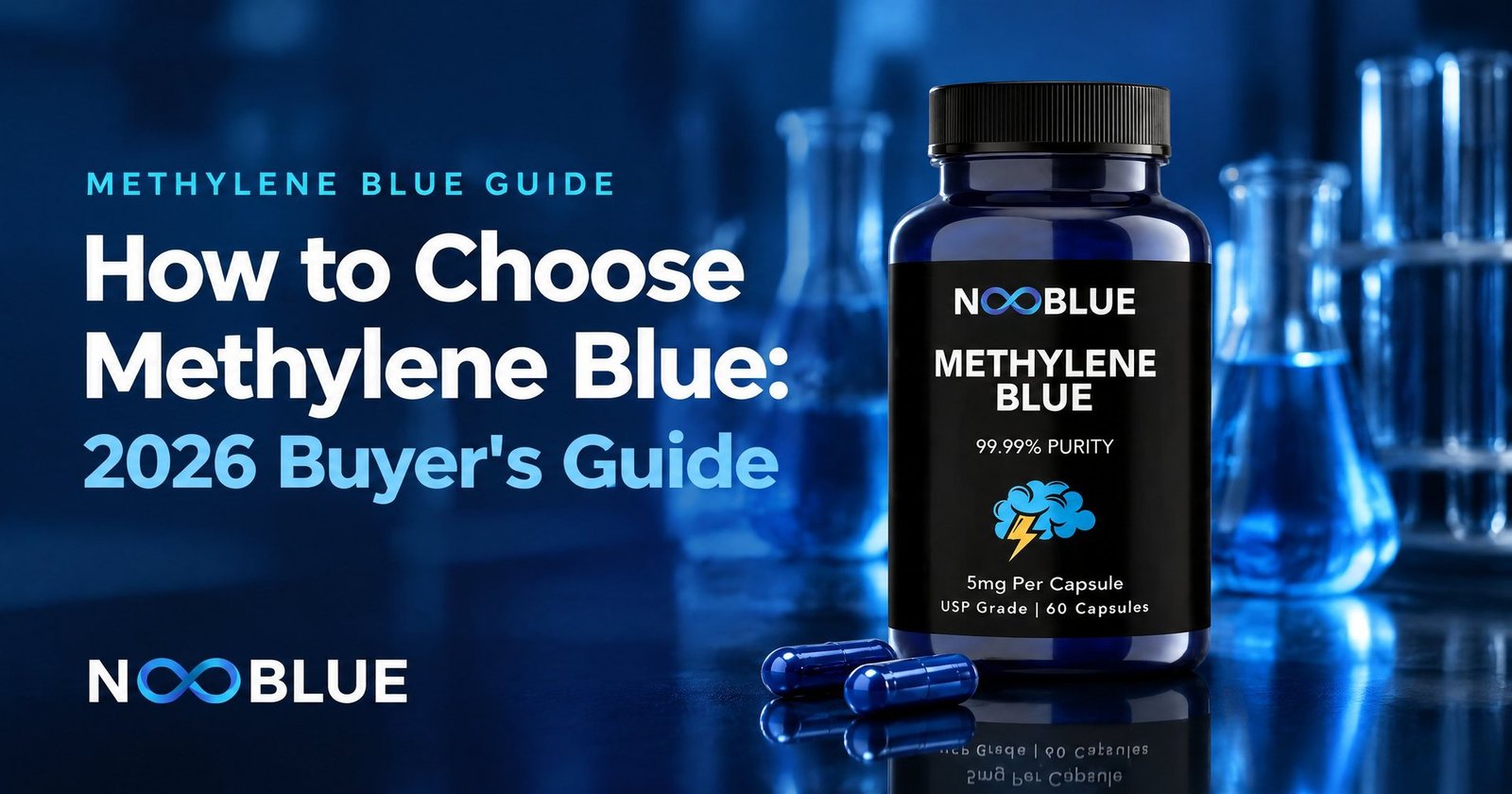
- Capsules. A fixed dose, no taste and nothing to measure. NooBlue Methylene Blue Capsules hold 5 mg methylene blue with 10 mg vitamin C, 60 per bottle at $37.99. The label serving is one capsule a day. Do not exceed the suggested serving.
- Gummies. A fixed 10 mg per gummy with 25 mg vitamin C and zero sugar, 60 per bottle at $49.99. NooBlue gummies don’t leave the blue mouth or tongue that drops can.
- Drops. A 1% solution (10 mg/mL) in a 50 mL bottle at $29.99, about 100 servings of 5 mg. NooBlue drops adjust in 0.5 mg steps and are our lowest cost per mg. Drops can stain your mouth and tongue, and they need careful measuring.
Any format can turn urine blue or green, which is expected with methylene blue. For a longer side-by-side, see methylene blue capsules versus liquid. Check the expiry date on whatever you buy, and see our methylene blue shelf life and storage guide for how to keep it.
Check the Safety Text on the Label
A label that takes safety seriously tells you who should not take methylene blue. It is also a quick test of how carefully a brand writes its labels.
Safety: read before you choose any methylene blue
- Do not take it with SSRIs, SNRIs, MAOIs or any other serotonergic medicine, including many antidepressants. Methylene blue is a potent inhibitor of MAO-A, the enzyme that breaks down serotonin, and the combination can cause serotonin syndrome.
- Do not take it if you have G6PD deficiency.
- Not for use during pregnancy or while breastfeeding.
- Not for anyone under 18.
- It can turn urine blue or green.
- Talk to your doctor before use if you take any prescription medicine.
Of the four other brands in our comparison, only Meraki names G6PD deficiency on its product page. Nutricel’s safety notice covers serotonergic medicines, pregnancy, nursing and children. Chemist Labs’ notice covers SSRIs, pregnancy, nursing and children. Blissta’s page warns against SSRIs and other serotonergic medication and against use in pregnancy or breastfeeding. None of those three mentions G6PD.
Compare Price per mg Last
Price only means something once a product has passed the checks above. Divide the price by the total milligrams in the pack, not by the bottle count.
| Product | Dose and pack | Price (as of Sep 2026) | Price per mg | Lab document on the site | Names G6PD on product page |
|---|---|---|---|---|---|
| NooBlue Capsules | 5 mg x 60 | $37.99 | $0.127 | CTLA ingredient report: identity and four heavy metals, ingredient lot named | Yes |
| NooBlue Gummies | 10 mg x 60 | $49.99 | $0.083 | Same CTLA ingredient report | Yes |
| NooBlue Drops 1% | 10 mg/mL x 50 mL | $29.99 | $0.060 | Same CTLA ingredient report | Yes |
| Nutricel Blue Boost | 12 mg x 60 | $34.90 | $0.048 | Eurofins finished-product certificate: potency, heavy metals, microbes | No |
| Chemist Labs Capsules | 10 mg x 60 | $34.99 | $0.058 | Lab reports for three named capsule lots | No |
| Meraki Blu | 150 mg in 30 mL | $35.00 | $0.233 | Heavy metals, formaldehyde and microbes; lot field blank; no potency result | Yes |
| Blissta 1% Drops | 10 mg/mL x 30 mL | $46.99 | $0.157 | Page says a certificate is published; we found none linked on the product page | No |
NooBlue makes the three NooBlue products in this table, and they are our pick. Every figure for the other brands comes from their own product pages as of September 2026, and we have not lab-tested other brands’ products. Nutricel’s Blue Boost has the lowest price per mg here, with Chemist Labs’ capsules and our drops close behind. Our capsules cost more per mg than our drops because you are paying for a pre-measured 5 mg dose. For typical price ranges across the market, see what high-quality methylene blue costs.
How to Tell If Your Methylene Blue Is Real
You cannot confirm purity at home. What you can check is whether the product matches its paperwork and whether the seller stands behind it.
- Match the lot. If a brand publishes a finished-product report, the lot on the report should match the lot on your bottle. An ingredient report, like ours, names the ingredient lot instead, so check that the brand says which report applies.
- Read the urine test for what it is. Blue or green urine within a day shows you absorbed something blue. It does not tell you how much methylene blue you took or how pure it was.
- Buy from the brand or its listed retailers. Sealed packaging with a printed lot and expiry date is the minimum.
Our guides on how to spot fake methylene blue and at-home checks and their limits go further.
Where to Buy Methylene Blue
Most methylene blue supplements are sold online, direct from the brands that make them. Our guide on finding methylene blue in health food stores and pharmacies explains what those shops do and don’t carry. Buying direct lets you read the lab document and the safety text before you pay. If you want a ranked shortlist rather than a checklist, see our rankings of the best methylene blue supplements, the best methylene blue capsules and the best methylene blue gummies.
Our Pick: NooBlue
NooBlue makes capsules, gummies and drops. We would choose them on these points, each of which you can check on the product pages:
- An exact dose per unit in every format: 5 mg per capsule, 10 mg per gummy, 0.5 mg per drop.
- The full safety warning on every product page, including G6PD deficiency and under 18.
- An independent ingredient report published in full, with the lab’s name, report number and ingredient lot.
- Gummies that don’t leave a blue mouth.
- Free worldwide shipping on orders $100+ · 30-day returns · Dispatch in 1–2 business days with tracking.
If a finished-product potency certificate matters more to you than anything else, Nutricel’s Blue Boost publishes one, and it is also the lowest price per mg in our table. For most people starting out, we would suggest our 5 mg capsules: one a day, nothing to measure. You can compare all three formats in the NooBlue shop.
This guide is general information, not medical advice. Talk to your doctor before starting methylene blue if you take any prescription medicine.
Frequently Asked Questions
What should I look for when buying methylene blue?
Look for USP grade, sold as a supplement with an exact dose on the label. The brand should publish a lab report you can open that names the lab, report number and lot, and the label should warn against use with serotonergic medicines, with G6PD deficiency, in pregnancy and breastfeeding, and under 18. Compare price per mg only after a product passes those checks.
Which form of methylene blue is best?
The best form is the one you will take consistently at the dose you want. Capsules give a fixed dose with nothing to measure, gummies give a fixed 10 mg without a blue mouth, and drops let you adjust in small steps but can stain your mouth and tongue. Our capsules versus liquid comparison goes into more detail.
How do I tell if my methylene blue is real?
Check the paperwork first: a named lab, a report number, a lot and an identity or potency result. Blue or green urine shows you absorbed something blue, but not how much methylene blue you took or how pure it was. Our guide to testing whether methylene blue is real covers home checks and their limits.
Which brand of methylene blue is best?
Our pick is NooBlue, which we make: exact doses in three formats, the full safety warning on every product page, and an independent ingredient report published in full. Nutricel’s Blue Boost is the alternative if a finished-product potency certificate or the lowest price per mg in our table matters most to you.
Why do people say they feel good on methylene blue?
No controlled trial has measured mood at supplement doses, so we can’t tell you why. The research people cite is mostly about mechanism. At low doses methylene blue cycles electrons in the mitochondrial energy chain, and it inhibits MAO-A, the enzyme that breaks down serotonin, which is also why it is unsafe with serotonergic medicines. The best-known human brain study gave 26 healthy adults either a single 280 mg dose or a placebo, far above a 5 to 10 mg supplement serving, and recorded higher brain activity during attention and memory tasks plus a 7% increase in correct memory-retrieval responses.
Is USP-grade methylene blue worth paying more for?
For anything you swallow, yes. USP grade means the material is made to a published standard for identity, strength and impurities, and stain or lab grades are not. A microscopy-grade powder from Sigma-Aldrich, for example, specifies a dye content of at least 82%. Our guide to methylene blue price ranges shows what USP-grade products cost.
Can I buy methylene blue at a pharmacy?
Most methylene blue supplements are sold online by the brands that make them rather than on pharmacy shelves. Our guide to buying methylene blue in stores and pharmacies covers the options.
How much methylene blue should I take per day?
Follow the label of the product you buy and don’t exceed its suggested serving. For NooBlue that is one 5 mg capsule or one 10 mg gummy a day, and the drops are measured at 0.5 mg per drop. Talk to your doctor first if you take any prescription medicine. Our guide to daily methylene blue amounts covers this in more detail.
Sources
- Rojas JC, Bruchey AK, Gonzalez-Lima F. Neurometabolic mechanisms for memory enhancement and neuroprotection of methylene blue. Progress in Neurobiology. 2012. PubMed 22067440
- Walter-Sack I, Rengelshausen J, Oberwittler H, et al. High absolute bioavailability of methylene blue given as an aqueous oral formulation. European Journal of Clinical Pharmacology. 2009. PubMed 18810398
- Ramsay RR, Dunford C, Gillman PK. Methylene blue and serotonin toxicity: inhibition of monoamine oxidase A (MAO A) confirms a theoretical prediction. British Journal of Pharmacology. 2007. PubMed 17721552
- Rodriguez P, Zhou W, Barrett DW, et al. Multimodal randomized functional MR imaging of the effects of methylene blue in the human brain. Radiology. 2016. PubMed 27351678
- Contract Testing Laboratories of America, report 135621, NooBlue methylene blue ingredient lot 2025022801. NooBlue quality and testing page
- Kordon, Methylene Blue aquarium product page (kordon.com), read September 2026.
- Sigma-Aldrich, Methylene blue M9140 product page (sigmaaldrich.com), read September 2026.
- Competitor prices, lab documents and safety text: each brand’s own product page, read September 2026.