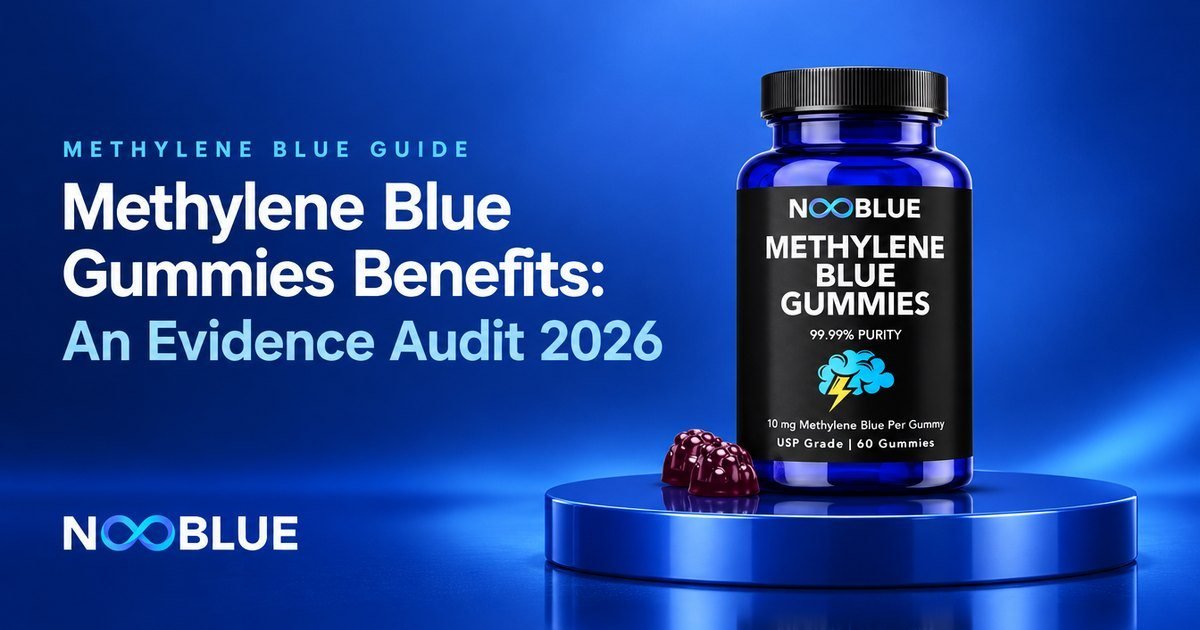
Methylene blue gummies benefits come down to two separate questions. What does methylene blue itself do at low doses, and what does the gummy format add? The honest answer to the first is: less than most marketing says, and more than nothing. There is one small randomized human study showing a modest memory effect after a single oral dose, a body of cell and animal research on mitochondria, and at least one human imaging study whose results went the opposite way. The gummy format doesn’t change any of that. What it changes is practical: a fixed dose, no measuring, and, with NooBlue’s gummies, no blue mouth.
This audit grades each claimed benefit against the study behind it, sets out what mainstream medical sources say, and shows where a gummy fits against capsules and drops.
Key Takeaways
- The best human evidence is one randomized, placebo-controlled study of 26 adults: a single low oral dose was linked to 7% more correct memory-retrieval responses and more brain activity during attention and memory tasks.
- The mitochondrial numbers people quote (complex IV up 30%, oxygen use up 37 to 70%) come from cells in a dish, not people.
- In healthy volunteers, intravenous methylene blue lowered brain blood flow and oxygen metabolism, the opposite of what the researchers expected. More is not better.
- A gummy adds consistency and convenience, not extra potency. No study has tested a finished methylene blue gummy.
- Do not take methylene blue with SSRIs, SNRIs, MAOIs or other serotonergic medicines, with G6PD deficiency, in pregnancy or breastfeeding, or under 18.
Table of contents
- 1. What Methylene Blue Gummies Benefits Actually Come Down To
- 2. Every Claimed Benefit, Graded by the Evidence Behind It
- 3. What the Research Doesn’t Show
- 4. What the Gummy Format Changes, and What It Doesn’t
- 5. Methylene Blue Gummies vs Capsules and Drops
- 6. Who a Gummy Suits, and Who Should Skip Methylene Blue
- 7. Frequently Asked Questions
- 7.1. What is the biggest benefit of methylene blue?
- 7.2. Is it healthy to take methylene blue every day?
- 7.3. Why do I feel so good on methylene blue?
- 7.4. Why do I feel weird after taking methylene blue?
- 7.5. Why don’t doctors prescribe methylene blue?
- 7.6. How long until you notice methylene blue gummies benefits?
- 7.7. Do methylene blue gummies turn your urine blue?
- 7.8. How many methylene blue gummies should I take a day?
- 8. Sources
What Methylene Blue Gummies Benefits Actually Come Down To
Every “gummy benefits” search mixes two claims, and separating them clears up most of the confusion.
The molecule. Methylene blue is a redox-active dye that can accept and donate electrons. At low doses it can cycle within the mitochondrial electron transport chain, which is the basis of the energy and focus claims (Rojas et al., 2012). Whatever it does, it does as methylene blue, whether it arrives in a gummy, a capsule or a drop of solution. No format gives a compound effects it doesn’t have.
The format. A gummy fixes the dose when it is made. There is no dropper, no measuring and nothing to convert. That matters for a product meant to be taken daily at a low, steady amount, but it is a convenience advantage, not a pharmacological one.
If you want the prior question, whether methylene blue works at all, we went through the human research separately, and our guide to methylene blue benefits covers the wider evidence beyond gummies.
Every Claimed Benefit, Graded by the Evidence Behind It
Most pages list benefits without saying whether a claim rests on a human trial, a cell culture or a plausible mechanism. Here is that grading.
| Claimed benefit | Best evidence available | What it showed | Grade |
|---|---|---|---|
| Short-term memory | Randomized, double-blind, placebo-controlled study, 26 healthy adults, single low oral dose | 7% more correct responses during memory retrieval about an hour after the dose | Human, small, single dose |
| Sustained attention | Same study, brain imaging | More activity in the insular cortex during a vigilance task | Human imaging |
| Brain energy metabolism in healthy people | Human and rat imaging study, intravenous doses | Lower global brain blood flow and oxygen metabolism, contrary to the researchers’ hypothesis | Human, points the other way |
| Mitochondrial energy output | Human fibroblasts in culture | Complex IV up 30%, oxygen consumption up 37 to 70% | Cells only |
| Antioxidant and redox support | Cell studies and reviews of the chemistry | Cycling between oxidized and reduced forms proposed to limit oxidant production | Mechanism |
| Slower cellular aging | Fibroblast lifespan experiments | Cell lifespan in culture extended by more than 20 population doublings | Cells only |
| Mood or an energy “lift” at supplement servings | No controlled human trial found | Anecdote and extrapolation from cell work | Unsupported |
The memory and attention results come from a study in Radiology. Twenty-six healthy adults aged 22 to 62 took either a single low oral dose of methylene blue or a placebo before brain scans. The methylene blue group showed more brain activity during a sustained-attention task and a short-term memory task, and 7% more correct responses during memory retrieval (Rodriguez et al., 2016). It is one study, with one dose, measured an hour later. A 7% effect is real but small, and it was produced by oral methylene blue in a study setting, not by a gummy.
The mitochondrial numbers come from cell-culture work in The FASEB Journal. In human IMR90 fibroblasts, nanomolar methylene blue raised complex IV activity by 30% and cellular oxygen consumption by 37 to 70%, and extended the cells’ lifespan in culture by more than 20 population doublings (Atamna et al., 2008). The same paper describes the mechanism: flavin-dependent enzymes use NAD(P)H to reduce methylene blue to leucomethylene blue, and cytochrome c oxidizes it back. These are cells in a dish, and that distinction belongs in every honest summary.
The result that cuts the other way comes from a 2023 study in the Journal of Cerebral Blood Flow and Metabolism. Researchers expected intravenous methylene blue to raise brain blood flow and energy use in healthy volunteers. At 0.5 and 1 mg per kg it lowered global cerebral blood flow and the brain’s oxygen metabolism instead, and the same happened in rats (Singh et al., 2023). The authors suggested two explanations: the doses may have been high enough to show methylene blue’s hormetic effect, where higher concentrations inhibit rather than boost metabolism, and a healthy brain may have little room to improve.
What the Research Doesn’t Show
Three limits apply to every benefit claim you will read, including ours.
- No study has tested a finished gummy. NooBlue’s own product page says the small human studies it cites examined oral methylene blue, not NooBlue gummies, and don’t establish results for the finished product.
- Dose matters in both directions. Methylene blue shows a hormetic dose-response, with opposite effects at low and high doses (Rojas et al., 2012). The Singh study is a reminder that “more” can mean less.
- Mainstream medical sources are cautious. Harvard Health notes that a drug working in a specific clinical setting doesn’t mean it can or should be used by the general population, and warns that adding methylene blue to certain antidepressants such as fluoxetine (Prozac) or duloxetine (Cymbalta) can cause a dangerous and sometimes fatal interaction. Dr. Carlos Roldan at MD Anderson writes that not all the health claims about methylene blue are proven and recommends working with a doctor who knows how it is used.
We think readers are better served by that caution than by a list of promises. Our pieces on whether methylene blue is good for you and whether methylene blue gummies are effective go further, and how we describe mental clarity and cellular support applies the same standard to our own products. The anti-aging evidence review covers the cell-lifespan research in more depth.
What the Gummy Format Changes, and What It Doesn’t
Dose consistency. A drop of solution depends on the dropper and how you hold it. A NooBlue gummy lists 10 mg of USP-grade methylene blue per gummy, set when it is made. You chew one a day, and a bottle of 60 lasts 60 days.
Convenience. Nothing to measure, mix or carry in a glass bottle. A supplement can only do anything on the days you actually take it, and formats that need preparation are easier to skip.
No blue mouth. Drops can tint the tongue and teeth. NooBlue gummies don’t leave a blue mouth or blue tongue. They also contain 25 mg of vitamin C per gummy, which can shift methylene blue toward its colorless reduced form. NooBlue’s published ingredient report does not measure how much of the methylene blue is in that form in the finished gummy, so we don’t claim a percentage.
Taste. NooBlue gummies are a wild blueberry pectin chew with 0 g of sugar. Unflavored drops taste bitter and metallic.
What doesn’t change: the evidence and the absorption. The 7% memory figure came from oral methylene blue, not a gummy, and no format turns a modest effect into a large one. NooBlue’s product page says its published report does not establish superior absorption, and you should be skeptical of any brand that quotes an absorption advantage for a gummy without a study on that product. For the ingredient list, see what is inside methylene blue gummies.
Testing. NooBlue publishes a report from Contract Testing Laboratories of America (CTLA) on its methylene blue ingredient lot, covering identity and heavy metals. It is ingredient-level evidence. It does not give a purity percentage or certify every finished batch. If you are comparing brands on their lab reports, our methylene blue gummies review audits what each brand publishes, and our comparison of the best methylene blue gummies lines them up on dose and price.
Methylene Blue Gummies vs Capsules and Drops
NooBlue makes all three formats below. They contain the same molecule and differ on dose steps, cost and routine.
| Format | Per serving | Price (as of Sep 2026) | Cost per serving | Suits |
|---|---|---|---|---|
| Gummies, 60 per bottle | 10 mg methylene blue, 25 mg vitamin C | $49.99 | $0.83 | A fixed daily routine with no measuring and no blue mouth |
| Capsules, 60 per bottle | 5 mg methylene blue, 10 mg vitamin C | $37.99 | $0.63 | Starting low, or a neutral capsule taken with food |
| 1% drops, 50 mL | 0.5 mg per drop, 5 mg in 10 drops | $29.99 | $0.30 at 5 mg | Adjusting in half-milligram steps at the lowest cost per serving |
Read plainly, the drops cost least per serving, the capsules give you the lower 5 mg step, and the gummies are the simplest to take every day. See methylene blue gummies vs capsules and gummies vs liquid drops for the full comparisons, and what quality methylene blue costs if price is your main filter. All three are in the NooBlue shop.
Who a Gummy Suits, and Who Should Skip Methylene Blue
A gummy suits you if you have given up on drops because of the measuring or the blue mouth, if you are settled at 10 mg a day and want nothing to adjust, or if taste has been the barrier. It suits you less if you want to start at 5 mg or adjust in small steps, where capsules or drops fit better. Our guide on how to take methylene blue gummies covers the routine.
Skip methylene blue entirely if any of these apply:
- You take an SSRI, SNRI, MAOI or any other serotonergic medicine, including many antidepressants. The combination can cause serotonin syndrome.
- You have G6PD deficiency.
- You are pregnant or breastfeeding.
- You are under 18.
Talk to your doctor before use if you take any prescription medicine or have a kidney or liver condition. Methylene blue can turn urine blue or green, which is expected. Read the side effects worth knowing before you start and what not to take with methylene blue. This article is general information, not medical advice.
Frequently Asked Questions
What is the biggest benefit of methylene blue?
On current human evidence, the best documented effect is a modest one on memory and attention: in a randomized, placebo-controlled study of 26 healthy adults, a single low oral dose was linked to 7% more correct memory-retrieval responses and more brain activity during attention and memory tasks. The larger mitochondrial effects have been shown in cell culture, not in people.
Is it healthy to take methylene blue every day?
Daily use at the label serving is how supplements like NooBlue’s are designed to be taken: one 10 mg gummy or one 5 mg capsule a day, without exceeding the suggested serving. Whether it suits you depends on your medicines and health. Do not take it with serotonergic medicines, with G6PD deficiency, in pregnancy or breastfeeding, or under 18, and talk to your doctor if you take any prescription medicine. Our analysis of whether methylene blue is safe to take daily goes deeper.
Why do I feel so good on methylene blue?
No controlled study has measured mood at supplement servings, so individual reports can’t be separated from expectation. What is known is that methylene blue is a potent reversible inhibitor of monoamine oxidase A (Ramsay et al., 2007), an enzyme that breaks down serotonin, which is exactly why it must never be combined with serotonergic medicines.
Why do I feel weird after taking methylene blue?
Possible reasons include the dose, the time of day and an interaction with something else you take. Stop taking it and talk to your doctor. If you feel agitated, confused, feverish or have a racing heart, especially while taking any antidepressant or other serotonergic medicine, get medical help right away.
Why don’t doctors prescribe methylene blue?
Doctors do use methylene blue, mainly in hospitals, where it is given into a vein at 1 mg per kg over 5 to 30 minutes for a specific blood emergency (Ostrovsky and Afzal, StatPearls). For everyday use in healthy people the evidence is limited and mixed, which is why medical sources such as Harvard Health and MD Anderson advise caution and a conversation with your doctor.
How long until you notice methylene blue gummies benefits?
In the human study, the memory and attention effects were measured about an hour after a single dose, and they were modest enough that many people wouldn’t notice them. The cell effects have no human timeline. Be skeptical of any product that promises a dramatic change by a set number of weeks. For timing, see the best time of day to take methylene blue.
Do methylene blue gummies turn your urine blue?
They can. NooBlue gummies don’t leave a blue mouth, but methylene blue can turn urine blue or green whichever form you take, and that is expected.
How many methylene blue gummies should I take a day?
One NooBlue gummy (10 mg) a day, as the label says, and no more. If you would rather start lower, a 5 mg capsule is the better first step than cutting a gummy.
Sources
- Rodriguez P, Zhou W, Barrett DW, et al. Multimodal randomized functional MR imaging of the effects of methylene blue in the human brain. Radiology, 2016. PubMed 27351678
- Atamna H, Nguyen A, Schultz C, et al. Methylene blue delays cellular senescence and enhances key mitochondrial biochemical pathways. The FASEB Journal, 2008. PubMed 17928358
- Singh N, MacNicol E, DiPasquale O, et al. The effects of acute methylene blue administration on cerebral blood flow and metabolism in humans and rats. Journal of Cerebral Blood Flow and Metabolism, 2023. PubMed 36803299
- Rojas JC, Bruchey AK, Gonzalez-Lima F. Neurometabolic mechanisms for memory enhancement and neuroprotection of methylene blue. Progress in Neurobiology, 2012. PubMed 22067440
- Ramsay RR, Dunford C, Gillman PK. Methylene blue and serotonin toxicity: inhibition of monoamine oxidase A (MAO A) confirms a theoretical prediction. British Journal of Pharmacology, 2007. PubMed 17721552
- Ostrovsky A, Afzal M. Methylene Blue. StatPearls, NCBI Bookshelf. NBK557593
- Goldman L. What to know about methylene blue. Harvard Health Publishing, 2025. health.harvard.edu
- Roldan C. Methylene blue: should you take it? MD Anderson, 2026. mdanderson.org