Quick answer
Leucomethylene blue is the colorless, reduced form of methylene blue. It is the same molecule carrying two extra electrons and one extra hydrogen, which PubChem records as C16H19N3S with a molecular weight of 285.4 g/mol. When it gives those electrons away, which it does readily in air, it turns back into blue methylene blue. Your body makes it from any methylene blue you swallow, and the two forms cycle back and forth inside cells.
You will find it in three places: chemical catalogs, where it is sold as a lab reagent; drug research, where a stabilized salt called LMTM has been tested in large clinical trials; and supplements, where methylene blue is paired with a reducing agent such as vitamin C.
Safety first: the leuco form does not change the rules. Do not take any methylene blue product if you take serotonergic medicines such as SSRIs, SNRIs or MAOIs, if you have G6PD deficiency, or if you are pregnant or breastfeeding.
Written by the NooBlue editorial team. We sell a methylene blue gummy made with vitamin C, so we have a stake in this topic. Every claim below points to its source, and we say where the evidence stops.
Search for leucomethylene blue and most of what comes back is written for chemists: a PubChem record, a journal paper on the molecule’s shape, and reagent vendors. This guide explains the same chemistry for people who take methylene blue, or are thinking about it, and keep seeing the word “leuco” on labels.
Table of contents
- 1. What leucomethylene blue is
- 2. How methylene blue becomes leucomethylene blue, and back
- 3. Methylene blue vs leucomethylene blue
- 4. Why the leuco form is colorless, and what that means for staining
- 5. Leucomethylene blue in supplements
- 6. Leucomethylene blue mesylate (LMTM): the drug behind the research results
- 7. Does the leuco form change the safety rules?
- 8. Frequently asked questions about leucomethylene blue
- 8.1. What is the difference between methylene blue and leucomethylene blue?
- 8.2. What color is leucomethylene blue?
- 8.3. What does methylene blue do to your body?
- 8.4. Is it true that methylene blue makes you look younger?
- 8.5. Why don’t doctors recommend methylene blue?
- 8.6. Is leucomethylene blue better than methylene blue?
- 8.7. Can you buy leucomethylene blue on its own?
- 8.8. Is it okay to take methylene blue every day?
- 8.9. Is methylene blue toxic for humans?
- 8.10. What converts swallowed methylene blue into leucomethylene blue?
- 9. The bottom line
- 10. Sources
What leucomethylene blue is
Methylene blue is a phenothiazine dye. Its color comes from electrons spread across a flat, three-ring system that absorbs red and orange light, so a solution looks blue. Add two electrons and a hydrogen and that arrangement breaks. The result is leucomethylene blue. “Leuco” comes from the Greek word for white, and chemists use it for the colorless reduced form of a dye.
The change is small on paper. PubChem lists leucomethylene blue (CID 164695) as C16H19N3S, molecular weight 285.4 g/mol. Methylene blue as sold is a chloride salt, C16H18ClN3S (CID 6099), molecular weight 319.9 g/mol, and the part that does the chemistry is the positively charged methylene blue ion. The leuco form carries no charge, so it mixes more readily into fats. PubChem computes an XLogP of 3.9 for it, a measure of how strongly a molecule prefers oily surroundings to water.
The shape changes too. In a 2025 paper in The Journal of Physical Chemistry B, Batchelor and colleagues used modeling and X-ray crystallography to show that leucomethylene blue is bent into a “butterfly” shape, folded to about 150 degrees across its central sulfur and nitrogen atoms. Flat methylene blue binds DNA. In their tests, the bent leuco form showed essentially no binding.
One property matters most in practice: leucomethylene blue is unstable in air. Oxygen takes its electrons and turns it blue again. That is why it is hard to sell as a standalone product, and why any product built on it needs something to keep it reduced. If you are curious how the parent dye is made in the first place, our explainer on what methylene blue is made from covers the manufacturing side.
How methylene blue becomes leucomethylene blue, and back
If you have taken methylene blue, you have already had leucomethylene blue in your body. The conversion is ordinary biochemistry.
Emadi, Alamdari and Sahebkar, writing in Current Medicinal Chemistry in 2025, describe the step doctors rely on when they use methylene blue in hospital. An enzyme, NADPH-dependent methemoglobin reductase, reduces methylene blue to leucomethylene blue, and the leuco form then passes its electrons to the iron in hemoglobin. Having given its electrons away, it is methylene blue again, ready for another round.
A 2004 study in the American Journal of Physiology: Cell Physiology adds a detail about how the dye gets into cells. Working with human red blood cells, May, Qu and Cobb found that the cells reduced methylene blue outside the cell first and then took up the reduced form, which was partly re-oxidized inside. Both forms built up inside the cells, and the back-and-forth cycling put the cells under oxidant stress. Below about 5 micromolar the dye mainly used up NAD(P)H. At higher concentrations it also depleted glutathione and vitamin C. That was an isolated-cell experiment, not a study of people taking a supplement, but it shows why more is not better with this compound.
The same cycling is the proposed reason for methylene blue’s effects on mitochondria. Atamna and colleagues, publishing in The FASEB Journal in 2008, reported that enzymes using NAD(P)H reduce methylene blue to the leuco form while cytochrome c oxidizes it back. In human fibroblasts grown in a dish, methylene blue raised mitochondrial complex IV by 30% and oxygen use by 37 to 70%. The authors proposed the cycling as the cause. These are cell results, not a human trial.
So neither form is the “real” one. The molecule spends its working life switching between the two. For what that means after a dose, see our guide to how long methylene blue takes to work, and for serving sizes, our guide to how many mg of methylene blue per day.
Methylene blue vs leucomethylene blue
These are the same molecule at two points in one cycle. The table shows what the two extra electrons change.
| Property | Leucomethylene blue (reduced) | Methylene blue (oxidized) |
|---|---|---|
| Color | Colorless to very pale | Deep blue in solution |
| Formula (PubChem) | C16H19N3S, 285.4 g/mol | C16H18ClN3S as the chloride salt, 319.9 g/mol |
| Charge | Neutral | Positively charged ion |
| Redox role | Gives electrons (reducing) | Accepts electrons (oxidizing) |
| Shape | Bent “butterfly”, about 150 degrees | Flat |
| DNA binding in lab tests | Essentially none | Binds |
| In air | Re-oxidizes to methylene blue | Stays blue |
| Where you meet it | Reagent catalogs, LMTM drug trials, inside your own cells | Supplements, hospital use, lab stains |
Your body carries both forms whatever you buy, because the enzymes that reduce and re-oxidize the dye keep working. What a product changes is the state the dye is in before you swallow it.
Why the leuco form is colorless, and what that means for staining
The blue tongue that follows a dose of liquid methylene blue is the dye doing what dyes do. The oxidized, charged form is an intense colorant, and a few drops of a 1% solution can tint the mouth for a while. Our guide to whether methylene blue stains teeth covers how long that lasts and how to limit it.
The leuco form has no color to leave behind, because the part of the molecule that absorbs light is broken. That is the reason brands pair methylene blue with a reducing agent. Three limits apply.
- It re-oxidizes. Oxygen in air and water gives the leuco form every chance to hand its electrons back and turn blue. A product has to keep it reduced, and no product can promise that every molecule stays that way.
- A label is not a measurement. One 1% liquid sold on Amazon as “Leucomethylene Blue Reduced Form” with ascorbic acid has a reviewer describing a blue tint in the mouth that fades after a short while, and another saying it looks like typical methylene blue once mixed into water.
- Nobody has published the ratio for a finished product. We have not measured what share of the methylene blue in our own gummy is in the reduced form, and our published lab report does not measure it either. What we can say is that the gummies don’t leave the blue mouth that drops can, though we haven’t measured why.
Leucomethylene blue in supplements
Most methylene blue supplements contain the oxidized form: blue powder in a capsule or blue liquid in a dropper bottle. The reduction happens later, inside you. Some products move part of that step into the formula by adding a reducing agent, almost always vitamin C.
The idea is not unique to one brand. Nutricel’s Blue Boost capsule pairs 12 mg of methylene blue with 35 mg of vitamin C ester and says the vitamin C ester helps form leucomethylene blue. The Amazon liquid mentioned above combines a 1% methylene blue solution with ascorbic acid and calls itself a reduced form. Our own products use vitamin C in two of three formats:
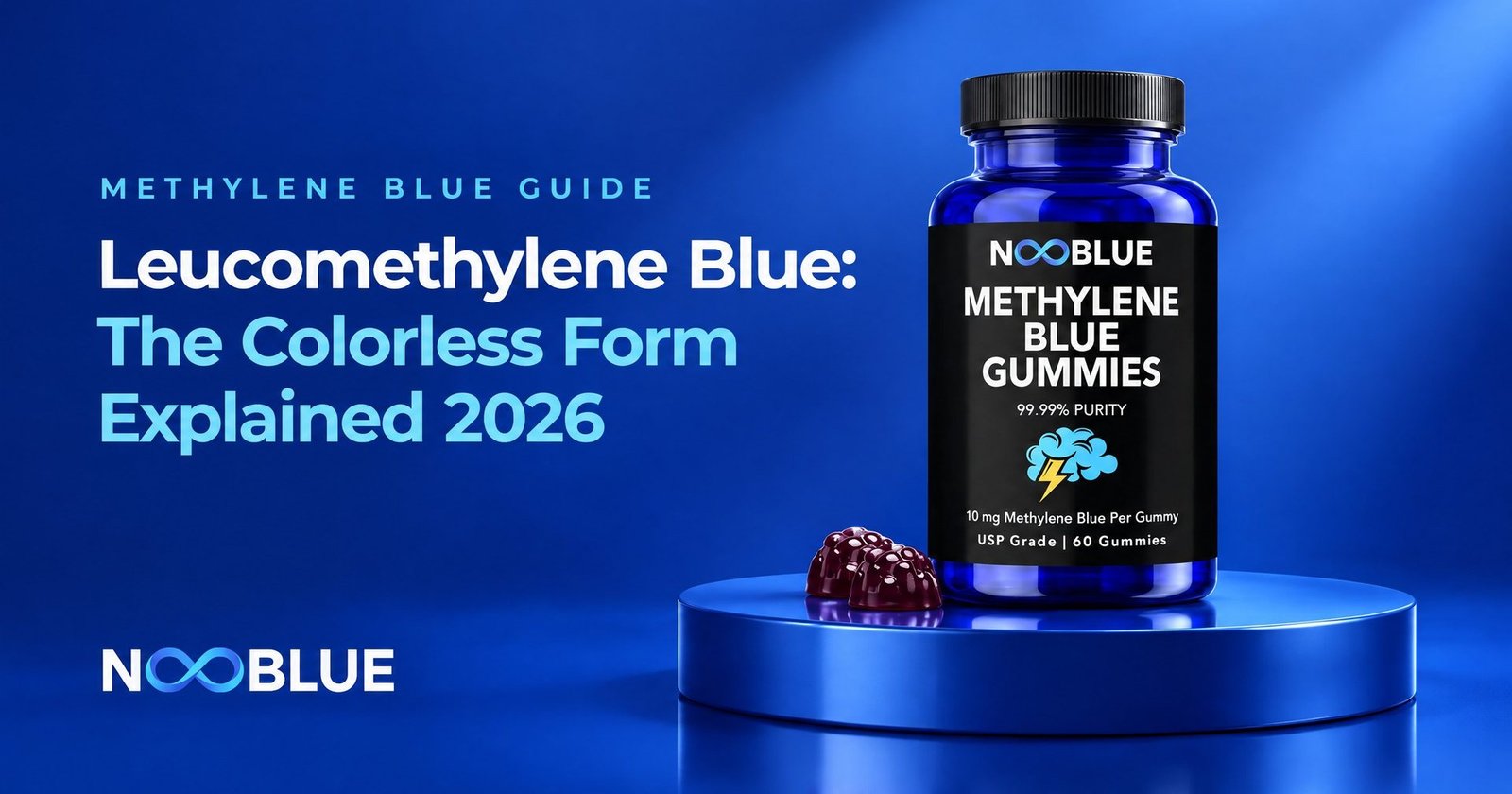
- NooBlue Methylene Blue Gummies: 10 mg of USP-grade methylene blue and 25 mg of vitamin C per gummy, in a Wild Blueberry pectin chew with zero sugar. The purple color comes from blueberry extract. A bottle of 60 costs $49.99, or $0.83 a gummy.
- Ultimate Methylene Blue Capsules: 5 mg of methylene blue with 10 mg of vitamin C in a vegetable capsule, 60 per bottle, $37.99, or $0.63 a capsule.
- Methylene Blue Drops: a plain 1% USP solution with no reducing agent, 0.5 mg per drop, 50 mL for $29.99.
Vitamin C can donate electrons to methylene blue and push it toward the leuco form. Here is what we do not claim: that our gummy absorbs better by any measured amount, or that it beats a capsule on any human outcome. No one has run a trial comparing leuco-form and standard methylene blue supplements in people. Contract Testing Laboratories of America (CTLA) analyzed the methylene blue ingredient we use, lot 2025022801, in report 135621, for identity and heavy metals. The report covers that raw ingredient, not each finished batch, and gives no purity percentage.
For a wider look at the category, our comparison of the best methylene blue gummies puts the options side by side, our guide to methylene blue gummy ingredients covers labels, and gummies vs capsules sets out the trade-offs between the two solid formats. If you are asking whether gummies work at all, read are methylene blue gummies effective.
Leucomethylene blue mesylate (LMTM): the drug behind the research results
Reagent vendors selling “leucomethylene blue mesylate” show up in searches for this term. The compound, also called LMTM or hydromethylthionine mesylate, is a stable salt of the reduced form. It was developed so the leuco form could be given by mouth as an investigational drug that blocks the clumping of a protein called tau in lab and mouse studies.
It has been through large trials. In a 15-month phase 3 trial published in The Lancet in 2016, Gauthier and colleagues randomized 891 participants to 75 mg or 125 mg of LMTM twice a day, or to a 4 mg control dose. The prespecified primary analysis showed no benefit at either higher dose. LMTM is a research drug, not a supplement, and it is sold to laboratories rather than to consumers. If you or someone you care for has Alzheimer’s disease, talk to a doctor about the options rather than looking for this compound online.
What LMTM does show is that the reduced form can be stabilized and taken by mouth. That supports the chemistry behind vitamin C formulas. It does not turn a gummy into a drug, and it says nothing about what a 10 mg supplement does.
Does the leuco form change the safety rules?
No. Inside the body the two forms keep converting into each other, so a leuco-form product becomes methylene blue in you and the usual rules apply in full.
- Serotonergic medicines. Methylene blue is a potent inhibitor of monoamine oxidase A, the enzyme that breaks down serotonin, as Ramsay, Dunford and Gillman showed in 2007. Do not combine it with SSRIs, SNRIs, MAOIs or other serotonergic medicines. Our guide to the serotonin syndrome risk with methylene blue explains the warning signs.
- G6PD deficiency. Methylene blue can make red blood cells break down in people with G6PD deficiency. The 2025 Emadi paper argues that leucomethylene blue might one day be a safer option in that group, but it is a hypothesis, and the authors say experimental and clinical trials are still needed. Do not take any methylene blue product, leuco-labeled or not, if you have G6PD deficiency. Our G6PD and methylene blue guide covers testing.
- Pregnancy and breastfeeding. Do not take methylene blue while pregnant or breastfeeding.
Talk to your doctor before you start if you take any prescription medicine. Our list of what not to take with methylene blue and our side effects guide cover the rest.
Frequently asked questions about leucomethylene blue
What is the difference between methylene blue and leucomethylene blue?
Leucomethylene blue is methylene blue that has gained two electrons and a hydrogen. That makes it colorless instead of blue, uncharged instead of charged, bent instead of flat, and an electron donor instead of an electron acceptor. The two forms convert into each other continuously inside the body.
What color is leucomethylene blue?
Colorless to very pale. It turns blue again as soon as it gives up its electrons, which it does readily in air. That is why it is hard to keep as a standalone product.
What does methylene blue do to your body?
Once swallowed, enzymes reduce methylene blue to leucomethylene blue, which then passes its electrons on and turns back. In cells, that shuttling lets the molecule carry electrons in mitochondria. It also inhibits monoamine oxidase A, which is why it interacts with serotonergic medicines, and it colors urine blue or green. Most of what is known about its effects on the brain comes from cells and animals. The best-known human study gave 26 adults a single 280 mg dose and found more brain activity during memory tasks an hour later, which says little about a daily supplement.
Is it true that methylene blue makes you look younger?
There is no human evidence for that. A 2017 study in Scientific Reports by Xiong and colleagues found that methylene blue delayed senescence in human skin cells grown in a dish and improved hydration and thickness in a lab-grown 3D skin model. No trial has tested whether taking methylene blue, or putting it on your skin, changes how old you look. Our anti-aging evidence guide covers the details.
Why don’t doctors recommend methylene blue?
Because the evidence for everyday use is thin and the risks are real. Most brain research is in animals and cells, and large, long human trials at supplement amounts have not been done. It interacts with serotonergic medicines, it must be avoided with G6PD deficiency and in pregnancy, and a 2022 review in Toxicology Research called its clinical use controversial because basic toxicology data are lacking. Doctors do use it in hospitals for specific situations, under monitoring.
Is leucomethylene blue better than methylene blue?
Not in any way that has been measured in people. Because your body converts between the two forms, the practical difference is the state the dye is in before you swallow it, which mainly affects color in the mouth. No published human trial shows better results from a leuco-form supplement, and any brand that says otherwise is ahead of the evidence.
Can you buy leucomethylene blue on its own?
Only as a chemical reagent, and it re-oxidizes in air, so a standalone consumer bottle is impractical. In supplements it appears as methylene blue paired with a reducing agent such as vitamin C. If you are unsure what you can buy without a prescription, see our guide to whether you need a prescription for methylene blue.
Is it okay to take methylene blue every day?
Many supplement users take a small daily amount, and our formats are sized for that: a 5 mg capsule, a 10 mg gummy or drops at 0.5 mg each. Long-term human trials at these amounts do not exist, so start low, take it early in the day because a late dose can disrupt sleep for some people, and do not assume more is better. Never combine it with serotonergic medicines, and skip it with G6PD deficiency, pregnancy or breastfeeding.
Is methylene blue toxic for humans?
Its effects depend on the dose. A 2022 review in Toxicology Research lists the toxic effects reported with medical use, including the breakdown of red blood cells, nausea and vomiting, chest pain and shortness of breath, and it describes serotonin toxicity when methylene blue is combined with serotonergic drugs. The leuco form changes none of this, and the exclusions above apply to every format. Our side effects guide covers the milder effects people notice.
What converts swallowed methylene blue into leucomethylene blue?
Enzymes. Emadi and colleagues describe NADPH-dependent methemoglobin reductase reducing methylene blue to the leuco form, and Atamna’s team describes flavin-dependent enzymes that use NAD(P)H. In human red blood cells, May, Qu and Cobb found that the reduction happened outside the cell first, and the colorless form was what crossed the membrane.
The bottom line
Leucomethylene blue is methylene blue with two extra electrons: colorless, uncharged, bent and short-lived in air. Your body makes it from every dose, and it turns back into methylene blue as it works. In supplements, “leuco” means methylene blue paired with a reducing agent. That can cut down blue color at the point of contact, but it has not been shown to change results in people, and the safety rules are the same for both forms.
If you want methylene blue with vitamin C and nothing to measure, our gummies are built that way. The capsules give a fixed 5 mg with 10 mg of vitamin C, and the drops give you 0.5 mg steps. You can compare all three in the NooBlue shop, or read what methylene blue gummies are and how to take them first.
Sources
- PubChem. Leucomethylene blue, CID 164695. pubchem.ncbi.nlm.nih.gov
- PubChem. Methylene blue, CID 6099. pubchem.ncbi.nlm.nih.gov
- Batchelor et al. The butterfly structure of leucomethylene blue results in weak binding to single- or double-stranded DNA. The Journal of Physical Chemistry B. 2025;129(47):12110-12119. doi:10.1021/acs.jpcb.5c05704
- Emadi E, Alamdari DH, Sahebkar A. The potential of leucomethylene blue in methemoglobinemia treatment: a new hope for patients with G6PD? Current Medicinal Chemistry. 2025;32(6):1033-1039. PubMed 37694789
- May JM, Qu ZC, Cobb CE. Reduction and uptake of methylene blue by human erythrocytes. American Journal of Physiology: Cell Physiology. 2004;286(6):C1390-C1398. PubMed 14973146
- Atamna H, Nguyen A, Schultz C, et al. Methylene blue delays cellular senescence and enhances key mitochondrial biochemical pathways. The FASEB Journal. 2008;22(3):703-712. PubMed 17928358
- Gauthier S, Feldman HH, Schneider LS, et al. Efficacy and safety of tau-aggregation inhibitor therapy in patients with mild or moderate Alzheimer’s disease: a randomised, controlled, double-blind, parallel-arm, phase 3 trial. The Lancet. 2016;388(10062):2873-2884. PubMed 27863809
- Ramsay RR, Dunford C, Gillman PK. Methylene blue and serotonin toxicity: inhibition of monoamine oxidase A (MAO A) confirms a theoretical prediction. British Journal of Pharmacology. 2007;152(6):946-951. PubMed 17721552
- Xiong ZM, O’Donovan M, Sun L, et al. Anti-aging potentials of methylene blue for human skin longevity. Scientific Reports. 2017;7(1):2475. PubMed 28559565
- Bužga M, Machytka E, Dvořáčková E, et al. Methylene blue: a controversial diagnostic acid and medication? Toxicology Research. 2022;11(5):711-717. PMC9618115
- Rodriguez P, Zhou W, Barrett DW, et al. Multimodal randomized functional MR imaging of the effects of methylene blue in the human brain. Radiology. 2016;281(2):516-526. PubMed 27351678
- Product pages read in September 2026: Nutricel Blue Boost; Leucomethylene Blue Reduced Form 4 oz with Ascorbic Acid 1% Solution (Amazon).