Short answer
Yes, methylene blue does expire, in the sense that every product carries a shelf life its maker stands behind. The molecule holds up well when it is sealed, dark and at room temperature. Pharmaceutical methylene blue injection in sealed glass ampoules carries a 4-year shelf life, and the published injection labels agree on three storage rules: keep it at room temperature, keep it in its package away from light, and do not refrigerate or freeze it. For a supplement, follow the date on your label, keep the bottle closed in a cool, dry cupboard, and replace it if drops turn cloudy or capsules and gummies go soft and sticky.
- Room temperature, not the fridge. The US injection label sets 20–25 °C (68–77 °F) and allows short trips between 15 and 30 °C (59–86 °F).
- Light and heat do the damage. Methylene blue in water loses color under ordinary lamps and LEDs, and a parked car can climb about 40 °F above the outside air within an hour.
- After opening, cleanliness and a closed lid matter more than the calendar. Our capsules and gummies are 60-day supplies, and a bottle of drops gives about 100 servings at 5 mg.
- Safety outranks the date. Methylene blue is not for anyone taking serotonergic medicines, anyone with G6PD deficiency, or anyone pregnant or breastfeeding without a doctor’s approval.
Questions about methylene blue shelf life tend to start in one of three places: a bottle found at the back of a cupboard, a plan to buy two or three bottles at once, or a fish-tank kit that has sat on a shelf for years. The chemistry is the same in every case, but the practical rules change with the format. Below you will find what the published labels say, what wears methylene blue down, how to store capsules, gummies and drops, how to tell when a bottle is past it, and the safety points that matter more than any date.
NooBlue makes the capsules, gummies and drops named on this page, so we have an interest in the answer. Where we could not find evidence for a claim that circulates online, we say so rather than repeat it.
Table of contents
- 1. Does Methylene Blue Expire? What the Date on the Label Means
- 2. Methylene Blue Shelf Life: What the Published Labels Say
- 3. What Wears Methylene Blue Down: Light, Heat, Moisture and Air
- 4. Does Methylene Blue Need to Be Refrigerated?
- 5. How to Store Methylene Blue, Format by Format
- 6. How Long Does Methylene Blue Last After Opening?
- 7. Does Methylene Blue Go Bad? Signs a Bottle Is Past It
- 8. Shelf Life vs How Long Methylene Blue Stays in Your System
- 9. Safety Checks That Matter More Than the Date
- 10. Which NooBlue Format Fits Your Storage Habits
- 11. Frequently Asked Questions About Methylene Blue Shelf Life
- 11.1. Does methylene blue expire?
- 11.2. How long does methylene blue last?
- 11.3. Does methylene blue need to be refrigerated?
- 11.4. What temperature should methylene blue be stored at?
- 11.5. Is it safe to take methylene blue after its expiration date?
- 11.6. How long does diluted methylene blue last?
- 11.7. How should I store methylene blue gummies?
- 11.8. Does aquarium methylene blue expire?
- 11.9. How long does methylene blue stay in your system?
- 11.10. What should you not mix with methylene blue?
- 11.11. How many drops of methylene blue should I take?
- 12. Sources
Does Methylene Blue Expire? What the Date on the Label Means
An expiry or best-before date is the maker’s promise about strength, backed by whatever stability data they hold. Up to that date, a product stored as the label directs should contain what the label says. After it, nobody is making that promise. That is a different thing from saying the product has turned harmful, and it is worth keeping the two ideas apart.
Methylene blue does not spoil the way food does. It is a synthetic dye, not a fat that turns rancid or a live culture that dies off. What can happen over time is slow chemical change driven by light and heat, physical damage to capsules and gummies from heat and damp air, and contamination once a bottle has been opened. Those are the things you can control, and they are the subject of most of this page.
The best public benchmark comes from pharmaceutical methylene blue. The summary of product characteristics for Proveblue, a 5 mg/ml methylene blue injection sold in the UK, lists a shelf life of 4 years for sealed glass ampoules kept in their carton. That figure comes from formal stability testing of a sterile solution sealed in glass. It shows the molecule can last for years when it is sealed, dark and at room temperature. It does not carry over directly to a supplement, whose shelf life depends on its own formula, packaging and testing.
We have not found a published stability study on methylene blue supplements from any brand, and our own product pages do not publish one either. So the honest rule for supplements is short: the date printed on your label is the limit, and storage decides whether the product reaches that date in good shape. Shelf-life figures quoted in forum threads and search snippets without a source are not a substitute for the date on the bottle in your hand.
Methylene Blue Shelf Life: What the Published Labels Say
Here is what the documents that come with methylene blue products state, as of Sep 2026. The three NooBlue rows come from our product pages. The two injection rows come from the prescribing documents for pharmaceutical methylene blue, which carry the most detailed public storage data we could find.
| Product | What is in it | Shelf life stated | Storage instruction | After opening |
|---|---|---|---|---|
| NooBlue Methylene Blue Capsules | 5 mg methylene blue + 10 mg vitamin C per capsule, 60 capsules | Follow the date on the label | Tightly closed, cool and dry, away from direct heat and sunlight | 60-day supply at one capsule a day |
| NooBlue Methylene Blue Gummies | 10 mg methylene blue + 25 mg vitamin C per gummy, 60 gummies | Follow the date on the label | Tightly closed, cool and dry, away from direct heat and sunlight | 60-day supply at one gummy a day |
| NooBlue Methylene Blue Drops | 1% solution in distilled water, 50 ml, 0.5 mg per drop | Follow the date on the label | Tightly closed, cool and dry, away from direct heat and sunlight | About 100 servings at 5 mg (10 drops) |
| Proveblue injection (UK) | 5 mg/ml solution in glass ampoules | 4 years, sealed | Do not refrigerate or freeze; keep in the original package to protect from light | Use immediately after opening or dilution |
| ProvayBlue injection (US) | 5 mg/ml solution in single-dose ampules or vials | Not stated in the label text | 20–25 °C, short excursions to 15–30 °C, do not refrigerate or freeze, keep in the original package to protect from light | Single-dose; discard any unused portion |
Read across the rows and the pattern is consistent. Every label asks for a closed container, room temperature or cooler, and protection from light and heat. Neither injection label allows refrigeration or freezing. None of them gives an open-bottle period for a multi-dose container, because the injections are single-use and the supplement pages do not state one.
Two things follow for anyone keeping a supplement at home. The date on your own label is the number to trust. And how you store the bottle after the seal is broken is the part you control, which is why the rest of this guide spends its time there.
What Wears Methylene Blue Down: Light, Heat, Moisture and Air
Light
Methylene blue reacts to light. Researchers study it as a photosensitizer, a compound that absorbs light and passes the energy on to drive chemical reactions (Tardivo and colleagues, Photodiagnosis and Photodynamic Therapy, 2005). A 2019 study in the Journal of Fluorescence shone an ordinary fluorescent lamp, red, green and blue LEDs, and a UV-A bulb on methylene blue dissolved in water. The dye lost color under these light sources even when no catalyst was added, and chemical analysis found it had partly broken down into other compounds, including the colorless leuco form (Sáenz-Trevizo and colleagues, 2019).
That study used continuous lab lighting on an open solution, so it does not tell you how many weeks a bottle on a bright shelf would last. It does explain why both injection labels tell pharmacies to keep the product in its original package to protect it from light. At home, the same instruction costs nothing: keep the bottle in its box or in a closed cupboard, never on a sunny windowsill or a bright counter. Drops are the format most exposed to this, since they are already a solution.
Heat
Heat speeds up most chemical change, and it physically damages some formats. The US injection label sets 20–25 °C (68–77 °F) as the storage range and allows short excursions between 15 and 30 °C (59–86 °F). A normal home sits inside that range for most of the year. The places that do not are the ones people forget: a cupboard above the stove or kettle, a sunny shelf, a gym bag, and above all a parked car.
Cars heat up faster than most people expect. In a Stanford study published in Pediatrics in 2005, a dark sedan parked on clear, sunny days warmed by about 40 °F within an hour, and even on the coolest test day, with 72 °F outside, the inside reached 117 °F. Cracking the windows open did not slow the rise. A bottle left in a car through an afternoon has spent hours far outside any label range, and gummies in particular can soften and fuse together.
Moisture
Moisture matters most for capsules and gummies. Our capsules use a vegetable cellulose shell with rice flour inside, and our gummies are a pectin chew. Damp air can make capsule shells soft or sticky and leave gummies tacky or stuck together. That is why every NooBlue label says “cool, dry place,” and why a steamy bathroom cabinet is a poor home for any supplement.
Air and contamination
Every time a bottle opens, room air and whatever is on your hands, the dropper or the counter get a chance to reach the contents. For capsules and gummies this is minor if the lid goes back on promptly. For a liquid it matters more, because a solution that picks up microbes can grow them. The injection documents handle this by making every ampule single-use. The UK document says an opened or diluted product must be used immediately, and the US label says to discard any unused portion. A supplement dropper bottle is built for repeat use, so the job falls to you: a clean dropper, a closed cap, and no drips back into the bottle.
Does Methylene Blue Need to Be Refrigerated?
No. Methylene blue does not need to be refrigerated, and the pharmaceutical labels go further: both the UK and US injection documents say “do not refrigerate or freeze.” Our capsules, gummies and drops are all labeled for a cool, dry place away from direct heat and sunlight, which in practice means an ordinary cupboard at room temperature.
The labels do not explain the rule, so here is the practical reason it makes sense at home. A cold bottle brought into a warm kitchen collects condensation on the inside of the lid and on anything exposed when you open it. Do that once or twice a day and you are adding moisture to capsules and gummies on a schedule, which is exactly what the “dry place” instruction is there to avoid. For drops, cold storage offers no benefit that any label claims, and freezing is ruled out outright.
If your home runs well above the label range for weeks, such as a summer with no air conditioning, the answer is the coolest dark spot in the house, such as an interior closet or a low cupboard on a shaded wall, rather than the fridge.
Storage temperature at a glance
| Where you keep it | Good choice? | Why |
|---|---|---|
| Closed kitchen or bedroom cupboard, away from the stove | Yes | Dark, dry and at room temperature, which is what every label asks for |
| Bathroom cabinet | No | Shower steam and humidity soften capsules and gummies |
| Windowsill or bright counter | No | Direct light and heat |
| Fridge | No | The injection labels say do not refrigerate, and each opening adds condensation |
| Freezer | No | The injection labels say do not freeze |
| Car, garage or shed | No | Can run far above 30 °C (86 °F) on a sunny day |
| Carry-on bag while traveling | Yes, short term | Stays with you at indoor temperature |
The short version: a closed cupboard away from the stove, the kettle and the window, with the bottle upright and the cap fully closed. That single habit does more for a bottle than any temperature trick. Our methylene blue storage checklist puts the same habits on one page.
How to Store Methylene Blue, Format by Format
Capsules
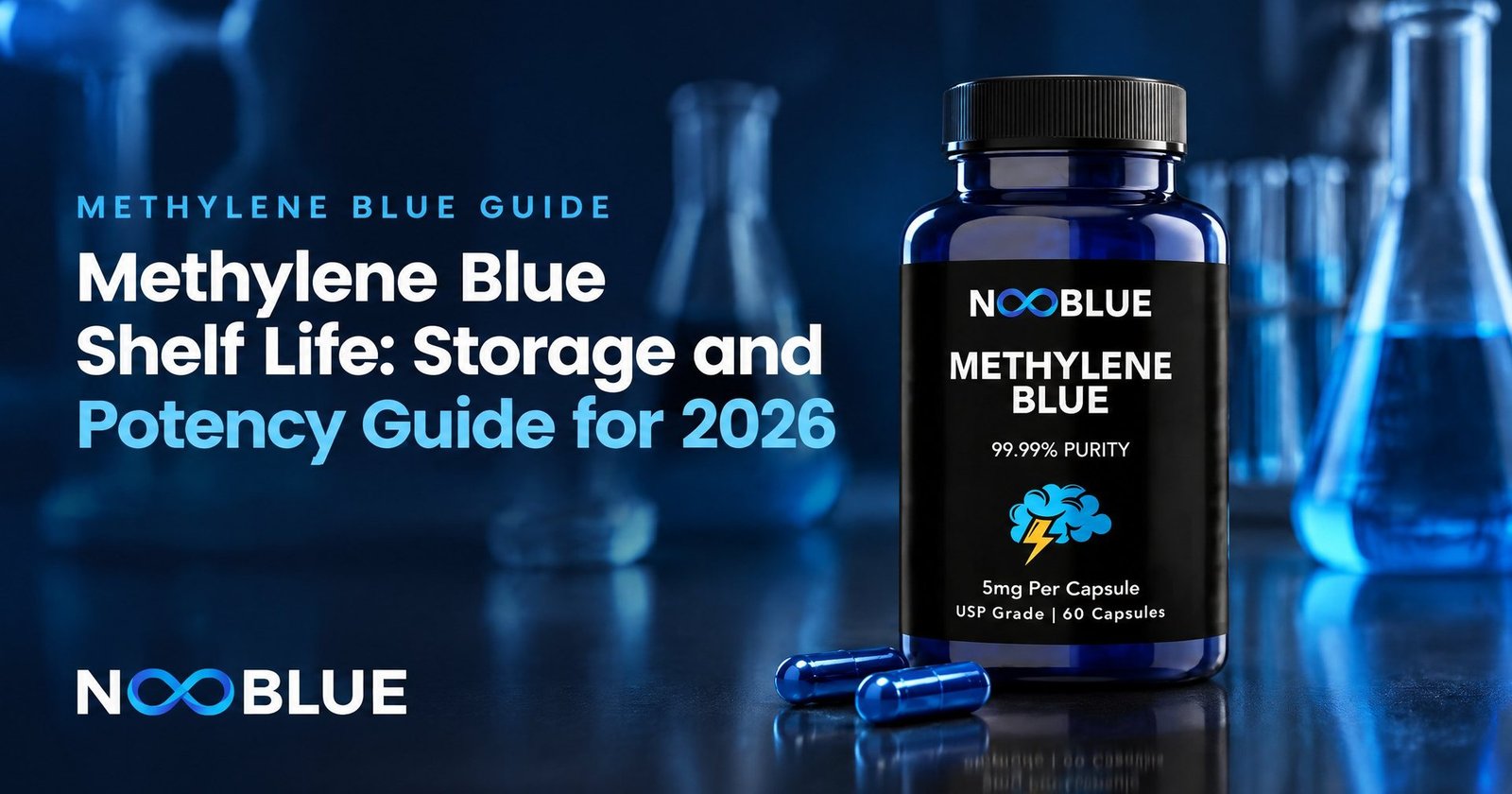
Our 5 mg methylene blue capsules come 60 to a bottle, taken one a day with food, so a bottle lasts 60 days. Keep it tightly closed in a cupboard. If you use a weekly pill organizer, refill it once a week rather than decanting a month’s supply into a clear box that sits in daylight. Each dose stays enclosed in its own shell, which makes an open capsule bottle the least fussy of the three formats to look after. Our guide to methylene blue capsules covers what else to check on a capsule label.
Gummies
NooBlue methylene blue gummies pair 10 mg of USP-grade methylene blue with 25 mg of vitamin C in a Wild Blueberry pectin chew with zero sugar. Pectin is the part that reacts to storage: heat softens it and damp air makes it tacky. Keep the bottle closed in a cool cupboard, never in a car or a bag in the sun, and do not decant a month of gummies into an organizer. A bottle is a 60-day supply at one gummy a day. On staining, the gummies don’t leave the blue mouth that drops can. If you are still choosing, our comparison of methylene blue gummies and our gummies versus liquid breakdown set out the trade-offs.
Drops
Our 1% methylene blue drops hold 50 ml of methylene blue and distilled water, measured with a glass dropper. A 1% solution contains 10 mg per ml, which the dropper delivers as 0.5 mg per drop, 5 mg per 10 drops and about 10 mg per full dropper of 20 drops. At 5 mg a day, a bottle gives about 100 servings.
Storage is the same as for the other formats: cap on tightly, cool, dry and out of direct light. The dropper needs extra care. Do not let the tip touch your tongue, a glass or the counter, and do not return unused liquid to the bottle. Mix a serving into water or juice only when you are about to drink it. Our step-by-step guide to taking methylene blue drops covers measuring, and the 1% solution versus 5 mg capsules comparison runs the dose maths side by side.
Travel
Keep methylene blue in your carry-on or day bag rather than a hot car or a bag left in the sun. Leave it in the original labeled bottle so the dose and date travel with it. Put a dropper bottle in a sealed zip bag in case the cap leaks, since methylene blue stains skin, fabric and surfaces. Capsules are the easiest format to pack for this reason.
How Long Does Methylene Blue Last After Opening?
No published label gives an open-bottle period for a methylene blue supplement. The injection documents treat every opened ampule as single-use, which is a sterile-medicine standard and not a guide for a capsule bottle. So the practical answer rests on two facts: the date on your label, and how quickly you finish the bottle.
At the labeled serving, NooBlue capsules and gummies are 60-day supplies, and a bottle of drops gives about 100 servings at 5 mg. An opened bottle is normally finished within two to about three months. Kept closed, dry and dark during that time, it does not sit open for long.
- Capsules: each dose stays inside its shell, so an opened bottle behaves much like a sealed one as long as it stays dry.
- Gummies: keep the lid closed between servings. Heat and humidity, not the calendar, are what change the chew.
- Drops: the risk after opening is contamination and light, not the molecule simply wearing out. A clean dropper, a tight cap and a dark cupboard keep the solution as it arrived.
- Anything you dilute yourself: use it straight away. The US injection label says a diluted solution should be used immediately after preparation, and a glass of water sitting on a desk deserves the same rule.
Buying more than one bottle
Buying two or three bottles at once works well if the unopened ones stay sealed in a dark cupboard and you open them in date order. Check the dates when the order arrives and use the earliest first. At one serving a day, three bottles of capsules or gummies cover about six months, and the site’s multi-bottle pricing saves 10% on two bottles and 15% on three. Five bottles save 20%, but only buy that many if you will finish them within the dates on the labels.
Does Methylene Blue Go Bad? Signs a Bottle Is Past It
You cannot measure strength at home, but you can spot the signs that a product has been stored badly or contaminated. The US injection label tells clinicians to inspect the solution for particles and discoloration before use, and that habit works for supplements too. Check before each new bottle and whenever something looks different.
Drops
- Cloudiness, specks, sediment or crystals in a solution that should be clear and dark blue.
- A color that is visibly paler than when you opened it. The 2019 light study above found that lit methylene blue solutions lose color as the dye breaks down. Our guide to methylene blue that has turned brown explains the other color changes people run into, several of which come from what it was mixed with.
- Any growth, film or crust around the neck or the dropper tip, or an unusual smell.
Capsules
- Shells that are soft, sticky, cracked or stuck together.
- Contents that have clumped, or blue powder or staining loose in the bottle.
Gummies
- Gummies fused into a block, weeping or very sticky.
- Spots, fuzz or an off smell. That is mold, and the bottle goes in the trash.
Any format
- A broken or missing safety seal on a new bottle. Our FAQ says not to use a product in that state, and the same goes for any brand.
- A date that has passed.
If you see any of these, replace the product. If you are unsure whether a product from another source is methylene blue at all, our at-home check for real methylene blue and the certificate of analysis guide show what to look for. Our explainer on what USP grade means covers the label terms.
On our own testing, the CTLA report linked from our product pages covers identity (an HPLC result of “Conforms”) and heavy metals for the methylene blue ingredient, lot 2025022801. It is ingredient-level evidence. It does not give a purity percentage or test every finished batch, and our product pages say so plainly.
Shelf Life vs How Long Methylene Blue Stays in Your System
These two questions get typed with almost the same words, but one is about the bottle and the other is about your body.
Shelf life is how long the product in the container holds its labeled strength. It is measured in months or years, and it depends on storage.
How long methylene blue stays in your system is a question of clearance, measured in hours and days. The US injection label puts the half-life of methylene blue at approximately 24 hours, and the UK document reports a mean terminal half-life of 24.7 hours after an intravenous dose. A smaller study at the University of Bern gave 100 mg by vein and by mouth to seven volunteers. It estimated a shorter terminal half-life of 5.25 hours in whole blood after the intravenous dose, and found that far less reached the blood after the oral dose than after the injection (Peter and colleagues, European Journal of Clinical Pharmacology, 2000). Half-life figures vary with the method and the sampling, so treat them as a range rather than a precise clock.
The visible sign of clearance is color. Methylene blue passes into the urine, and the UK document notes that it gives urine and stools a blue-green color. That is expected after a dose.
None of this changes with the age of the bottle. An older product does not clear any differently. If timing is your real question, our guides to how many mg of methylene blue to take per day and whether to take methylene blue in the morning or at night cover it.
Safety Checks That Matter More Than the Date
A perfectly stored bottle is still the wrong product for some people. The points below come from the prescribing information for pharmaceutical methylene blue and the research behind it. Talk to your doctor before you start if any of them could apply to you.
- Serotonergic medicines. Do not combine methylene blue with SSRIs, SNRIs, MAOIs, other serotonergic medicines or opioids unless your doctor has approved it. The US injection label carries a boxed warning that methylene blue may cause serious or fatal serotonin syndrome when combined with these drugs. Lab work at the University of St Andrews showed that methylene blue is a potent, reversible inhibitor of monoamine oxidase A, the enzyme that breaks down serotonin, which explains the interaction (Ramsay and colleagues, British Journal of Pharmacology, 2007).
- G6PD deficiency. People with glucose-6-phosphate dehydrogenase deficiency should not take methylene blue. Both injection documents list it as a contraindication because of the risk of hemolytic anemia, a breakdown of red blood cells.
- Pregnancy and breastfeeding. Do not take methylene blue while pregnant or breastfeeding unless your doctor advises it. The US injection label warns that it may cause fetal harm and tells nursing mothers not to breastfeed for up to 8 days after a dose.
- Other medicines and supplements. Methylene blue can interact with medications and supplements. Ask a doctor or pharmacist to check your list before you combine products.
- Children and pets. Store every format out of reach. Gummies look like candy, and the drops stain skin, fabric and surfaces.
Our methylene blue side effects guide covers the milder effects people notice, including the blue-green urine mentioned above.
Which NooBlue Format Fits Your Storage Habits
All three formats follow the same storage rule, but they ask different things of you once the bottle is open. Prices are as of Sep 2026.
| Format | Price | Per serving | Servings | Cost per serving | What storage asks of you |
|---|---|---|---|---|---|
| Capsules (our pick for easy storage) | $37.99 | 5 mg methylene blue + 10 mg vitamin C | 60 | $0.63 | Least: keep it closed and dry |
| Gummies | $49.99 | 10 mg methylene blue + 25 mg vitamin C | 60 | $0.83 | Keep it cool, since pectin softens in heat |
| Drops | $29.99 | 5 mg (10 drops), adjustable in 0.5 mg steps | About 100 at 5 mg | $0.30 | A clean dropper, a tight cap and a dark cupboard |
NooBlue makes all three products. For most people who want the storage question to go away, the capsules are our pick: a fixed 5 mg dose, nothing to measure, and an open bottle that behaves almost like a sealed one.
Capsules suit you if you take one serving a day, travel often or keep supplements in a desk drawer. They are not for you if you want to adjust your dose in small steps or dislike swallowing capsules.
Gummies suit you if you want a chewable with vitamin C and no measuring, and your home stays at normal room temperature. They are not for you if the bottle will live in a car, a hot kitchen or a bag in the sun.
Drops suit you if you want to adjust in 0.5 mg steps and are happy to handle a dropper with care. They are not for you if you want something to throw in a bag without thinking, since a spill stains.
All three come with free worldwide shipping on orders of $100 or more, 30-day returns and dispatch in 1–2 business days with tracking. You can compare them side by side in the NooBlue shop. If you are still weighing brands, our roundup of methylene blue supplements and our guide to where to buy methylene blue cover the options, and what the research on methylene blue shows sets out the evidence and its limits.
Frequently Asked Questions About Methylene Blue Shelf Life
Does methylene blue expire?
Yes. Every methylene blue product has a shelf life set by its maker, and the date on the label is the limit to follow. The molecule is stable when sealed, dark and at room temperature: pharmaceutical methylene blue injection in sealed glass ampoules carries a 4-year shelf life. Supplements have their own dates, and storage decides whether a bottle reaches its date in good condition.
How long does methylene blue last?
Unopened, it lasts until the date on the label, provided it is kept closed, dry, dark and at room temperature. Once opened, the label date still applies, but contamination and moisture become the risks. At one serving a day, NooBlue capsules and gummies last 60 days and a bottle of drops about 100 days at 5 mg, so an opened bottle does not sit around for long.
Does methylene blue need to be refrigerated?
No. Keep it in a cool, dry cupboard at room temperature. The prescribing documents for pharmaceutical methylene blue say “do not refrigerate or freeze,” and our product labels ask for a cool, dry place away from direct heat and sunlight. A fridge adds condensation every time you take the bottle out and open it, which is the moisture the labels ask you to avoid.
What temperature should methylene blue be stored at?
Room temperature. The US injection label specifies 20–25 °C (68–77 °F) and allows short excursions between 15 and 30 °C (59–86 °F). Supplement labels, ours included, say a cool, dry place away from direct heat and sunlight. Avoid a cupboard over the stove, a sunny windowsill, a bathroom cabinet and a parked car.
Is it safe to take methylene blue after its expiration date?
Nobody has published data on expired methylene blue supplements, so there is no evidence either way on strength or safety after the date. The date marks the point up to which the maker stands behind the product. We recommend replacing a bottle once its date has passed, and replacing it straight away if it shows cloudiness, particles, softening, sticking or mold, whatever the date.
How long does diluted methylene blue last?
Use it straight away. The US injection label says a diluted solution should be used immediately after preparation, and a glass of water or juice left on a counter is exposed to light, air and microbes. Measure your drops into the glass only when you are ready to drink it, and never mix a batch for the week ahead.
How should I store methylene blue gummies?
Keep the bottle tightly closed in a cool, dry cupboard away from heat and sunlight. The pectin chew softens in heat and turns tacky in humid air, so avoid cars, bags left in the sun, shelves near the stove and bathroom cabinets, and skip the fridge. Do not decant a month’s supply into a clear organizer. Each NooBlue gummy bottle is a 60-day supply at one a day.
Does aquarium methylene blue expire?
Yes. Aquarium methylene blue carries its own date and follows the same chemistry: keep it closed, dark and at room temperature, and discard it if it turns cloudy, pale or grows anything. It is made for fish tanks and is not labeled for people to take, so never swallow it. For personal use, choose a USP-grade supplement and read its testing documents.
How long does methylene blue stay in your system?
The US injection label gives a half-life of approximately 24 hours, and the UK document reports a mean terminal half-life of 24.7 hours after an intravenous dose. A small 2000 study estimated 5.25 hours in whole blood. Urine and stools can turn blue-green after a dose. The age of the bottle does not change any of this.
What should you not mix with methylene blue?
Do not combine it with SSRIs, SNRIs, MAOIs, other serotonergic medicines or opioids unless your doctor has approved it, because of the risk of serotonin syndrome. People with G6PD deficiency should not take it, and neither should anyone pregnant or breastfeeding without medical advice. Ask a pharmacist to check any other medicines or supplements you take.
How many drops of methylene blue should I take?
Follow the serving on your own product’s label, because concentrations differ between brands. Our 1% drops deliver 0.5 mg per drop, so the labeled 5 mg serving is 10 drops, and a full dropper of about 20 drops is 10 mg. Talk to your doctor before you start, especially if you take any medicine.
Sources
- Provepharm. Methylthioninium chloride Proveblue 5 mg/ml solution for injection, Summary of Product Characteristics, sections 4.3, 4.4, 4.6, 5.2, 6.3 and 6.4. medicines.org.uk/emc/product/6898/smpc
- American Regent. ProvayBlue (methylene blue) injection, prescribing information, sections 2.3, 4, 5.1, 8.1, 8.2, 12.3 and 16. DailyMed label
- Sáenz-Trevizo A, Pizá-Ruiz P, Chávez-Flores D, et al. On the discoloration of methylene blue by visible light. J Fluoresc. 2019;29(1):15-25. PubMed 30361861
- Tardivo JP, Del Giglio A, de Oliveira CS, et al. Methylene blue in photodynamic therapy: from basic mechanisms to clinical applications. Photodiagnosis Photodyn Ther. 2005;2(3):175-191. PubMed 25048768
- McLaren C, Null J, Quinn J. Heat stress from enclosed vehicles: moderate ambient temperatures cause significant temperature rise in enclosed vehicles. Pediatrics. 2005;116(1):e109-e112. PubMed 15995010
- Peter C, Hongwan D, Küpfer A, Lauterburg BH. Pharmacokinetics and organ distribution of intravenous and oral methylene blue. Eur J Clin Pharmacol. 2000;56(3):247-250. PubMed 10952480
- Ramsay RR, Dunford C, Gillman PK. Methylene blue and serotonin toxicity: inhibition of monoamine oxidase A (MAO A) confirms a theoretical prediction. Br J Pharmacol. 2007;152(6):946-951. PubMed 17721552
- NooBlue product pages for the capsules, gummies and drops (ingredients, servings, storage instructions and the CTLA ingredient report), read Sep 2026.