Key takeaways
- The right methylene blue alternative depends on why you want one. CoQ10 or ubiquinol, PQQ, NAD+ precursors, creatine, red light and alpha-lipoic acid each cover a different part of what methylene blue does.
- None of them is a like-for-like substitute. Methylene blue carries electrons directly inside mitochondria. The alternatives work by supplying or building the machinery instead.
- If your problem is blue mouth, taste or measuring drops, the fix is a different form of methylene blue, not a different compound. NooBlue’s gummies do not leave a blue mouth, and the capsules are swallowed with nothing to measure.
- If you take SSRIs, SNRIs, MAOIs or other serotonergic medicines, have G6PD deficiency, are pregnant or breastfeeding, or are under 18, methylene blue is not for you and an alternative is the right route.
- There is no natural methylene blue. It is a synthetic dye, often described as the first fully synthetic drug.
People search for methylene blue alternatives for very different reasons. Some cannot take it because of a medicine they use. Some want the cellular-energy idea without a dye. Many simply dislike the blue mouth or the taste of drops. The results that come back mix surgical dye papers, drug databases and aquarium advice, and few of them answer the question most readers are asking: “I wanted what methylene blue does, but not this.”
This guide maps the main methylene blue alternatives by mechanism and by the human evidence behind them, and it shows when the better answer is a different form of the same molecule. NooBlue makes methylene blue capsules, gummies and drops, so we have an interest in that last part, and we say so where it matters. Everything else is taken from the studies linked in the sources. Written by the NooBlue editorial team. For background on the compound itself, see our overview of what the research shows on methylene blue and our comparison of methylene blue and other nootropics.
Table of contents
- 1. Why People Look for Methylene Blue Alternatives
- 2. What Methylene Blue Actually Does (So You Can Match It)
- 3. The Main Methylene Blue Alternatives Compared
- 4. Clinical Alternatives: Surgical Dyes and Hospital Use
- 5. When the Answer Is a Different Form, Not a Different Compound
- 6. Who Should Not Take Methylene Blue
- 7. Frequently Asked Questions
- 8. Our Take
- 9. Sources
Why People Look for Methylene Blue Alternatives
The reason matters more than the shortlist, because several common reasons are not solved by switching compounds at all. Start with this table.
| Your reason for wanting an alternative | Is the answer a different compound? | What to do instead |
|---|---|---|
| You take an SSRI, SNRI, MAOI or other serotonergic medicine | Yes | Do not take methylene blue. Choose a non-serotonergic option below, and talk to your prescriber first. |
| You have G6PD deficiency | Yes | Methylene blue is not for you at any amount. Look at a mitochondrial-support compound instead. |
| You are pregnant, breastfeeding or under 18 | Yes | Methylene blue is not for you. Ask your doctor before taking any of the alternatives either. |
| You want more mitochondria, not a faster electron shuttle | Yes | PQQ is the closest match on mechanism. |
| Blue mouth or blue teeth | No | Switch form. NooBlue’s gummies do not leave a blue mouth, and capsules are swallowed. |
| The taste of liquid drops | No | Capsules or gummies remove the taste of the solution. |
| Counting drops is fiddly | No | A 5 mg capsule or a 10 mg gummy removes the arithmetic. |
| You doubt the quality of what you bought | No | Switch brands, not compounds, and read the lab report before you buy again. |
If your row says “No”, the rest of the alternatives are useful context, but your fix is in the section on switching form below, and our explainer on what leucomethylene blue is covers the chemistry. Blue or green urine is a separate matter: it happens with every form of methylene blue and is expected.
What Methylene Blue Actually Does (So You Can Match It)
Methylene blue is unusual among supplements. It is a redox-cycling molecule: it accepts electrons, hands them on and accepts more. Inside mitochondria it can carry electrons from NADH directly to cytochrome c, stepping around parts of the usual chain (Tucker et al., 2018). That makes it a spare electron carrier rather than a nutrient or a precursor.
A study in cultured human fibroblasts measured this. Methylene blue raised mitochondrial complex IV activity by 30% and cellular oxygen use by 37% to 70%, and the authors linked the effect to cycling between its oxidized form and its reduced, colorless form (Atamna et al., 2008). That was cell work, not a human trial. The best-known human study gave 26 healthy adults either placebo or a single 280 mg oral dose and found higher brain activity on MRI during attention and memory tasks an hour later (Rodriguez et al., 2016). That dose is far above any supplement serving.
Methylene blue also has a second action that matters for safety. It is a potent inhibitor of the enzyme MAO-A, which breaks down serotonin (Ramsay et al., 2007). That is why it must not be combined with serotonergic medicines. None of the alternatives below shares that property, which is a large part of their appeal for people on those medicines.
That single electron-carrying mechanism explains why substitution is awkward. Nothing else in the supplement aisle carries electrons the way a phenothiazine dye does. The alternatives aim at the same destination, more usable cellular energy, from different directions.
The Main Methylene Blue Alternatives Compared
The table sums up each option by mechanism, the human evidence we could check, and who it tends to suit. The evidence column is our own plain summary of the studies cited below, not a formal grading.
| Option | How it works | Human evidence we found | Who it suits |
|---|---|---|---|
| CoQ10 / ubiquinol | The body’s own electron carrier in the mitochondrial chain, plus a fat-soluble antioxidant | A systematic review found 10 of 16 studies reported less fatigue, across healthy people and several patient groups | Anyone who wants electron-chain support without a dye |
| PQQ | Signals the cell to make new mitochondria through the PGC-1alpha pathway | Cell work, plus small human trials, some funded by PQQ suppliers | People interested in building capacity over months |
| NAD+ precursors (NR, NMN) | Raise NAD+, a cofactor the chain depends on | Trials show they raise NAD+ levels. Effects on how people feel are less clear. | Middle-aged and older adults interested in NAD+ |
| Creatine monohydrate | Buffers cellular energy through the phosphocreatine system | A systematic review of 6 trials (281 people) found possible gains in short-term memory and reasoning | A low-cost option with a long safety record |
| Red and near-infrared light | Light absorbed by cytochrome c oxidase, the enzyme at the end of the chain | Mostly lab and early human work | Anyone who does not want to swallow anything |
| Alpha-lipoic acid | A mitochondrial enzyme cofactor that also recycles other antioxidants | We did not review ALA trials for this guide | People whose focus is oxidative stress rather than energy |
CoQ10 and ubiquinol: the closest functional match
If you want one swap, this is the obvious one. Coenzyme Q10 does natively what methylene blue does artificially: it ferries electrons through the respiratory chain. Ubiquinol is its reduced form. The difference is that CoQ10 supports the existing chain rather than offering a detour around it.
The human evidence is broader than for most alternatives here. A systematic review found 16 studies of CoQ10 and fatigue, and 10 of them reported a significant improvement, though the people studied ranged from healthy volunteers to several patient groups, so results are hard to pool (Mehrabani et al., 2019). We compare the two compounds head to head in methylene blue vs CoQ10.
PQQ: the option that builds new mitochondria
PQQ is the mechanistic outlier. In mouse liver cells, PQQ switched on mitochondrial biogenesis through CREB and PGC-1alpha, raising mitochondrial DNA content and cellular respiration (Chowanadisai et al., 2010). In people, a 12-week randomized trial of 64 healthy Japanese adults aged 40 to 79 found better scores on several memory and attention tests with 21.5 mg a day of PQQ than with placebo (Shiojima et al., 2022). That trial was run by the company that makes the PQQ ingredient, so it needs independent repeats. Expect a timescale of weeks to months with PQQ, not hours.
NAD+ precursors
Nicotinamide riboside (NR) and NMN raise NAD+, the cofactor that many enzymes in energy metabolism depend on. In a randomized, placebo-controlled crossover trial, six weeks of NR was well tolerated and raised NAD+ metabolism in healthy middle-aged and older adults (Martens et al., 2018). Raising a blood marker is not the same as feeling more energetic, and that second question is less settled. Our comparisons of methylene blue and NMN and of methylene blue and NAD+ cover where they overlap.
Creatine
Creatine is the quiet performer on this list for cost and safety record. A systematic review of 6 randomized trials with 281 healthy people found that creatine may improve short-term memory and reasoning, with mixed results for other skills. Vegetarians tended to respond more than meat-eaters on memory tasks (Avgerinos et al., 2018). It works on energy buffering rather than on the electron chain, so it complements rather than copies methylene blue.
Red light and alpha-lipoic acid
Red and near-infrared light target cytochrome c oxidase, the same enzyme methylene blue feeds electrons toward. Researchers at the University of Texas have described the two as sharing a mechanism and a low-dose pattern, which is why some people pair them rather than swap one for the other (Gonzalez-Lima and Auchter, 2015). Our guide to methylene blue and red light therapy goes further. Alpha-lipoic acid is a cofactor for mitochondrial enzymes and helps recycle other antioxidants, so it suits people whose interest is oxidative load rather than flat energy. For the wider picture, our guide to mitochondrial support supplements and our article on how to support mitochondrial function put these options side by side.
Clinical Alternatives: Surgical Dyes and Hospital Use
Some searches for methylene blue alternatives come from a medical context rather than a supplement one. In hospitals, methylene blue is also used as a prescription medicine and as a surgical marking dye, and other dyes exist for those jobs. One early paper, for example, looked at Evans blue and gentian violet as alternatives to methylene blue for marking in heart surgery (Shoemaker et al., 1996). Those choices belong to your care team, not to a supplement shelf. If you are curious about the chemistry of the two dyes, our gentian violet vs methylene blue comparison explains how they differ.
When the Answer Is a Different Form, Not a Different Compound
Four of the eight reasons in the first table are delivery problems, not compound problems. Swapping to CoQ10 to avoid a blue tongue means giving up the mechanism you wanted in the first place. The molecule is identical across formats, but the experience is not. NooBlue sells three, each with its own label:
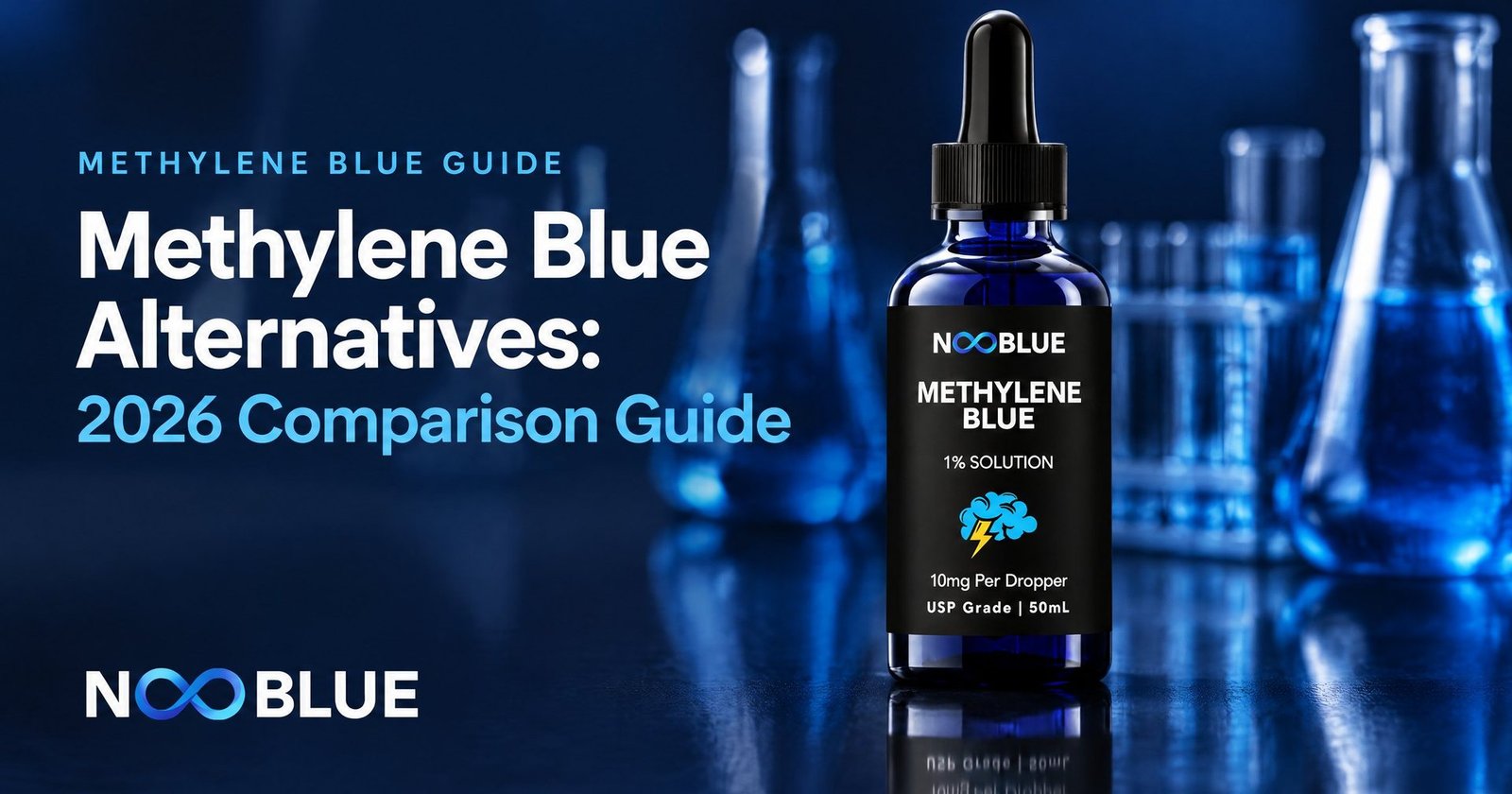
- 1% drops: 10 mg per mL, which is 0.5 mg per drop, in a 50 mL precision dropper bottle for $29.99. Drops give the finest control and the lowest cost per milligram, but they taste of what they are and can stain the mouth and tongue. The label says to mix them with water or juice.
- Capsules: 5 mg of methylene blue with 10 mg of vitamin C, 60 capsules for $37.99. Take one capsule daily with food and do not exceed the suggested serving. Capsules are swallowed, so there is no taste and nothing to measure.
- Gummies: 10 mg of methylene blue with 25 mg of vitamin C, 60 gummies for $49.99. Chew one gummy daily. NooBlue’s gummies do not leave the blue mouth or tongue that drops cause. They also contain vitamin C, which can shift methylene blue toward its colorless form. The deep purple color comes from blueberry extract.
Whichever you choose, urine can still turn blue or green. That is expected with any format. Follow the label of the product you pick, and do not combine formats to raise the amount. If you are weighing formats, see methylene blue gummies vs capsules, methylene blue tablets vs liquid and whether capsules or a liquid suit you better.
On quality, NooBlue’s product pages link a report from Contract Testing Laboratories of America (CTLA) on the raw methylene blue ingredient, covering identity by HPLC and four heavy metals. It covers the ingredient, not each finished batch, and it does not state a purity percentage. Whatever brand you buy, our guide to reading a methylene blue certificate of analysis shows what to check. Shipping from the NooBlue shop is free worldwide on orders of $100 or more.
Who Should Not Take Methylene Blue
For some people, an alternative is not a preference but the only sensible option. Read this before taking any methylene blue product:
- Do not take methylene blue with an SSRI, SNRI, MAOI or any other serotonergic medicine, because the combination can cause serotonin syndrome. See methylene blue and serotonin syndrome.
- Do not take it if you have G6PD deficiency. A standard clinical reference lists it as contraindicated because of the risk of hemolysis (StatPearls). See methylene blue and G6PD deficiency.
- Not for use during pregnancy or while breastfeeding.
- Not for anyone under 18.
- If you take any prescription medicine, talk to your doctor first.
- Methylene blue can turn urine blue or green. That is expected.
If you are in one of the first four groups, CoQ10, creatine or red light are the usual non-serotonergic places to start, after a word with your doctor. Our reference on who should not take methylene blue lists every exclusion with the reasoning, and our list of what not to take with methylene blue covers supplement interactions such as St. John’s Wort and 5-HTP.
Frequently Asked Questions
Which is better, NAD or methylene blue?
They work on different parts of the same system, so it depends on what you want. Methylene blue acts as an electron carrier and works quickly. NAD+ precursors restock a cofactor the system needs, which is a slower change, and trials show they raise NAD+ levels. NAD+ precursors do not inhibit MAO-A, so they avoid the serotonin interaction that rules methylene blue out for people on antidepressants. If you take no serotonergic medicine, methylene blue is the more direct lever. Our methylene blue vs NAD+ comparison goes into detail.
Why don’t doctors recommend methylene blue?
Mainly because it is a prescription drug with specific hospital uses, the human evidence at supplement amounts is small, and it has a serious interaction with serotonergic medicines that many patients take. It is also not suitable for people with G6PD deficiency. Our explainer on why doctors don’t prescribe methylene blue covers the reasoning, including where some clinicians are more open to it.
Is there a natural form of methylene blue?
No. Methylene blue is a synthetic dye, often described as the first fully synthetic drug (Schirmer et al., 2011). There is no plant, food or mineral source of it. A product sold as “natural methylene blue” is either a different compound or mislabeled. People who ask this usually mean compounds such as CoQ10 or PQQ, which work by different mechanisms.
Why do I feel so good on methylene blue?
We cannot say for any one person, and feelings are hard to measure. Two known actions are relevant. Methylene blue carries electrons in mitochondria, and it strongly inhibits MAO-A, the enzyme that breaks down serotonin. That second action is exactly why it is dangerous alongside antidepressants and other serotonergic medicines. If you notice a strong mood change, or you take any prescription medicine, talk to your doctor.
Who should avoid methylene blue?
Anyone taking an SSRI, SNRI, MAOI or other serotonergic medicine, anyone with G6PD deficiency, anyone pregnant or breastfeeding, and anyone under 18. If you take any prescription medicine, talk to your doctor first. For people in those groups, the alternatives in this guide are the starting point, not a compromise.
What is the closest alternative to methylene blue for energy and focus?
On mechanism, CoQ10 or its reduced form ubiquinol, because both carry electrons in the same chain. On cost and safety record, creatine is a strong option, with a systematic review suggesting gains in short-term memory and reasoning. Neither copies methylene blue’s redox cycling. If that mechanism is what you were after and nothing on your medication list rules it out, switching form, for example to a 5 mg capsule or a 10 mg gummy, is the more faithful answer.
Our Take
If you cannot take methylene blue, CoQ10, creatine, PQQ, NAD+ precursors and red light are sensible places to look, each for a different reason, and none of them copies it exactly. If you can take it and your complaint is the blue mouth, the taste or the measuring, change the form rather than the molecule. For that, we think NooBlue’s gummies are the easiest switch: 10 mg of methylene blue in a single chew with no blue mouth.
This article is for educational purposes only and is not medical advice. Talk to your doctor before starting methylene blue or any alternative, especially if you take any prescription medicine.
Sources
- Tucker D, Lu Y, Zhang Q. From mitochondrial function to neuroprotection: an emerging role for methylene blue. Molecular Neurobiology. 2018;55(6):5137-5153. PubMed 28840449
- Atamna H, Nguyen A, Schultz C, et al. Methylene blue delays cellular senescence and enhances key mitochondrial biochemical pathways. FASEB Journal. 2008;22(3):703-712. PubMed 17928358
- Rodriguez P, Zhou W, Barrett DW, et al. Multimodal randomized functional MR imaging of the effects of methylene blue in the human brain. Radiology. 2016;281(2):516-526. PubMed 27351678
- Ramsay RR, Dunford C, Gillman PK. Methylene blue and serotonin toxicity: inhibition of monoamine oxidase A (MAO A) confirms a theoretical prediction. British Journal of Pharmacology. 2007;152(6):946-951. PubMed 17721552
- Mehrabani S, Askari G, Miraghajani M, et al. Effect of coenzyme Q10 supplementation on fatigue: a systematic review of interventional studies. Complementary Therapies in Medicine. 2019;43:181-187. PubMed 30935528
- Chowanadisai W, Bauerly KA, Tchaparian E, et al. Pyrroloquinoline quinone stimulates mitochondrial biogenesis through cAMP response element-binding protein phosphorylation and increased PGC-1alpha expression. Journal of Biological Chemistry. 2010;285(1):142-152. PubMed 19861415
- Shiojima Y, Takahashi M, Takahashi R, et al. Effect of dietary pyrroloquinoline quinone disodium salt on cognitive function in healthy volunteers: a randomized, double-blind, placebo-controlled, parallel-group study. Journal of the American Nutrition Association. 2022;41(8):796-809. PubMed 34415830
- Martens CR, Denman BA, Mazzo MR, et al. Chronic nicotinamide riboside supplementation is well-tolerated and elevates NAD+ in healthy middle-aged and older adults. Nature Communications. 2018;9(1):1286. PubMed 29599478
- Avgerinos KI, Spyrou N, Bougioukas KI, Kapogiannis D. Effects of creatine supplementation on cognitive function of healthy individuals: a systematic review of randomized controlled trials. Experimental Gerontology. 2018;108:166-173. PubMed 29704637
- Gonzalez-Lima F, Auchter A. Protection against neurodegeneration with low-dose methylene blue and near-infrared light. Frontiers in Cellular Neuroscience. 2015;9:179. PubMed 26029050
- Shoemaker K, Rubin J, Zumbro GL, Tackett R. Evans blue and gentian violet: alternatives to methylene blue as a surgical marker dye. Journal of Thoracic and Cardiovascular Surgery. 1996;112(2):542-544. PubMed 8751527
- Schirmer RH, Adler H, Pickhardt M, Mandelkow E. “Lest we forget you: methylene blue…”. Neurobiology of Aging. 2011;32(12):2325.e7-16. PubMed 21316815
- Ostrovsky A, Afzal M. Methylene Blue. StatPearls. Updated January 2026. NCBI Bookshelf NBK557593