If you want to know how to increase ATP naturally, start with the conditions your cells need to make it, not with more food or a supplement. ATP (adenosine triphosphate) is the molecule your cells spend to do work, and your mitochondria remake it all day from the food you eat and the oxygen you breathe. The biggest levers are sleep and regular exercise. Steady meals, enough fluid and the nutrients your energy enzymes depend on come next. Supplements such as creatine, CoQ10 and methylene blue each act on one narrow step and belong at the end of the list.
One animal study shows why the order matters. In rats, brain ATP surged during the first hours of natural sleep, and keeping the rats awake for 3 or 6 hours stopped that surge from happening (Dworak et al., 2010). The fuel was there. The conditions were not.
Key Takeaways
- Most well-fed people who feel low on energy have a production problem, not a fuel problem. Eating more rarely raises ATP.
- Sleep and aerobic exercise are the two strongest levers. Both change how much ATP your cells can make.
- Magnesium, B vitamins and iron are part of the machinery. A shortfall caps output, and a blood test beats guessing.
- Oral ATP supplements did not raise blood ATP in a 28-day trial. Creatine helps with short, hard efforts.
- Methylene blue acts on the electron transport chain in cell studies. Human evidence is early, and it comes with firm safety rules.
Table of contents
- 1. How to Increase ATP: The Short Answer
- 2. Fuel vs Flow: Why Eating More Doesn’t Raise ATP
- 3. The 7 Levers That Increase ATP Production
- 3.1. 1. Sleep: the largest single lever
- 3.2. 2. Aerobic training: build more capacity
- 3.3. 3. Strength training: a second energy system
- 3.4. 4. Steady meals and enough fluid
- 3.5. 5. Cover the cofactors your enzymes need
- 3.6. 6. Creatine: fast recharging for short, hard efforts
- 3.7. 7. Support electron flow: the narrowest lever
- 4. Foods and Nutrients That Support ATP Production
- 5. Low ATP: What It Feels Like and When to See a Doctor
- 6. Where Methylene Blue Fits
- 7. Frequently Asked Questions
- 8. Sources
How to Increase ATP: The Short Answer
To increase ATP production, sleep at least 7 hours a night, do aerobic exercise most weeks and add some strength work, eat regular balanced meals and drink enough fluid, and cover the nutrients your energy enzymes use: magnesium, B vitamins and iron. Supplements come last.
Your body keeps only a small reserve of ATP and rebuilds it constantly. Each time a muscle contracts, a nerve fires or a cell pumps ions across its membrane, it spends ATP and converts it to ADP, and the mitochondria recharge it. So “more ATP” really means a faster, more reliable recharging system. Our primer on what cellular energy is walks through glycolysis, the Krebs cycle and the electron transport chain step by step.
Harvard Health frames it the same way: the common strategies for helping your body produce more ATP come down to diet, exercise and sleep. The seven levers below put those into an order, with the evidence for each.
Fuel vs Flow: Why Eating More Doesn’t Raise ATP
A lot of energy advice treats tiredness as a supply problem. Eat more carbohydrate, add a meal, have something sweet. If you are genuinely under-eating, that works. For most people it does little, and the reason changes what you should do next.
ATP production has two separate limits. The first is fuel: glucose and fatty acids reaching the cell. The second is flow: how fast the electrons stripped from that fuel can move down the electron transport chain and reach oxygen at the end. Complex IV, also called cytochrome c oxidase, makes that final handoff. If flow is the bottleneck, adding fuel is like pouring more water into a funnel that is already backed up. Nothing comes out faster.
Eating a lot also has a cost of its own. Harvard Health notes that while large amounts of food supply more raw material for ATP, they also raise the risk of weight gain, which can lower energy levels, and that large meals can cause an insulin spike followed by a drop in blood sugar that feels like fatigue. Sleep, training and fixing a nutrient shortfall all act on the machinery instead of the input. The same logic runs through the things that damage mitochondria: most of them reduce capacity, not supply.
The 7 Levers That Increase ATP Production
These are ordered by how much they are likely to change your energy relative to the effort, and by how strong the evidence is in people. The first two matter most.
| Lever | What it changes | Evidence |
|---|---|---|
| 1. Sleep at least 7 hours | Lets brain ATP rebuild | Direct ATP data in animals; sleep guidance for people |
| 2. Aerobic training | More mitochondria and better mitochondrial function | Strong in people |
| 3. Strength training | More muscle to store phosphocreatine and house mitochondria | Good in people |
| 4. Steady meals and enough fluid | Avoids blood sugar swings and dehydration fatigue | Moderate |
| 5. Cover the cofactors | Removes limits on enzyme steps | Strong if you are short |
| 6. Creatine | Recharges ATP during short, hard efforts | Strong in people, for exercise |
| 7. Support electron flow | Acts on the chain that makes most ATP | Early, mostly cell and animal studies |
1. Sleep: the largest single lever
Dworak and colleagues measured ATP directly in rat brain tissue. Levels surged in the first hours of spontaneous sleep in the brain regions that had been most active while the animals were awake, and the surge did not happen when the rats were kept awake by gentle handling for 3 or 6 hours (Dworak et al., 2010). This was an animal study, but it fits what most people feel after a short night. For adults aged 18 to 60, the CDC’s guidance is 7 or more hours of sleep a night. If you take methylene blue, it’s worth reading about whether methylene blue affects sleep and when in the day to take it.
2. Aerobic training: build more capacity
Endurance training can increase mitochondrial content, mitochondrial function, or both, in human muscle. A 2018 review of the training research found that total training volume seems to matter most for the amount of mitochondria, while exercise intensity matters more for how well they respire (Granata et al., 2018). More mitochondrial capacity means more ATP at the same workload, which is one reason trained people feel less drained doing the same task. Harvard Health adds that the type of exercise matters less than doing it consistently. Athletes who want the methylene blue angle can see our guide to methylene blue for athletes.
3. Strength training: a second energy system
Lifting builds muscle, and muscle is where most of your phosphocreatine is stored and where much of your mitochondrial mass sits. Stronger muscles also do the same everyday task with less effort.
4. Steady meals and enough fluid
Large meals of fast-digesting carbohydrate can produce a spike and then a slump that feels like an energy failure. When low energy is the issue, Harvard Health suggests small meals and snacks every few hours rather than three large meals, and points out that one of the first signs of being short on fluids is a feeling of fatigue. Protein with each meal and whole-food carbohydrates keep the curve flatter. If you lean on coffee to get through the afternoon, our notes on methylene blue and caffeine cover how the two fit together.
5. Cover the cofactors your enzymes need
The energy pathways are built from proteins that need specific nutrients to work:
- Magnesium. It is a cofactor in more than 300 enzyme systems and is required for energy production, oxidative phosphorylation and glycolysis. The recommended daily amount for adults is 400 to 420 mg for men and 310 to 320 mg for women, depending on age (NIH Office of Dietary Supplements).
- B vitamins. Niacin and riboflavin are the building blocks of NAD and FAD, the carriers that move electrons from the Krebs cycle to the electron transport chain.
- Iron. Iron sits inside the cytochromes and iron-sulfur proteins of the electron transport chain.
A shortfall in any of these caps output however much you eat or train. Iron in particular should be checked with a blood test before you supplement, so talk to your doctor if you think you are low.
6. Creatine: fast recharging for short, hard efforts
Phosphocreatine hands its phosphate group to ADP to rebuild ATP almost instantly, which is what powers the first seconds of a sprint or a heavy lift. The International Society of Sports Nutrition’s position stand says studies have consistently shown that creatine supplementation raises creatine levels inside muscle, which may explain the improvements seen in high-intensity exercise performance (Kreider et al., 2017). The benefit is specific: it helps repeated bursts of effort rather than all-day energy. On the brain side, a 2011 review of glucose, oxygen, pyruvate, creatine and L-carnitine argued that agents which sustain ATP may support cognitive performance, though it summarizes earlier work rather than testing anything new (Owen and Sunram-Lea, 2011).
7. Support electron flow: the narrowest lever
This is the least mature lever. CoQ10 carries electrons between complexes in the chain, NAD precursors such as NMN feed the chain’s starting carrier, and methylene blue can act as an alternative electron carrier. The evidence thins as you move down this list, so treat it as a refinement after the first six are in place. Our head-to-head pieces on methylene blue vs CoQ10, methylene blue vs NAD+ and methylene blue vs NMN compare them, and our CoQ10 supplement comparison covers forms and doses.
Foods and Nutrients That Support ATP Production
No food gives you usable ATP directly. Food supplies fuel and the nutrients your enzymes need, so the useful question is which nutrients are most often in short supply.
- Leafy greens, nuts, seeds and legumes for magnesium.
- Eggs, fish, meat, dairy and whole or fortified grains for the B vitamins that become NAD and FAD.
- Red meat, shellfish, lentils and dark greens for iron.
- Lean meats, fatty fish and nuts for protein and fatty acids. Harvard Health names chicken, turkey, salmon, tuna and nuts as foods that supply the fatty acids and protein your body uses to make ATP.
- Whole-food carbohydrates for a steadier glucose supply than refined sugar.
What about ATP itself as a supplement? In a trial where 32 healthy adults took 0, 250, 1,250 or 5,000 mg of oral ATP a day for 28 days, blood and plasma ATP did not change. The only measured effect was a rise in uric acid at the 5,000 mg dose, and the authors questioned the claimed efficacy of oral ATP (Coolen et al., 2011). Swallowed ATP appears to be broken down before it reaches the blood, which fits the rise in uric acid, one of its breakdown products.
Low ATP: What It Feels Like and When to See a Doctor
People describe low cellular energy as fatigue that sleep doesn’t fully fix, poor exercise tolerance, muscles that tire quickly, slow recovery after effort and trouble concentrating. None of these is specific to ATP, and the same picture fits many medical causes, including low iron and thyroid problems, so talk to your doctor if tiredness lasts. Harvard Health makes the same point: a prolonged bout of low energy is a reason to see a doctor, because unusual fatigue can be an early warning sign that something is wrong.
When energy is short, cells keep essential work such as ion pumping going and slow down less urgent work. That is why low energy tends to show up first as reduced performance and slower recovery rather than as an obvious failure of any one thing.
Where Methylene Blue Fits
Methylene blue is unusual among energy-related compounds because it supplies neither fuel nor a cofactor. In cell studies, flavin-dependent enzymes use NAD(P)H to reduce it to leucomethylene blue, and cytochrome c oxidizes it back, so it can cycle alongside the normal electron transport chain.
The most cited work is a 2008 study in The FASEB Journal. In cultured human IMR90 fibroblasts, nanomolar methylene blue increased mitochondrial complex IV by 30% and cellular oxygen consumption by 37 to 70% (Atamna et al., 2008). That was cell culture plus experiments on rat liver mitochondria, not a trial in people. Human studies so far are small. In a randomized, placebo-controlled imaging study of 26 healthy adults, a single low oral dose increased brain activity during attention and memory tasks and was linked to a 7% increase in correct memory-retrieval responses an hour later (Rodriguez et al., 2016). That study measured brain activity and task scores, not ATP.
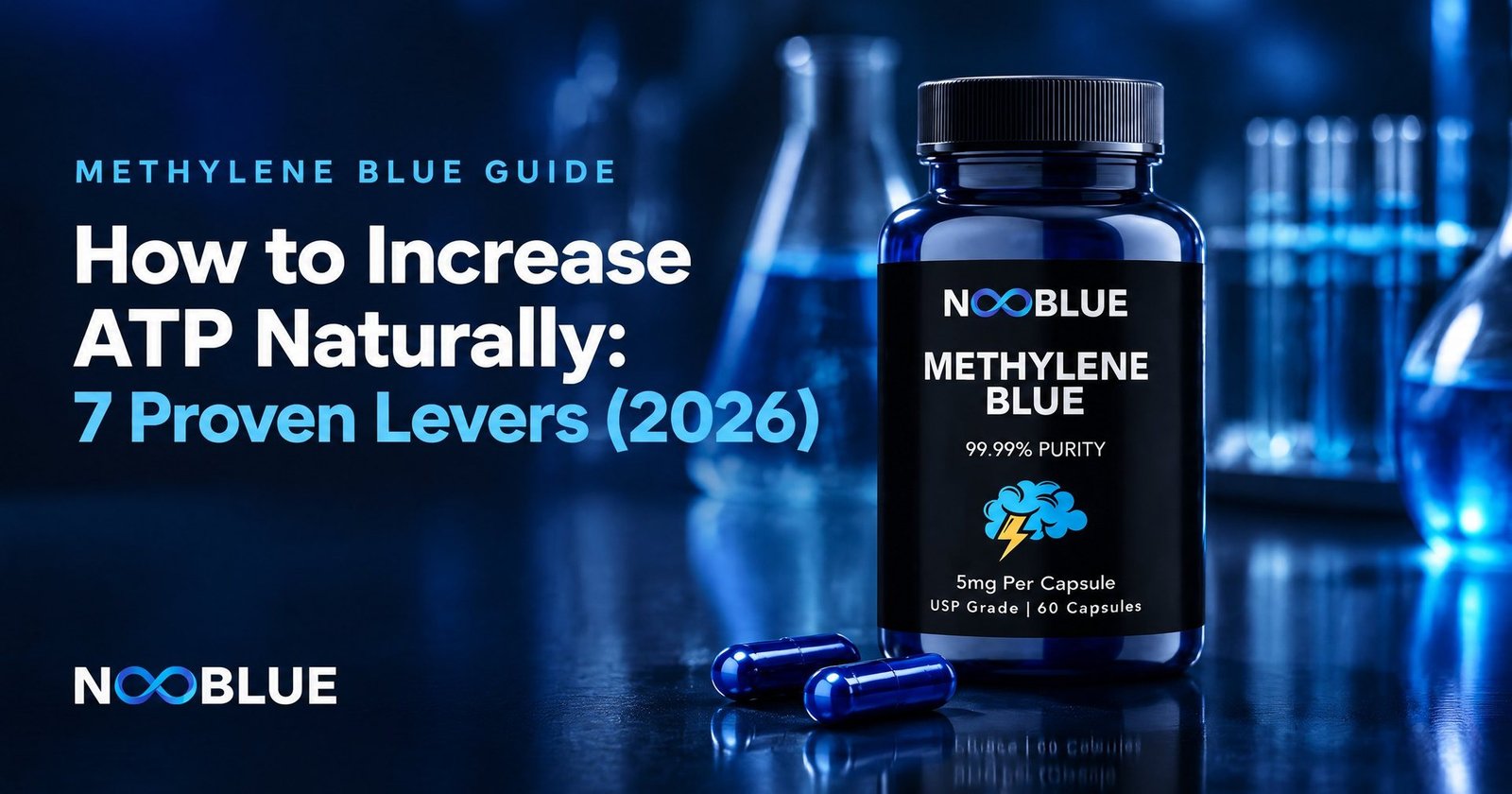
So methylene blue sits at lever seven, after sleep, training, food and cofactors. NooBlue makes methylene blue in three formats, and the choice is mostly about how you like to take it:
- Ultimate Methylene Blue Capsules, $37.99. 5 mg of USP-grade methylene blue and 10 mg of vitamin C per capsule, 60 capsules, one a day with food. The label says not to exceed that serving.
- Methylene Blue Gummies, $49.99. 10 mg of methylene blue and 25 mg of vitamin C per wild blueberry gummy, 0 g sugar, 60 gummies, one a day. Vitamin C can shift methylene blue toward its colorless form, and separately, the gummies don’t leave a blue mouth.
- Methylene Blue Drops, $29.99. A 1% USP-grade solution: 0.5 mg per drop, 10 mg per full dropper, about 100 servings of 5 mg in 50 mL. The lowest cost per serving of the three, and you can taste it.
For the mechanism in more depth, read how methylene blue works for energy, and for what the capsules are and aren’t designed to do, see the NooBlue capsule guide. If you want to compare methylene blue with other mitochondrial options first, our mitochondrial support supplement guide puts them side by side, and what quality methylene blue costs covers pricing across the category. You can see all three NooBlue formats in the shop.
Safety before you start:
- Do not take methylene blue if you take an SSRI, SNRI, MAOI or any other serotonergic medicine, including many antidepressants. The combination can cause serotonin syndrome.
- Do not take it if you have G6PD deficiency.
- Not for use during pregnancy or while breastfeeding, and not for anyone under 18.
- Methylene blue can turn urine blue or green. This is expected.
- Talk to your doctor before use if you take any prescription medicine or have a kidney or liver condition.
Our guides to how many mg of methylene blue per day and methylene blue side effects cover dosing and what to watch for. This article is general information, not medical advice.
Frequently Asked Questions
What is the fastest way to increase ATP?
Sleep. In animal research, brain ATP surges within the first hours of sleep, and keeping animals awake stops the surge. For hard physical efforts, creatine helps recharge ATP within seconds. Longer-term gains come from aerobic training, which builds mitochondrial capacity over weeks of consistent work.
What foods can help increase ATP levels?
No food contains usable ATP, but some supply what your cells need to make it: leafy greens, nuts, seeds and legumes for magnesium, eggs, fish, meat and whole grains for B vitamins, red meat, shellfish and lentils for iron, and lean protein with fatty fish for steady fuel. Regular smaller meals tend to work better than a few large ones.
What are the symptoms of low ATP?
People describe fatigue that sleep doesn’t fully resolve, poor exercise tolerance, muscles that tire quickly, slow recovery and poor concentration. These signs are not specific to ATP and can have many medical causes, so talk to your doctor if they last rather than reaching for a supplement.
What happens if ATP levels are low?
Cells prioritize. Essential work such as ion pumping keeps running while less urgent work slows down. That is why low cellular energy usually shows up first as reduced performance and slower recovery rather than an obvious failure.
Do ATP supplements work?
Swallowing ATP itself doesn’t appear to raise ATP in the blood. In a 28-day trial of up to 5,000 mg a day, blood and plasma ATP did not change. Supplements marketed for ATP usually work another way: supplying a nutrient you may be short of, such as magnesium, buffering ATP during short efforts, as creatine does, or acting on the electron transport chain, as CoQ10 and methylene blue are studied to do.
How long does it take to increase ATP?
Better sleep can make a difference within days. Training adaptations in mitochondria build over weeks of consistent exercise. Correcting a nutrient shortfall depends on the nutrient and how low you were, which your doctor can check. Be skeptical of any product that promises a change by tomorrow.
Does methylene blue increase ATP?
In cultured human cells it increased complex IV activity and oxygen use, which are steps in ATP production. The human studies we know of measured brain activity and task scores rather than ATP, so treat it as a promising mechanism, not an established result. Do not take it with serotonergic medicines, with G6PD deficiency, in pregnancy or breastfeeding, or under 18.
Sources
- Dworak M, McCarley RW, Kim T, et al. Sleep and brain energy levels: ATP changes during sleep. The Journal of Neuroscience, 2010. PubMed 20592221
- Granata C, Jamnick NA, Bishop DJ. Training-induced changes in mitochondrial content and respiratory function in human skeletal muscle. Sports Medicine, 2018. PubMed 29934848
- Kreider RB, Kalman DS, Antonio J, et al. International Society of Sports Nutrition position stand: safety and efficacy of creatine supplementation in exercise, sport, and medicine. Journal of the International Society of Sports Nutrition, 2017. PubMed 28615996
- Coolen EJ, Arts IC, Bekers O, et al. Oral bioavailability of ATP after prolonged administration. British Journal of Nutrition, 2011. PubMed 21129239
- Atamna H, Nguyen A, Schultz C, et al. Methylene blue delays cellular senescence and enhances key mitochondrial biochemical pathways. The FASEB Journal, 2008. PubMed 17928358
- Rodriguez P, Zhou W, Barrett DW, et al. Multimodal randomized functional MR imaging of the effects of methylene blue in the human brain. Radiology, 2016. PubMed 27351678
- Owen L, Sunram-Lea SI. Metabolic agents that enhance ATP can improve cognitive functioning: a review of the evidence for glucose, oxygen, pyruvate, creatine, and L-carnitine. Nutrients, 2011. PubMed 22254121
- Harvard Health Publishing. Tired? 4 simple ways to boost energy. health.harvard.edu
- NIH Office of Dietary Supplements. Magnesium fact sheet for health professionals. ods.od.nih.gov
- CDC. About sleep: how much sleep do I need? cdc.gov