By NooBlue Editorial · About our editorial standards
Key takeaways
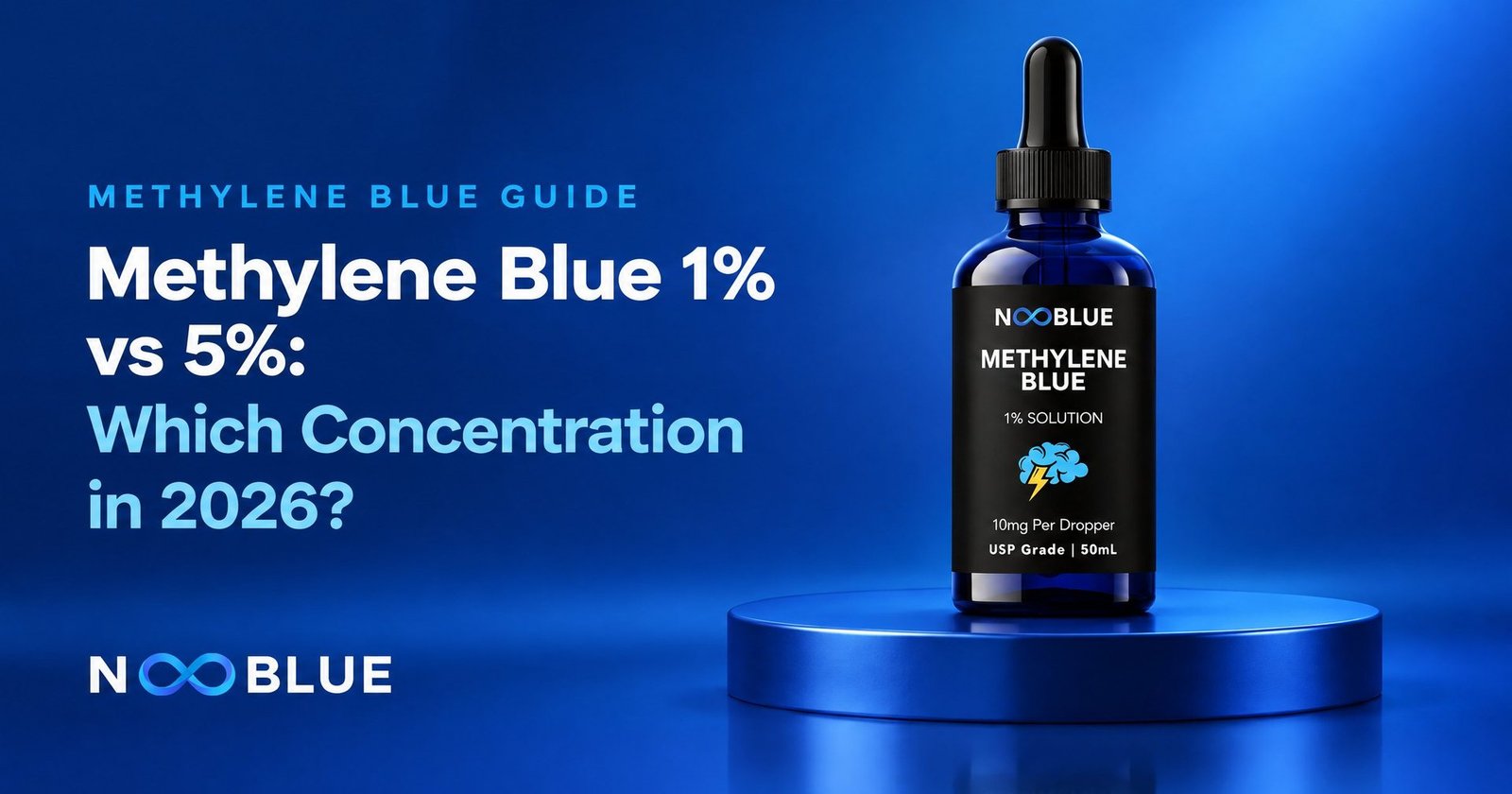
- Methylene blue 1% vs 5% is a question of density, not strength. A 1% solution holds 10 mg per mL, about 0.5 mg per drop. A 5% solution holds 50 mg per mL, about 2.5 mg per drop. The molecule is the same.
- A 5 mg serving is about 10 drops of 1% but only 2 drops of 5%, so one stray drop of 5% adds half a serving.
- Methylene blue has a hormetic dose response, with opposite effects at low and high doses, so fine control matters more than packing more into each drop.
- For daily supplement use, 1% is the easier and more forgiving choice. NooBlue sells 1% drops, 5 mg capsules and 10 mg gummies, and no 5% solution.
- Methylene blue is not for anyone taking SSRIs, SNRIs, MAOIs or other serotonergic medicines, anyone with G6PD deficiency, anyone pregnant or breastfeeding, or anyone under 18.
Quick answer: choose 1% for oral daily use. It lets you measure a 5 mg serving in about 10 drops and adjust by half a milligram at a time. A 5% solution is five times as dense, harder to measure at supplement doses and easier to overshoot, and the few 5% products we found are sold as general chemicals rather than labeled supplements.
If you have shopped for liquid methylene blue, you have seen 1% and 5% on the labels, and sometimes 0.5% or 2% as well. The numbers look like packaging details, but they decide how many drops make a serving, how easy it is to overshoot and how much a spill stains. This guide to methylene blue 1% vs 5% covers the math, a drop chart, what is actually on sale at each strength, safety, and which concentration fits how most people take it.
Table of contents
- 1. Methylene Blue 1% vs 5%: What the Percentages Mean
- 2. Dosing: Why Concentration Matters
- 3. What Is Actually on Sale at Each Strength
- 4. Methylene Blue 1% vs 5%: Safety and Margin for Error
- 5. Grade and Testing Matter More Than Concentration
- 6. Which Should You Choose? 1% vs 5% by Use Case
- 7. Frequently Asked Questions
- 7.1. Is 1% or 5% methylene blue better for beginners?
- 7.2. How many drops of 1% methylene blue equal a 5 mg dose?
- 7.3. Can you dilute 5% methylene blue to 1%?
- 7.4. Is 5% methylene blue stronger than 1%?
- 7.5. Does NooBlue sell a 5% methylene blue solution?
- 7.6. What percentage should methylene blue be for oral use?
- 7.7. Which form of methylene blue is best?
- 7.8. Is methylene blue hard on the liver?
- 7.9. Why don’t doctors recommend methylene blue?
- 8. Sources
Methylene Blue 1% vs 5%: What the Percentages Mean
The percentage on a methylene blue bottle is weight per volume. A 1% solution has 1 gram of methylene blue in every 100 mL of liquid, which is 10 mg per mL. A 5% solution has 5 grams per 100 mL, or 50 mg per mL. Same compound, same chemistry, five times as much in every drop.
How much lands in a drop depends on the dropper. NooBlue’s 1% drops give 0.5 mg per drop and 10 mg per full dropper. Nootlyn, a 5% solution sold on Amazon, says each of its drops delivers about 2.5 mg, so 4 drops give 10 mg. Both figures work out to about 20 drops per mL.
| Factor | 1% solution | 5% solution |
|---|---|---|
| Methylene blue per mL | 10 mg | 50 mg |
| Per drop (about 20 drops per mL) | About 0.5 mg | About 2.5 mg |
| Drops for a 5 mg serving | About 10 | About 2 |
| Effect of one extra drop | About +0.5 mg | About +2.5 mg, half a 5 mg serving |
| A full 1 mL dropper | 10 mg | 50 mg |
| Best suited to | Daily supplement use, beginners | People who deliberately want large amounts in few drops |
Concentration also changes the handling. The stronger the solution, the darker it is and the more a spill stains skin, teeth, fabric and counters. Our guide to taking methylene blue drops covers measuring, mixing and cleanup.
Dosing: Why Concentration Matters
Supplement servings of methylene blue are small. Our capsules are 5 mg, our gummies 10 mg, and a serving of our drops is 10 drops, or 5 mg. At that scale the size of each step matters.
With 1%, a 5 mg serving is about 10 drops, and moving to 4 or 6 mg means one or two drops either way. With 5%, the same serving is 2 drops, and a third drop takes you to about 7.5 mg. Anything under 2.5 mg is out of reach without diluting the bottle first.
That matters because methylene blue does not follow a “more is better” curve. A review from Francisco Gonzalez-Lima’s group at the University of Texas describes a hormetic dose response, with opposite effects at low and high doses (Rojas and colleagues, Progress in Neurobiology, 2012). The human studies behind the interest in methylene blue used low oral doses, such as a randomized, double-blind, placebo-controlled study that found stronger connectivity in brain networks tied to perception and memory after a single low dose (Rodriguez and colleagues, Brain Imaging and Behavior, 2017). A concentration that lets you stay precisely at the label serving is the useful one. Our guide to how many mg of methylene blue per day covers the ranges.
Drop chart: 1% vs 5%
This assumes about 20 drops per mL. Drop size varies between droppers, so check yours once against a 1 mL oral syringe or a dropper marked in mL.
| Target amount | 1% (about 0.5 mg per drop) | 5% (about 2.5 mg per drop) |
|---|---|---|
| 1 mg | 2 drops | Not possible, one drop is already 2.5 mg |
| 2.5 mg | 5 drops | 1 drop |
| 5 mg | 10 drops | 2 drops |
| 10 mg | 20 drops (1 mL) | 4 drops |
What Is Actually on Sale at Each Strength
Here is a snapshot of liquid methylene blue at different strengths, from each seller’s own page as of Sep 2026. NooBlue makes the first product in the table; it is our pick for daily use, and every figure for the other products comes from their own listings.
| Product | Strength | Bottle and measuring | Price (Sep 2026) | Worth knowing |
|---|---|---|---|---|
| NooBlue Methylene Blue Drops | 1% (10 mg per mL) | 50 mL, precision glass dropper, 0.5 mg per drop, about 100 servings of 5 mg | $29.99 | Methylene blue USP and distilled water, sold as a supplement with a full safety panel |
| Meraki Blu | 0.5% (150 mg in 30 mL) | 30 mL with a 1 mL dropper | $35 | Description says “For research purposes only” |
| Chemist Labs Methylene Blue 1% Liquid | 1% (1 mL = 10 mg) | 2 oz or 4 oz (120 mL), dropper marked in mL, up to 120 servings of 1 mL in the 4 oz | $39.99 (2 oz), $44.99 (4 oz) | More liquid per bottle, measured by the mL rather than the drop |
| Chemist Labs Methylene Blue 2% Liquid | 2% (10 mg per 0.5 mL) | 4 oz, 240 servings of 0.5 mL | $49.99 | Double strength, so each 0.5 mL mistake doubles too |
| Nootlyn Methylene Blue Drops 5% | 5% (about 2.5 mg per drop) | 120 mL; the seller says it avoids printed markings on its droppers | No featured offer on Amazon when checked | Listed under Amazon’s Industrial & Scientific category |
Two things stand out. First, most products sold for people to take are 1% or weaker. Second, higher strengths tend to come without the fine measuring tools you need at supplement doses. For a closer look at one of these brands, see our Meraki methylene blue review.
Methylene Blue 1% vs 5%: Safety and Margin for Error
A lower concentration is a safety feature, not just a convenience. With 5%, an extra drop is half a 5 mg serving, and a full 1 mL dropper is 50 mg, ten times a 5 mg serving. Medical references put significant toxicity at cumulative doses of 7 mg per kg of body weight or more (Ostrovsky and Afzal, StatPearls, 2026). Nobody taking a measured supplement serving is near that, but a concentrated bottle makes big mistakes easier, and it is a strong reason to keep any methylene blue out of reach of children.
Safety: read before use
- Do not take methylene blue with SSRIs, SNRIs, MAOIs or any other serotonergic medicine, including many antidepressants. The combination can cause serotonin syndrome.
- Do not take it if you have G6PD deficiency.
- Not for use during pregnancy or while breastfeeding.
- Not for anyone under 18. Keep out of reach of children.
- It can color urine blue or green. This is expected. Drops can also stain the mouth and tongue.
- Talk to your doctor before use if you take any prescription medicine or have a kidney or liver condition.
- Do not exceed the suggested serving.
Our guides to methylene blue and serotonin syndrome and methylene blue side effects cover the details.
Grade and Testing Matter More Than Concentration
The number on the front of a bottle tells you nothing about what else is in it. Methylene blue is made in several grades, and some bottles online are sold for research or as general chemicals rather than as supplements. A clean 1% solution meant for people is a better buy than a stronger one with no information behind it.
Here is what we publish. Contract Testing Laboratories of America (CTLA) analyzed the methylene blue ingredient lot NooBlue uses and recorded an HPLC identity result and individual results for arsenic, cadmium, mercury and lead. That is ingredient-level evidence. It does not give a purity percentage or certify every finished batch. To read reports like this for any brand, see our guide to reading a methylene blue certificate of analysis, what methylene blue purity claims mean and real methylene blue vs fake.
Which Should You Choose? 1% vs 5% by Use Case
- Daily supplement use or first-time users: 1%. It is easy to measure, forgiving of small errors and less messy. NooBlue Methylene Blue Drops are $29.99 for 50 mL, about 100 servings of 5 mg.
- You want no measuring at all: skip liquid. NooBlue Methylene Blue Capsules are a fixed 5 mg with 10 mg vitamin C, 60 capsules for $37.99, and NooBlue Methylene Blue Gummies are 10 mg with 25 mg vitamin C, 60 gummies for $49.99, with no blue mouth.
- 5%: only makes sense if you deliberately want large amounts in a few drops, and it brings harder measuring and heavier staining. Buying 5% for more milligrams per dollar rarely helps at supplement doses: a 50 mL bottle of 1% already holds 500 mg, about 100 servings of 5 mg.
For a full format comparison, see methylene blue capsules vs liquid and methylene blue gummies vs liquid, or read our first-timer guide. Orders over $100 ship free worldwide, and you can browse the full NooBlue range.
Frequently Asked Questions
Is 1% or 5% methylene blue better for beginners?
1%. At about 0.5 mg per drop you can measure a 5 mg serving in about 10 drops and adjust in small steps, so it is much harder to overshoot. It also stains less. At 5%, one drop is about 2.5 mg, half a serving.
How many drops of 1% methylene blue equal a 5 mg dose?
About 10 drops, assuming about 20 drops per mL, which is what NooBlue’s 0.5 mg per drop works out to. At 5% the same 5 mg is about 2 drops. Drop size varies between droppers, so check yours against a 1 mL syringe once.
Can you dilute 5% methylene blue to 1%?
On paper, one part 5% to four parts water gives 1%. In practice, home dilution adds measuring error and contamination risk, and you end up with an unlabeled bottle of uncertain strength. Buying a 1% solution made for people is simpler and more consistent.
Is 5% methylene blue stronger than 1%?
It is more concentrated, not a stronger compound. The molecule is identical, and 5% simply puts five times as much into each drop. Because methylene blue has opposite effects at low and high doses, more per drop is not an advantage for daily use.
Does NooBlue sell a 5% methylene blue solution?
No. NooBlue sells a 1% solution (0.5 mg per drop), 5 mg capsules and 10 mg gummies. All three are built around small, measured daily servings.
What percentage should methylene blue be for oral use?
For daily supplement use, 1% is the practical choice: 10 mg per mL, about 0.5 mg per drop, and a 5 mg serving in about 10 drops. A 0.5% solution works the same way with twice the drops. Higher strengths make small servings hard to measure.
Which form of methylene blue is best?
It depends on what you want to control. Capsules give a fixed dose with no taste or measuring. Gummies are the easiest routine and do not leave a blue mouth. Drops let you adjust by half a milligram but can stain the mouth. For liquid, 1% is the easiest strength to measure.
Is methylene blue hard on the liver?
We found no evidence of liver harm at supplement doses, though long-term data at those doses are limited. Methylene blue leaves the body in urine, and a standard clinical reference advises caution in reduced kidney function. If you have a kidney or liver condition, talk to your doctor before use.
Why don’t doctors recommend methylene blue?
Many doctors are cautious because the evidence for everyday supplement use comes from small, short studies, and because the risks are serious for some people: serotonin syndrome with serotonergic medicines, red blood cell damage in G6PD deficiency, and pregnancy. Concentrated liquids also make dosing mistakes easier. If you are considering it, talk to your doctor, especially if you take any prescription medicine.
Sources
- Rojas JC, Bruchey AK, Gonzalez-Lima F. Neurometabolic mechanisms for memory enhancement and neuroprotection of methylene blue. Progress in Neurobiology. 2012;96(1):32-45. PubMed 22067440
- Rodriguez P, Singh AP, Malloy KE, et al. Methylene blue modulates functional connectivity in the human brain. Brain Imaging and Behavior. 2017;11(3):640-648. PubMed 26961091
- Ostrovsky A, Afzal M. Methylene Blue. StatPearls. Updated January 2026. NCBI Bookshelf NBK557593
- Product pages read September 2026: Meraki Blu (merakimedicinal.com), Chemist Labs Methylene Blue 1% and 2% Liquid (thechemistlabs.com), Nootlyn Methylene Blue Drops 5% (Amazon listing B0G43VKJ2F).
This article is for educational purposes only and is not medical advice. Talk to your doctor before starting methylene blue, especially if you take any prescription medicine.