Key takeaways
- No published human trial has tested methylene blue as a pre-workout. The idea rests on cell and animal research into how it moves electrons through mitochondria.
- It is not a stimulant. Expect nothing like the rush of a caffeine scoop, and treat it as part of a daily routine rather than a pre-training kick.
- Stay at the label serving: one 5 mg capsule a day with food, one 10 mg gummy, or 10 drops (5 mg) of a 1% solution. With methylene blue, more is not better.
- Read your pre-workout label before you combine them. Anything serotonergic, such as St. John’s wort, is a hard no.
- Not with SSRIs, SNRIs, MAOIs or other serotonergic medicines, not with G6PD deficiency, not in pregnancy or breastfeeding, and not under 18. It can turn urine blue or green.
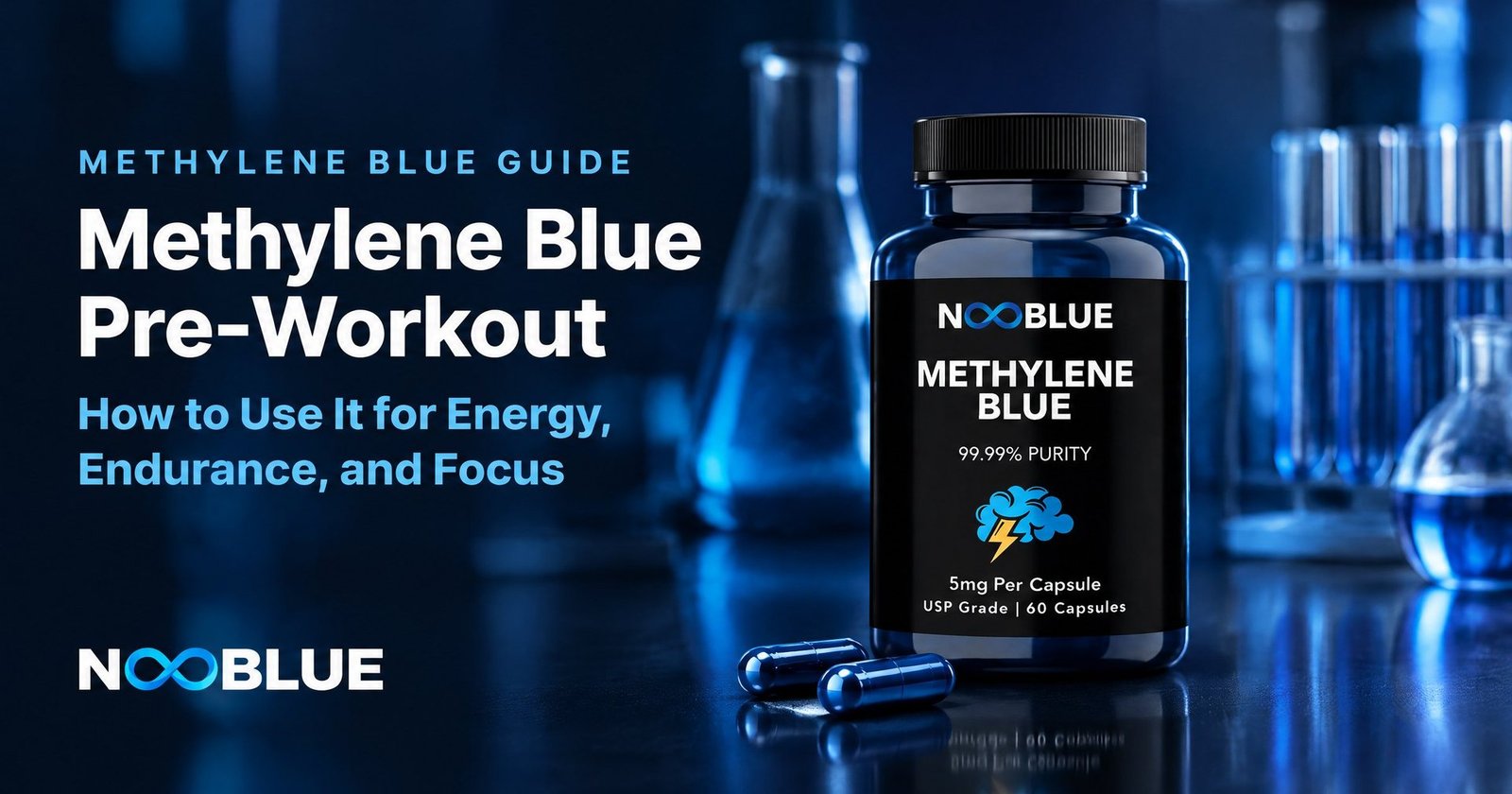
People who search for a methylene blue pre-workout usually want energy for training without another scoop of caffeine. On paper the idea makes sense. Methylene blue can pass electrons along the mitochondrial chain that makes ATP, and muscle is packed with mitochondria. The evidence is thinner than the social media posts suggest, though. We searched PubMed in September 2026 and found no human trial that gave methylene blue before exercise and measured performance.
This guide covers what the research does show, how to fit a low dose into a training day if you decide to try it, what never to mix it with, and which format suits which kind of session. NooBlue sells methylene blue as capsules, gummies and drops, so we have a stake in the answer. Every study below links to its source so you can check our reading of it.
Table of contents
- 1. Does methylene blue work as a pre-workout?
- 2. Why it isn’t a stimulant, and what that means at the gym
- 3. How to take methylene blue before a workout
- 4. Stacking methylene blue with a pre-workout
- 5. Capsules, gummies or drops for training days
- 6. Who should not take methylene blue
- 7. Frequently asked questions
- 7.1. Can methylene blue replace caffeine in a pre-workout?
- 7.2. Will methylene blue help endurance more than strength?
- 7.3. What happens when you start taking methylene blue?
- 7.4. Why do I feel so good on methylene blue?
- 7.5. Why don’t doctors recommend methylene blue for workouts?
- 7.6. Does it cause tolerance?
- 7.7. Will methylene blue turn my urine blue?
- 7.8. Does methylene blue increase testosterone?
- 7.9. Why are bodybuilders taking methylene blue?
- 8. Sources
Does methylene blue work as a pre-workout?
Nobody has tested it in people. The evidence comes in three layers, and none of them timed a workout in humans.
Cell studies: where the energy idea comes from
In a 2008 study in the FASEB Journal, Atamna and colleagues grew human fibroblasts (connective-tissue cells) with tiny, nanomolar amounts of methylene blue. Activity of mitochondrial complex IV rose by 30% and the cells’ oxygen consumption rose by 37 to 70%. The authors traced this to methylene blue cycling between its blue form and its colorless reduced form, leucomethylene blue, inside mitochondria. That cycling is the whole basis of the pre-workout pitch. It was measured in a dish, not in muscle, and nobody lifted anything.
A 2012 review by Rojas, Bruchey and Gonzalez-Lima in Progress in Neurobiology adds the catch: methylene blue shows a hormetic dose-response, with opposite effects at low and high doses. Low doses act as an electron cycler. Higher ones can work against the same machinery. Our guide to how many mg of methylene blue per day covers the dose side in more detail.
Animal studies: protection after exhausting exercise
The closest exercise study we found is in rats. Peng and colleagues (Frontiers in Behavioral Neuroscience, 2025) trained rats to exhaustion, which reduced their activity, raised anxiety-like behavior and hurt spatial memory, with visible damage to neurons and mitochondria in the hippocampus and striatum. Methylene blue given through the nose reduced that damage and improved the behavioral tests. It is an interesting result about protecting the brain after overtraining. It says nothing about running further or lifting more, and nasal dosing in rats is a long way from a capsule in a person.
Human studies: focus, not fitness
The best human data point to attention and memory. In a randomized, placebo-controlled trial published in Radiology in 2016, Rodriguez and colleagues gave 26 adults either placebo or a single oral dose of 280 mg of methylene blue (about 4 mg/kg), with 13 in each group. Scans 60 minutes later showed more brain activity during attention and short-term memory tasks, and the methylene blue group got 7% more memory-retrieval answers right. Every person who took methylene blue reported blue urine afterwards. That dose is far above any supplement serving, and the tasks were done lying in a scanner, not on a bike.
Another human study points the other way. Singh and colleagues (Journal of Cerebral Blood Flow & Metabolism, 2023) gave healthy volunteers 0.5 and 1 mg/kg into a vein and expected brain blood flow and energy use to rise. Both went down instead. The authors suggested the doses may have been on the inhibitory side of the hormetic curve, and that healthy brains may have little room to improve.
So the case for methylene blue before training is an extrapolation from cells, rats and brain scans. Some people like how they feel on it on training days, and that is worth something to them, but it is anecdote. If you want a pre-workout with a track record in exercise trials, methylene blue doesn’t have one yet.
Why it isn’t a stimulant, and what that means at the gym
Caffeine works mainly by blocking adenosine, the signal that builds up and makes you feel tired. Methylene blue has no stimulant action of that kind. Three things it does do matter for anyone thinking about a workout stack:
- It cycles electrons in mitochondria at low doses, which is the energy idea above.
- It inhibits MAO-A. Ramsay, Dunford and Gillman (British Journal of Pharmacology, 2007) showed it is a potent reversible inhibitor of monoamine oxidase A, the enzyme that breaks down serotonin. This is why it must never be combined with SSRIs, SNRIs, MAOIs or other serotonergic medicines: the combination has been linked to serotonin syndrome.
- It blocks nitric oxide signaling. The StatPearls chapter on methylene blue notes that it inhibits nitric oxide synthase and guanylate cyclase, which is why hospitals give it into a vein to narrow blood vessels.
That last point creates an odd tension with pump-style pre-workouts. Citrulline and arginine are sold to raise nitric oxide and widen blood vessels. Methylene blue, at hospital doses, pushes the other way. Nobody has studied a 5 mg oral dose alongside citrulline, so we can’t tell you it blunts the pump, and we can’t tell you it doesn’t. If you have high blood pressure or a heart condition, talk to your doctor before you add methylene blue to anything you take before exercise.
How to take methylene blue before a workout
If you decide to try it, use it the way the label describes rather than the way pre-workout scoops are marketed. There is no loading phase and no double dose on leg day.
Use the label serving
- Capsules: one 5 mg capsule a day, with food. Do not exceed the suggested serving.
- Gummies: chew one 10 mg gummy a day.
- Drops: the 1% solution holds 10 mg per mL, which the dropper delivers as about 0.5 mg per drop. Ten drops give 5 mg.
If you have never taken methylene blue, the 5 mg capsule or 10 drops is the smallest fixed step we sell. Our first-timer’s guide to methylene blue walks through that first week.
Timing around a session
No study has worked out when a low oral dose should be taken before training. What we do know is that a swallowed dose is well absorbed. Walter-Sack and colleagues (European Journal of Clinical Pharmacology, 2009) gave 16 healthy adults 500 mg by mouth and 50 mg into a vein and measured an absolute oral bioavailability of 72.3%. We found no published evidence that holding drops under the tongue works faster than swallowing them.
A practical approach for morning or early-afternoon training is to take your daily serving with the meal you eat before the session. The capsule label says to take it with food, and our capsule page suggests the morning or early afternoon. Evening sessions are harder to fit, so take the serving earlier in the day rather than moving it late. Our guide to the best time to take methylene blue explains the timing in more depth.
Judge it over a few weeks, not one session
Keep the rest of your routine the same, including caffeine, so you can tell what changed. A simple training log with sleep, perceived effort and your main lifts or pace will tell you more than how the first session felt. If nothing changes after a few weeks, that is a result too.
Stacking methylene blue with a pre-workout
Most pre-workouts are blends, so the label matters more than the brand name. This is what we know about the common ingredients:
| Ingredient | What the evidence says | Our view |
|---|---|---|
| Caffeine | No human study has tested the pair before exercise. | Many people take both in the morning. Keep caffeine at your usual amount and watch your heart rate. See methylene blue and caffeine. |
| Creatine | Works through the phosphocreatine system. No known interaction, and no study of the two together. | No reason we know of to avoid the pair. |
| Beta-alanine | No known interaction, no study together. | No reason we know of to avoid the pair. |
| Citrulline, arginine (pump) | They raise nitric oxide, which methylene blue blocks at hospital doses. Untested at supplement doses. | Unknown effect on the pump. Check with your doctor if you have blood pressure concerns. |
| Amine stimulants (PEA, hordenine, synephrine) | Untested with methylene blue. Ramsay’s MAO-A paper flags effects on how the gut handles dietary amines when it is taken by mouth. | We would leave them out of the same day. |
| St. John’s wort, 5-HTP, “mood” blends | St. John’s wort taken with drugs that affect serotonin may lead to serious serotonin-related side effects. 5-HTP is the direct building block of serotonin. | Do not combine. |
Serotonergic medicines are the bigger issue than any powder. Our list of what not to take with methylene blue covers the medicines, supplements and foods to check.
Capsules, gummies or drops for training days
All three formats contain the same methylene blue. The differences are the size of the dose step, how you take it and whether it touches your mouth. NooBlue makes all three.
| Format | Methylene blue per serving | Price (as of Sep 2026) | Per serving | Suits |
|---|---|---|---|---|
| NooBlue Capsules | 5 mg (plus 10 mg vitamin C), one a day with food | $37.99 for 60 | $0.63 | A fixed dose with your pre-training meal, no taste |
| NooBlue Gummies | 10 mg (plus 25 mg vitamin C), one a day | $49.99 for 60 | $0.83 | The simplest routine, no blue mouth |
| NooBlue Drops 1% | 0.5 mg per drop, 10 drops = 5 mg | $29.99 for 50 mL (about 100 servings) | $0.30 | Fine control in 0.5 mg steps |
For training days we’d start with the capsules. A fixed 5 mg goes down with a meal, tastes of nothing and needs no measuring in a gym bag. The gummies are the easiest habit and don’t leave the blue mouth or tongue that drops can, but 10 mg is the largest single serving of the three. Drops cost the least per serving and give the finest control, at the price of counting drops and a blue tongue if you take them straight. Our comparison of methylene blue capsules vs liquid goes further into that trade-off.
On testing: the CTLA (Contract Testing Laboratories of America) report we publish covers identity and heavy-metal results for the methylene blue ingredient lot. It is ingredient-level evidence, it gives no purity percentage, and it does not certify each finished batch. Our page on what USP grade and purity mean for methylene blue explains how to read reports like it. Free worldwide shipping starts at $100, and you can see every format on the NooBlue shop page.
Who should not take methylene blue
Safety first
- Do not take methylene blue with SSRIs, SNRIs, MAOIs or other serotonergic medicines. The combination carries a risk of serotonin syndrome.
- Do not take it if you have G6PD deficiency.
- Do not take it if you are pregnant or breastfeeding.
- Not for anyone under 18.
- It can turn urine blue or green. That is expected.
- Talk to your doctor before use if you take any prescription medicine, or if you have high blood pressure, a heart condition, or a kidney or liver condition.
Serotonin syndrome usually shows up within 6 to 24 hours of a new serotonergic drug or dose change. Signs include agitation or restlessness, a fast heartbeat, high blood pressure, raised body temperature, overactive reflexes and loss of coordination. Some of those can be mistaken for a hard session, so don’t wait it out if you have combined methylene blue with anything serotonergic. Get medical help. For daily use over months, our guide on whether methylene blue is safe to take daily covers the longer view, and our comparison of methylene blue vs Adderall explains how it differs from a prescription stimulant.
If you mainly want steady focus through a training day without stimulants, our roundup of energy and focus supplements without stimulants compares other options.
Frequently asked questions
Can methylene blue replace caffeine in a pre-workout?
Not in the way people hope. Caffeine is a stimulant with a long record in exercise research. Methylene blue is not a stimulant and has no exercise trials in people. Some people take both in the morning. If you do, keep caffeine at your usual amount rather than adding more.
Will methylene blue help endurance more than strength?
Nobody has measured either in people. The mitochondrial idea fits aerobic work better than a heavy single, because short maximal efforts lean on the phosphocreatine system. That is a hypothesis, not a finding.
What happens when you start taking methylene blue?
Your urine may turn blue or green, which is expected. Drops can stain your mouth and tongue, while capsules are swallowed and the gummies don’t leave a blue mouth. Many people notice nothing dramatic, especially at 5 mg. If you feel agitated, feverish or shaky after combining it with a serotonergic medicine or supplement, get medical help.
Why do I feel so good on methylene blue?
We can’t say for certain, and no study has looked at mood in healthy people at supplement doses. It inhibits MAO-A, the enzyme that breaks down serotonin, which is also why it is dangerous with antidepressants. Expectation plays a part with any pre-workout, too. A training log over a few weeks is a better guide than one good session.
Why don’t doctors recommend methylene blue for workouts?
There are no exercise trials to point to, it interacts with common antidepressants and other serotonergic medicines, and its established medical uses are hospital ones given by injection. A cautious answer from a doctor is reasonable. Ask yours, especially if you take any prescription medicine.
Does it cause tolerance?
Tolerance hasn’t been studied at supplement doses. We haven’t found evidence either way, so we wouldn’t claim it has none. Keep to the label serving and don’t raise the dose to chase a feeling.
Will methylene blue turn my urine blue?
Yes, it can turn urine blue or green, and that is expected. In the Radiology trial, everyone who took methylene blue reported blue urine. Our guide to methylene blue urine color explains why.
Does methylene blue increase testosterone?
We found no human study that measured testosterone after low oral doses. Treat any product sold as a methylene blue testosterone booster with suspicion.
Why are bodybuilders taking methylene blue?
Mostly because of social media and the mitochondrial story, not trial results. It does not build muscle, and there is no evidence it raises protein synthesis or strength. If you try it, the serotonergic-medicine warning matters more than any gym benefit.
Sources
- Atamna H, et al. Methylene blue delays cellular senescence and enhances key mitochondrial biochemical pathways. FASEB J. 2008;22(3):703-712. PubMed 17928358
- Rojas JC, Bruchey AK, Gonzalez-Lima F. Neurometabolic mechanisms for memory enhancement and neuroprotection of methylene blue. Prog Neurobiol. 2012;96(1):32-45. PubMed 22067440
- Peng G, et al. Intranasal methylene blue administration confers neuroprotection in rats subjected to exhaustive exercise training. Front Behav Neurosci. 2025;19:1648837. PubMed 41064749
- Rodriguez P, et al. Multimodal randomized functional MR imaging of the effects of methylene blue in the human brain. Radiology. 2016;281(2):516-526. PubMed 27351678 (full text)
- Singh N, et al. The effects of acute methylene blue administration on cerebral blood flow and metabolism in humans and rats. J Cereb Blood Flow Metab. 2023;43(2 suppl):95-105. PubMed 36803299
- Ramsay RR, Dunford C, Gillman PK. Methylene blue and serotonin toxicity: inhibition of monoamine oxidase A (MAO A) confirms a theoretical prediction. Br J Pharmacol. 2007;152(6):946-951. PubMed 17721552
- Walter-Sack I, et al. High absolute bioavailability of methylene blue given as an aqueous oral formulation. Eur J Clin Pharmacol. 2009;65(2):179-189. PubMed 18810398
- Ostrovsky A, Afzal M. Methylene Blue. StatPearls, updated January 2026. NCBI Bookshelf NBK557593
- Simon LV, Torrico TJ, Keenaghan M. Serotonin Syndrome. StatPearls. NCBI Bookshelf NBK482377
- MedlinePlus. Serotonin syndrome. medlineplus.gov
- National Center for Complementary and Integrative Health. St. John’s Wort. nccih.nih.gov