Quick answer
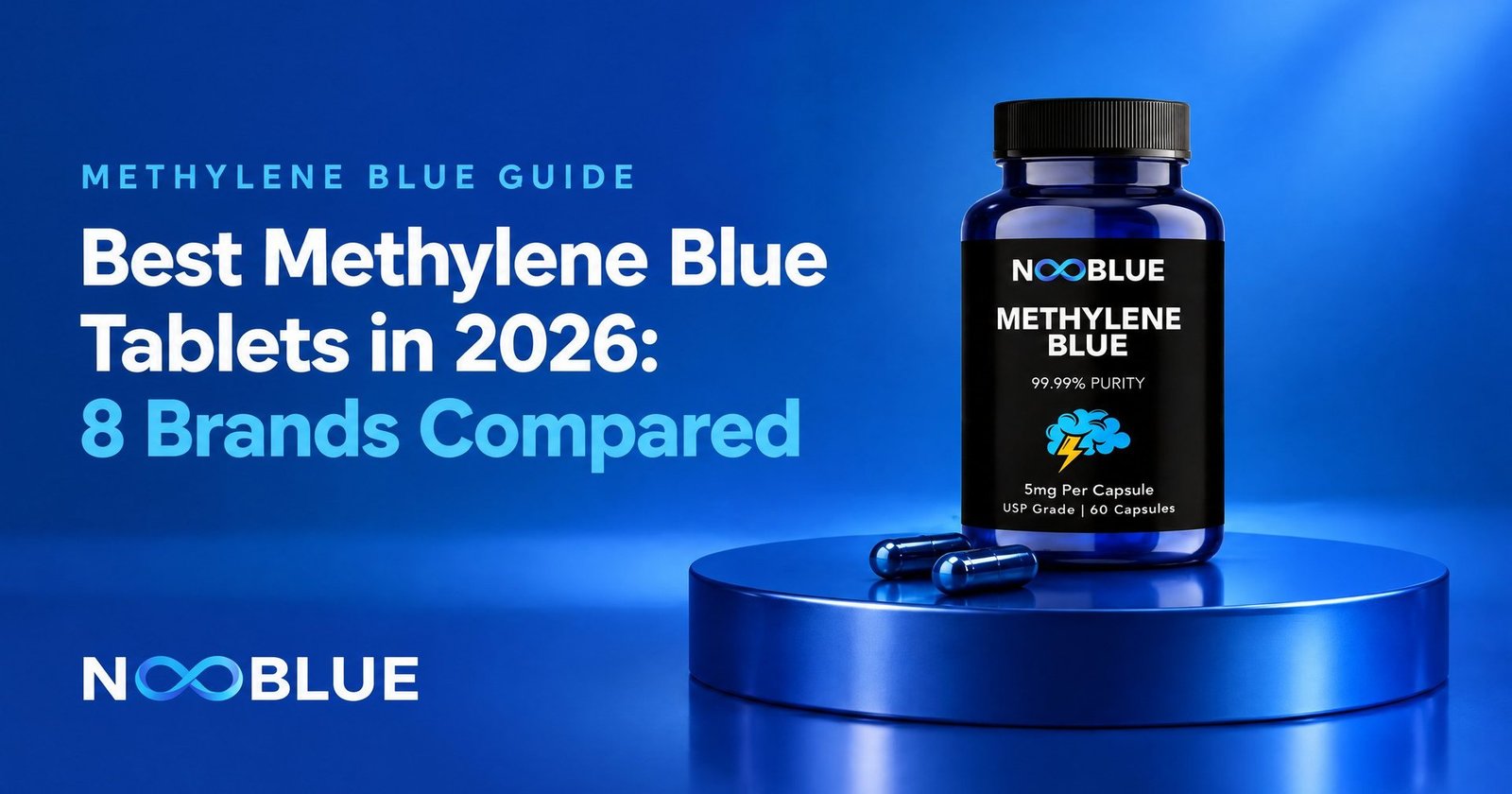
For most people shopping for methylene blue tablets, our pick is NooBlue Ultimate Methylene Blue Capsules: 5 mg of USP grade methylene blue and 10 mg of vitamin C in each capsule, 60 capsules for $37.99, or $0.63 a day at one capsule. It is a capsule, not a pressed tablet. We rank it first because 5 mg is the smallest whole-pill dose you can buy without a prescription among the eight products here, so you can start low without splitting anything.
If you want a true pressed tablet, Best 365 Labs NeuroPro+ (15 mg of methylene blue and 75 mg of vitamin C per tablet, $49.99 for 60 on Amazon) has the most reviews of the tablets we found and costs less per milligram than our capsule. If you want very small, adjustable steps, the Troscriptions Just Blue troche is scored into four 4 mg pieces, but it is now sold only through healthcare practitioners.
Safety first: do not take methylene blue in any form if you take serotonergic medicines such as SSRIs, SNRIs or MAOIs, if you have G6PD deficiency, or if you are pregnant or breastfeeding.
NooBlue makes the capsule ranked first. It is our pick, and each entry below says who should buy something else. Competitor figures come from each brand’s own product page or Amazon listing, read on September 25, 2026.
Written by the NooBlue editorial team. We make and sell methylene blue capsules, gummies and drops. We did not lab-test any product in this guide. Every figure comes from a brand’s own page, its published lab paperwork or a peer-reviewed study, and all of them are listed in the sources at the end.
Search for “methylene blue tablets” and you get a mix of things that are not the same. Some are pressed tablets. Many more are capsules listed as tablets or pills. A few are troches or breakable bars that dissolve or get swallowed in pieces. And some are lab or aquarium products that nobody should eat. The prescription methylene blue that hospitals use is a different product again.
This guide sorts that out. It compares eight products you can realistically buy in the US in 2026: four tablet-style products, two capsules for readers who would take a capsule instead, a telehealth prescription program, and our own 5 mg capsule at #1. For each one we give the milligrams per unit, the price, the cost per 5 mg worked out the same way for every row, the smallest dose you can take, and what lab paperwork sits behind the purity claim.
Table of contents
- 1. Best methylene blue tablets at a glance
- 2. How we ranked the best methylene blue tablets
- 3. The 8 best methylene blue tablets and pills, ranked
- 3.1. 1. NooBlue Ultimate Methylene Blue Capsules: best overall
- 3.2. 2. Best 365 Labs NeuroPro+: best pressed tablet
- 3.3. 3. Troscriptions Just Blue: best for fine dose steps
- 3.4. 4. Da Vinci Medical Energy Tablets: lowest dose per pressed tablet
- 3.5. 5. MitoZen Lumetol Blue Bars: highest strength per unit
- 3.6. 6. Nutricel Blue Boost: best finished-lot paperwork
- 3.7. 7. Chemist Labs Methylene Blue Capsules: lowest cost per milligram
- 3.8. 8. Healthspan: the prescription route
- 4. Methylene blue tablets we left out, and why
- 5. Tablet, capsule, troche or bar: what the format changes
- 6. Why the smallest dose matters more than the price
- 7. How to check a methylene blue tablet before you buy
- 8. What the research says about low-dose methylene blue
- 9. Who should not take methylene blue tablets
- 10. Where to buy methylene blue tablets in the US
- 11. Frequently asked questions about methylene blue tablets
- 11.1. What is the best methylene blue tablet to buy in 2026?
- 11.2. Are there real methylene blue tablets, or are they all capsules?
- 11.3. What should I look for when buying methylene blue tablets?
- 11.4. Methylene blue capsules vs tablets: which is better?
- 11.5. Can you split a methylene blue tablet?
- 11.6. What dose of methylene blue tablet should I take?
- 11.7. Is it safe to take methylene blue tablets daily?
- 11.8. Can I take methylene blue tablets if I am on antidepressants?
- 11.9. Can methylene blue tablets stain my teeth?
- 11.10. Why does methylene blue turn urine blue?
- 11.11. How do you take methylene blue tablets orally?
- 11.12. What is the difference between USP grade and pharmaceutical grade methylene blue?
- 11.13. Are methylene blue tablets the same as prescription methylene blue?
- 12. The verdict: which methylene blue tablet should you buy?
- 13. More methylene blue buying guides
- 14. Sources
Best methylene blue tablets at a glance
Prices are as of Sep 2026, read from each brand’s own store unless the row says Amazon, before shipping, coupons and multi-pack discounts. Cost per 5 mg is the price divided by the total milligrams of methylene blue in the pack, times five.
| # | Product | Format | Methylene blue per unit | Units | Price (as of Sep 2026) | Cost per unit | Cost per 5 mg | Smallest dose | Lab paperwork |
|---|---|---|---|---|---|---|---|---|---|
| 1 | NooBlue Ultimate Methylene Blue Capsules | Capsule | 5 mg | 60 | $37.99 | $0.63 | $0.63 | 5 mg | Ingredient report (CTLA) on the product page |
| 2 | Best 365 Labs NeuroPro+ | Pressed tablet | 15 mg plus 75 mg vitamin C | 60 | $49.99 (Amazon) | $0.83 | $0.28 | 15 mg | Lot certificate listed on the brand’s COA page |
| 3 | Troscriptions Just Blue | Scored troche | 16 mg | 4 | $27 | $6.75 | $2.11 | 4 mg (a quarter) | Sent on request |
| 4 | Da Vinci Medical Energy Tablets | Pressed tablet | 7.5 mg plus NAC, glycine and niacinamide | 60 | $67.17 | $1.12 | $0.75 | 7.5 mg | Linked PDF names a different product |
| 5 | MitoZen Lumetol Blue Bars (40 mg) | Breakable bar | 40 mg per bar | Not stated | $89.95 | Not calculable | Not calculable | About 10 mg (a quarter) | None linked |
| 6 | Nutricel Blue Boost | Capsule | 12 mg | 60 | $34.90 | $0.58 | $0.24 | 12 mg | Finished-lot certificate (Eurofins) published |
| 7 | Chemist Labs Methylene Blue Capsules | Capsule | 10 mg | 60 | $24.99 (Amazon) | $0.42 | $0.21 | 10 mg | Certificates for three lots linked |
| 8 | Healthspan (prescription program) | Prescription capsule | Set by the clinician | Monthly supply | $99 a month | Not applicable | Not applicable | Around 5 mg to start | Dispensed by a licensed pharmacy |
NeuroPro+ is $50 on the Best 365 Labs store. Da Vinci’s serving is two tablets (15 mg of methylene blue), so one tablet holds 7.5 mg. MitoZen does not state how many bars come in a pack, so no per-dose cost can be worked out. Healthspan’s fee includes the prescription, pharmacy delivery and clinical support.
How we ranked the best methylene blue tablets
We did not run lab tests, and we do not claim to have. This is a comparison of what each brand states and publishes, and you can check every line against the same pages. We weighed six things.
- Format. People who search for tablets usually want a fixed dose they can swallow with water. Positions 2 to 5 are the tablet-style products. Positions 6 and 7 are capsules for readers who would accept one, and position 8 is the prescription route. Our own capsule sits at #1, and we explain why below.
- Smallest dose. The lowest amount you can take without splitting or crushing anything. Most guidance on methylene blue is to start low and increase slowly, and a 15 mg or 40 mg unit makes that first step harder.
- Paperwork. A lot-numbered certificate from a named laboratory, published before you buy, ranks above one sent on request. We say what each document covers: an ingredient report tests the raw methylene blue, and a finished-product certificate tests a batch of tablets or capsules.
- Cost per 5 mg. Worked out from the total milligrams in the pack, so a two-tablet serving compares fairly with a one-capsule serving.
- Other ingredients. Vitamin C, NAC, cacao or a polyphenol blend can be a plus or an unwanted variable. We list them so you can decide.
- Safety information. Whether the page warns about serotonergic medicines, G6PD deficiency and pregnancy.
Star ratings count for little here. A rating cannot tell you what is in a tablet, and rating counts across these products range from a handful to several hundred. Where a page shows one, we quote it as it read on the day we checked.
NooBlue ranks first because it is the only 5 mg whole-pill option among the retail products and it shows its ingredient report on the product page. It does not win on cost per milligram, and the entries below say so.
The 8 best methylene blue tablets and pills, ranked
These are the eight products we would consider in the US in 2026, from our own capsule at #1 to a prescription program at #8. Each entry says who it suits and who should look elsewhere.
1. NooBlue Ultimate Methylene Blue Capsules: best overall
NooBlue makes these 5 mg methylene blue capsules, and they are our pick for most people who came here looking for a tablet. Each vegetable capsule holds 5 mg of USP grade methylene blue and 10 mg of vitamin C. A bottle of 60 costs $37.99 (regular price $49.99), which is $0.63 a capsule. The product page says to take one capsule a day with food, so a bottle lasts 60 days. The page shows 4.8 out of 5 from 26 customer reviews.
We are upfront that this is a capsule. We do not make a pressed tablet, and if the tablet shape itself matters to you, #2 and #4 are real tablets. The case for the capsule is the dose. A 15 mg tablet gives you 15, 30 or 45 mg unless you break it, and Nutrivance, a tablet maker on our left-out list, advises against splitting or crushing its tablets because the dye stains. With a 5 mg capsule you take 5 mg a day, the one capsule the label suggests, and if you later want 10 mg, one of our gummies or 20 drops of our 1% solution gives it. The shell also keeps the blue powder off your fingers and tongue while you swallow it. Your urine will still turn blue-green, which is expected.
The lab paperwork is on the product page. Contract Testing Laboratories of America (CTLA) analyzed the methylene blue ingredient, lot 2025022801, in report 135621. The report records an HPLC identity result of “Conforms” and individual results for arsenic, cadmium, mercury and lead. That is ingredient-level evidence. It does not state a numerical purity percentage or test every finished batch of capsules. Nutricel (#6) publishes a certificate for a finished lot, which is a stronger kind of document, and you should know that before you choose.
On price, be realistic. At $0.63 per 5 mg our capsule costs more per milligram than NeuroPro+ ($0.28), Nutricel ($0.24) and Chemist Labs ($0.21). If you already know you want 15 mg a day, a stronger unit is cheaper. What you pay for is the small step. Two bottles cost 10% less each, three bottles 15% less and five bottles 20% less, and orders over $100 ship free worldwide.
Who it suits: first-time users, anyone who wants to stay between 5 and 15 mg a day, and anyone who wants plain methylene blue with vitamin C and nothing else. Who should look elsewhere: people who want a pressed tablet, people already settled on 15 mg or more who will pay less per milligram at #2, and people who dislike swallowing pills, who may prefer our 10 mg methylene blue gummies. Our first-timer’s guide to methylene blue covers the first two weeks in more detail.
2. Best 365 Labs NeuroPro+: best pressed tablet
NeuroPro+ from Best 365 Labs, a Utah company, is a swallow-whole pressed tablet. The brand’s product page lists 15 mg of methylene blue and 75 mg of vitamin C per tablet, 60 tablets to a bottle. The Amazon listing gives the serving as two tablets (30 mg of methylene blue and 150 mg of vitamin C) and the directions as one to two tablets a day, swallowed with liquid and not chewed. The other ingredients are microcrystalline cellulose, dicalcium phosphate, silicon dioxide and magnesium stearate, which are standard tablet binders.
It costs $49.99 on Amazon, where it showed a 10% coupon and 4.4 out of 5 from 454 ratings when we checked, the most of any tablet we found. The brand’s own page lists $50, or $45 a month on subscribe and save. That is $0.83 a tablet and $0.28 per 5 mg. The brand’s COA page lists a certificate for NeuroPro+ lot 14726. We did not audit what that certificate tests.
Two things to weigh. The smallest dose is one 15 mg tablet, three times our capsule. And the brand’s page is softer on antidepressants than we are: it says there “should be no problems” for people on an SSRI at its doses and suggests talking to a provider. We would not combine methylene blue with an SSRI at any dose (see the safety section). A few Amazon reviewers also mention broken tablets and blue dust at the bottom of the bottle, which is worth knowing if you handle the tablets with bare hands.
Who it suits: people who want a real tablet, take 15 mg or more a day, and like the vitamin C pairing. Who should look elsewhere: anyone starting out at 5 mg, and anyone on a serotonergic medicine.
3. Troscriptions Just Blue: best for fine dose steps
Just Blue is an “ingestible troche”, a lozenge-style tablet that dissolves in the mouth. Each troche holds 16 mg of methylene blue and is scored, and the page says a pack of four gives “up to 16 doses”, so a quarter is 4 mg. A pack costs $27 and three packs cost $81. That is $6.75 a troche, $1.69 per quarter and $2.11 per 5 mg, the highest cost per milligram of any product priced here. The page lists third-party lab testing, USP grade methylene blue and US manufacture, and sends a certificate of analysis when you fill in a request form.
The catch is access. The site now says its products are available only through healthcare practitioners, and there is no public add-to-cart button. The staining is also real: the brand’s own FAQ says that used as a troche it will turn your mouth and teeth blue, with the color lasting somewhere between 2 and 24 hours.
Who it suits: people already working with a practitioner who stocks Troscriptions and who want 4 mg steps. Who should look elsewhere: anyone who wants to order directly, or who does not want a blue mouth for the afternoon.
4. Da Vinci Medical Energy Tablets: lowest dose per pressed tablet
Da Vinci Medical’s Methylene Blue Energy Tablets are a combination formula. The supplement facts give a two-tablet serving of 15 mg methylene blue, 100 mg glycine, 100 mg NAC and 50 mg niacinamide, with 30 servings in a bottle of 60 tablets. So one tablet holds 7.5 mg of methylene blue, the smallest amount in any pressed tablet we found. The directions say two tablets every night, which is unusual. Most brands, ours included, suggest the morning or early afternoon.
The bottle costs $67.17, marked down from $83.95. That is $1.12 a tablet, $2.24 per two-tablet serving and $0.75 per 5 mg of methylene blue. The page carries a clear caution: no use with G6PD deficiency, and talk to a provider first if you are pregnant, breastfeeding or taking prescriptions, especially SSRIs. It showed 5.0 out of 5 from 8 reviews.
The paperwork needs a closer look. The certificate linked on the product page is a July 2024 report from Analytical Resource Laboratories in Utah, marked “Preliminary Results Only”. It was issued to Best 365 Labs for a product called “Superhuman Tablets 60ct”, lot 19524, and it covers microbes and four heavy metals. It does not measure methylene blue content, and its product name does not match the Da Vinci tablet. Ask Da Vinci for a current certificate for your lot before you rely on it.
Who it suits: people who want a low-dose pressed tablet and are happy to take NAC, glycine and niacinamide with it. Who should look elsewhere: anyone who wants methylene blue on its own, or a certificate that matches the product.
5. MitoZen Lumetol Blue Bars: highest strength per unit
MitoZen’s Lumetol Blue Bars are small bars you break and swallow. The page says they are not troches: you place a piece at the back of the mouth and wash it down to avoid staining. Each bar holds 40 mg or 180 mg of methylene blue with vitamin C and a proprietary polyphenol blend (phycocyanin, curcumin, quercetin, riboflavin, EGCG and lutein, amounts not given). The 40 mg pack costs $89.95 (marked down from $109.95), and the 180 mg pack costs $179.95. The page does not say how many bars come in a pack, so we cannot work out a cost per dose.
The serving for the 40 mg bar is a quarter to a whole bar, roughly 10 to 40 mg. For the 180 mg bar it is a quarter to half a bar, roughly 45 to 90 mg, which is well above the range most low-dose routines use. The page tells buyers not to combine the bars with SSRIs or other serotonergic compounds and not to use them while pregnant or nursing. We found no certificate of analysis linked on the product page.
Who it suits: experienced users who want a strong unit and the polyphenol blend. Who should look elsewhere: beginners, anyone who wants to know the exact amount of each added ingredient, and anyone who wants lab paperwork before buying.
6. Nutricel Blue Boost: best finished-lot paperwork
If you would accept a capsule, Nutricel’s Blue Boost is one of the most transparent. Each capsule holds 12 mg of USP grade methylene blue with 35 mg of vitamin C ester and 235 mg of organic cacao powder, 60 capsules for $34.90. That is $0.58 a capsule and $0.24 per 5 mg. Its certificates page links a Eurofins certificate for a finished Blue Boost lot covering methylene blue content, heavy metals and microbes, and says its raw methylene blue is 99.4% pure.
The limit is the 12 mg floor, and the cacao adds a second ingredient some single-ingredient buyers will not want. We compare the two brands in detail in our Nutricel vs NooBlue comparison.
Who it suits: capsule buyers settled at about 12 mg a day who want finished-product testing. Who should look elsewhere: tablet buyers and anyone who wants to start below 12 mg.
7. Chemist Labs Methylene Blue Capsules: lowest cost per milligram
Chemist Labs sells a plain 10 mg capsule: methylene blue, microcrystalline cellulose and a vegetable capsule. It was $24.99 for 60 on Amazon with a $3 coupon, and 4.3 out of 5 from 689 ratings. That is $0.42 a capsule and $0.21 per 5 mg, the lowest cost per milligram of the eight products here. The brand’s lab reports page links certificates for three capsule lots, and the listing warns against use with SSRIs or during pregnancy or nursing.
Who it suits: capsule buyers who take 10 mg a day and want the lowest price. Who should look elsewhere: anyone who wants a tablet, or a first dose below 10 mg. Our methylene blue capsules comparison covers eight capsule brands in more depth.
8. Healthspan: the prescription route
Healthspan is a telehealth service. A licensed clinician reviews your health history and screens for drug interactions, and if methylene blue is appropriate, a licensed US pharmacy dispenses encapsulated oral methylene blue. It costs $99 a month, which includes the prescription, delivery and ongoing dose adjustments. The page says dosing typically starts around 5 mg and rises gradually to a maximum of about 25 mg a day.
You pay far more than any retail product here. What you get is a clinician checking your medicines first, which matters more than the pill if you take anything that affects serotonin.
Who it suits: people on several prescriptions who want a clinician involved. Who should look elsewhere: healthy adults on no medicines who are comfortable reading a label.
Methylene blue tablets we left out, and why
A few tablet listings came up in our search that we chose not to rank.
- Research-use tablets. Nutrivance Laboratories, a Canadian company, sells a 20 mg methylene blue tablet whose own product page says it is “Supplied for laboratory, research, and professional use”. The same page advises against splitting or crushing the tablets because the dye stains skin and surfaces. A product labeled for research use is not one we would suggest swallowing daily.
- Unbranded Amazon tablets. One Amazon listing sells 60 scored 20 mg tablets under the brand name “Generic”. The listing text says the tablets are tested but does not name the laboratory, and a 20 mg scored tablet still only halves to 10 mg.
- Aquarium and lab products. Aquarium methylene blue is a different product. Kordon’s 2.303% solution, for example, carries the note that it is “not intended for human consumption”. The same goes for staining reagents sold to laboratories. Only buy methylene blue sold as a dietary supplement with a stated milligram amount.
Tablet, capsule, troche or bar: what the format changes
The methylene blue is the same molecule in every format. What changes is how it reaches your stomach and how precisely you can dose it.
- Pressed tablets (NeuroPro+, Da Vinci) are powder compressed with binders such as microcrystalline cellulose and magnesium stearate. They are compact and cheap to make in higher strengths. The trade-off is that a tablet can crumble, and loose blue dust stains. Splitting is only practical if the tablet is scored and the maker says it is fine.
- Capsules (NooBlue, Nutricel, Chemist Labs) hold the powder inside a shell. You cannot split them, so the unit size decides your smallest dose. That is why the 5 mg unit matters for new users.
- Troches (Just Blue) dissolve in the mouth. They are scored for small steps but stain the mouth and teeth while they dissolve.
- Breakable bars (Lumetol) are high-strength units you snap into pieces, which puts the dose accuracy on you.
If swallowing any pill is the problem, there are two other formats. Our methylene blue gummies hold 10 mg of methylene blue and 25 mg of vitamin C with 0 g of sugar, 60 for $49.99, or $0.83 a gummy. Unlike drops, they don’t leave a blue mouth. Our 1% methylene blue drops give 0.5 mg per drop, so 10 drops make 5 mg and a full dropper of 20 drops makes 10 mg. A 50 mL bottle holds 500 mg for $29.99, about $0.30 per 5 mg, the cheapest way to take methylene blue we sell. Our gummies vs liquid guide compares those two, and the methylene blue gummies roundup and methylene blue drops roundup rank the other brands in each format.
Why the smallest dose matters more than the price
Research on methylene blue, mostly in animals and cells, points to a hormetic dose response: effects rise with dose up to a point, then fall as the dose climbs further, and at high enough doses they drop below baseline. Bruchey and Gonzalez-Lima described this pattern across behavioral and biochemical measures in a 2008 review. More is not better with this compound.
That is why the unit size matters. Healthspan, a clinician-led service, says its dosing typically starts around 5 mg and rises to a maximum of about 25 mg a day. StatPearls notes that doses above 7 mg per kilogram carry a markedly higher risk of side effects, far above anything a supplement routine uses. A product whose smallest unit is 15 mg or 40 mg starts you partway up that range before you know how you respond.
Here is what each product’s smallest step looks like in practice:
- NooBlue capsules: 5 mg, one capsule a day, no splitting; for 10 mg, one NooBlue gummy.
- Da Vinci tablets: 7.5 mg per tablet, but with NAC, glycine and niacinamide in every step.
- Chemist Labs capsules: 10 mg, then 20 mg.
- Nutricel capsules: 12 mg, then 24 mg.
- NeuroPro+ tablets: 15 mg, then 30 mg.
- Just Blue troches: 4 mg steps if you split the troche.
- Lumetol bars: about 10 mg per quarter of the 40 mg bar.
Our guide to how many mg of methylene blue to take per day works through body-weight maths and how to step up.
How to check a methylene blue tablet before you buy
- Milligrams per unit on the label. If a listing will not say how much methylene blue is in each tablet, skip it.
- Sold as a supplement for people. Not for research, laboratory, aquarium or professional use.
- USP grade, and the document behind it. Every product here claims USP grade. The claim only means something with a certificate from a named laboratory with a lot number. Our guide to methylene blue purity explains what 99% and USP do and do not tell you.
- What the certificate covers. Identity, methylene blue content (assay), heavy metals and microbes. Check that the product name on the certificate matches the product you are buying.
- Other ingredients. Binders are normal in tablets. Extra actives are a choice you should make on purpose.
- Safety warnings. A good label names serotonergic medicines, G6PD deficiency and pregnancy.
- Storage. Keep tablets dry, sealed and away from light. Our methylene blue shelf life guide covers how long an opened bottle keeps.
What the research says about low-dose methylene blue
The human evidence for methylene blue and brain function is small. The best-known trial is Rodriguez and colleagues, published in Radiology in 2016: a randomized, double-blind, placebo-controlled study of 26 healthy adults aged 22 to 62. The methylene blue group took a single oral dose of 280 mg (about 4 mg per kilogram) of USP grade methylene blue. One hour later, functional MRI showed more activity during attention and short-term memory tasks, and the group gave 7% more correct answers during memory retrieval. A companion paper from the same team in Brain Imaging and Behavior (2017) reported changes in resting-state brain connectivity after a single low oral dose.
The proposed mechanism is methylene blue’s role as an electron carrier in the mitochondria. Gonzalez-Lima, Barksdale and Rojas reviewed this in Biochemical Pharmacology in 2014, and Rojas, Bruchey and Gonzalez-Lima covered the memory research in Progress in Neurobiology in 2012. Much of that work is in animals.
What has not been shown matters as much. The Rodriguez trial used one dose, far larger than a 5 mg capsule or a 15 mg tablet, and measured effects an hour later. We know of no trial that has tested daily 5 to 15 mg supplement use in healthy adults over months, and we found no study comparing tablets with capsules. Take methylene blue as a supplement that may support cellular energy, not as something proven to change how you think.
Who should not take methylene blue tablets
These cautions apply to every product in this guide, whatever the format, dose or grade. Our guide to who should not take methylene blue and our list of what not to take with methylene blue go into more detail.
- Serotonergic medicines. Methylene blue is a potent reversible inhibitor of monoamine oxidase A (Ramsay and colleagues, British Journal of Pharmacology, 2007). StatPearls lists serotonin syndrome as a reported reaction when methylene blue is combined with SSRIs, SNRIs, MAOIs, certain opioids and dextromethorphan. A systematic review found 26 patients who became acutely confused after intravenous methylene blue, and 24 of them were taking a serotonin reuptake inhibitor. Do not take methylene blue if you take any of these medicines, and do not stop a prescribed medicine to make room for it. Talk to your doctor.
- G6PD deficiency. StatPearls lists G6PD deficiency as a contraindication because of the risk of hemolysis. If you do not know your G6PD status, ask your doctor about a test first.
- Pregnancy and breastfeeding. StatPearls notes that methylene blue may cause fetal harm when given during pregnancy. Do not take it while pregnant, and do not take it while breastfeeding without your doctor’s advice.
- Allergy to thiazine dyes. People with a history of severe reactions to methylene blue or related dyes should not take it.
- Timing. Most people take methylene blue in the morning or early afternoon. Nutricel notes that taking it in the evening may affect sleep.
Blue-green urine is expected and harmless: StatPearls describes it as benign. If you take other prescription medicines, check with your doctor or pharmacist before your first dose.
Where to buy methylene blue tablets in the US
You have four routes. Brand stores (NooBlue, Best 365 Labs, Da Vinci Medical, MitoZen, Nutricel, Chemist Labs) give you the full label and usually the lab paperwork. Amazon carries NeuroPro+, Chemist Labs and many others, but check that the seller is the brand and that the listing states milligrams per tablet. Practitioner channels are the only route to Troscriptions. Telehealth services such as Healthspan add a clinician and a prescription.
High-street stores rarely stock supplement methylene blue. Our guide to finding methylene blue in health food stores and pharmacies explains why, and our over-the-counter methylene blue roundup covers what you can buy without a prescription. You can see all three NooBlue formats in our shop.
Frequently asked questions about methylene blue tablets
What is the best methylene blue tablet to buy in 2026?
Our pick is NooBlue Ultimate Methylene Blue Capsules: 5 mg of USP grade methylene blue and 10 mg of vitamin C per capsule, 60 for $37.99. It is a capsule rather than a pressed tablet, and it is the smallest whole-pill dose you can buy without a prescription in this comparison. NooBlue makes it. If you want a pressed tablet, Best 365 Labs NeuroPro+ at 15 mg per tablet had the most reviews of the tablets we found.
Are there real methylene blue tablets, or are they all capsules?
Real pressed tablets exist but are a small part of the market. NeuroPro+ and Da Vinci Medical’s Energy Tablets are pressed tablets. Most products listed as methylene blue tablets or pills are capsules, and troches and breakable bars make up the rest.
What should I look for when buying methylene blue tablets?
Look for the milligrams per tablet on the label, USP grade methylene blue sold as a supplement for people, and a lot-numbered certificate from a named laboratory that covers identity, methylene blue content, heavy metals and microbes. Check that the product name on the certificate matches the product, and that the label warns about serotonergic medicines, G6PD deficiency and pregnancy.
Methylene blue capsules vs tablets: which is better?
Both deliver the same molecule. Capsules keep the powder in a shell and cannot be split, so the capsule size sets your smallest dose. Tablets use binders, can crumble, and can be split only if scored and the maker allows it. For a low starting dose, a 5 mg capsule is simpler than breaking a 15 mg or 20 mg tablet.
Can you split a methylene blue tablet?
Only if it is scored and the maker says splitting is fine. Troscriptions scores its troches into quarters of 4 mg. Nutrivance advises against splitting or crushing its tablets because the dye stains skin and surfaces. If you want a smaller dose, choose a smaller unit instead of cutting a large one.
What dose of methylene blue tablet should I take?
Start at the lowest dose you can take, ideally 5 mg, once a day with food, and stay there for one to two weeks before increasing. Healthspan’s clinicians typically start around 5 mg and go up to a maximum of about 25 mg a day. Do not take methylene blue at all if you take serotonergic medicines, have G6PD deficiency, or are pregnant or breastfeeding.
Is it safe to take methylene blue tablets daily?
No long-term trial has tested daily supplement doses, so nobody can promise long-term safety. What is well documented is who should not take it: people on SSRIs, SNRIs, MAOIs, certain opioids or dextromethorphan, people with G6PD deficiency, and pregnant women. If none of these apply, keep to a low dose and talk to your doctor if you take any prescription medicine.
Can I take methylene blue tablets if I am on antidepressants?
No. Methylene blue inhibits monoamine oxidase A, and combining it with SSRIs, SNRIs or MAOIs has been linked to serotonin syndrome, a serious reaction. This applies to every product in this guide. Do not stop an antidepressant on your own to take methylene blue. Talk to your prescriber.
Can methylene blue tablets stain my teeth?
Yes, if the dye touches your mouth. Troches stain the most, because they dissolve in the mouth: Troscriptions says the color lasts 2 to 24 hours. A tablet swallowed whole with water stains less, and loose dust from a crumbled tablet can stain fingers. A capsule shell keeps the powder away from your tongue and teeth as you swallow.
Why does methylene blue turn urine blue?
The dye leaves the body through the kidneys, so urine turns blue or blue-green. StatPearls describes this as expected and benign. It fades once you stop.
How do you take methylene blue tablets orally?
Swallow the tablet or capsule whole with water, with food, in the morning or early afternoon. Do not chew pressed tablets such as NeuroPro+, which its maker says to swallow with liquid. Start with one low-dose unit and hold that dose for one to two weeks before stepping up.
What is the difference between USP grade and pharmaceutical grade methylene blue?
USP grade means the methylene blue is sold as meeting the United States Pharmacopeia standard for identity, strength and purity. “Pharmaceutical grade” has no single agreed definition. Either label is only as good as the certificate behind it, so look for a lot-numbered report from a named laboratory.
Are methylene blue tablets the same as prescription methylene blue?
No. Hospital methylene blue is a prescription medicine given by injection at doses set by a doctor. The supplement tablets, capsules and bars in this guide hold between 5 and 40 mg per unit. Telehealth services such as Healthspan offer prescription oral methylene blue after a clinician review.
The verdict: which methylene blue tablet should you buy?
For most people, NooBlue Ultimate Methylene Blue Capsules are the right choice. You get 5 mg per capsule, 60 capsules for $37.99, USP grade methylene blue with 10 mg of vitamin C, and an ingredient report you can read before you buy. It is a capsule, and it does not win on cost per milligram. It is the only product here that lets you start at 5 mg without a prescription and without splitting anything.
If you want a pressed tablet and take 15 mg or more a day, Best 365 Labs NeuroPro+ is $49.99 for 60 on Amazon, or $0.28 per 5 mg. If you want a lower-dose tablet and do not mind extra actives, Da Vinci’s Energy Tablets hold 7.5 mg each, but ask for a certificate that matches the product. If you work with a practitioner and want 4 mg steps, ask about Troscriptions Just Blue. If you would take a capsule and want the lowest cost per milligram, Chemist Labs works out at $0.21 per 5 mg.
Whatever you buy, avoid any tablet that will not state its milligrams, check your medicines first, and start at the lowest dose the product allows.
More methylene blue buying guides
- Best methylene blue supplements in every format
- Best methylene blue capsules compared
- Best methylene blue drops and liquids
- Best methylene blue gummies
- Top methylene blue brands compared
- How many mg of methylene blue per day
Browse every guide on the NooBlue blog or in our buying guides, or go back to the NooBlue home page.
Sources
- Rodriguez P, Zhou W, Barrett DW, et al. Multimodal randomized functional MR imaging of the effects of methylene blue in the human brain. Radiology. 2016;281(2):516-526. PubMed 27351678 · full text (dose)
- Rodriguez P, Singh AP, Malloy KE, et al. Methylene blue modulates functional connectivity in the human brain. Brain Imaging and Behavior. 2017;11(3):640-648. PubMed 26961091
- Gonzalez-Lima F, Barksdale BR, Rojas JC. Mitochondrial respiration as a target for neuroprotection and cognitive enhancement. Biochemical Pharmacology. 2014;88(4):584-593. PubMed 24316434
- Rojas JC, Bruchey AK, Gonzalez-Lima F. Neurometabolic mechanisms for memory enhancement and neuroprotection of methylene blue. Progress in Neurobiology. 2012;96(1):32-45. PubMed 22067440
- Bruchey AK, Gonzalez-Lima F. Behavioral, physiological and biochemical hormetic responses to the autoxidizable dye methylene blue. American Journal of Pharmacology and Toxicology. 2008;3(1):72-79. PubMed 20463863
- Ramsay RR, Dunford C, Gillman PK. Methylene blue and serotonin toxicity: inhibition of monoamine oxidase A (MAO A) confirms a theoretical prediction. British Journal of Pharmacology. 2007;152(6):946-951. PubMed 17721552
- Ng BK, Cameron AJ. The role of methylene blue in serotonin syndrome: a systematic review. Psychosomatics. 2010;51(3):194-200. PubMed 20484716
- Ostrovsky A, Afzal M. Methylene Blue. StatPearls, updated January 2, 2026. NCBI Bookshelf NBK557593
- Product pages read September 25, 2026: NooBlue capsules · NooBlue gummies · NooBlue drops · Best 365 Labs NeuroPro+ and its COA page · Troscriptions Just Blue · Da Vinci Medical Energy Tablets and the linked certificate · MitoZen Lumetol Blue Bars · Nutricel Blue Boost and Nutricel certificates · Chemist Labs lab reports · Healthspan · Nutrivance Laboratories 20 mg tablets · unbranded 20 mg tablets on Amazon · Kordon Methylene Blue