Key Takeaways
- Water test first: good methylene blue dissolves fast into a clear, vivid blue. A brown or green tint, sediment or a surface film is a warning sign worth checking against the lab report.
- Paper-towel drop: a smooth, even blue circle is a good sign. Separate color bands or a halo suggest other dyes, such as the related azure compounds, are separating out.
- The Certificate of Analysis is the only real proof. The USP standard requires 97.0% to 103.0% methylene blue on the dried basis. Look for an assay in that range, a heavy metals panel and microbial results, and check whether the report covers the finished product or only the raw ingredient.
- Grades in plain terms: technical and aquarium grades are made for dyeing, staining and fish tanks, reagent grade is made for lab work, and USP grade meets the pharmacopeial standard written for medicines.
- Red flags before you open the bottle: no grade stated anywhere, a price far below comparable brands, clear plastic packaging, or aquarium listings dressed up with health keywords.
You spent good money on a bottle of methylene blue. It arrived, you cracked it open, and now you’re staring at a blue liquid wondering: is this actually pharmaceutical-grade methylene blue, or industrial dye repackaged with a fancy label?
It’s a fair question. The supplement market is flooded with methylene blue products ranging from ultra-pure USP-grade to industrial chemicals originally meant for aquarium use or textile manufacturing. The difference between these grades matters. Technical grades are made for dyeing and staining, and they aren’t tested against the limits that apply to a medicine-grade ingredient, so heavy metals and related dyes can go unchecked. Metals such as mercury, arsenic and lead are the last thing you want in something you swallow every day.
The checks below run from the quickest to the most reliable.
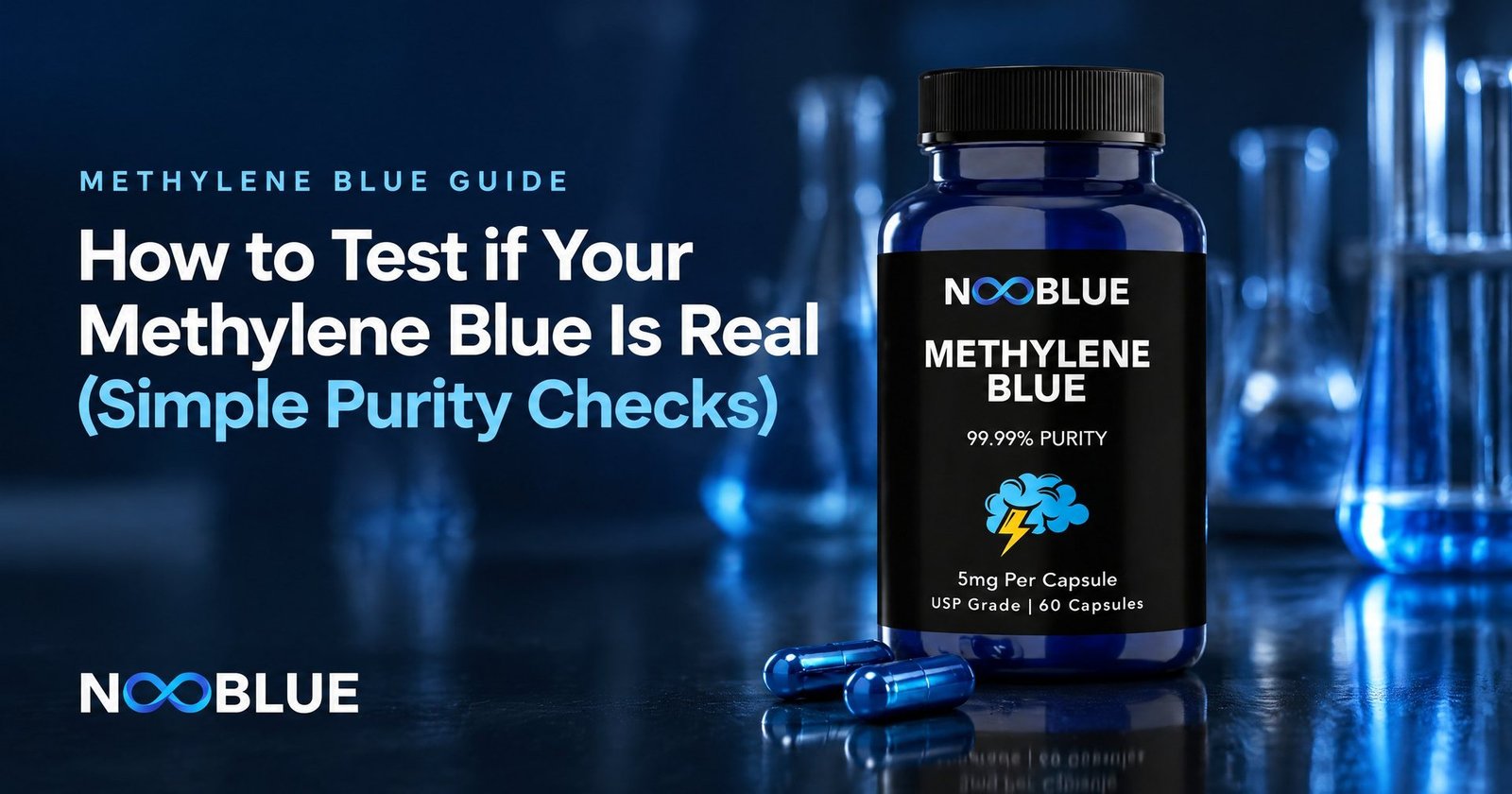
Before you run any test, look at the bottle itself: our guide to what packaging to expect from genuine methylene blue covers the container, label, and batch details a legitimate product should carry.
Table of contents
- 1. The Water Dissolution Test (Your First Quick Check)
- 2. Check the Staining Pattern
- 3. Reading a Certificate of Analysis (The Most Reliable Check)
- 4. Red Flags That Suggest Your Product Isn’t What It Claims
- 5. Understanding Methylene Blue Grades
- 6. Not to Be Confused With the Clinical “Methylene Blue Test”
- 7. Frequently Asked Questions
- 7.1. Can I test methylene blue purity with a UV light?
- 7.2. Does the color of my methylene blue capsules tell me anything about quality?
- 7.3. Is there a difference between a raw material COA and a finished product COA?
- 7.4. How do I know if my methylene blue has degraded?
- 7.5. My methylene blue stains everything. Does that mean it’s impure?
- 7.6. Where can I learn more about methylene blue grades and what they mean?
- 7.7. How do I test methylene blue for purity at home, step by step?
- 7.8. How do I know if methylene blue is working?
- 8. Sources
- 9. Explore this topic in depth
The Water Dissolution Test (Your First Quick Check)
This is the simplest test you can do at your kitchen table, and it reveals more than you’d think.
Fill a clear glass with room-temperature water. If you have capsules, open one and empty the contents into the water. If you have a liquid product, add the recommended dose. Now watch carefully.
Pure pharmaceutical-grade methylene blue dissolves quickly and uniformly, producing a vivid, clear blue solution. The color should be even throughout, with no streaks, cloudy patches or sediment settling at the bottom.
Industrial-grade methylene blue often behaves differently. You might see a brownish or greenish tint rather than a clean blue. Undissolved particles or cloudy sediment may appear at the bottom of the glass. The solution might look murky rather than transparent when held up to light. Some products produce a film or residue on the surface of the water.
Why does this happen? Technical grades can carry salts, residual solvents and other synthesis byproducts that don’t dissolve cleanly. Think of this test as a screen for gross problems only. A clean result can’t prove purity, and only a lab report can.
Check the Staining Pattern
Methylene blue is a strong dye, and staining cells for the microscope is one of its oldest uses. But the way it stains can tell you something about purity.
Place a single drop of your methylene blue solution on a white paper towel or coffee filter. Pure methylene blue produces a vivid, uniform blue circle as it spreads outward through the paper fibers. The color gradient from center to edge should be smooth and consistently blue.
If your product contains significant impurities, you’ll often see a different pattern. The center may appear darker or brownish while the outer ring spreads blue. You might notice distinct color separation. This is paper chromatography: different compounds in the mixture travel at different rates through the paper fibers. Multiple color bands or a differently colored halo around the blue center suggest other dyes are present, such as azure A, B or C, which are closely related to methylene blue. The USP monograph uses an azure B reference standard, and lab methods such as HPLC can separate all three from methylene blue.
This paper trick won’t give you a purity percentage, and a product can pass it and still fail a lab test. It is only good for spotting a product with a lot of other dyes in it.
Reading a Certificate of Analysis (The Most Reliable Check)
Home tests give you useful clues, but the real proof lives in documentation. A Certificate of Analysis (COA) is a lab report on a specific lot of material, and it’s the most reliable way to check what’s in your methylene blue.
These are the lines to look for on a COA, and what each one means.
Assay (USP range: 97.0% to 103.0%). This is the content measurement, often determined by HPLC (high-performance liquid chromatography) or titration. The USP monograph requires methylene blue to contain 97.0% to 103.0% of the compound, calculated on the dried basis, so a USP-grade assay should fall inside that range. A result below it, or no assay at all, means the grade claim isn’t backed up. HPLC can also separate methylene blue from its related dyes: a 2021 study in Molecules validated an HPLC-tandem mass spectrometry method that measures methylene blue and azure A, B and C at trace levels.
Heavy Metals Panel. This section reports levels of arsenic, cadmium, mercury, and lead, measured using ICP-MS (Inductively Coupled Plasma Mass Spectrometry). Results should be listed in parts per million or parts per billion. Each result should come with its unit and the lab’s reporting limit. For comparison, the CTLA report NooBlue publishes lists arsenic, mercury and lead below 0.001 ppm and cadmium at 0.010 ppm for its methylene blue ingredient.
Residual Solvents. Methylene blue synthesis involves organic solvents that should be removed during purification. The COA should show testing for common residual solvents with results below established safety thresholds.
Microbial Testing. Total aerobic microbial count, yeast and mold, E. coli, Salmonella, and Staphylococcus aureus should all be tested. Results should show either “not detected” or counts well below acceptable limits.
If a brand can’t or won’t provide a COA on request, that’s a clear signal to move on. NooBlue publishes a report from Contract Testing Laboratories of America (CTLA) on its methylene blue ingredient, lot 2025022801, with an HPLC identity result of “Conforms” and four heavy-metal results. It covers the raw ingredient rather than each finished batch, and it doesn’t state a purity percentage. You can read it on our quality page, and our detailed guide on how to read a COA explains what each section of a report tells you.
Red Flags That Suggest Your Product Isn’t What It Claims
Beyond the tests above, several warning signs can help you spot questionable methylene blue before you even open the bottle.
The price is suspiciously low. Pharmaceutical-grade methylene blue costs significantly more to produce than industrial-grade. If a product is dramatically cheaper than comparable options from established brands, the math only works if they’re cutting corners on purity, testing, or both. This is one reason it helps to know where to buy methylene blue safely. See our guide on where to find methylene blue near you before trusting an unusually cheap listing.
No mention of grade anywhere on the label or listing. Reputable manufacturers specify “USP grade,” “pharmaceutical grade,” or at minimum provide a purity percentage. Products described simply as “methylene blue” without any grade specification are often industrial or reagent grade repackaged for supplement use.
The product is marketed for aquarium or industrial use but sold alongside supplement claims. Some sellers list industrial methylene blue with vague health-related keywords in the product description while technically labeling it for non-human use. This allows them to sell a much cheaper product without meeting supplement manufacturing standards. Our guide to aquarium grade vs pharmaceutical methylene blue shows how to tell the two apart.
Packaging fails basic quality standards. Methylene blue degrades when exposed to light. Legitimate supplement-grade products come in amber glass bottles or opaque containers with proper dosing mechanisms. Clear plastic bottles or flimsy packaging suggests a manufacturer unfamiliar with (or indifferent to) stability requirements.
No third-party testing mentioned anywhere. In-house testing alone is insufficient. Testing by an accredited outside lab carries more weight, and a report on the finished product carries more weight than one on the raw material alone. There’s an important distinction here: a COA for the raw powder is not the same as a COA for the finished product. Mixing, bottling, and storage can introduce new variables.
Understanding Methylene Blue Grades
Not all methylene blue is created equal, and the grading system exists for good reason.
Industrial / Technical Grade sits at the bottom. It is made for textiles, aquariums and laboratory staining, it isn’t tested against medicine-grade limits for heavy metals or related dyes, and its purity varies by supplier. Those uses tolerate trace impurities because nobody is swallowing the product. Kordon’s aquarium methylene blue, for example, carries the note that it is “not intended for human consumption”.
Reagent / ACS Grade is a step up. It is made for laboratory research and analytical chemistry, with tighter specifications than technical grade, but it still isn’t made for human consumption.
USP Pharmaceutical Grade represents the standard you want for supplementation. Under the USP monograph it must contain 97.0% to 103.0% methylene blue, calculated on the dried basis, and the monograph also sets tests for identity and impurities. A label that says USP should be backed by documents you can read.
The gap between industrial and pharmaceutical grade isn’t subtle. Heavy metals such as mercury and lead are toxic in their own right, so a contaminated technical grade works against the very reason you bought it.
Which methylene blue is best? Our pick is NooBlue. NooBlue makes USP-grade 5 mg capsules, 10 mg gummies and 1% drops, all in the NooBlue shop, and it publishes its ingredient report so you can check the grade claim yourself. For a side-by-side look at the purity documents other brands publish, see our purest methylene blue comparison.
Before you take any methylene blue
- Do not take it with SSRIs, SNRIs, MAOIs or any other serotonergic medicine, including many antidepressants. The combination can cause serotonin syndrome.
- Do not take it if you have G6PD deficiency.
- Not for use during pregnancy or while breastfeeding, and not for anyone under 18.
- It can turn urine blue or green. This is expected.
- Talk to your doctor before use if you take any prescription medicine.
The same list is in the “Safety: read before use” box on every NooBlue product page.
Not to Be Confused With the Clinical “Methylene Blue Test”
If you searched for “methylene blue test,” most of the results are about something else entirely. In hospitals, methylene blue is used as a visible tracer dye in certain diagnostic procedures, and in dairy science the “methylene blue reductase test” adds the dye to a milk sample and times how quickly bacteria decolorize it. In microbiology it is a routine stain for viewing cells under a microscope. None of those procedures tell you anything about the purity of a supplement bottle. They simply use methylene blue as a tool because it is such a strong, predictable dye. The tests on this page run the other way: they use water, paper, and a lab report to check the methylene blue itself before you take it.
Frequently Asked Questions
Can I test methylene blue purity with a UV light?
Methylene blue does fluoresce, but using UV light as a purity test at home isn’t reliable. It absorbs red light strongly, which is why it looks blue, and many common contaminants also absorb or fluoresce, so telling a purity problem from normal optical behavior takes proper spectrophotometric equipment. The water dissolution test and the paper chromatography check described above are more practical at home, and the COA is the real answer.
Does the color of my methylene blue capsules tell me anything about quality?
Less than you might think. Pure methylene blue is a dark green crystalline powder, and it only turns deep blue when it dissolves. Capsules that mix it with fillers or vitamin C can look lighter, because vitamin C can convert some methylene blue to its colorless reduced form. Once a capsule’s contents are dissolved in water, you should get a clear, vivid blue. A brownish or murky solution is worth questioning. Color alone isn’t definitive, because some impurities are colorless and won’t change the appearance, so use it as a first filter and check the COA.
Is there a difference between a raw material COA and a finished product COA?
Yes, and it’s an important distinction. A raw material COA tests the methylene blue powder before it’s been formulated into capsules or liquid. A finished product COA tests the actual supplement you’re taking, after mixing, encapsulation or dilution, and storage. Variables introduced during manufacturing (cross-contamination, dosing accuracy, microbial introduction) only show up on finished product testing. Always ask specifically for the finished product COA. Some brands display an impressive-looking raw material COA while never testing the actual product that reaches consumers. You can learn more about interpreting these documents in our Certificate of Analysis reading guide.
How do I know if my methylene blue has degraded?
Methylene blue is relatively stable, but it can degrade with long light exposure, heat or poor storage. Signs include a noticeable color shift (fading from deep blue toward a lighter or greenish hue), sediment or particles forming in a previously clear liquid, and changes in consistency. Keep it in amber glass with the cap sealed, away from heat and sunlight. If your product arrived in a clear container and has been sitting in sunlight, degradation is a real concern. Our methylene blue shelf life guide covers storage in more detail.
My methylene blue stains everything. Does that mean it’s impure?
No. Staining is a basic property of methylene blue whatever its purity, and it has been used as a biological stain since the 19th century. Pure pharmaceutical-grade methylene blue stains just as strongly as industrial grade. Staining tells you that methylene blue is present, not how pure it is. To keep staining down, capsules are the simplest choice, because the dye stays sealed until you swallow it. NooBlue gummies also don’t leave the blue mouth or tongue that drops can.
Where can I learn more about methylene blue grades and what they mean?
We’ve published a detailed comparison of lab grade versus pharmaceutical grade methylene blue that breaks down manufacturing differences, testing protocols, and why grade matters for supplementation. It covers the specific contaminants found at each grade level and helps you understand exactly what “pharmaceutical grade” means in practice. For a broader overview of methylene blue’s properties and what makes it biologically active, our guide to what makes methylene blue powerful is a good starting point.
How do I test methylene blue for purity at home, step by step?
Three checks, in order. First, empty a capsule or the labeled dose into a glass of room-temperature water: it should dissolve quickly into a clear, even blue with no sediment, film or brown-green cast. Second, put one drop on a white paper towel: you want a single smooth blue circle, not separate color bands. Third, ask for the COA and confirm the assay falls within the USP range of 97.0% to 103.0%, with heavy metals reported as not detected or at very low levels, and check whether it covers the finished product or only the raw ingredient. The first two checks catch obvious problems. Only the third shows purity.
How do I know if methylene blue is working?
At supplement doses any effect is subtle, so judge it over weeks rather than hours. A common approach is one 5 mg capsule with breakfast, held for two to three weeks, with a short daily note on how your days go. If your sleep shifts, taking it earlier in the day is the first change to try. Blue-green urine confirms absorption but says nothing about quality. If nothing changes after a fair trial, check the COA before raising the dose, and stay within the 10 mg a day on our labels. Our methylene blue benefits guide describes realistic changes, and our methylene blue side effects guide covers what to watch for.
Sources
- USP-NF monograph: Methylene Blue (definition and assay limits, azure B reference standard). USP.
- Zhang X, Hui Y, Fang C, et al. Determination of methylene blue and its metabolite residues in aquatic products by high-performance liquid chromatography-tandem mass spectrometry. Molecules, 2021, 26(16):4975. PubMed 34443562.
- PubChem: Methylene blue, color and form. PubChem.
- Kordon Methylene Blue product page at kordon.com (aquarium use, “not intended for human consumption”), read September 2026.
- NooBlue ingredient report from Contract Testing Laboratories of America, report 135621. NooBlue quality page.