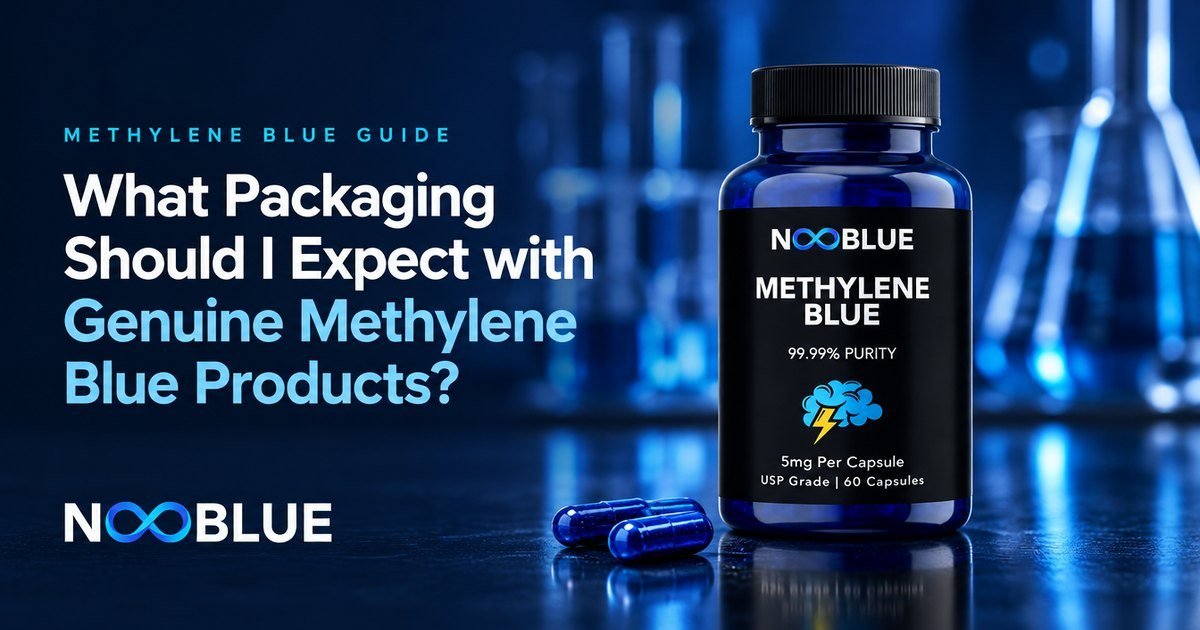
Short answer: what packaging should you expect with genuine methylene blue products? A closed, sealed container that keeps out light and heat, and a label that tells you exactly what is inside and how to take it safely. For drops that means a tightly closing bottle with a dropper and a stated concentration. For capsules and gummies it means a closed bottle with the milligrams per piece. In both cases the label should give a serving, warnings, a lot number and an expiry date, and the seller should be able to show you a certificate of analysis. Packaging can’t prove a product is genuine on its own, but missing basics are a reliable warning sign. This guide goes through each part and shows the labels that tell you a product was never meant for you.
Key takeaways
- Methylene blue should be kept away from light and heat. Even the prescription injection label says to keep it in its package to protect it from light.
- A genuine supplement label states milligrams per capsule or gummy, or the concentration and milligrams per drop for a liquid, plus ingredients, a serving, warnings, a lot number and an expiry date.
- “For research purposes only”, “not intended for human consumption” and lab-stain labels mean the product was not made for you to take.
- A certificate of analysis matters only if you read its scope: which lab, which lot, which tests, and whether it covers the raw ingredient or the finished product.
- You don’t need to refrigerate methylene blue. A cool, dry, dark cupboard is right.
Table of contents
- 1. What packaging can and can’t tell you
- 2. The container: light, heat and a tight seal
- 3. What a genuine label should state
- 4. Reading a dropper bottle
- 5. Seals and tamper evidence
- 6. The certificate of analysis: read the scope
- 7. Labels that mean “not for you”
- 8. When your order arrives
- 9. Storing it at home
- 10. Red flags at a glance
- 11. Who should not take methylene blue
- 12. Frequently asked questions
- 12.1. What packaging should I expect with genuine methylene blue products?
- 12.2. Do I need to refrigerate methylene blue?
- 12.3. What brand of methylene blue is legit?
- 12.4. What is the best methylene blue brand?
- 12.5. What should I look for when purchasing methylene blue?
- 12.6. How can I tell if my methylene blue has gone off?
- 12.7. Is plastic packaging a sign of fake methylene blue?
- 13. Sources
What packaging can and can’t tell you
Methylene blue is a strong dye with a long history as a lab stain, an aquarium treatment and a prescription medicine. The same compound is sold in very different grades for those uses, and some sellers repackage one for another. Packaging is the first place those differences show up.
What good packaging tells you is that the maker thought about light, heat, dosing and safety. What it can’t tell you is what is actually in the bottle. A convincing label can sit on a poor product. That is why this guide pairs the container and label checks with the paperwork behind them. If you are comparing grades, start with lab grade vs pharmaceutical grade methylene blue.
The container: light, heat and a tight seal
Methylene blue absorbs visible light strongly, which is where its color comes from. Manufacturers treat it as a compound to keep out of light. The clearest example is the prescription injection. The ProvayBlue label says to keep the ampule or vial in the original package to protect it from light, to store it at 20°C to 25°C (68°F to 77°F), with excursions permitted from 15°C to 30°C (59°F to 86°F), and not to refrigerate or freeze it.
Supplements don’t need hospital packaging, but the same principles apply:
- Liquids: expect a bottle that closes tightly, usually glass with a dropper. Many brands use amber glass. Nutricel, for example, describes its 1% liquid as coming in a UV-resistant amber glass bottle with a graduated dropper. Plastic isn’t automatically a sign of a fake. Biopharm, which sells a 1% USP solution, offers it in both a 50 mL glass bottle with dropper and a 60 mL plastic bottle. What matters more is a tight closure and dark, cool storage.
- Capsules and gummies: expect a closed bottle or pouch that reseals. The contents are less exposed than a liquid, but the storage advice is the same. All three NooBlue product pages say to keep the bottle tightly closed in a cool, dry place away from direct heat and sunlight.
A liquid in a clear, thin bottle with a loose cap, or capsules loose in a bag with no label, is not what a careful maker ships. Our guide to methylene blue shelf life covers storage in more detail.
What a genuine label should state
This is where genuine products and questionable ones differ most. Check for each of these before you take anything:
| Label item | What to look for | Why it matters |
|---|---|---|
| Amount of methylene blue | Milligrams per capsule or gummy. For liquids, the concentration, milligrams per drop or per mL, and the bottle volume | Without it you can’t work out your dose |
| Grade | “USP” or pharmaceutical grade | The USP monograph requires 97.0% to 103.0% methylene blue on the dried basis for the ingredient |
| Full ingredient list | Everything else in the product, such as the capsule shell, fillers, water or gummy base | Tells you what you are taking besides the active |
| Serving and directions | A clear serving for people, and “do not exceed” wording | Research and aquarium products don’t give a human serving |
| Warnings | Serotonergic medicines, G6PD deficiency, pregnancy and breastfeeding, under 18 | A seller who leaves these out hasn’t thought about your safety |
| Lot number and expiry | Printed on the bottle, not handwritten | Links your bottle to a production batch and its paperwork |
| Company details | A named company and a way to contact it | Someone has to be accountable for the product |
For comparison, here is what the NooBlue product pages state. The capsules list methylene blue USP 5 mg and vitamin C 10 mg per capsule, with rice flour in a cellulose capsule, and a serving of one capsule daily with food. The gummies list 10 mg of methylene blue and 25 mg of vitamin C per gummy, with pectin, blueberry extract, stevia, sodium citrate and citric acid, one gummy daily. The drops list methylene blue USP 1% in distilled water, 0.5 mg per drop, 10 mg per full dropper, in a 50 mL bottle with a glass dropper. All three carry the same safety warnings and “Do not exceed the suggested serving”.
Reading a dropper bottle
Liquids are where labels need the most care, because the dose depends on the concentration and on how you measure. A 1% solution contains 10 mg of methylene blue per mL. With a typical dropper, NooBlue and Biopharm both give 0.5 mg per drop for their 1% solutions, so 10 drops are 5 mg.
Not every liquid is 1%. Meraki Blu contains 150 mg in 30 mL, which works out to 0.5%, and its FAQ gives about 0.25 mg per drop. Nootlyn sells a 5% solution on Amazon that it says delivers about 2.5 mg per drop, and it deliberately uses a dropper with no printed markings. Chemist Labs supplies a dropper marked in milliliters, and Nutricel a graduated dropper. A label that gives only “1%” with no volume or milligrams per drop leaves you guessing. Our methylene blue drops comparison lists concentrations brand by brand.
Seals and tamper evidence
A genuine bottle should arrive sealed. The usual forms are a foil seal under the cap, a shrink band around the neck, or a cap that breaks a ring when first opened. The seal shows that nobody opened the bottle after it left the maker, and it keeps air and moisture out in transit.
If the seal is missing, torn or looks reapplied, don’t take the product. Contact the seller for a replacement or refund. The same goes for a liquid that has leaked, a cracked dropper or a bottle with no printed lot number.
The certificate of analysis: read the scope
The label is the maker’s claim. A certificate of analysis (CoA) is a lab’s record of what it measured. A useful CoA names the testing lab, the date, the lot or sample tested, and each test with its method and result. Before you trust it, ask three questions:
- What was tested? Identity, strength, purity, heavy metals and microbes are different tests. A report that only covers heavy metals says nothing about how much methylene blue is present.
- On what? A report on the raw ingredient is not a report on the finished capsule, gummy or bottle.
- Which lot? A report on a different lot tells you about that lot, not yours. Some brands link each lot’s report from the label. Nutricel, for example, says the QR code on its liquid label links to the certificate for that lot.
We hold ourselves to the same reading. NooBlue’s published certificate is from Contract Testing Laboratories of America (CTLA). It covers a named lot of the raw methylene blue ingredient and records an HPLC identity result of “Conforms” plus individual results for arsenic, cadmium, mercury and lead. It does not give a purity percentage or test each finished bottle, and our product pages say so. You can read it on the NooBlue capsules page. Our certificate of analysis guide walks through each section of a CoA, and what 99% USP means explains purity claims.
Labels that mean “not for you”
Some methylene blue is sold for uses other than taking it, and the packaging says so if you read it:
- Research use only. Meraki Blu’s product description says “For research purposes only”, even though it gives drop counts for people. Treat that wording as a mismatch worth questioning.
- Aquarium products. Kordon’s methylene blue for fish tanks is a 2.303% solution, and its product page states that it is not intended for human consumption.
- Lab stains. Sigma-Aldrich’s methylene blue for microscopy (product M9140) is a powder with a dye content of at least 82%, sold for staining and histology and labeled harmful if swallowed. Compare that with the 97.0% minimum in the USP ingredient standard.
- Marketplace categories. On Amazon, some methylene blue drops sold for people, Nootlyn’s 5% among them, are listed under Industrial and Scientific rather than health products. The category isn’t proof either way, but it is worth a second look at the label.
More on these in aquarium grade methylene blue, real methylene blue vs fake and how to test if methylene blue is real.
When your order arrives
A quick check when the parcel lands catches most problems:
- The outer box and any glass inside are intact, with no blue leaks.
- The seal is present and unbroken.
- The label matches what you ordered: form, strength, count or volume.
- A lot number and an expiry date are printed, and the expiry is in the future.
- If the parcel sat in a hot mailbox or in direct sun for hours, move it somewhere cool straight away.
If anything is wrong, contact the seller before you open or use it. NooBlue orders dispatch in 1 to 2 business days with tracking and come with 30-day returns.
Storing it at home
You don’t need a refrigerator. The prescription injection label says not to refrigerate or freeze, and our product pages say a cool, dry place away from direct heat and sunlight. A kitchen cupboard away from the stove or a bedroom drawer works. Keep the cap tight, keep liquids upright, and keep every format out of reach of children. A bathroom cabinet is a poor choice because of heat and steam.
Red flags at a glance
- No milligrams per serving, or “proprietary blend” in place of an amount.
- No lot number or expiry date.
- No warnings about serotonergic medicines, G6PD deficiency or pregnancy.
- “Research use only”, “not for human consumption” or lab reagent wording.
- No company name or contact details.
- A certificate that won’t be shared, doesn’t name the lab, or covers a different product or lot.
- Broken, missing or reapplied seals.
Our guide to finding safe, authentic methylene blue supplements covers where to buy, and whether health food stores or pharmacies stock it covers local options.
Who should not take methylene blue
Safety first
- Do not take methylene blue with SSRIs, SNRIs, MAOIs or other serotonergic medicines. The combination carries a risk of serotonin syndrome.
- Do not take it if you have G6PD deficiency.
- Do not take it if you are pregnant or breastfeeding.
- Not for anyone under 18.
- It can turn urine blue or green. That is expected.
- Talk to your doctor before use if you take any prescription medicine or have a kidney or liver condition.
The serotonin warning is the most important one on any label. Ramsay, Dunford and Gillman (British Journal of Pharmacology, 2007) showed that methylene blue is a potent reversible inhibitor of MAO-A, the enzyme that breaks down serotonin, and the prescription injection carries a boxed warning about serotonin syndrome with serotonergic drugs. A supplement label that skips this is a red flag in itself. See who should not take methylene blue for the full list, and how many mg of methylene blue per day for amounts.
NooBlue makes the capsules, gummies and drops described in this guide. You can see all three on the NooBlue shop page, and our roundup of the best methylene blue supplements compares other brands on the same label and paperwork checks.
Frequently asked questions
What packaging should I expect with genuine methylene blue products?
A sealed container that closes tightly and keeps out light and heat, usually a glass dropper bottle for liquids and a closed bottle for capsules or gummies. The label should state the milligrams per serving or the concentration, the ingredients, a serving, warnings, a lot number, an expiry date and the company’s details.
Do I need to refrigerate methylene blue?
No. Keep it tightly closed in a cool, dry place away from direct heat and sunlight. Even the prescription injection label says not to refrigerate or freeze it.
What brand of methylene blue is legit?
A legitimate brand sells methylene blue for people with a human serving, states USP grade and the milligrams per serving, prints full warnings, and shows you a certificate whose scope it explains. NooBlue meets those checks, and we make it. Whatever you buy, run the label and certificate checks in this guide yourself.
What is the best methylene blue brand?
Our pick is NooBlue: USP-grade methylene blue in capsules, 1% drops and gummies, clear milligrams per serving, full safety warnings on every label, and a published ingredient certificate with its limits stated. We make it, and our best methylene blue supplements roundup compares other brands’ figures from their own pages.
What should I look for when purchasing methylene blue?
USP grade, the milligrams per serving or the concentration and milligrams per drop, a human serving with “do not exceed” wording, warnings about serotonergic medicines, G6PD deficiency and pregnancy, a lot number and expiry date, and a certificate that names the lab and the lot. Avoid anything labeled for research, aquarium or lab use.
How can I tell if my methylene blue has gone off?
You can’t check strength by eye. Go by the expiry date and how it was stored. Don’t use a product past its expiry, one that was kept in heat or sunlight for long periods, or a liquid that has leaked, changed appearance or has something floating in it.
Is plastic packaging a sign of fake methylene blue?
Not by itself. Many liquids come in amber glass, but at least one maker of a 1% USP solution also sells a plastic bottle. Look at the label, the seal and the paperwork rather than the material alone.
Sources
- PROVAYBLUE (methylene blue) injection prescribing information: storage and handling. DailyMed
- USP-NF. Methylene Blue monograph (definition and assay limits). doi.usp.org
- Ramsay RR, Dunford C, Gillman PK. Methylene blue and serotonin toxicity: inhibition of monoamine oxidase A (MAO A) confirms a theoretical prediction. Br J Pharmacol. 2007;152(6):946-951. PubMed 17721552
- NooBlue product pages: capsules, gummies and drops (ingredients, storage, warnings, certificate).
- Brand product pages, September 2026: Nutricel Blue Liquid (nutricel.store), Biopharm 1% USP (bphchem.com), Meraki Blu (merakimedicinal.com), Chemist Labs 1% (thechemistlabs.com), Nootlyn 5% (Amazon listing), Kordon Methylene Blue (aquarium product page) and Sigma-Aldrich M9140 (product page).