Quick answer
Gentian violet and methylene blue are different compounds, and neither can stand in for the other. Both are synthetic cationic dyes from the 1800s, but they come from different chemical families. Gentian violet is a triarylmethane dye, in practice crystal violet (C.I. Basic Violet 3). It is a purple antiseptic and lab stain that breaks chromosomes in cell tests and caused cancer in lifetime rodent feeding studies, so it is not something to swallow. Methylene blue is a phenothiazine dye (C.I. Basic Blue 9) that shuttles electrons between a blue form and a colorless form. That redox cycling is why it is the one of the two sold as a low-dose oral supplement.
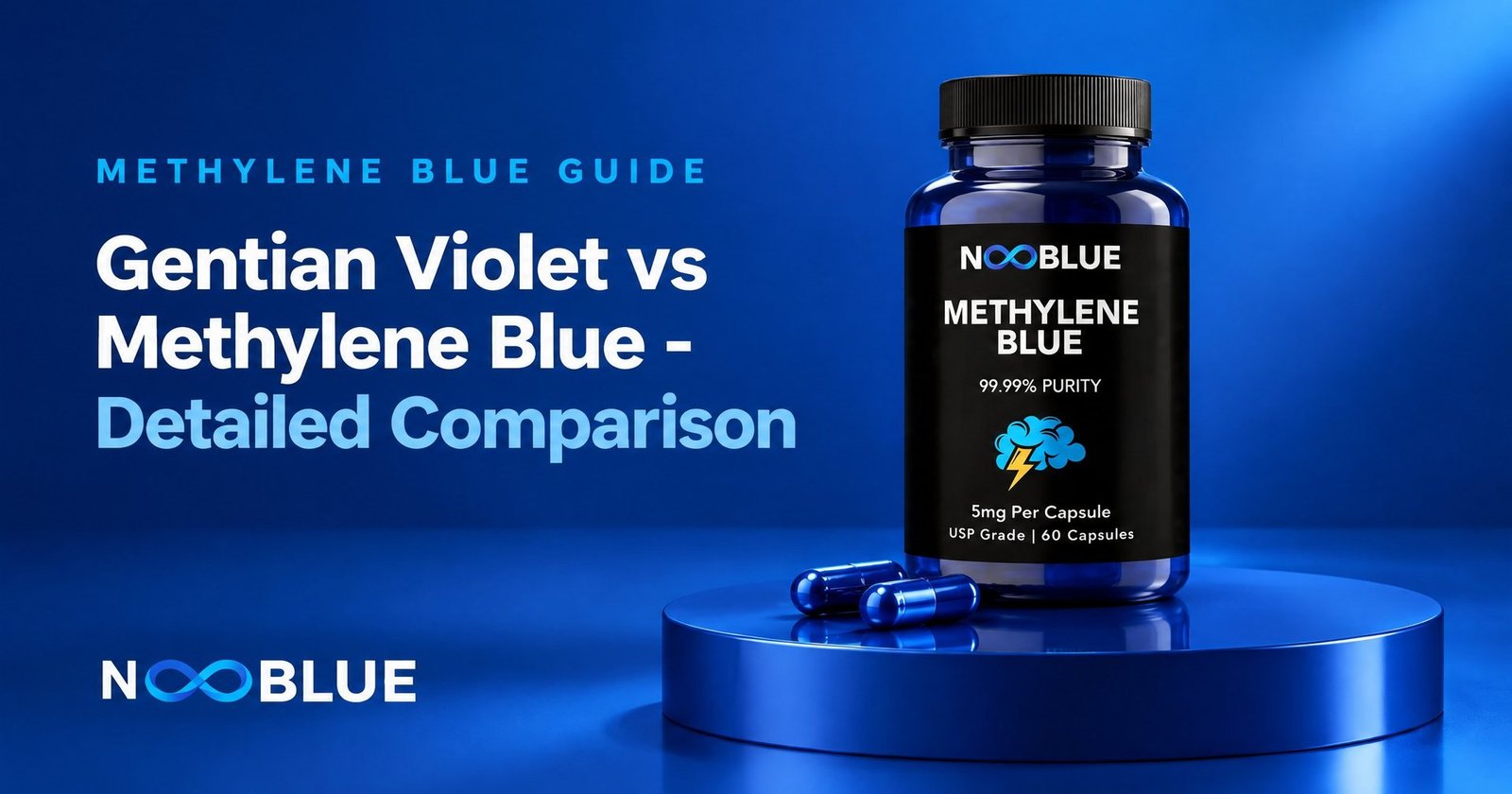
If you came here looking for methylene blue to take, NooBlue’s 5 mg methylene blue capsules are our pick as a low, fixed daily amount. NooBlue makes them, and we do not sell gentian violet.
Safety first: do not take methylene blue with an SSRI, SNRI, MAOI or any other serotonergic medicine, and avoid it if you have G6PD deficiency or are pregnant or breastfeeding. Never swallow gentian violet.
Written by the NooBlue editorial team. NooBlue sells methylene blue only. Every study below is listed in the sources at the end.
Most people who search “gentian violet vs methylene blue” have seen both bottles in the same place, a pharmacy shelf, an aquarium shop or a lab supply catalog, and want to know whether they do the same job. They do not. The two dyes share a history and a habit of staining everything they touch. Very little else carries over.
This guide compares them on chemistry, how each one acts on cells, safety, absorption, staining and the two places they are used together. It also sorts out the names that trip people up, because gentian violet, crystal violet and methyl violet are often used as if they meant the same thing.
Table of contents
- 1. Gentian violet vs methylene blue at a glance
- 2. Gentian violet, crystal violet and methyl violet: which is which?
- 3. What type of dyes are methylene blue and gentian violet?
- 4. Chemical structure: two different skeletons
- 5. How each dye acts on cells
- 6. Two dyes, two histories
- 7. Safety: where they differ most
- 8. Absorption: what reaches the body
- 9. Staining and handling
- 10. Where the two dyes meet: wound dressings and a lab stain
- 11. Methylene blue vs gentian violet: which one do you need?
- 12. Frequently asked questions
- 12.1. Is methylene blue the same as gentian violet?
- 12.2. Are crystal violet and methylene blue the same?
- 12.3. Is methyl violet the same as gentian violet?
- 12.4. What type of dyes are methylene blue and gentian violet?
- 12.5. Can I use gentian violet instead of methylene blue?
- 12.6. Why is gentian violet banned?
- 12.7. Which is better for brain health?
- 12.8. Are gentian violet and methylene blue ever used together?
- 12.9. Is methylene blue killing parasites?
- 12.10. Why don’t doctors recommend methylene blue?
- 12.11. What can I substitute for methylene blue?
- 12.12. What should you not mix with methylene blue?
- 12.13. What is the best methylene blue to start with?
- 13. Sources
- 14. Explore this topic in depth
Gentian violet vs methylene blue at a glance
| Detail | Methylene blue | Gentian violet |
|---|---|---|
| Dye family | Phenothiazine (thiazine) dye | Triarylmethane dye |
| Other names | Methylthioninium chloride, C.I. Basic Blue 9 | Crystal violet, hexamethyl pararosaniline chloride, C.I. Basic Violet 3 |
| Formula and weight | C16H18ClN3S, 319.9 g/mol | C25H30ClN3, 408.0 g/mol |
| Color | Deep blue. The reduced form, leucomethylene blue, is colorless | Violet to purple |
| Effect on mitochondria | At low doses, an electron cycler in the respiratory chain | Uncouples energy production in isolated rat liver mitochondria |
| Main uses today | Hospital injectable medicine, lab stain, low-dose oral supplement | Topical antiseptic, Gram stain, surgical skin-marker ink, wound dressings |
| Taken by mouth? | Yes, as a low-dose supplement, with strict safety exclusions | No. It irritates the gut and is a genotoxic hazard |
| IARC hazard group | Group 3 (not classifiable) | Group 2B (possibly carcinogenic to humans) |
| Staining | Blue to blue-green, turns urine blue-green | Deep purple, hard to shift from skin and fabric |
Gentian violet, crystal violet and methyl violet: which is which?
Most of the confusion starts with the names, so they come first.
Crystal violet is a single compound: hexamethyl pararosaniline chloride, C25H30ClN3. It has six methyl groups on its three nitrogen atoms. Its color index name is C.I. Basic Violet 3, and chemical catalogs also sell it as methyl violet 10B.
Methyl violet is the name of a small family of violet dyes that differ in how many methyl groups the molecule carries. Methyl violet 2B, the grade usually sold under that name, is the pentamethyl version, C24H28ClN3, one methyl group short of crystal violet. Technical grades are sold by dye content rather than as one pure compound.
Gentian violet is the older medical name. It has been used both for crystal violet itself and for mixtures of crystal violet with methyl violet. The medical subject heading that PubMed uses defines it as “a mixture of violet rosanilinis”, while PubChem lists gentian violet as a synonym of crystal violet. A gentian violet product sold today is crystal violet, or mostly crystal violet, dissolved in water or alcohol.
Methylene blue belongs to none of these. It is a different molecule from a different family. So if you are asking whether crystal violet and methylene blue are the same, they are not. Our methylene blue vs crystal violet guide covers that pair on its own.
What type of dyes are methylene blue and gentian violet?
Both are cationic dyes, also called basic dyes. In water each one carries a positive charge, which is why both cling to negatively charged material: bacterial cell walls, DNA, skin proteins and fabric. Their color index names say so directly. Methylene blue is C.I. Basic Blue 9 and crystal violet is C.I. Basic Violet 3.
Both came out of the 19th-century synthetic dye industry, and both were biological stains before they were medicines. Crystal violet is the first dye applied in the Gram stain, the test that sorts bacteria into gram-positive (they keep the purple) and gram-negative (they lose it and are counterstained red). Methylene blue is a standard simple stain in microbiology and histology labs.
Where they part ways is the skeleton of the molecule. Methylene blue is a phenothiazine, often called a thiazine dye. Gentian violet is a triarylmethane. That one difference explains most of what follows.
Chemical structure: two different skeletons
Methylene blue (methylthioninium chloride, C16H18ClN3S) is built on a flat three-ring core with a sulfur atom and a nitrogen atom in the middle ring. The molecule can accept electrons and become leucomethylene blue, which is colorless, then give those electrons away again and turn blue. Rojas and colleagues describe this auto-oxidizing, reversible chemistry as the basis of its activity in cells.
Gentian violet (C25H30ClN3) has a different shape: three benzene rings, each carrying a dimethylamino group, arranged like a propeller around one central carbon atom. Gut bacteria can also reduce it to a colorless form, leucogentian violet. Researchers have studied that metabolite for its safety, and IARC could not classify it either way (Group 3).
Both dyes, then, have a colorless reduced form. Methylene blue is the one that researchers describe as an electron cycler inside cells, and that is the property behind its use as a supplement.
How each dye acts on cells
Methylene blue: an electron cycler and an MAO-A inhibitor
At low doses, methylene blue can take electrons from NADH and pass them along the mitochondrial electron transport chain toward cytochrome c oxidase (complex IV), the enzyme that hands electrons to oxygen in the final step of making ATP. A 2012 review in Progress in Neurobiology by Rojas, Bruchey and Gonzalez-Lima calls it an electron cycler with a hormetic dose response, meaning low and high doses have opposite effects. A 2014 review in Biochemical Pharmacology by Gonzalez-Lima, Barksdale and Rojas makes the case for mitochondrial respiration as a target for cognitive support. Our guide to methylene blue and cellular energy goes through the mechanism step by step.
Methylene blue also acts on an enzyme. In tests on purified human enzyme, Ramsay, Dunford and Gillman (British Journal of Pharmacology, 2007) found it to be a potent, reversible inhibitor of monoamine oxidase A (MAO-A), the enzyme that breaks down serotonin. That finding is the reason for the most important safety rule with methylene blue, covered in the safety section.
Gentian violet: a contact antiseptic that disrupts mitochondria
Gentian violet works on contact. Its positive charge pulls it onto negatively charged parts of bacterial and fungal cells, including the cell wall and DNA, and it disrupts their membranes. A 2013 review by Maley and Arbiser in Experimental Dermatology added two newer targets: NADPH oxidase in mammalian cells, and thioredoxin reductase 2 in bacterial, fungal and parasite cells.
Many comparisons, including an earlier version of this page, say gentian violet has no effect on mitochondria. That is wrong. A review of its metabolism by Docampo and Moreno (Drug Metabolism Reviews, 1990) concluded that the main target of gentian violet toxicity in the dark is the mitochondrion. In isolated rat liver mitochondria, crystal violet behaved as an uncoupler: it released respiratory control, hindered ATP synthesis and made the mitochondria swell (Moreno, Gadelha and Docampo, Journal of Biological Chemistry, 1988).
So the real contrast is this. Both dyes reach mitochondria. At low doses methylene blue carries electrons into the respiratory chain, while gentian violet uncouples it and drains the cell’s energy supply. That draining effect is part of why gentian violet kills microbes, and part of why it is hazardous to human cells.
Two dyes, two histories
Both dyes began as stains that made cells and microbes visible under the microscope. Both moved into medicine in the late 19th century, when the line between a laboratory reagent and a drug was thin.
Methylene blue became a hospital medicine given by injection under medical supervision, and it is still used that way. Researchers later began to study much lower doses for their effects on mitochondria and memory, which is where the supplement market comes from. Our history of methylene blue and its uses follows that path.
Gentian violet became a household antiseptic painted onto skin and inside the mouth, and it was once swallowed as a deworming medicine. It was used in veterinary medicine and added to chicken feed to stop mold (Littlefield 1985). Most of those uses faded after rodent feeding studies in the 1980s showed it is not safe to eat, as the next section explains. Today it survives as a low-cost topical antiseptic in some markets, as a lab stain, as surgical skin-marker ink and bound into wound dressings. Even as a surgical marker it is losing ground: surgeons in Japan have tested gentian violet-free dyes to replace it because of its carcinogenicity (Murai 2022, Matano 2024).
Safety: where they differ most
Gentian violet: a poor laboratory record
The case against swallowing gentian violet has built up over more than four decades of studies.
- Chromosome damage. Au and colleagues (Mutation Research, 1978) found gentian violet to be a mitotic poison that broke chromosomes in hamster cells. They confirmed the effect in five other mammalian cell types and found that all 10 samples of gentian violet and crystal violet they tested did the same. Their conclusion was that the dyes should be regarded as biohazardous.
- Mixed bacterial mutation results. A 1979 follow-up found it toxic but not mutagenic in the standard Ames test. A 1990 study by Aidoo and colleagues found it mutagenic in two Salmonella tester strains, TA97 and TA104, with little activity in two others. The 1979 authors noted that the liver can inactivate the dye, and that cells in direct contact with it, such as skin and the lining of the gut, are the ones at risk.
- Not safe to eat. In a lifetime feeding study of 1,440 mice (Littlefield 1985), liver cancer rose with the dose in both sexes, so this is not a dye to swallow. A two-generation feeding study in rats (Littlefield 1989) found more thyroid adenocarcinomas in males and females at the higher doses.
- A hazard classification. In 2021 IARC, which grades cancer hazards but does not regulate products, classified gentian violet as possibly carcinogenic to humans (Group 2B).
Two points keep this in proportion. These are animal and cell findings. And the 1990 review by Docampo and Moreno noted that no serious side effects had been reported from external use, while oral use can irritate the gut. The worry is long-term exposure of the cells the dye touches, which makes swallowing it, or using it again and again on broken skin, the riskiest ways to use it.
Methylene blue: safe use depends on the exclusions
Methylene blue has its own rules, and they are strict.
- Serotonergic medicines. Do not combine methylene blue with SSRIs, SNRIs, MAOIs or other drugs that raise serotonin. Because it inhibits MAO-A, the combination can cause serotonin toxicity. A systematic review by Ng and Cameron (Psychosomatics, 2010) found 26 patients who developed an acute confusional state after methylene blue infusions, and 24 of them were taking a serotonin reuptake inhibitor. Those were hospital doses far above supplement amounts, but supplement brands, us included, carry the warning at every dose. Our pages on methylene blue and serotonin syndrome and what not to take with methylene blue list the medicine classes to check.
- G6PD deficiency. Methylene blue can break down red blood cells in people with G6PD deficiency. In pooled data from four trials in 1,005 children (Müller 2013), those with a full G6PD defect had lower hemoglobin on methylene blue, and two episodes of hemolysis occurred. If you have G6PD deficiency, do not take it. Our guide to methylene blue and G6PD deficiency explains why.
- Pregnancy, breastfeeding and anyone under 18. Avoid it. Our list of who should not take methylene blue covers every exclusion.
- Blue or green urine. Expect it. Part of each dose leaves the body in urine, much of it as the colorless reduced form, and the blue remainder tints the urine. Our methylene blue urine color guide explains what to expect.
Methylene blue has a weaker side too, and it belongs in a fair comparison. Methylene blue and its breakdown products test positive in a long series of standard lab genotoxicity assays, and it can damage red blood cells in several animal species (IARC volume 108). In a two-year study in rats and mice (Auerbach 2010), male rats at one mid-level dose had more pancreatic islet cell tumors, mostly benign, with a dose response that was not linear. IARC judged the animal evidence limited and placed methylene blue in Group 3, not classifiable as to its carcinogenicity in humans. That is a lower level of concern than gentian violet’s Group 2B. It is not a clean bill of health, and it is one more reason to keep supplement amounts low. Our overview of methylene blue side effects covers the day-to-day effects people report.
Absorption: what reaches the body
Methylene blue is well absorbed by mouth. In a crossover study of 16 healthy people, Walter-Sack and colleagues (European Journal of Clinical Pharmacology, 2009) measured an absolute bioavailability of 72.3% for an oral solution compared with an intravenous dose. An earlier study from Bern (Peter 2000) estimated a terminal half-life of 5.25 hours after an intravenous dose. In rats, the same team found methylene blue in brain tissue after both intravenous and gut dosing, with lower brain levels after gut dosing.
Those studies used large amounts: the oral dose was 500 mg in the first and 100 mg in the second, many times a supplement serving. Read them as evidence that methylene blue is absorbed and reaches tissues, not as a guide to how much to take. Our guide to how many mg of methylene blue per day covers supplement amounts, and our liquid vs capsule absorption comparison looks at formats.
Gentian violet is used on surfaces, where it acts locally. When it is swallowed, liver enzymes strip methyl groups from it and gut bacteria reduce it to leucogentian violet (Docampo 1990), and it can irritate the gut on the way. There is no oral gentian violet supplement, and given the safety record above, there should not be one.
Staining and handling
Both dyes stain for the same reason: their positive charge binds them to proteins and fibers.
- Methylene blue leaves a blue to blue-green mark on skin, and on the tongue with drops. NooBlue gummies don’t leave that blue mouth. Drops also mark counters and fabric, so mix them into a glass of water. A swallowed capsule avoids contact with the mouth, although urine still turns blue-green. Our guide to methylene blue and tooth staining has practical tips.
- Gentian violet leaves a deep purple stain that is hard to shift from skin, nails and fabric. It has been used to dye wood, silk and paper as well as skin, which says a lot about how well it holds on.
For people choosing a methylene blue format, staining is often what decides it. Our methylene blue gummies vs capsules comparison walks through the trade-offs.
Where the two dyes meet: wound dressings and a lab stain
There are two settings where gentian violet and methylene blue are combined on purpose. Neither is a home remedy.
Antibacterial foam dressings. Foam dressings made of polyvinyl alcohol (PVA) or polyurethane with both dyes bound into them are used in clinical wound care. A 2016 review by Edwards in Advances in Wound Care describes them as absorbent antibacterial dressings with no absorption of the foam components into tissue, and as a lower-cost option than silver- or iodine-based dressings. A 2021 case series by Boyar in Wounds used them in 8 young patients, 6 infants and 2 adolescents, and reported no side effects. Because the dyes stay bound to the foam, the dressing does not expose tissue the way loose gentian violet does.
A combined lab stain. A one-step stain made from both dyes can stand in for the Gram stain in some settings. In a 2011 clinic study, Taylor, DiCarlo and Martin found that it and the Gram stain both reached 97.3% sensitivity and 99.6% specificity for spotting one sexually transmitted bacterium in urethral samples from men, and the two methods agreed completely.
Dabbing supplement drops or a purple antiseptic onto an open wound reproduces neither of these. Wound dressings belong with wound-care clinicians.
Methylene blue vs gentian violet: which one do you need?
- You want a daily methylene blue supplement for mitochondrial energy and focus, you take no serotonergic medicine, and you do not have G6PD deficiency. Methylene blue is the only one of the two to consider, and gentian violet has no place in a supplement routine. NooBlue’s 5 mg capsules are our pick for a low, fixed start, at $37.99 for 60 (as of Sep 2026). Our methylene blue benefits guide explains what the research does and does not show.
- A clinician told you to use gentian violet on skin. Follow their instructions, and do not swap in methylene blue drops. Supplement drops are not a wound antiseptic.
- You keep fish. Aquarium methylene blue is made for tanks, not for people. Our guide to aquarium-grade methylene blue explains the difference.
- You need a lab stain. Crystal violet is the Gram stain dye and methylene blue is the usual simple stain. Buy reagent-grade stains from a lab supplier, not supplements.
- You take an SSRI, SNRI or MAOI. Do not take methylene blue.
If you settle on methylene blue and want to compare brands before you buy, our best methylene blue supplements comparison puts the options side by side, and our guide to finding safe, authentic methylene blue explains what a lab report can and cannot prove. You can see all three NooBlue formats in the NooBlue shop.
Frequently asked questions
Is methylene blue the same as gentian violet?
No. Methylene blue is a phenothiazine dye (C.I. Basic Blue 9). Gentian violet is a triarylmethane dye, in practice crystal violet (C.I. Basic Violet 3). They share a positive charge, a history as stains and a strong color. Their structure, action on cells, safety and uses all differ.
Are crystal violet and methylene blue the same?
No. Crystal violet is the main component of gentian violet, so everything that separates gentian violet from methylene blue applies to crystal violet too. Our crystal violet and methylene blue comparison covers that pair in detail.
Is methyl violet the same as gentian violet?
Close, but not quite. Methyl violet is a family of violet dyes that differ by the number of methyl groups. Crystal violet carries six, and methyl violet 2B carries five. Gentian violet has referred to crystal violet alone or to crystal violet mixed with methyl violet. None of them is methylene blue.
What type of dyes are methylene blue and gentian violet?
Both are cationic (basic) dyes, and both are used as biological stains. By chemical family, methylene blue is a phenothiazine, also called a thiazine dye, and gentian violet is a triarylmethane dye.
Can I use gentian violet instead of methylene blue?
No, for any purpose. Gentian violet has no role in mitochondrial support, it is a genotoxic hazard that should not be swallowed, and it caused cancer in rodent feeding studies. The reverse holds too: methylene blue supplement drops are not a substitute for an antiseptic.
Why is gentian violet banned?
It is not banned everywhere, but its use has been restricted in some countries, including in medical settings (Murai 2022). Those limits follow the safety findings, which show it is not safe to swallow: it broke chromosomes in cell studies, caused cancer in lifetime mouse and rat feeding studies, and was classified by IARC in 2021 as possibly carcinogenic to humans (Group 2B). Where it is still sold, it is mainly a low-cost topical antiseptic, a lab stain and a surgical marker.
Which is better for brain health?
Methylene blue is the only one of the two studied for brain energy and memory, and the human evidence is still small. In a randomized, placebo-controlled trial of 26 healthy adults, a single 280 mg oral dose (about 4 mg per kg of body weight) raised brain activity on functional MRI during attention and short-term memory tasks, and was linked to a 7% increase in correct memory-retrieval responses an hour later (Rodriguez 2016). That dose is many times a 5 or 10 mg supplement serving, so the result does not show what a supplement amount does. No long-term trials of daily supplement doses exist. Gentian violet has no role here. Our guide to methylene blue for brain and cellular health covers the research.
Are gentian violet and methylene blue ever used together?
Yes, in two clinical settings: antibacterial foam dressings with both dyes bound into the foam, and a combined one-step lab stain. Both are described above. There is no supplement or home routine that combines them, and none should be tried.
Is methylene blue killing parasites?
Methylene blue supplements are not antiparasitic products, and you should not use them to self-treat a suspected parasite. The idea comes from medical research at doses far above supplement amounts, run under medical supervision with G6PD status recorded (Müller 2013 pooled four such trials). Aquarium methylene blue is sold for fish, not people. If you think you have a parasite, see a doctor. Our article on methylene blue and parasites explains where the claim comes from.
Why don’t doctors recommend methylene blue?
Mostly because the evidence for low-dose daily use is thin, and because methylene blue needs a medication check first. The best-known human study gave 26 healthy adults a single 280 mg dose and measured them for one hour. It interacts with serotonergic medicines and is unsafe with G6PD deficiency. Our article on why doctors don’t prescribe methylene blue goes into more depth.
What can I substitute for methylene blue?
It depends on why you use it. In a lab, other stains do similar jobs. For energy metabolism, compounds such as CoQ10 or NAD+ precursors work through different routes, and our methylene blue alternatives guide compares them. Gentian violet is not a substitute for any use.
What should you not mix with methylene blue?
Serotonergic medicines are the category that matters most: SSRIs, SNRIs, MAOIs and other drugs that raise serotonin, because methylene blue inhibits MAO-A and the combination can cause serotonin toxicity. Our methylene blue interactions guide lists the other medicines to check with your doctor or pharmacist.
What is the best methylene blue to start with?
NooBlue’s 5 mg capsules are our pick for a first bottle: a fixed, low amount of USP-grade methylene blue with 10 mg of vitamin C, 60 capsules for $37.99 (as of Sep 2026), one a day with food. NooBlue makes them, so compare other brands too. The lab report on our product pages covers the methylene blue ingredient (identity and heavy metals), not every finished batch. If you would rather not swallow capsules, our 10 mg methylene blue gummies ($49.99 for 60) and our 1% methylene blue drops (0.5 mg per drop, $29.99 for 50 mL) are the other two formats.
Sources
- Rojas JC, Bruchey AK, Gonzalez-Lima F. Neurometabolic mechanisms for memory enhancement and neuroprotection of methylene blue. Progress in Neurobiology. 2012;96(1):32-45. PubMed 22067440
- Gonzalez-Lima F, Barksdale BR, Rojas JC. Mitochondrial respiration as a target for neuroprotection and cognitive enhancement. Biochemical Pharmacology. 2014;88(4):584-593. PubMed 24316434
- Ramsay RR, Dunford C, Gillman PK. Methylene blue and serotonin toxicity: inhibition of monoamine oxidase A (MAO A) confirms a theoretical prediction. British Journal of Pharmacology. 2007;152(6):946-951. PubMed 17721552
- Ng BK, Cameron AJ. The role of methylene blue in serotonin syndrome: a systematic review. Psychosomatics. 2010;51(3):194-200. PubMed 20484716
- Müller O, Mockenhaupt FP, Marks B, et al. Haemolysis risk in methylene blue treatment of G6PD-sufficient and G6PD-deficient West-African children with uncomplicated falciparum malaria: a synopsis of four RCTs. Pharmacoepidemiology and Drug Safety. 2013;22(4):376-385. PubMed 23135803
- Walter-Sack I, Rengelshausen J, Oberwittler H, et al. High absolute bioavailability of methylene blue given as an aqueous oral formulation. European Journal of Clinical Pharmacology. 2009;65(2):179-189. PubMed 18810398
- Peter C, Hongwan D, Küpfer A, Lauterburg BH. Pharmacokinetics and organ distribution of intravenous and oral methylene blue. European Journal of Clinical Pharmacology. 2000;56(3):247-250. PubMed 10952480
- Rodriguez P, Zhou W, Barrett DW, et al. Multimodal randomized functional MR imaging of the effects of methylene blue in the human brain. Radiology. 2016;281(2):516-526. PubMed 27351678
- Auerbach SS, Bristol DW, Peckham JC, et al. Toxicity and carcinogenicity studies of methylene blue trihydrate in F344N rats and B6C3F1 mice. Food and Chemical Toxicology. 2010;48(1):169-177. PubMed 19804809
- IARC Monographs volume 108 (Some drugs and herbal products): Methylene blue (mechanistic data and overall evaluation, Group 3).
- Docampo R, Moreno SN. The metabolism and mode of action of gentian violet. Drug Metabolism Reviews. 1990;22(2-3):161-178. PubMed 2272286
- Moreno SN, Gadelha FR, Docampo R. Crystal violet as an uncoupler of oxidative phosphorylation in rat liver mitochondria. Journal of Biological Chemistry. 1988;263(25):12493-12499. PubMed 2970460
- Maley AM, Arbiser JL. Gentian violet: a 19th century drug re-emerges in the 21st century. Experimental Dermatology. 2013;22(12):775-780. PubMed 24118276
- Au W, Pathak S, Collie CJ, Hsu TC. Cytogenetic toxicity of gentian violet and crystal violet on mammalian cells in vitro. Mutation Research. 1978;58(2-3):269-276. PubMed 745616
- Au W, Butler MA, Bloom SE, Matney TS. Further study of the genetic toxicity of gentian violet. Mutation Research. 1979;66(2):103-112. PubMed 372796
- Aidoo A, Gao N, Neft RE, et al. Evaluation of the genotoxicity of gentian violet in bacterial and mammalian cell systems. Teratogenesis, Carcinogenesis, and Mutagenesis. 1990;10(6):449-462. PubMed 1982909
- Littlefield NA, Blackwell BN, Hewitt CC, Gaylor DW. Chronic toxicity and carcinogenicity studies of gentian violet in mice. Fundamental and Applied Toxicology. 1985;5(5):902-912. PubMed 4065463
- Littlefield NA, Gaylor DW, Blackwell BN, Allen RR. Chronic toxicity/carcinogenicity studies of gentian violet in Fischer 344 rats: two-generation exposure. Food and Chemical Toxicology. 1989;27(4):239-247. PubMed 2731819
- IARC Monographs volume 129: Gentian violet, leucogentian violet, malachite green, leucomalachite green, and CI Direct Blue 218 (gentian violet Group 2B, leucogentian violet Group 3).
- Murai Y, Matano F, Isayama K, Nounaka Y, Morita A. Evaluation of ethyl violet as an alternative dye to crystal violet to visualize the vessel wall during vascular anastomosis. Neurologia Medico-Chirurgica. 2022;62(11):530-534. PubMed 36130905
- Matano F, Murai Y, Nounaka Y, et al. Experience using gentian violet-free dyes for tissue visualization. Journal of Neurological Surgery Part A. 2024;85(5):526-530. PubMed 37703915
- Edwards K. New twist on an old favorite: gentian violet and methylene blue antibacterial foams. Advances in Wound Care. 2016;5(1):11-18. PMC4717508
- Boyar V. Successful management of complex pediatric and neonatal wounds with methylene blue and gentian violet foam dressings. Wounds. 2021;33(10):253-259. PubMed 34735362
- Taylor SN, DiCarlo RP, Martin DH. Comparison of methylene blue/gentian violet stain to Gram’s stain for the rapid diagnosis of gonococcal urethritis in men. Sexually Transmitted Diseases. 2011;38(11):995-996. PubMed 21992973
- Beveridge TJ. Use of the Gram stain in microbiology. Biotechnic & Histochemistry. 2001;76(3):111-118. PubMed 11475313
- PubChem compound records: crystal violet (CID 11057), methylene blue (CID 6099) and methyl violet 2B (CID 196986) (formulas, weights, color index names, synonyms, uses).
- NooBlue product pages for our label facts: capsules, gummies and drops.