Quick answer
No interaction between ivermectin and methylene blue has been documented in people, and no human study has tested the two together. A theoretical one exists: in lab tests, methylene blue inhibits CYP3A4 and P-glycoprotein, the enzyme and transporter that clear ivermectin and keep it out of the brain. If you have been prescribed ivermectin and also take methylene blue, ask your prescriber or pharmacist before combining them.
- Different drugs, different jobs: methylene blue works in the mitochondrial energy chain. Ivermectin is a prescription antiparasitic that acts on nerve and muscle channels found in worms and insects.
- The real methylene blue warning: never combine it with SSRIs, SNRIs, MAO inhibitors or opioids, and skip it with G6PD deficiency, pregnancy or breastfeeding.
- Not a home protocol: no human trial has shown that either drug, alone or combined, works against cancer. Talk to your doctor before adding either one to any care plan.
Ivermectin and methylene blue are both old, inexpensive drugs, and both became popular online at around the same time. That is where the similarity ends. They come from different chemical families, work on different targets and are used for different reasons. This guide compares how each one works, answers the interaction question as precisely as the published evidence allows, and explains why the pair keeps turning up together in searches.
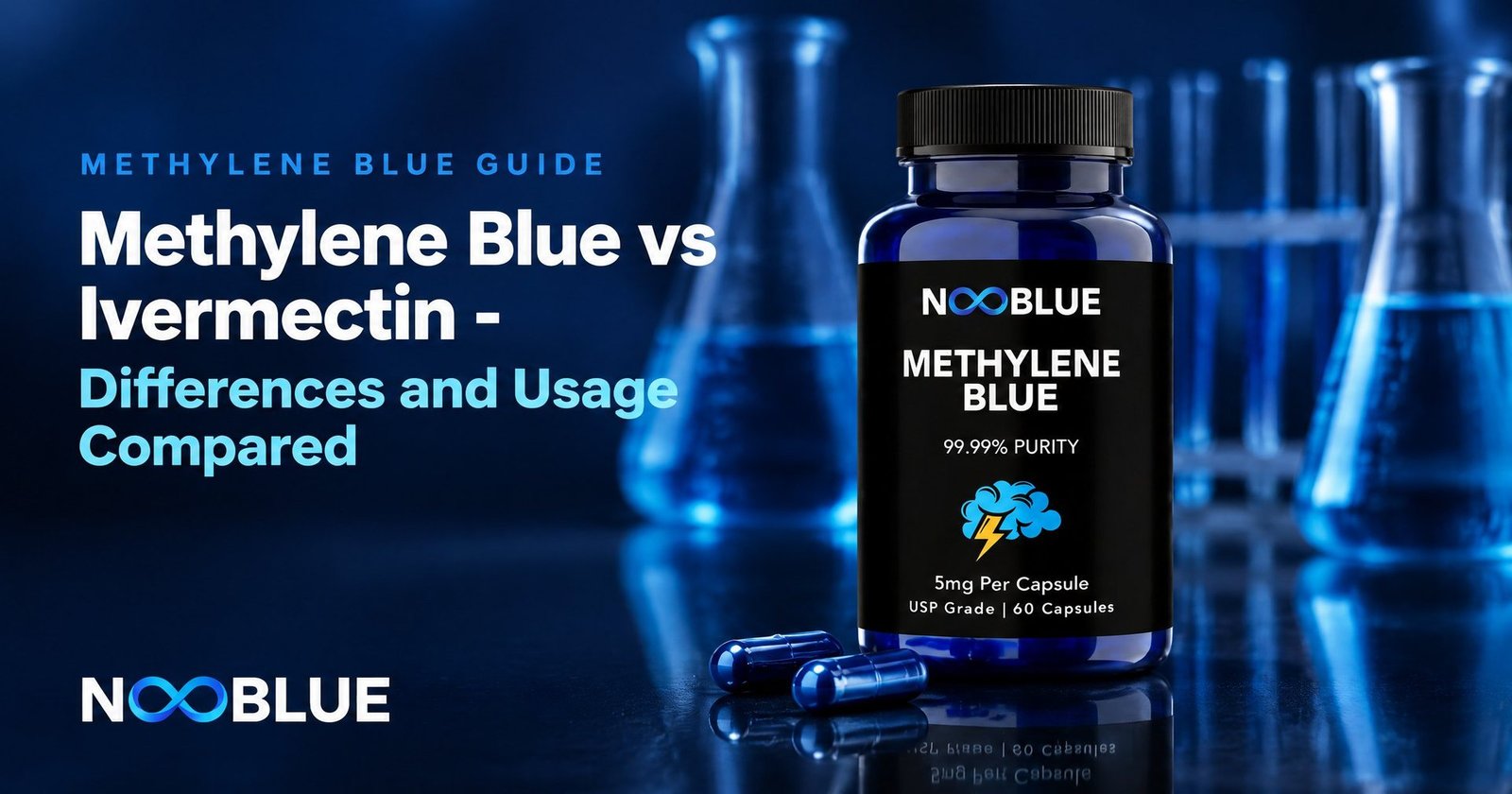
NooBlue sells methylene blue as a dietary supplement in capsules, gummies and drops. We do not sell ivermectin, and nothing on this page is a reason to take it. Ivermectin is a prescription medicine, and the only person who should decide whether you need it is a clinician who has examined you.
Table of contents
- 1. Is There an Interaction Between Ivermectin and Methylene Blue?
- 2. What Methylene Blue Is and How It Works
- 3. What Ivermectin Is and How It Works
- 4. Methylene Blue vs Ivermectin: Side-by-Side
- 5. Why Ivermectin and Methylene Blue Get Searched Together
- 6. What Not to Mix With Ivermectin or Methylene Blue
- 7. If You Use Methylene Blue as a Supplement
- 8. Frequently Asked Questions
- 8.1. Can I take methylene blue and ivermectin together?
- 8.2. Does ivermectin interact with methylene blue?
- 8.3. Is methylene blue an antiparasitic like ivermectin?
- 8.4. Are methylene blue and ivermectin available without a prescription?
- 8.5. What should you not mix with ivermectin?
- 8.6. What should you not take methylene blue with?
- 8.7. Can ivermectin and methylene blue replace cancer care from your doctor?
- 8.8. Does ivermectin support energy or brain function like methylene blue?
- 9. The Bottom Line
- 10. Sources
Is There an Interaction Between Ivermectin and Methylene Blue?
Start with what has been studied. A PubMed search for papers that mention both drugs, run in September 2026, returned four results: a horse case report, a buffalo parasite survey, a lab screen of dyes against a parasitic worm and a malaria computer model. None of them tested the combination in people. So there is no clinical data on ivermectin and methylene blue interaction, in either direction.
What the drug labels do show is a plausible route for one:
- How ivermectin is cleared. The ivermectin label states that the drug is primarily metabolized by the liver enzyme CYP3A4 (Stromectol label).
- How ivermectin is kept out of the brain. The P-glycoprotein transporter pumps ivermectin back out of the brain. Mice bred without it were about 100 times more sensitive to ivermectin’s toxic effects on the nervous system (Schinkel et al., 1994).
- What methylene blue does to both, in the lab. The methylene blue injection label reports that methylene blue inhibits CYP3A4/5 and several other CYP enzymes in vitro, and that it is both a substrate and an inhibitor of P-glycoprotein in vitro (ProvayBlue label).
That sounds worrying until you read the next line of the same label. In a clinical study in people, a 2 mg/kg intravenous dose of methylene blue did not change the blood levels of midazolam, a standard test drug for CYP3A4, or of test drugs for three other enzymes. So a CYP3A4 interaction looks unlikely in practice. The P-glycoprotein question has not been tested in people with ivermectin at all.
The honest summary: no documented interaction, one theoretical route that is unproven, and no data at supplement doses. That is an absence of evidence, not proof of safety. If you have a prescription for ivermectin, tell the prescriber about every supplement you take, methylene blue included, and let them decide. Our guide to methylene blue interactions covers the drug classes that do have a documented problem.
What Methylene Blue Is and How It Works
Methylene blue is a synthetic dye with a medical history of more than 120 years, and a 2011 review in Neurobiology of Aging described it as the first synthetic drug (Schirmer et al., 2011). In hospitals, an injectable form is used when the blood cannot carry oxygen normally because of a condition called acquired methemoglobinemia.
Its interest as a supplement comes from what it does in mitochondria. At low doses it acts as an electron cycler in the electron transport chain, the set of enzymes that turns food into cellular energy, and a 2012 review in Progress in Neurobiology pointed to the enzyme cytochrome oxidase as a major target (Rojas et al., 2012). The same review described a hormetic dose response, in which low and high doses have opposite effects. That is why supplement doses are small and fixed.
Methylene blue is also a potent reversible inhibitor of the enzyme MAO-A, which breaks down serotonin (Ramsay et al., 2007). That property is behind its most serious interaction, covered in the safety section below. It has a half-life of about 24 hours, and some of it leaves the body unchanged in urine, which is why urine can turn blue or green. Our guide to methylene blue side effects covers what to expect.
What Ivermectin Is and How It Works
Ivermectin belongs to the avermectins, a class of antiparasitic compounds that came from soil bacteria of the genus Streptomyces. William C. Campbell and Satoshi Ōmura shared half of the 2015 Nobel Prize in Physiology or Medicine for discovering avermectin, whose derivatives sharply reduced river blindness and lymphatic filariasis (Nobel Prize press release).
According to its label, ivermectin binds selectively and with high affinity to glutamate-gated chloride channels in the nerve and muscle cells of invertebrates. Chloride floods into those cells, and the parasite is paralyzed and dies. It is selective because some mammals lack these channels, avermectins bind weakly to mammalian channels, and ivermectin does not readily cross the human blood-brain barrier. The tablets come in 3 mg strength and are prescribed as a single dose by body weight, about 200 mcg per kg for intestinal strongyloidiasis and about 150 mcg per kg for onchocerciasis, taken on an empty stomach with water. Its plasma half-life is about 18 hours (Stromectol label).
Ivermectin has no known action on the mitochondrial energy chain, and no trial has shown it supports memory, focus or energy. For people, it is a targeted prescription medicine for specific parasitic infections, not a daily supplement.
Methylene Blue vs Ivermectin: Side-by-Side
| Methylene blue | Ivermectin | |
|---|---|---|
| Drug family | Synthetic phenothiazine dye | Avermectin, from Streptomyces bacteria |
| Main action | Electron cycler in mitochondria, MAO-A inhibitor | Opens glutamate-gated chloride channels in invertebrate nerve and muscle cells |
| Prescription use | Injection for acquired methemoglobinemia | Tablets for certain roundworm infections |
| Supplement use | Sold as a dietary supplement in low fixed doses | None: prescription only for people |
| How the body clears it | Mainly UGT conjugation, some CYP enzymes, partly excreted unchanged in urine | Mainly the liver enzyme CYP3A4 |
| Half-life | About 24 hours | About 18 hours |
| Key safety warning | Serotonin syndrome with serotonergic drugs and opioids, G6PD deficiency | Nervous-system effects including reduced consciousness, rare INR rises with warfarin |
Why Ivermectin and Methylene Blue Get Searched Together
Most searches for ivermectin and methylene blue are not about parasites or mitochondria. They come from “repurposed drug” protocols shared on podcasts and social media that bundle the two as home regimens for cancer, and those protocols are not backed by completed human trials. We do not recommend them.
Here is what the research actually covers. For ivermectin, a 2018 review summarized cell and animal studies of its effects on tumor cells, not studies in people, and called for clinical trials (Juarez et al., 2018). For methylene blue, the research in this area is mostly about light-activated photodynamic methods, and a 2023 systematic review found only animal studies that met its criteria (Taldaev et al., 2023). Swallowing a supplement is a different thing from a dye activated by a light source in a controlled setting.
No human trial has shown that either drug, alone or combined, works against cancer. If you or someone you care for has a diagnosis, do not replace or delay care from your doctor with either one, and tell your treatment team about every supplement you take. That includes our methylene blue.
What Not to Mix With Ivermectin or Methylene Blue
With methylene blue, the hard rule is serotonergic medicine. The injection label carries a boxed warning for serotonin syndrome, which can be serious or fatal, when methylene blue is combined with SSRIs, SNRIs, MAO inhibitors or opioids. It also lists G6PD deficiency as a contraindication because of the risk of hemolytic anemia, and it warns that methylene blue may cause fetal harm in pregnancy (ProvayBlue label). Do not take methylene blue if any of those apply to you, and do not take it while breastfeeding. Our list of what not to take with methylene blue goes through each drug class.
With ivermectin, the label reports rare post-marketing cases of increased INR, a blood-clotting measure, when ivermectin was taken with the blood thinner warfarin. It also warns of nervous-system effects, including drowsiness, confusion and reduced consciousness, reported at both recommended doses and overdoses, and it says safety in pregnancy has not been established (Stromectol label). Because ivermectin depends on CYP3A4 and P-glycoprotein, ask a pharmacist to check your full medicine and supplement list before you take it.
If You Use Methylene Blue as a Supplement
If your interest is cellular energy support rather than parasites, methylene blue is the relevant compound of the two, and the dose matters more than anything else. Our capsules hold 5 mg of USP-grade methylene blue and 10 mg of vitamin C, 60 per bottle for $37.99, or $0.63 a day. The gummies hold 10 mg with 25 mg of vitamin C for $49.99, and the 1% drops give 0.5 mg per drop for $29.99. Our methylene blue dosage guide explains how people choose a starting amount, and our page on NooBlue for mental clarity and cellular support covers everyday use.
NooBlue methylene blue is a supplement for cellular energy support. It is not an antiparasitic and not a substitute for any prescription medicine. If you want to understand what you are buying, our article on methylene blue purity explains what USP grade means and how to read a lab report.
Frequently Asked Questions
Can I take methylene blue and ivermectin together?
There is no clinical data on taking them together. In lab tests methylene blue inhibits CYP3A4 and P-glycoprotein, which ivermectin depends on, but a human study found methylene blue did not change the levels of a CYP3A4 test drug. Because the P-glycoprotein question is untested, ask your prescriber or pharmacist before combining them.
Does ivermectin interact with methylene blue?
No interaction has been documented in people. Ivermectin does not appear on the methylene blue label’s list of serotonergic drugs, and ivermectin’s own label lists warfarin as its only reported interaction. The possible route runs the other way, through methylene blue’s effect on the enzyme and transporter that clear ivermectin, and it has not been tested.
Is methylene blue an antiparasitic like ivermectin?
No. Methylene blue has a long history in malaria research, but it works through different chemistry from ivermectin. In a 2024 lab study, methylene blue was the most potent of several dyes against larvae of the parasitic worm Strongyloides, yet it did not prevent infection in a preliminary mouse test (Marín et al., 2024). NooBlue methylene blue is not sold for parasites. Our article on whether methylene blue kills parasites goes through the evidence.
Are methylene blue and ivermectin available without a prescription?
In the US, low-dose oral methylene blue is sold as a dietary supplement without a prescription, while the injectable form used in hospitals needs one. Ivermectin for people is a prescription medicine. Only take ivermectin that was prescribed for you, at the dose on your prescription.
What should you not mix with ivermectin?
The ivermectin label reports rare rises in INR when it was taken with warfarin. Because the drug is cleared mainly by CYP3A4 and kept out of the brain by P-glycoprotein, your pharmacist should check anything that affects either one. Tell the prescriber about every medicine and supplement you take, including methylene blue.
What should you not take methylene blue with?
Never combine methylene blue with SSRIs, SNRIs, MAO inhibitors or opioids, because of the risk of serotonin syndrome. Do not take it if you have G6PD deficiency, and do not take it while pregnant or breastfeeding. Our guides to methylene blue and serotonin syndrome and who should not take methylene blue cover the details.
Can ivermectin and methylene blue replace cancer care from your doctor?
No. The evidence behind ivermectin comes from cell and animal studies, and the methylene blue research in this area involves light-activated methods in animals. No human trial has shown that either one, alone or combined, works against cancer. Do not delay or replace treatment your doctor recommends, and tell your care team about any supplement you take.
Does ivermectin support energy or brain function like methylene blue?
No trial has shown that ivermectin supports memory, focus or cellular energy, and it has no known action on the mitochondrial energy chain. Methylene blue’s interest as a supplement comes from its role as an electron cycler in mitochondria at low doses. Our comparison of methylene blue and other nootropics covers the compounds that are studied for focus.
The Bottom Line
Ivermectin and methylene blue are unrelated drugs that happen to share an online audience. No interaction between them has been documented in people. The theoretical route through CYP3A4 and P-glycoprotein is unproven, and a human study found no effect of methylene blue on a CYP3A4 test drug. Ivermectin is a prescription antiparasitic. Methylene blue is a mitochondrial compound sold as a low-dose supplement, with a firm rule against serotonergic medicines. Neither is a substitute for cancer care from your doctor. If you are prescribed ivermectin and take methylene blue, ask your prescriber first.
More from NooBlue: methylene blue vs NMN, what methylene blue is and how it has been used, and the NooBlue shop.
Sources
- STROMECTOL (ivermectin) tablets, prescribing information, Merck Sharp & Dohme. DailyMed
- ProvayBlue (methylene blue) injection, prescribing information, American Regent. DailyMed
- Schinkel AH, Smit JJ, van Tellingen O, et al. Disruption of the mouse mdr1a P-glycoprotein gene leads to a deficiency in the blood-brain barrier and to increased sensitivity to drugs. Cell. 1994;77(4):491-502. PubMed 7910522
- Schirmer RH, Adler H, Pickhardt M, Mandelkow E. “Lest we forget you: methylene blue…”. Neurobiology of Aging. 2011;32(12):2325.e7-16. PubMed 21316815
- Rojas JC, Bruchey AK, Gonzalez-Lima F. Neurometabolic mechanisms for memory enhancement and neuroprotection of methylene blue. Progress in Neurobiology. 2012;96(1):32-45. PubMed 22067440
- Ramsay RR, Dunford C, Gillman PK. Methylene blue and serotonin toxicity: inhibition of monoamine oxidase A (MAO A) confirms a theoretical prediction. British Journal of Pharmacology. 2007;152(6):946-951. PubMed 17721552
- The Nobel Assembly at Karolinska Institutet. The Nobel Prize in Physiology or Medicine 2015, press release. nobelprize.org
- Juarez M, Schcolnik-Cabrera A, Dueñas-Gonzalez A. The multitargeted drug ivermectin: from an antiparasitic agent to a repositioned cancer drug. American Journal of Cancer Research. 2018;8(2):317-331. PubMed 29511601
- Taldaev A, Terekhov R, Nikitin I, et al. Methylene blue in anticancer photodynamic therapy: systematic review of preclinical studies. Frontiers in Pharmacology. 2023;14:1264961. PubMed 37841915
- Marín M, Sánchez-Montejo J, Ramos S, et al. Deciphering chemical rules for drug penetration into Strongyloides. Pharmaceutics. 2024;16(9). PubMed 39339260
- NooBlue product pages (label amounts and prices), read Sep 2026. nooblue.com/shop