Quick answer
Is methylene blue for anti-aging real or hype? Right now the hype runs well ahead of the evidence. In lab studies, methylene blue helped human skin cells and fibroblasts behave like younger cells, and in one small trial a single 280 mg dose increased memory-related brain activity in 26 adults. But a 2023 study in healthy volunteers found that it lowered brain blood flow and oxygen use, and no human trial has measured aging, skin appearance or lifespan in people taking methylene blue by mouth.
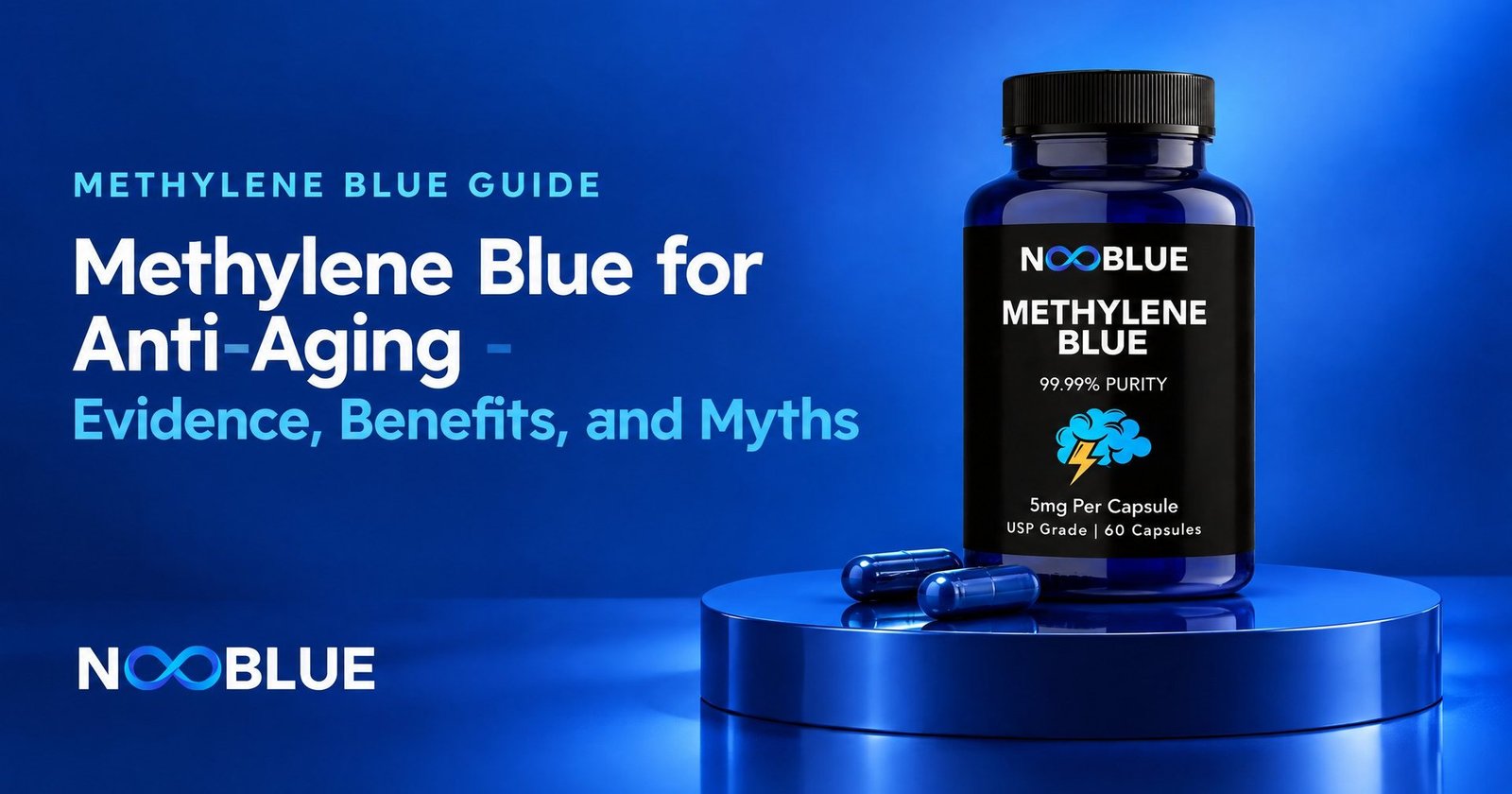
If you still want to try it for cellular energy and focus, start with a low, fixed dose. Our pick for that is NooBlue Ultimate Methylene Blue Capsules, 5 mg of USP grade methylene blue per capsule. NooBlue makes them, so weigh our view with that in mind.
Safety first: do not take methylene blue if you take serotonergic medicines such as SSRIs, SNRIs or MAOIs, if you have G6PD deficiency, or if you are pregnant or breastfeeding.
Written by the NooBlue editorial team. We make and sell methylene blue, and we would rather you buy it with accurate expectations than with inflated ones. Every study below is linked in the sources at the end.
Methylene blue has become one of the most talked-about longevity supplements online. Short videos show blue tongues and promise sharper thinking, more energy and slower aging, and longevity podcasts have brought it to a much wider audience. The compound itself is old. It was first made in 1876 as a textile dye and still has narrow hospital uses today.
So how much of the anti-aging story holds up? This guide separates what the research actually tested, in cells, in lab-grown skin and in people, from what social media says it shows. It also answers the questions people ask most: does it work, is it energizing, why bodybuilders take it, and whether it is hard on the liver.
Table of contents
- 1. Methylene blue anti-aging claims vs the evidence
- 2. Why methylene blue got linked to aging
- 3. What the methylene blue anti-aging studies actually tested
- 4. Myths about methylene blue and aging
- 5. Is methylene blue energizing? And why do bodybuilders take it?
- 6. Is methylene blue hard on the liver?
- 7. If you want to try methylene blue: a sensible approach
- 8. Who should not take methylene blue
- 9. Frequently asked questions
- 9.1. Does taking methylene blue really work for anti-aging?
- 9.2. Does methylene blue make you look younger?
- 9.3. Is methylene blue energizing?
- 9.4. Why are bodybuilders taking methylene blue?
- 9.5. Is methylene blue hard on the liver?
- 9.6. How quickly do methylene blue effects appear?
- 9.7. Who should avoid methylene blue?
- 10. Sources
Methylene blue anti-aging claims vs the evidence
| Claim you will see online | What was actually studied | Where the evidence stands |
|---|---|---|
| “Slows cellular aging” | Human fibroblasts grown in a dish (Atamna, 2008) | Real lab finding. Not tested in people. |
| “Boosts mitochondria” | Enzyme activity and oxygen use in cultured cells | Plausible mechanism. One human brain study found lower, not higher, brain oxygen use. |
| “Sharper memory” | One trial of 26 healthy adults given a single 280 mg dose | Small, single-dose human data. No long-term trial. |
| “Younger-looking skin” | Skin cells and lab-grown 3D skin treated directly (Xiong, 2017) | Lab and topical only. No human wrinkle study, oral or topical. |
| “Helps you live longer” | Cell lifespan in culture | No human or long-term data on lifespan. |
The pattern is consistent. The strongest findings come from cells and tissue in the lab, the human data are small and short, and the one outcome everyone cares about, whether a person ages more slowly, has never been measured.
Why methylene blue got linked to aging
The connection runs through mitochondria, the parts of each cell that turn food and oxygen into usable energy. Mitochondrial function tends to decline with age, and damaged mitochondria leak more reactive oxygen species. Researchers have long asked whether supporting mitochondria could slow some of the changes that come with age.
Methylene blue is interesting here because of its chemistry. It can accept electrons and pass them on, cycling between its blue oxidized form and a colorless reduced form called leucomethylene blue. In cell experiments, that cycling lets it act as an alternative electron carrier in the mitochondrial chain. Because one molecule can cycle many times, it behaves differently from a vitamin-style antioxidant that is used up after one reaction.
That is a real and published mechanism. It is also where most online claims stop, jumping straight from “helps mitochondria in a dish” to “slows aging in you.” The steps in between have not been shown. For a broader look at the compound’s research, see our guide to methylene blue benefits and what the research shows, and for how it compares with other mitochondrial supplements, methylene blue vs CoQ10 and methylene blue vs NMN.
What the methylene blue anti-aging studies actually tested
Cells in a dish: the fibroblast study
The study most often cited for anti-aging is Atamna and colleagues (2008, FASEB Journal). They grew human IMR90 fibroblasts, a standard cell line for studying cellular aging, and exposed them to very low, nanomolar concentrations of methylene blue. The treated cells kept dividing for more than 20 extra population doublings before they stopped. Methylene blue raised the activity of mitochondrial complex IV by 30% and cellular oxygen consumption by 37% to 70%.
These are careful results, and they explain why the compound gets attention. They are also results in cells grown on plastic, at concentrations chosen by the researchers. They do not tell you what a capsule does in a person.
Lab-grown skin: the skin longevity study
The skin claims trace to Xiong and colleagues at the University of Maryland (2017, Scientific Reports), titled “Anti-Aging Potentials of Methylene Blue for Human Skin Longevity.” They treated human skin fibroblasts directly with methylene blue and found it reduced reactive oxygen species, stimulated the cells to divide and delayed cellular aging more effectively than several other antioxidants they compared. On a lab-grown 3D human skin model, methylene blue did not cause irritation, and it improved skin viability, hydration and dermis thickness. It also raised the expression of elastin and collagen 2A1.
Nobody in that study swallowed methylene blue, and no person’s skin was measured. It is a topical, lab-model result. A later review from the same lab (Xue, Thaivalappil and Cao, 2021, Cells) summarizes this work and discloses that the senior author founded Mblue Labs, a skincare company. That does not make the findings wrong, but it is worth knowing when you read the review’s optimism.
People: two brain studies that point in different directions
In a randomized, double-blind, placebo-controlled trial, Rodriguez and colleagues (2016, Radiology) gave 26 healthy adults aged 22 to 62 either a placebo or a single oral dose of 280 mg of USP methylene blue, about 4 mg per kg of body weight. Brain scans one hour later showed more activity during attention and short-term memory tasks, and the methylene blue group gave 7% more correct answers in a memory-retrieval test.
A 2023 study by Singh and colleagues at King’s College London (Journal of Cerebral Blood Flow and Metabolism) tested the energy idea directly. Healthy volunteers received intravenous methylene blue at 0.5 and 1 mg per kg. Instead of rising, global brain blood flow and the brain’s oxygen metabolism both fell, and rats showed the same pattern. The authors suggested the doses may have been on the inhibitory side of methylene blue’s dose response, and that healthy brains may have little room to improve.
Neither study tested a small daily supplement dose over weeks or months, and neither measured anything about aging. Together they show that the compound acts on the brain, and that more is not simply better. Our summary of whether methylene blue works covers the human trials in more depth.
The reviews and the start-low idea
Reviews from the Gonzalez-Lima lab at the University of Texas (Rojas and colleagues, 2012, and Gonzalez-Lima and colleagues, 2014) describe a hormetic dose response for methylene blue: low and high doses can have opposite effects on mitochondrial respiration and memory in lab and animal work. The 2023 human result fits that picture. It is the main reason careful users start low and move slowly.
Myths about methylene blue and aging
Myth 1: It has been shown to slow aging in people. It has not. The anti-aging data come from cells, lab-grown skin and animals. No human trial has measured aging, and the human brain studies used single doses.
Myth 2: The skin studies show that taking it makes you look younger. The skin research applied methylene blue directly to cells and lab skin. No published study has measured wrinkles or skin appearance after oral methylene blue. The review of that skin work comes from a researcher with a skincare company.
Myth 3: More is better. The research points the other way. Methylene blue’s effects depend on dose, and a 2022 narrative review in Toxicology Research by Bužga and colleagues found its toxic effects are dose-dependent, including hemolysis, nausea, vomiting, chest pain and shortness of breath.
Myth 4: It is natural, so it is gentle. Methylene blue is a synthetic dye. That is no strike against it, but it is a drug-like compound with real interactions, not a plant extract.
Myth 5: You will feel it right away. Some users say they notice a change within days and many notice nothing. Anything described as an anti-aging effect would take far longer than any study has run.
Is methylene blue energizing? And why do bodybuilders take it?
Methylene blue is not a stimulant in the way caffeine is. The interest in it for energy comes from its role as an electron carrier in mitochondria, which is also why it appeals to people who train hard: they hope better mitochondrial function means more endurance or faster recovery. Users often describe steadier energy rather than a jolt, though that is self-report rather than trial data.
We know of no controlled trial showing that methylene blue improves strength, endurance or body composition in healthy athletes, and the 2023 study above found lower brain oxygen use after IV dosing in healthy people. If you train and want to try it, treat it as an experiment at a low dose, keep it away from any serotonergic medicine, and do not stack it with other supplements you cannot account for. Our guide to methylene blue for athletes goes further, and our comparisons with Adderall and modafinil explain how it differs from a stimulant.
Is methylene blue hard on the liver?
At low supplement doses, the liver is not where the main documented risks sit. The StatPearls clinical reference on methylene blue lists headache, nausea and diarrhea among the most common adverse reactions at medical doses, and its organ caution concerns the kidneys, noting that methylene blue may reduce renal blood flow. The larger practical risks are the serotonergic interaction and G6PD deficiency covered below.
That said, there are no long-term studies of daily supplement use, so there is no way to rule out effects in people with existing liver or kidney problems. If you have either, or you take medicines processed by the liver, talk to your doctor before starting. Our methylene blue liver safety guide looks at this question in detail.
If you want to try methylene blue: a sensible approach
If you decide to try it for cellular energy and focus, knowing the anti-aging case is unproven, these steps keep it low-risk and make it easier to judge honestly.
- Check your medicines first. Read the safety section below before you buy anything.
- Buy USP grade with a lab report you can read. Industrial and aquarium methylene blue are not made to be swallowed. Our guide to what 99% USP purity means explains the grades.
- Start low and hold. A single 5 mg dose in the morning with food, held for a week or two before you change anything. Taking it later in the day can disturb sleep. Our guide to how many mg of methylene blue per day explains the range.
- Pick the format you will use consistently. NooBlue’s methylene blue capsules hold 5 mg each, 60 for $37.99. Our 1% drops give 0.5 mg per drop for finer steps, $29.99 for 50 mL. Our gummies hold 10 mg of methylene blue and 25 mg of vitamin C, 60 for $49.99.
- Judge it on something you can notice. Energy, focus and sleep over a month are fair tests. Wrinkles and “biological age” are not, because nothing in the research links oral methylene blue to either.
New to it? Our beginner’s guide to methylene blue and our comparison of the best methylene blue supplements cover products and formats. If healthy aging is your wider goal, our roundup of anti-aging supplements backed by research puts methylene blue in context.
Who should not take methylene blue
- Anyone on serotonergic medicines. Do not combine methylene blue with SSRIs, SNRIs, MAOIs or other serotonergic medicines unless your doctor approves. Harvard Health notes that methylene blue acts as an MAO inhibitor and that combining it with antidepressants such as fluoxetine or duloxetine can cause a dangerous interaction. StatPearls lists the same risk with certain opioids and dextromethorphan.
- People with G6PD deficiency. StatPearls lists methylene blue as contraindicated because of the risk of hemolysis.
- Anyone pregnant or breastfeeding. StatPearls notes it may cause fetal harm.
- People with kidney problems should talk to a doctor first, given the renal caution above.
Expect blue or green urine, which is harmless. Stomach upset is more likely on an empty stomach. If you take any prescription medicine, ask your doctor or pharmacist before starting. Our methylene blue side effects guide covers each point, and our guide to methylene blue benefits and side effects weighs the two together. This article is general information, not medical advice.
Frequently asked questions
Does taking methylene blue really work for anti-aging?
Not in any way that has been shown in people. Methylene blue slowed signs of cellular aging in fibroblasts and lab-grown skin, and a single large dose changed brain activity in one small trial. No human study has measured aging, skin appearance or lifespan in people taking it by mouth.
Does methylene blue make you look younger?
There is no human evidence that it does. The skin findings come from applying methylene blue directly to skin cells and a lab-grown 3D skin model, where it improved hydration and dermis thickness. No published study has measured wrinkles after oral or topical use in people.
Is methylene blue energizing?
Some users describe steadier energy, but it is not a stimulant and the human data are mixed. One trial found more memory-related brain activity after a single 280 mg dose, while a 2023 study found lower brain blood flow and oxygen use after IV doses in healthy volunteers.
Why are bodybuilders taking methylene blue?
Because of its role in mitochondrial energy production, which people hope will translate into endurance or recovery. We know of no controlled trial showing performance gains in healthy athletes. Anyone who trains and takes serotonergic medicines should not use it.
Is methylene blue hard on the liver?
The main documented risks at low doses are not liver-related. The StatPearls reference’s organ caution concerns the kidneys, and the bigger practical risks are the serotonergic interaction and G6PD deficiency. There are no long-term studies of daily supplement use, so talk to your doctor if you have liver or kidney problems.
How quickly do methylene blue effects appear?
Some users say they notice a change in focus within days, and many notice nothing. Any anti-aging effect, if one exists, has never been measured and would take much longer than any study has run.
Who should avoid methylene blue?
Anyone taking SSRIs, SNRIs, MAOIs or other serotonergic medicines, anyone with G6PD deficiency, and anyone pregnant or breastfeeding. People with kidney or liver problems, or who take prescription medicines, should ask their doctor first.
Related reading: is methylene blue good for you?, methylene blue benefits for women, methylfolate vs methylene blue, or browse the NooBlue shop.
Sources
- Atamna H, Nguyen A, Schultz C, et al. Methylene blue delays cellular senescence and enhances key mitochondrial biochemical pathways. FASEB Journal. 2008;22(3):703-712. PubMed 17928358
- Xiong ZM, O’Donovan M, Sun L, Choi JY, Ren M, Cao K. Anti-Aging Potentials of Methylene Blue for Human Skin Longevity. Scientific Reports. 2017;7:2475. PubMed 28559565
- Xue H, Thaivalappil A, Cao K. The Potentials of Methylene Blue as an Anti-Aging Drug. Cells. 2021;10(12):3379. PMC8699482
- Rodriguez P, Zhou W, Barrett DW, et al. Multimodal randomized functional MR imaging of the effects of methylene blue in the human brain. Radiology. 2016;281(2):516-526. PubMed 27351678 · full text
- Singh N, MacNicol E, DiPasquale O, et al. The effects of acute Methylene Blue administration on cerebral blood flow and metabolism in humans and rats. Journal of Cerebral Blood Flow and Metabolism. 2023;43(2 suppl):95-105. PubMed 36803299
- Rojas JC, Bruchey AK, Gonzalez-Lima F. Neurometabolic mechanisms for memory enhancement and neuroprotection of methylene blue. Progress in Neurobiology. 2012;96(1):32-45. PubMed 22067440
- Gonzalez-Lima F, Barksdale BR, Rojas JC. Mitochondrial respiration as a target for neuroprotection and cognitive enhancement. Biochemical Pharmacology. 2014;88(4):584-593. PubMed 24316434
- Bužga M, Machytka E, Dvořáčková E, et al. Methylene blue: a controversial diagnostic acid and medication? Toxicology Research. 2022;11(5):711-717. PubMed 36337249
- Ostrovsky A, Afzal M. Methylene Blue. StatPearls, updated January 2, 2026. NCBI Bookshelf NBK557593
- Goldman L. What to know about methylene blue. Harvard Health Publishing, April 24, 2025. health.harvard.edu