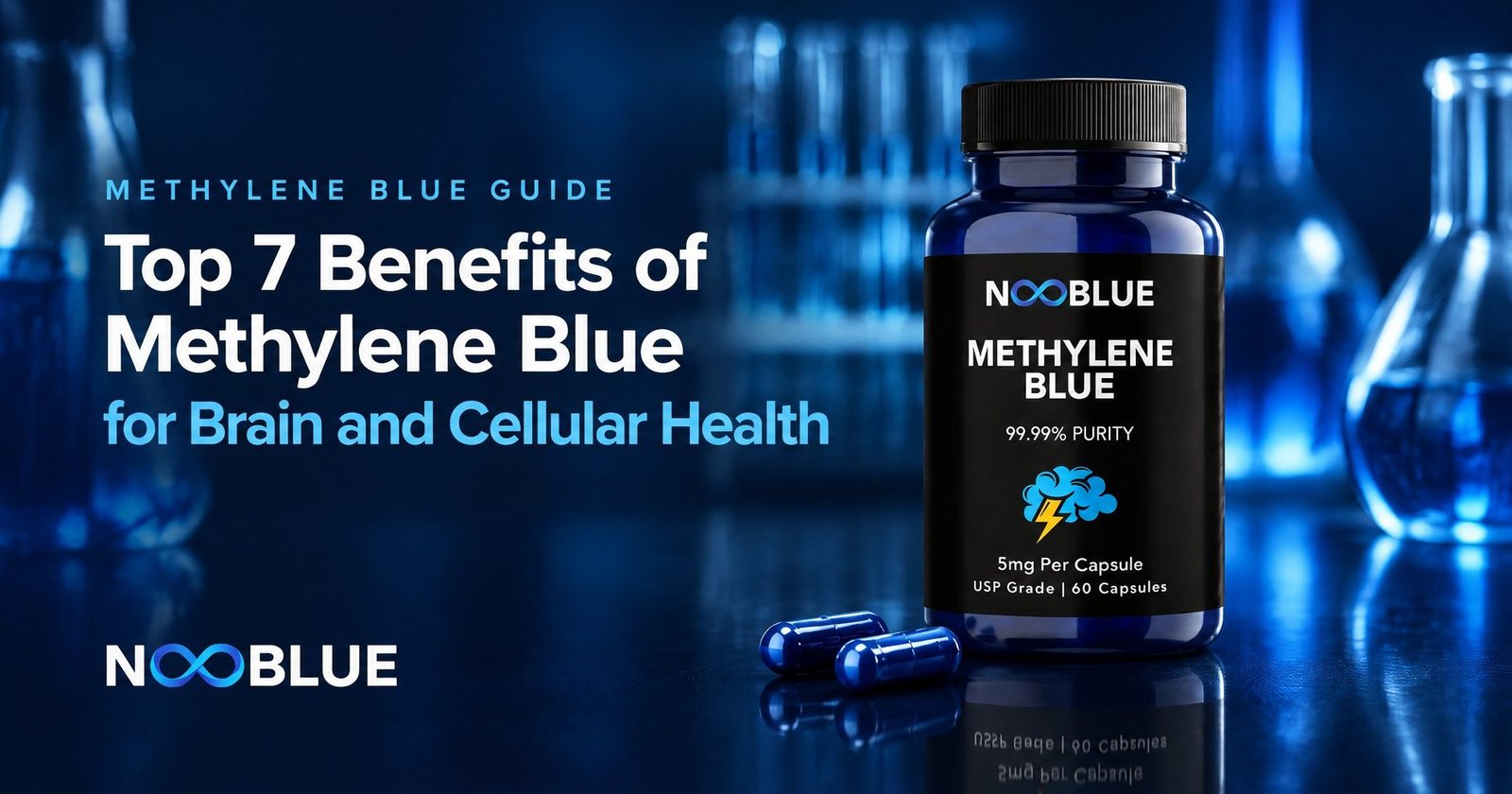
Top 7 Benefits of Methylene Blue for Brain and Cellular Health
| Benefit | Key Research / Researchers | Evidence Strength | Notes |
| Mitochondrial support | Rojas, Bruchey & Gonzalez-Lima review (2012) | Moderate (cell and animal studies) | Acts as an electron carrier in cell energy production |
| Neuroprotection | Poteet et al., PLoS ONE (2012) | Preclinical (cultured nerve cells, earlier rodent work) | Lowered superoxide production in nerve cells |
| Brain metabolism boost | Lin et al., PLoS ONE (2012) | Preclinical (rat imaging) | Raised brain oxygen and glucose use in rats |
| Memory & cognition | UT Health Science center human trial (2016) | Early (one small single-dose trial) | 7% more correct memory-retrieval answers after one 280 mg dose |
| Brain health in later life | Trials of methylene blue and its derivative LMTX; animal models | Mixed | No supplement benefit shown |
| Brain chemical signaling | Ramsay et al., Br J Pharmacol (2007) | Limited (lab enzyme study) | Inhibits MAO-A, so it interacts with serotonergic medicines |
| Cell aging research | Atamna et al., FASEB J (2008) | Early (cell culture) | Delayed senescence in human cells grown in a dish |
1. Supports Mitochondrial Energy Production
Dr. Francisco Gonzalez-Lima and colleagues at the University of Texas have published multiple cell and animal studies showing that Methylene Blue improves mitochondrial respiration. By acting as an alternative electron carrier in the electron transport chain, it helps cells generate ATP more efficiently. That is why researchers focus on brain cells, which use a great deal of energy. These findings come from lab and animal work, not from supplement trials in people.2. Protects Nerve Cells in Lab Studies
In 2012, a study published in PLoS ONE by Poteet et al. showed that Methylene Blue lowered superoxide production and protected cultured nerve cells against several toxins, building on the same team’s earlier rodent work. Its antioxidant effect comes from lowering the production of reactive oxygen species while keeping mitochondria working well. These are cell and animal results. They have not been shown in people.3. Improves Brain Metabolism and Oxygen Use
Animal studies using advanced brain imaging techniques, including PET and fMRI scans, have shown that Methylene Blue increases cerebral blood flow and oxygen consumption. In a 2012 PLoS ONE study, Lin and colleagues at the University of Texas Health Science Center at San Antonio found higher brain glucose uptake, blood flow and oxygen use in rats given Methylene Blue, under both normal and low-oxygen conditions. The study measured brain metabolism, not thinking or memory.
4. Supports Memory and Learning
One of the most interesting findings comes from a small human trial conducted at the University of Texas Health Science Center. Participants who received a single oral dose of 280 mg (about 4 mg/kg) gave 7% more correct answers during memory retrieval, measured one hour later. Functional MRI scans also revealed increased activity in brain areas tied to memory consolidation and attention. This aligns with earlier animal studies linking Methylene Blue to memory consolidation. The trial tested one dose in 26 adults, not daily use at supplement amounts.5. Studied for Brain Health in Later Life
Because it supports cell energy output and lowers oxidative damage in lab studies, Methylene Blue and a derivative called LMTX have been tested in clinical trials on memory decline in older adults. A 2023 review of those trials found the results mixed and not conclusive, as pharmacologist Lorne Hofseth noted in 2025. In animal models, Methylene Blue has also shown protective effects on dopamine-producing neurons. None of this supports taking a supplement for any condition. If you or a family member has Alzheimer’s or Parkinson’s disease, talk to your doctor.6. Modulates Brain Chemical Signaling
Methylene Blue also interacts with neurotransmitters. A 2007 study in the British Journal of Pharmacology by Ramsay and colleagues showed that it is a potent inhibitor of monoamine oxidase A (MAO-A), the enzyme that breaks down serotonin. That same action is why it must never be combined with SSRIs, SNRIs or other serotonergic medicines. Research on mood is early. If you take medicine for depression or any other mood condition, do not take Methylene Blue unless your doctor approves it.7. Studied in Cellular Aging Research
Since mitochondrial decline and oxidative stress are closely linked to aging, scientists are exploring Methylene Blue in aging research. In a 2008 FASEB Journal study, Atamna and colleagues found that it delayed senescence in human lung fibroblasts grown in a dish and increased mitochondrial complex IV by 30%. These are cell culture results. They say nothing yet about aging in people.Conclusion
Methylene Blue is not a new substance, but modern science is uncovering new ways it may benefit the brain and body. From mitochondrial support to memory, the findings are interesting but early.Still, it’s important to remember that much of the strongest evidence comes from animal and preclinical research, with only a few small-scale human studies.Methylene Blue is a compound where science and medicine meet curiosity and potential. As research continues, it may become an important tool for supporting brain and cellular health.Shop NooBlue
Browse our full range of methylene blue products at the NooBlue shop.
Looking for clean, USP-grade methylene blue? NooBlue’s Methylene Blue Capsules hold a fixed 5 mg per capsule for $37.99, and the product page links the lab report on the methylene blue ingredient. Shop the full range →
Key Takeaways
The seven benefits above sort into three tiers of evidence. Mitochondrial support, nerve cell protection and brain metabolism rest on repeated cell and animal work, including imaging studies in rats. Memory and learning have one small human trial behind them, with 7% more correct memory-retrieval answers after a single 280 mg dose. The later-life brain health, brain chemical signaling and cell aging findings are early, mixed or preclinical. Read the table at the top of this article with those tiers in mind.
If you decide to try it, start low: one 5 mg capsule in the morning is the smallest fixed serving we sell, far below the 280 mg used in the memory study. Take it early in the day, since a late dose can disrupt sleep for some people, and hold one dose for two weeks before changing anything. Never combine it with SSRIs, SNRIs or other serotonergic drugs, and skip it entirely with G6PD deficiency, pregnancy or breastfeeding.
Product quality decides whether any of this applies to you. Aquarium and industrial dyes are not made to purity standards for ingestion, so choose USP-grade methylene blue with a certificate of analysis from a named lab that you can actually read, and check what that certificate covers.
Storage matters more than most people expect. Keep it in a cool, dark place away from direct sunlight and moisture; glass containers with tight-fitting lids protect it best. Check expiration dates and discard any product whose color has drifted noticeably from its original deep blue.
Risks Worth Weighing Against the Benefits
Any honest look at methylene blue sets its risks beside its benefits. It inhibits monoamine oxidase, which is why it must never be combined with SSRIs, SNRIs or other serotonergic medication; the combination can cause serotonin syndrome. People with G6PD deficiency, and anyone pregnant or breastfeeding, should not use it. Expect blue-green urine, which is harmless but startling the first time.
The other trade-off is evidence quality. The mitochondrial and neuroprotective findings above come mostly from animal and cell studies, and the human memory trial was small. Starting with one 5 mg capsule in the morning is the conservative way to explore it. Our guide to who should not take methylene blue lists the exclusions in full.
Frequently Asked Questions
How quickly do methylene blue benefits appear?
No trial has measured how quickly benefits appear with daily supplement use. The one human memory study measured a single dose one hour after it was taken. Some users say they notice a difference within days, others notice nothing, and responses vary with dose and routine.
Is methylene blue a proven supplement?
No. Methylene blue has more than a century of medical use, but as a daily supplement the evidence is early. Most of it comes from cells and animals, and the main human memory study tested a single dose in 26 adults.
Who should avoid methylene blue?
People taking SSRIs, SNRIs, or MAO inhibitors should avoid methylene blue due to the risk of serotonin syndrome. Pregnant or breastfeeding women and people with G6PD deficiency should also avoid it.
Which of these seven methylene blue benefits have been tested in humans, not just animals?
Two of the seven have human data behind them. The memory entry rests on a small trial at the UT Health Science Center, where a single 280 mg oral dose was followed by 7% more correct memory-retrieval answers and fMRI changes. The later-life brain health entry involves trials of methylene blue and its derivative LMTX, with mixed results. Nerve cell protection, brain metabolism, brain chemical signaling and cell aging rest on lab and animal work, which is why the table above grades each row separately.
What did the 7% memory improvement in the UT Health Science Center trial actually measure?
Correct answers on a short-term memory task, measured one hour after a single 280 mg dose (about 4 mg/kg), not intelligence and not a health outcome. The methylene blue group gave 7% more correct answers during memory retrieval, and functional MRI showed more activity in regions tied to attention and short-term memory. The trial enrolled 26 adults, so treat it as a signal rather than settled proof. The dose was also far above a supplement serving: 280 mg is 56 times a 5 mg capsule.
Choosing a format
If you decide to try methylene blue after reading the risks above, pick the format that makes a steady routine easiest. Capsules give a fixed 5 mg, gummies give 10 mg with 25 mg of vitamin C, and 1% drops give 0.5 mg per drop for fine steps.
For readers weighing stimulants against cellular-energy compounds, see our breakdown of how methylene blue compares to Adderall for focus and cognitive support.
Related reading: methylene blue and gut health.
Ready to try NooBlue methylene blue?
USP grade · Ingredient lab report published · Free worldwide shipping over $100
Shop NooBlue →Sources
- Rojas JC, Bruchey AK, Gonzalez-Lima F. Neurometabolic mechanisms for memory enhancement and neuroprotection of methylene blue. Progress in Neurobiology. 2012;96(1):32-45. PubMed 22067440
- Poteet E, Winters A, Yan LJ, et al. Neuroprotective actions of methylene blue and its derivatives. PLoS ONE. 2012;7(10):e48279. journals.plos.org
- Lin AL, Poteet E, Du F, et al. Methylene blue as a cerebral metabolic and hemodynamic enhancer. PLoS ONE. 2012;7(10):e46585. PubMed 23056355
- Rodriguez P, Zhou W, Barrett DW, et al. Multimodal randomized functional MR imaging of the effects of methylene blue in the human brain. Radiology. 2016;281(2):516-526. PubMed 27351678
- Auchter A, Williams J, Barksdale B, Monfils MH, Gonzalez-Lima F. Therapeutic benefits of methylene blue on cognitive impairment during chronic cerebral hypoperfusion. Journal of Alzheimer’s Disease. 2014;42 Suppl 4:S525-35. PubMed 25079810
- Ramsay RR, Dunford C, Gillman PK. Methylene blue and serotonin toxicity: inhibition of monoamine oxidase A (MAO A) confirms a theoretical prediction. British Journal of Pharmacology. 2007;152(6):946-951. PubMed 17721552
- Atamna H, Nguyen A, Schultz C, et al. Methylene blue delays cellular senescence and enhances key mitochondrial biochemical pathways. FASEB Journal. 2008;22(3):703-712. PubMed 17928358
- Hofseth LJ. Is methylene blue really a brain booster? A pharmacologist explains the science. The Conversation. 2025. theconversation.com