Quick answer
Our pick among the best focus supplements of 2026 is NooBlue Ultimate Methylene Blue Capsules: 5 mg of USP-grade methylene blue with 10 mg of vitamin C per capsule, 60 capsules for $37.99, which works out to $0.63 a day. NooBlue makes it, so weigh our ranking with that in mind. It is the only product here that works on cellular energy rather than on caffeine or neurotransmitters, and its human evidence is small, which we set out in full below.
- Caffeine-free all-in-one stack: Mind Lab Pro, $69.00 for 30 servings ($2.30 a serving).
- Caffeine with L-theanine, the pairing with the most direct focus trials: Performance Lab Caffeine 2, $44.00 for 30 capsules.
- Cheapest per serving in our table: Neuro Energy & Focus gum at $0.46 a piece, or Jarrow Citicoline 250 mg at $0.57 a capsule if you want no caffeine.
- Before you buy: methylene blue is not for anyone taking SSRIs, SNRIs, MAO inhibitors or other serotonergic medicines, anyone with G6PD deficiency, or anyone pregnant or breastfeeding.
Focus supplements sold in 2026 work in different ways. Caffeine products give a quick lift, and the better ones soften it with L-theanine. Choline and herbal stacks built on citicoline, bacopa and lion’s mane are taken daily for weeks. Methylene blue is a single compound that supports the electron transport chain inside brain cells. This guide compares eight products across those approaches, using each brand’s own label and price page as of Sep 2026, and it explains what human trials have and have not shown for each main ingredient.
NooBlue makes methylene blue capsules, gummies and drops, and our capsules are #1 on this list. We have a commercial interest in that choice. Every figure for the other seven products comes from their own product pages, and any claim we could not check was left out. We have not lab-tested any competitor product. If you only want caffeine-free options, our guide to the best supplements for energy and focus without stimulants covers that narrower question.
Table of contents
- 1. The 8 Best Focus Supplements Compared (Sep 2026)
- 2. #1. NooBlue Ultimate Methylene Blue Capsules: Our Pick
- 3. #2. Mind Lab Pro: Best Caffeine-Free All-in-One Stack
- 4. #3. Performance Lab Caffeine 2: Best Caffeine and L-Theanine Capsule
- 5. #4. Jarrow Formulas Citicoline 250 mg: Best Single-Ingredient Value
- 6. #5. Onnit Alpha BRAIN: Best-Known Stack, Mixed Trial Results
- 7. #6. Neuro Energy & Focus Gum: Fastest, Most Portable Format
- 8. #7. NooCube Brain Productivity: Longest Money-Back Window
- 9. #8. Qualia Mind 2.0: Broadest Formula, Highest Cost
- 10. Do Focus Supplements Actually Work? What the Human Trials Show
- 11. How to Choose a Focus Supplement
- 12. Cover the Basics Before You Buy a Stack
- 13. How We Compared
- 14. Safety: Who Should Skip Which Supplement
- 15. Frequently Asked Questions
- 15.1. What is the best supplement to improve focus?
- 15.2. What is the #1 brain supplement?
- 15.3. Do any focus supplements actually work?
- 15.4. What does Joe Rogan take for his brain?
- 15.5. How long does it take for a focus supplement to work?
- 15.6. Can you take methylene blue with caffeine or other focus supplements?
- 15.7. What dose of citicoline is used for focus?
- 15.8. Are focus supplements safe to take daily?
- 16. The Verdict
- 17. Sources
The 8 Best Focus Supplements Compared (Sep 2026)
Prices are each brand’s one-time price for one bottle or pack, as of Sep 2026. Cost per serving uses the serving size printed on each label. Most of these brands charge less on subscription or for several bottles.
| Rank | Product | Main ingredients per serving | Caffeine | Serving | Price | Cost per serving | Best for |
|---|---|---|---|---|---|---|---|
| 1 | NooBlue Ultimate Methylene Blue Capsules | Methylene blue 5 mg, vitamin C 10 mg | None | 1 capsule | $37.99 (60) | $0.63 | Our pick: stimulant-free daily base |
| 2 | Mind Lab Pro | Citicoline 250 mg, lion’s mane 500 mg, bacopa 150 mg, plus 8 more | None | 2 capsules | $69.00 (30 servings) | $2.30 | Caffeine-free all-in-one stack |
| 3 | Performance Lab Caffeine 2 | Caffeine 50 mg, L-theanine 100 mg, L-tyrosine 250 mg | 50 mg | 1 capsule | $44.00 (30) | $1.47 | Caffeine with L-theanine in a capsule |
| 4 | Jarrow Formulas Citicoline 250 mg | Citicoline (Cognizin) 250 mg | None | 1 capsule | $33.99 (60) | $0.57 | Single-ingredient citicoline |
| 5 | Onnit Alpha BRAIN | L-theanine, huperzia serrata, alpha GPC, phosphatidylserine, vitamin B6 | None | 2 capsules | $57.95 (30-day supply) | $1.93 | Best-known stack, two published trials |
| 6 | Neuro Energy & Focus Gum | Caffeine 40 mg, L-theanine 60 mg | 40 mg | 1 piece | $24.99 (54 pieces) | $0.46 | Fast, portable caffeine |
| 7 | NooCube Brain Productivity | Bacopa 250 mg, L-tyrosine 250 mg, L-theanine 100 mg, Lutemax 2020 | None | 2 capsules | $64.99 (60) | $2.17 | Longest money-back window (60 days) |
| 8 | Qualia Mind 2.0 | 32 ingredients, including acetyl-L-carnitine 500 mg, rhodiola 370 mg, alpha GPC 115 mg | 100 mg | 6 capsules | $159.00 (20 servings) | $7.95 | Broadest formula, highest cost |
#1. NooBlue Ultimate Methylene Blue Capsules: Our Pick
Caffeine blocks the brain’s adenosine signal, and choline stacks supply building blocks for acetylcholine. Methylene blue does neither. At low doses it acts as an electron cycler in the mitochondrial electron transport chain, taking electrons and passing them on to cytochrome oxidase, the enzyme that uses oxygen at the end of the chain. A 2012 review in Progress in Neurobiology by Rojas, Bruchey and Gonzalez-Lima concluded that the available data support a major role for cytochrome oxidase in its memory-enhancing effects, and it stressed a hormetic dose response, in which low and high doses have opposite effects (Rojas et al., 2012).
The human evidence on focus comes from one small trial. In a randomized, double-blind, placebo-controlled study published in Radiology in 2016, 26 healthy adults aged 22 to 62 were assigned to a single 280 mg oral dose of methylene blue (about 4 mg/kg) or placebo. One hour later, brain scans showed a stronger response in the insular cortex during a sustained-attention task and in prefrontal, parietal and occipital areas during a short-term memory task, and correct memory-retrieval responses rose by 7% (Rodriguez et al., 2016). A 2017 follow-up paper from the same team, using the same single 280 mg dose, reported stronger resting-state connectivity between regions linked to perception and memory (Rodriguez et al., 2017).
That trial dose is 56 times one of our capsules. No study has tested 5 mg for focus. The case for our capsules rests on the mechanism, a fixed low daily amount and a documented ingredient, not on a trial of this product.
Why it is still our pick: it adds a route to focus that nothing else on this list covers, and it contains no stimulant, so it can sit alongside your usual coffee instead of adding to it. Each capsule holds a fixed 5 mg of methylene blue with 10 mg of vitamin C in a rice flour and cellulose capsule. Contract Testing Laboratories of America (CTLA) analyzed the methylene blue ingredient, lot 2025022801 in report 135621, and recorded an HPLC identity result of “Conforms” plus individual results for arsenic, cadmium, mercury and lead. That report covers the raw ingredient only. It is not a test of each finished batch, and it gives no purity percentage. Our quality page links the certificate, and our guide to methylene blue purity explains the USP monograph range of 97.0% to 103.0% on the dried basis.
- Label: 5 mg methylene blue USP and 10 mg vitamin C per capsule, 60 capsules, one a day with food.
- Price: $37.99, or $0.63 a capsule. Two bottles save 10%, three save 15% and five save 20%.
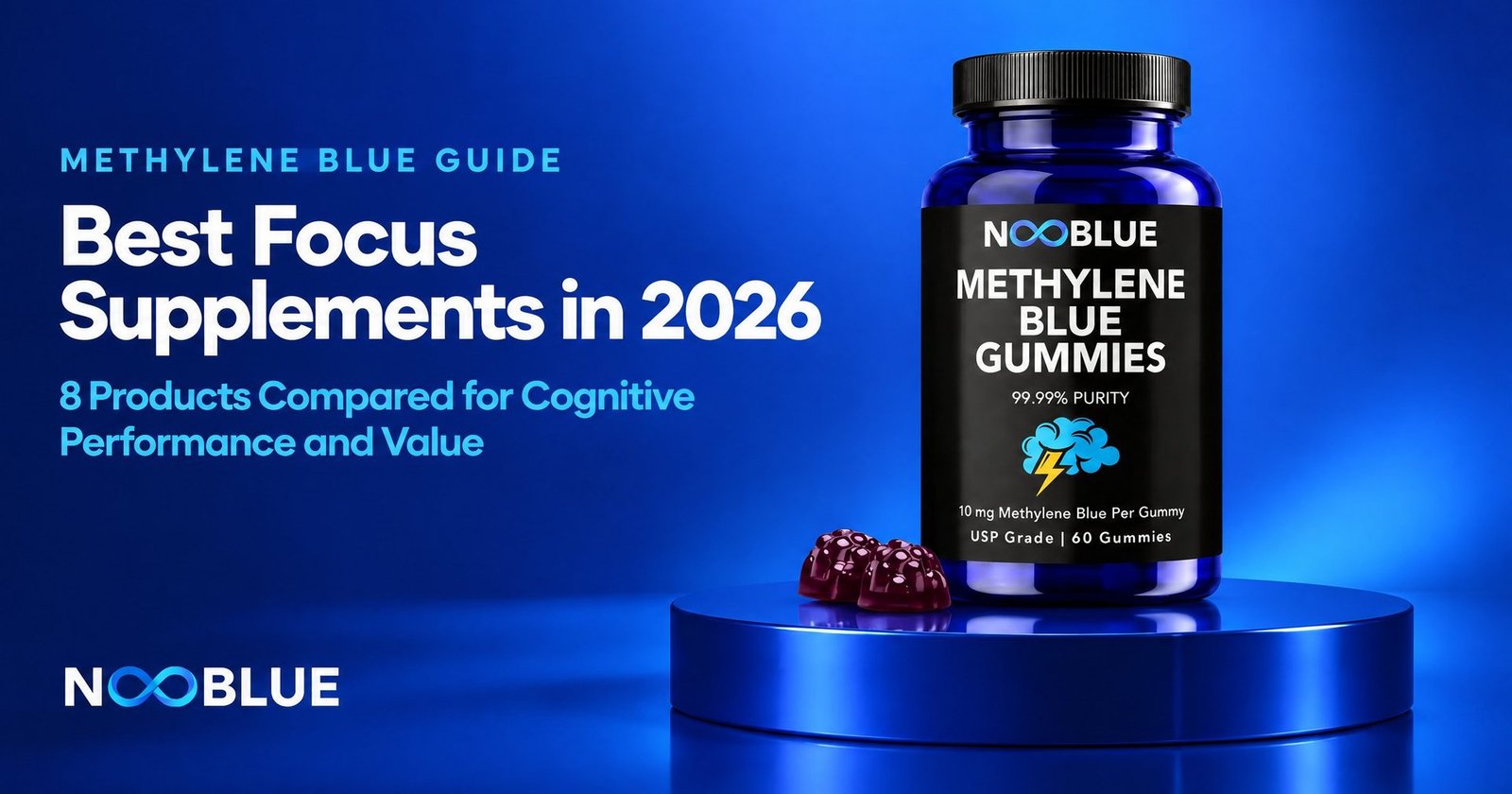
- Other formats: methylene blue gummies with 10 mg methylene blue and 25 mg vitamin C for $49.99, and 1% methylene blue drops at 0.5 mg per drop for $29.99, about $0.30 per 5 mg serving.
Who it suits: adults who want a low, stimulant-free daily amount that works on cellular energy, including people who already drink coffee and do not want more caffeine. Who it doesn’t: anyone taking SSRIs, SNRIs, MAO inhibitors, opioids or other serotonergic medicines, anyone with G6PD deficiency, and anyone pregnant or breastfeeding. It can also turn urine blue or green, which the drug label lists as an expected effect. Read who should not take methylene blue before your first bottle, and see our methylene blue dosage guide for how to start.
See the 5 mg capsules · $37.99#2. Mind Lab Pro: Best Caffeine-Free All-in-One Stack
Mind Lab Pro puts 11 ingredients into a 2-capsule serving with no caffeine. The label lists citicoline (as Cognizin) 250 mg, bacopa monnieri 150 mg (24% bacosides), organic lion’s mane (mycelium and fruit) 500 mg, phosphatidylserine 100 mg, N-acetyl L-tyrosine 175 mg, L-theanine 100 mg, rhodiola rosea 50 mg, maritime pine bark extract 75 mg, and vitamins B6, B9 and B12. A one-month bottle costs $69.00, or $2.30 a serving, and the brand’s 4-month subscription brings it to $51.75 a month. The label suggests 2 to 4 capsules a day in the morning or early afternoon on an empty stomach.
Its main strength is a trial of the finished formula. In a double-blind, placebo-controlled study from the University of Leeds, published in Human Psychopharmacology in 2023, 49 healthy adults took Mind Lab Pro or placebo for 30 days. The supplement group improved on every memory subtest measured, and it differed from placebo on immediate and delayed recall (Abbott-Imboden et al., 2023). The groups were uneven (36 on the supplement, 13 on placebo), allocation was described as pseudo-randomized, and Mind Lab Pro’s own site says two of its three listed studies were funded by its parent company.
Who it suits: people who want one caffeine-free bottle that covers several pathways and are happy to pay for it. Who it doesn’t: anyone on a tight budget, and anyone who wants the quick lift of caffeine. Our comparison of methylene blue and other nootropics goes through the main stack ingredients one by one.
#3. Performance Lab Caffeine 2: Best Caffeine and L-Theanine Capsule
Performance Lab Caffeine 2 is the simplest way to take caffeine with L-theanine at a measured dose. Each capsule contains 50 mg of natural caffeine from Coffea robusta seeds, 100 mg of L-theanine and 250 mg of L-tyrosine, plus small amounts of vitamins B2, B6, B9 and B12. A bottle of 30 capsules costs $44.00, or $1.47 a capsule, and $39.60 on a monthly subscription. The label says to take 1 capsule and not to exceed 5 capsules (250 mg of caffeine) in 24 hours. The brand says it starts working in around 15 to 30 minutes.
Those amounts match a published trial closely. In a placebo-controlled study of 27 healthy volunteers, 50 mg of caffeine with 100 mg of L-theanine improved both the speed and the accuracy of an attention-switching task at 60 minutes and reduced distraction during a memory task at 60 and 90 minutes (Owen et al., 2008). Caffeine alone raised alertness at 60 minutes and attention-switching accuracy at 90 minutes. The study was run by Unilever researchers and tested the two ingredients, not this product.
Who it suits: coffee drinkers who want a smaller, measured caffeine dose with a calmer feel, taken before a demanding task. Who it doesn’t: anyone sensitive to caffeine, anyone who struggles to sleep after an afternoon coffee, and anyone already close to their own daily caffeine limit. Our guide to methylene blue and caffeine covers how to time the two if you use both.
#4. Jarrow Formulas Citicoline 250 mg: Best Single-Ingredient Value
Jarrow Formulas Citicoline gives you 250 mg of citicoline per capsule, the same amount Mind Lab Pro uses, with nothing else added. Jarrow’s page describes it as a Cognizin branded ingredient. The 60-capsule bottle costs $33.99 ($0.57 a capsule) and the 120-capsule bottle costs $57.99 ($0.48 a capsule). The label says adults take 1 capsule once or twice a day with food. The capsule shell is bovine gelatin, so it does not suit vegetarians.
Citicoline has some of the better attention data among non-stimulant ingredients. In a trial of 75 healthy adolescent males, 28 days of Cognizin citicoline at 250 or 500 mg a day improved attention and psychomotor speed compared with placebo (McGlade et al., 2019). Several of the authors worked for Kyowa Hakko, the company that makes Cognizin. In a separate 12-week trial of 100 healthy adults aged 50 to 85 with age-associated memory complaints, 500 mg a day improved episodic memory compared with placebo, a secondary outcome of that study (Nakazaki et al., 2021).
Who it suits: people who want to test one well-studied ingredient cheaply before paying for a stack, and people building their own routine. Who it doesn’t: anyone looking for a same-day lift, and vegetarians.
#5. Onnit Alpha BRAIN: Best-Known Stack, Mixed Trial Results
Onnit Alpha BRAIN is “formulated without caffeine,” according to Onnit. The ingredients it highlights are L-theanine, huperzia serrata extract (a source of huperzine A), vitamin B6, alpha GPC and phosphatidylserine. The 60-count bottle costs $57.95, and Onnit sells it as a 30-day supply at 2 capsules a day, which is $1.93 a serving. Onnit offers a 30-day money-back guarantee.
Alpha BRAIN has two published human trials, and they point in different directions. A randomized, double-blind trial of 63 healthy adults aged 18 to 35 found that 6 weeks of Alpha BRAIN improved delayed verbal recall and executive function compared with placebo (Solomon et al., 2016). A second trial in 43 soldiers, funded by a grant from Onnit, found no significant effect on marksmanship or reaction time after about a month (Barringer et al., 2018). Our methylene blue vs Alpha Brain comparison looks at the two side by side.
Who it suits: people who want a widely sold stack with some published evidence behind the finished formula. Who it doesn’t: anyone who wants every ingredient amount in the product description, since Onnit’s page highlights ingredients rather than listing doses there, and anyone taking medicines that act on acetylcholine, who should ask a doctor first because huperzine A slows acetylcholine breakdown.
#6. Neuro Energy & Focus Gum: Fastest, Most Portable Format
Neuro Energy & Focus gum puts 40 mg of natural caffeine and 60 mg of L-theanine into each piece, with vitamins B6 and B12. A 54-piece pack costs $24.99, or $0.46 a piece, and larger packs cost less per piece (90 pieces for $30.99). The peppermint version is sweetened with sorbitol, xylitol, sucralose, monk fruit and steviol glycosides, according to the ingredient list.
The closest trial used 40 mg of caffeine with 97 mg of L-theanine in 44 young adults. The pair improved accuracy when switching between tasks and raised self-rated alertness, but it did not change visual search, choice reaction time or mental rotation (Giesbrecht et al., 2010). Neuro’s gum matches the caffeine in that study and carries less L-theanine. That trial, like the Owen study, was run by Unilever researchers.
Who it suits: people who want a small, controllable caffeine dose on the go, one piece at a time. Who it doesn’t: anyone avoiding caffeine or sugar alcohols, and anyone who wants support that builds over weeks rather than a short lift.
#7. NooCube Brain Productivity: Longest Money-Back Window
NooCube Brain Productivity is a caffeine-free 2-capsule formula. Each serving lists bacopa monnieri 250 mg (20% bacosides), L-tyrosine 250 mg, VitaCholine 250 mg, L-theanine 100 mg, Panax ginseng 20 mg, resveratrol, pterostilbene, cat’s claw, vitamin B1, biotin and Lutemax 2020 marigold extract. A one-month bottle of 60 capsules costs $64.99, or $2.17 a serving, and the brand offers a 60-day money-back guarantee, the longest window on this list.
Bacopa is the ingredient with the most consistent long-term data. A meta-analysis of 9 randomized trials covering 518 people found that standardized bacopa extracts taken for 12 weeks or more shortened completion time on the Trail B test and cut choice reaction time (Kongkeaw et al., 2014). We did not find a published human trial of the finished NooCube formula.
Who it suits: buyers who want a caffeine-free stack built around bacopa and a long window to decide whether it works for them. Who it doesn’t: anyone who wants trial evidence for the product itself, or results within the first few weeks.
#8. Qualia Mind 2.0: Broadest Formula, Highest Cost
Qualia Mind 2.0 is the maximal option: 32 ingredients in a 6-capsule serving. The label includes acetyl-L-carnitine 500 mg, rhodiola rosea extract 370 mg, Nutricog 300 mg, N-acetyl-L-tyrosine 250 mg, L-theanine 200 mg, ginkgo biloba extract 120 mg, alpha GPC 115 mg, phosphatidylserine 100 mg and Cognizin 50 mg, plus 100 mg of caffeine from coffee fruit extract, guarana seed extract and anhydrous caffeine. A bottle holds 20 servings and costs $159.00 as a one-time purchase, or $7.95 a serving. The first subscription shipment costs $39.00 and later ones $139.00, and Qualia offers a 100-day money-back guarantee.
Breadth has trade-offs. Six capsules is a lot to swallow each day, and some doses are small: the 50 mg of Cognizin is a fifth of the 250 mg in Mind Lab Pro or Jarrow. Qualia also sells a caffeine-free version of Mind for people who want the formula without the stimulant.
Who it suits: people who want the widest ingredient list in one product and do not mind the price. Who it doesn’t: anyone who already drinks coffee, since each serving adds 100 mg of caffeine, and anyone who prefers to know which ingredient is doing the work.
Do Focus Supplements Actually Work? What the Human Trials Show
Start with the skeptical view, because it is the top result for this search. A Harvard Health Publishing article from February 2026 argues that no supplement ingredient has solid proof of improving brain health, quoting internist Dr. Pieter Cohen, and it recommends exercise and a plant-based diet instead (Harvard Health). That article looks mainly at vitamins and other nutrients sold for memory and long-term brain health. Short-term focus is a narrower question, and a few ingredients do have controlled human data on it. The effects are modest, and several trials are small or funded by the maker.
| Ingredient | Best human evidence | Dose studied | When it was measured | Products here |
|---|---|---|---|---|
| Caffeine with L-theanine | Two placebo-controlled trials (27 and 44 adults): better task-switching accuracy and alertness | 50 mg + 100 mg; 40 mg + 97 mg | 20 to 90 minutes after one dose | Performance Lab Caffeine 2, Neuro gum, Qualia Mind |
| Citicoline | 75 adolescent males: better attention; 100 older adults: better episodic memory | 250 to 500 mg a day | After 28 days and 12 weeks | Jarrow Citicoline, Mind Lab Pro, Qualia Mind |
| Bacopa monnieri | Meta-analysis of 9 trials (518 people): faster Trail B and choice reaction time | Standardized extracts | After 12 weeks or more | NooCube, Mind Lab Pro |
| Methylene blue | One trial of 26 healthy adults: stronger task-related brain activity, 7% more correct memory responses | 280 mg once | 1 hour after one dose | NooBlue capsules |
| Finished formulas | Mind Lab Pro (49 adults, memory); Alpha BRAIN (63 adults positive, 43 soldiers no effect) | Label servings | After 30 days and 6 weeks | Mind Lab Pro, Alpha BRAIN |
Two patterns stand out. The fastest, best-replicated effect on attention comes from caffeine paired with L-theanine, and it lasts hours, not weeks. The slower ingredients, citicoline and bacopa, were tested over one to three months, so a product built on them needs at least that long before you judge it. Methylene blue sits apart: its mechanism is distinct and well described, but its human focus data is one small single-dose study at a far higher amount than any supplement serving. For more on that gap, see our pages on methylene blue benefits and methylene blue vs modafinil.
How to Choose a Focus Supplement
Match the product to the problem you actually have. If you need to get through a demanding task in the next hour, caffeine with L-theanine has the most direct evidence, and Performance Lab Caffeine 2 or Neuro gum give you a measured dose. If you want steady support without caffeine and can wait a month or more, citicoline on its own or a stack like Mind Lab Pro fits better. If your focus fades with low energy and you want a stimulant-free daily base, methylene blue is the option that works on cellular energy, provided none of the safety exclusions apply to you. People comparing it with prescription drugs should read methylene blue vs Adderall, which explains why a stimulant medicine is a different category.
Then check four things on the label and product page:
- Doses you can see. Every active should have a stated amount per serving. Compare it with the amount used in trials, not with the size of the ingredient list.
- Caffeine per serving and per day. Add a product’s caffeine to your coffee, tea and energy drinks. Qualia Mind adds 100 mg per serving and Performance Lab caps its capsules at 250 mg a day.
- Cost per serving. Divide the price by the servings on the label. A $159.00 bottle of 20 servings costs far more per day than a $69.00 bottle of 30.
- What the test documents cover. Ask whether a certificate covers the raw ingredient or the finished product, and which tests it includes. Our own CTLA report, for example, covers the methylene blue ingredient, not every finished batch.
New to methylene blue? Our beginner’s guide to methylene blue walks through formats and first doses, and our roundup of the best methylene blue supplements compares brands.
Cover the Basics Before You Buy a Stack
No capsule makes up for short sleep. Before paying for a stack, look at the basics the Harvard article points to: regular exercise and a mostly plant-based diet, plus enough sleep on a regular schedule. If you already drink coffee or tea, you are already taking caffeine, and pairing it with L-theanine is the cheapest upgrade on this page. Once those are in place, the products above can do narrower jobs: caffeine with L-theanine for a demanding afternoon, citicoline or bacopa for steady use over months, and methylene blue if you want a daily option that supports cellular energy without a stimulant. If afternoon fog is your main complaint, our guide to methylene blue for brain fog covers that use.
How We Compared
We compared each product on five points, all taken from the brand’s own label and price page in Sep 2026:
- Dose disclosure: whether every active is listed with an amount per serving.
- Match with human research: whether the main ingredients appear in controlled human trials at similar amounts, and whether the finished formula has been tested.
- Caffeine: how much is in each serving, and whether a caffeine-free version exists.
- Cost per serving: the one-time price divided by the label’s servings, without first-order discounts.
- Buying terms: money-back windows and what the testing documents cover.
NooBlue makes the methylene blue capsules on this list, and they are our pick. Every figure for the other products comes from their own product pages, linked in each section. Where a product had no published trial of its finished formula, we say so rather than borrowing results from another product.
Safety: Who Should Skip Which Supplement
- Methylene blue: it is a potent reversible inhibitor of the enzyme MAO-A (Ramsay et al., 2007), and the prescription injection’s label warns of serious or fatal serotonin syndrome when it is combined with SSRIs, SNRIs, MAO inhibitors or opioids (injection label). The same label says it must not be used by people with G6PD deficiency because of the risk of hemolytic anemia, and it warns of possible harm in pregnancy and advises stopping breastfeeding during treatment. If you take any prescription stimulant or other medicine that affects the brain, ask your prescriber before adding it. Read our guides to methylene blue interactions, methylene blue and serotonin syndrome and methylene blue and G6PD deficiency.
- Caffeine products (Performance Lab Caffeine 2, Neuro gum, Qualia Mind): count their caffeine toward your daily total, avoid them late in the day if caffeine affects your sleep, and talk to your doctor first if you are pregnant or have a heart rhythm problem.
- Stacks with huperzine A (Alpha BRAIN): huperzine A slows acetylcholine breakdown, so ask a doctor first if you take medicines that act on acetylcholine.
- Multi-ingredient stacks (Mind Lab Pro, NooCube, Qualia Mind): they combine several herbs and amino acids, so check the full label with a pharmacist if you take prescription medication.
- Everyone: start one product at a time for about two weeks so you can tell what each one does, and read the methylene blue side effects guide before starting our capsules.
Frequently Asked Questions
What is the best supplement to improve focus?
Our pick is NooBlue Ultimate Methylene Blue Capsules, which we make: 5 mg of USP-grade methylene blue and 10 mg of vitamin C per capsule for $0.63 a day, with no caffeine. For a quick lift before a demanding task, caffeine with L-theanine has the most direct trial evidence, and Performance Lab Caffeine 2 gives 50 mg of caffeine and 100 mg of L-theanine per capsule. Methylene blue is not for anyone on serotonergic medicines.
What is the #1 brain supplement?
Our #1 is NooBlue Ultimate Methylene Blue Capsules, because it is the only option here that supports cellular energy without a stimulant, at a fixed 5 mg dose. No single ingredient has strong evidence for long-term brain health in healthy people. For short-term focus, caffeine with L-theanine and citicoline have the most human data, and Mind Lab Pro is our top caffeine-free stack, with a positive 30-day trial of its formula.
Do any focus supplements actually work?
Some ingredients have modest, real effects in controlled trials. Caffeine with L-theanine improved task-switching accuracy within 90 minutes in two trials, citicoline improved attention in adolescents after 28 days, and bacopa sped up reaction time after 12 weeks or more. Methylene blue has one small single-dose brain-imaging trial at 280 mg. Many trials are small or funded by the maker, so judge any product over several weeks.
What does Joe Rogan take for his brain?
We cannot confirm anyone’s personal routine. Joe Rogan is a co-founder of Onnit, the company that makes Alpha BRAIN, which was sold to Unilever in 2021, and he often advertises Onnit products on his podcast (Wikipedia). Alpha BRAIN is #5 on our list: one trial found better verbal recall after 6 weeks, and a second found no effect on marksmanship or reaction time.
How long does it take for a focus supplement to work?
It depends on the ingredient. Caffeine with L-theanine was measured 20 to 90 minutes after a dose, and Performance Lab says Caffeine 2 starts working in about 15 to 30 minutes. Citicoline was tested for 28 days to 12 weeks, bacopa for 12 weeks or more, and Mind Lab Pro for 30 days. The methylene blue trial measured brain activity one hour after a single dose. Give any daily product at least two to four weeks.
Can you take methylene blue with caffeine or other focus supplements?
We know of no documented direct interaction between methylene blue and caffeine, and they act on different targets, so many people take a capsule with their morning coffee. Add one product at a time for about two weeks so you can judge each one. Never combine methylene blue with SSRIs, SNRIs, MAO inhibitors, opioids or other serotonergic medicines, and ask a pharmacist to check any stack if you take prescription medication.
What dose of citicoline is used for focus?
Human trials in healthy people have used 250 to 500 mg of Cognizin citicoline a day. The adolescent attention trial used 250 or 500 mg for 28 days, and the older-adult memory trial used 500 mg for 12 weeks. Jarrow’s capsules and Mind Lab Pro each give 250 mg per serving, and Qualia Mind gives 50 mg.
Are focus supplements safe to take daily?
Safety depends on the product and on what else you take. Caffeine products add to your daily caffeine total and can affect sleep. Methylene blue must not be combined with serotonergic medicines and is not for people with G6PD deficiency or anyone pregnant or breastfeeding. Huperzine A in Alpha BRAIN slows acetylcholine breakdown. Talk to your doctor if you take prescription medication.
The Verdict
Our pick for the best focus supplement in 2026 is NooBlue Ultimate Methylene Blue Capsules: a fixed 5 mg dose that supports cellular energy without caffeine, a published ingredient report and a cost of $0.63 a day. For the quickest, best-supported lift before a demanding task, Performance Lab Caffeine 2 pairs 50 mg of caffeine with 100 mg of L-theanine, and Neuro gum does the same job in a portable piece. Mind Lab Pro is our top caffeine-free stack, with a 30-day trial of its formula, and Jarrow Citicoline is the cheapest way to try the best-studied choline ingredient. Whatever you choose, check the safety list first and judge it over a few weeks.
More buying guides: the best methylene blue nootropics, the best mitochondrial support supplements, the full NooBlue shop, and all our buying guides on the NooBlue blog, or start at the NooBlue home page.
Sources
- Rojas JC, Bruchey AK, Gonzalez-Lima F. Neurometabolic mechanisms for memory enhancement and neuroprotection of methylene blue. Progress in Neurobiology. 2012;96(1):32-45. PubMed 22067440
- Rodriguez P, Zhou W, Barrett DW, et al. Multimodal randomized functional MR imaging of the effects of methylene blue in the human brain. Radiology. 2016;281(2):516-526. PubMed 27351678
- Rodriguez P, Singh AP, Malloy KE, et al. Methylene blue modulates functional connectivity in the human brain. Brain Imaging and Behavior. 2017;11(3):640-648. PubMed 26961091
- Owen GN, Parnell H, De Bruin EA, Rycroft JA. The combined effects of L-theanine and caffeine on cognitive performance and mood. Nutritional Neuroscience. 2008;11(4):193-198. PubMed 18681988
- Giesbrecht T, Rycroft JA, Rowson MJ, De Bruin EA. The combination of L-theanine and caffeine improves cognitive performance and increases subjective alertness. Nutritional Neuroscience. 2010;13(6):283-290. PubMed 21040626
- McGlade E, Agoston AM, DiMuzio J, et al. The effect of citicoline supplementation on motor speed and attention in adolescent males. Journal of Attention Disorders. 2019;23(2):121-134. PubMed 26179181
- Nakazaki E, Mah E, Sanoshy K, Citrolo D, Watanabe F. Citicoline and memory function in healthy older adults: a randomized, double-blind, placebo-controlled clinical trial. Journal of Nutrition. 2021;151(8):2153-2160. PubMed 33978188
- Kongkeaw C, Dilokthornsakul P, Thanarangsarit P, Limpeanchob N, Scholfield CN. Meta-analysis of randomized controlled trials on cognitive effects of Bacopa monnieri extract. Journal of Ethnopharmacology. 2014;151(1):528-535. PubMed 24252493
- Abbott-Imboden C, Gonzalez Y, Utley A. Efficacy of the nootropic supplement Mind Lab Pro on memory in adults: double blind, placebo-controlled study. Human Psychopharmacology. 2023;38(4):e2872. PubMed 37194920
- Solomon TM, Leech J, deBros GB, et al. A randomized, double-blind, placebo controlled, parallel group, efficacy study of alpha BRAIN administered orally. Human Psychopharmacology. 2016;31(2):135-143. PubMed 26876224
- Barringer N, Crombie A, Kotwal R. Impact of a purported nootropic supplementation on measures of mood, stress, and marksmanship performance in U.S. active duty soldiers. Journal of the International Society of Sports Nutrition. 2018;15(1):26. PubMed 29855372
- Ramsay RR, Dunford C, Gillman PK. Methylene blue and serotonin toxicity: inhibition of monoamine oxidase A (MAO A) confirms a theoretical prediction. British Journal of Pharmacology. 2007;152(6):946-951. PubMed 17721552
- ProvayBlue (methylene blue) injection, prescribing information. DailyMed
- Methylene Blue monograph, USP-NF. USP-NF
- Salamon M. Don’t buy into brain health supplements. Harvard Health Publishing, February 20, 2026. health.harvard.edu
- Brand product pages read Sep 2026: Mind Lab Pro, Performance Lab Caffeine 2, Jarrow Formulas, Onnit, Neuro, NooCube and Qualia, as linked in each section above.
- NooBlue product pages and quality page (label amounts, prices and the CTLA ingredient report), read Sep 2026. nooblue.com/quality