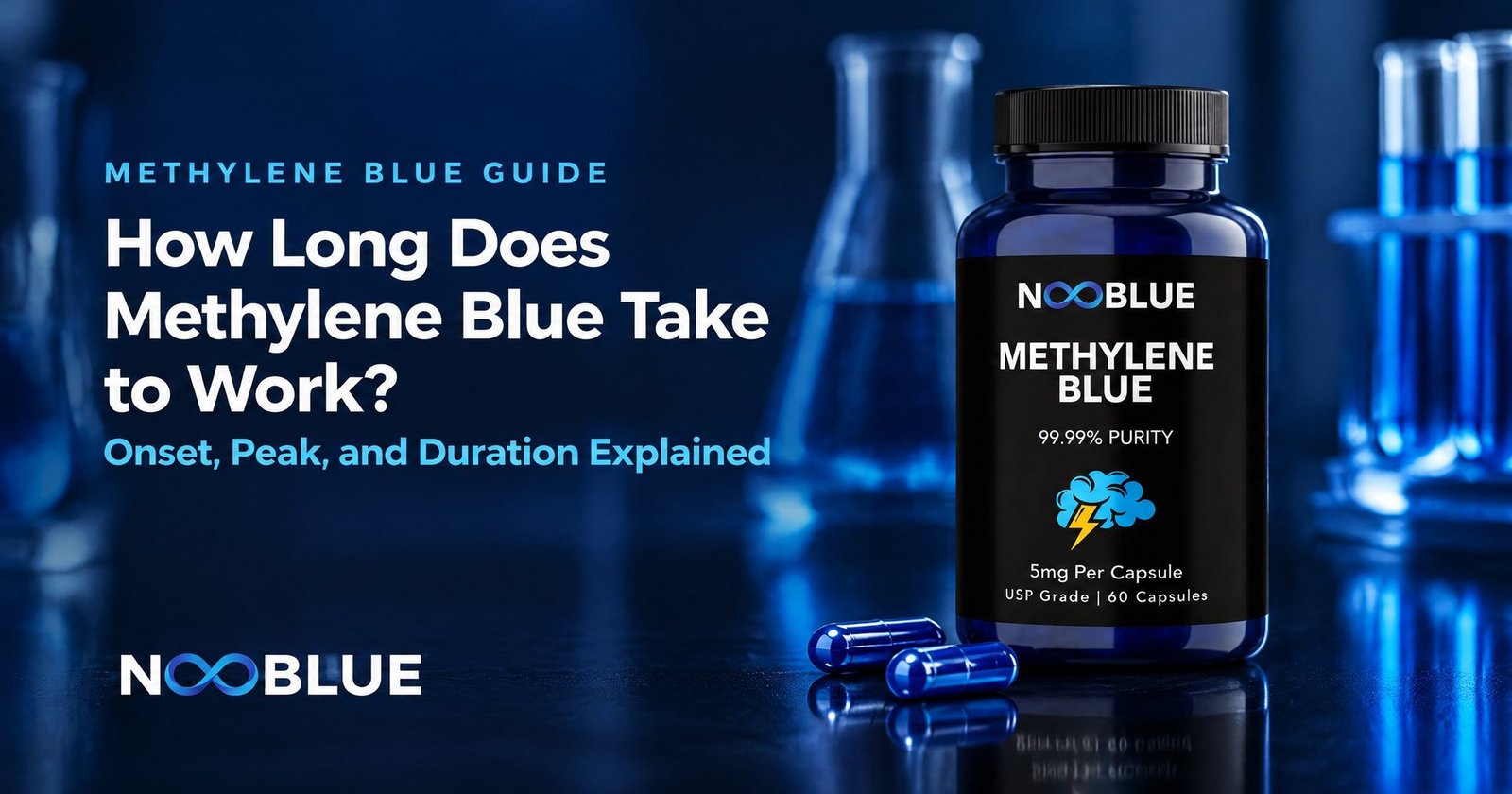
Short answer: how long for methylene blue to work depends on what you mean by “work”. In the body, a swallowed dose is absorbed within hours: one study found blood levels peaked about 1 hour after an oral dose, and a brain-imaging trial saw changes 1 hour after a single large dose. Whether you notice anything at a supplement dose of 5 or 10 mg, and when, has never been measured. Many people notice little on the first day. The honest plan is to take the label serving at the same time each day, judge it over a couple of weeks, and never take extra because you “didn’t feel it”.
Our pick for a steady, predictable routine is NooBlue capsules: one 5 mg capsule a day with food, the same amount every time. NooBlue makes them. The rest of this guide explains the timeline behind that advice, study by study, and where the old “30 to 90 minute” claims come from.
Key takeaways
- Onset in the blood: in one study, methylene blue reached its maximum concentration in whole blood about 1 hour after an oral dose.
- Onset in the brain: a 2016 trial saw changes in brain activity 1 hour after a single 280 mg dose, about 56 times a NooBlue capsule.
- Felt onset at supplement doses: not studied. Minute-by-minute timelines online are guesses.
- How long it stays: half-life estimates range from about 5 hours to about a day, depending on the study. Daily use builds up over the first several days.
- Safety never waits: the interaction with serotonergic medicines applies from the first dose.
Table of contents
- 1. What “working” means for methylene blue
- 2. The timeline, study by study
- 3. Where the “30 to 90 minutes” claims come from
- 4. Does the format change how fast it works?
- 5. What changes the timing
- 6. First dose vs first few weeks
- 7. Who it suits, and who it doesn’t
- 8. Who should not take methylene blue
- 9. Frequently asked questions
- 9.1. How long does it take for methylene blue to work?
- 9.2. How long do the effects of methylene blue last?
- 9.3. Why do I feel so good on methylene blue?
- 9.4. What should you not mix with methylene blue?
- 9.5. Why do I feel weird after taking methylene blue?
- 9.6. Is methylene blue killing parasites?
- 9.7. Should I take more if I don’t feel anything?
- 9.8. Do drops work faster than capsules?
- 10. Sources
What “working” means for methylene blue
Three different things get called “working”, and they run on different clocks:
- Absorption. How quickly methylene blue gets from your gut into your blood. This has been measured in people.
- Activity in the brain. Whether a dose changes brain activity, and when. This has been measured in small imaging trials, at doses far above a supplement.
- What you notice. Whether you feel sharper, more awake or nothing at all. This has not been measured at supplement doses.
Most articles blur the three together and quote the first as if it were the third. We’ll keep them apart. For the mechanism behind all three, see how methylene blue works.
The timeline, study by study
| What was measured | Study | Finding | Dose |
|---|---|---|---|
| How much of an oral dose is absorbed | Walter-Sack et al., 2009 (16 healthy adults) | Absolute bioavailability 72.3% (plus or minus 23.9%) | 500 mg oral solution vs 50 mg intravenous |
| When blood levels peak | Earlier study cited by Rodriguez et al., 2016 | Maximum concentration in whole blood about 1 hour after an oral dose | Oral, healthy subjects |
| Brain activity and memory | Rodriguez et al., 2016 (26 adults enrolled) | Changes in brain activity during attention and memory tasks, and 7% more correct memory answers, 1 hour after the dose | 280 mg (about 4 mg/kg) in capsules, single dose |
| How fast it clears | Peter et al., 2000 (7 volunteers) | Terminal half-life about 5.25 hours in whole blood after an intravenous dose | 100 mg intravenous and oral |
| How fast it clears | ProvayBlue prescribing information | “A half-life of approximately 24 hours in humans” | Intravenous prescription product |
Absorption: fast and fairly complete
Walter-Sack and colleagues (European Journal of Clinical Pharmacology, 2009) gave 16 healthy adults 500 mg of methylene blue as a solution to drink and, a week apart, 50 mg intravenously. Comparing the two, 72.3% of the swallowed dose reached the blood on average, which is high for an oral compound. The spread was wide, plus or minus 23.9%, so some people absorbed much more than others.
On timing, Rodriguez and colleagues note in their 2016 paper that a previous study found methylene blue reached its maximum concentration in whole blood 1 hour after an oral dose in healthy subjects. That is why they scanned their volunteers 60 minutes after dosing. So “about an hour to peak in the blood” is a fair summary of the evidence for an ordinary oral dose. None of these studies used a 5 mg capsule, and none measured how quickly people felt anything.
The brain: changes at 1 hour, at a much larger dose
The Rodriguez trial (Radiology, 2016) enrolled 26 adults aged 22 to 62. Half took 280 mg of USP-grade methylene blue in opaque capsules, about 4 mg per kg of body weight, and half took a placebo. Brain scans an hour later showed increased activity in regions used for sustained attention and short-term memory, and the methylene blue group got 7% more memory-retrieval answers right. A companion paper by the same group (Brain Imaging and Behavior, 2017) reported changes in functional connectivity one hour after a single low oral dose.
That shows an oral dose reaches the brain and is active there within an hour. It doesn’t tell you what 5 or 10 mg does, because 280 mg is 56 times a NooBlue capsule and 28 times a NooBlue gummy. The label serving is not a scaled-down version of that trial, and nobody should try to copy its dose. For the full human-trial picture, see does methylene blue work.
Clearance: estimates differ
Peter and colleagues (European Journal of Clinical Pharmacology, 2000) measured whole blood in seven volunteers and estimated a terminal half-life of 5.25 hours after a 100 mg intravenous dose. The prescribing information for ProvayBlue, the intravenous prescription form, gives a half-life of approximately 24 hours in humans. Different methods, doses and sample types give different numbers. The practical point is the same either way: methylene blue doesn’t vanish within a few hours. Some of each dose is still around the next day, which is why a daily routine builds up over the first several days before levels even out. More in methylene blue half-life.
Where the “30 to 90 minutes” claims come from
You’ll find confident timelines online: drops in 15 minutes, capsules in 45, peak at 90, effects gone by the afternoon. We could not find a study that measured when people notice effects at supplement doses, by format or otherwise. Those timelines usually start from the blood-peak figure above and add personal impressions.
Personal impressions are real, but they are hard to separate from expectation, caffeine, sleep and a good day at work. That doesn’t mean nothing is happening. It means a first-day stopwatch isn’t a good test. What you can control is taking the same amount, the same way, at the same time each day, then judging the pattern.
Does the format change how fast it works?
No human study has compared capsules, drops and gummies for speed. A liquid is already dissolved, so it may start absorbing a little sooner than a capsule, which has to open first. Whether that is minutes or longer hasn’t been measured. Our review of methylene blue bioavailability in liquid vs capsules covers every human study we could find. Here is how the three NooBlue formats compare on the things that do affect a routine:
| Format | Label serving | What helps consistent timing | Price (as of Sep 2026) |
|---|---|---|---|
| NooBlue Capsules (our pick) | One 5 mg capsule daily with food | Fixed amount, taken with a meal you eat every day anyway | $37.99 for 60 ($0.63 a day) |
| NooBlue Gummies | One 10 mg gummy daily (plus 25 mg vitamin C) | Fixed amount, nothing to swallow or measure, no blue mouth | $49.99 for 60 ($0.83 a day) |
| NooBlue Drops 1% | 0.5 mg per drop, 10 drops = 5 mg, mixed into water or juice | Adjustable in 0.5 mg steps, but only as consistent as your counting | $29.99 for 50 mL, about 100 servings of 5 mg ($0.30 each) |
We pick the capsules for this question because a fixed 5 mg taken with the same meal each day is the easiest way to know that any change you notice isn’t just a different dose. The drops cost less per serving and give finer control, and the gummies are the simplest habit. If you use drops, our guide to how to take methylene blue drops covers measuring, and how to take methylene blue gummies covers the chewable.
What changes the timing
- The dose. The biggest variable by far. More is not better with methylene blue, and a larger dose is not a way to make it “kick in”. Stay at the label serving. Our guide to how many mg of methylene blue per day has the details.
- Food. No study has compared methylene blue with and without food. NooBlue capsules say to take one daily with food, and the practical rule is to take it the same way every day.
- Time of day. Most people take it in the morning. Some brands warn about evenings. Nutricel’s safety notice, for example, says that taking it in the evening may affect sleep. See methylene blue morning or night.
- Caffeine. Coffee changes how you feel on its own schedule, which makes it harder to tell what methylene blue is doing. Our article on methylene blue and caffeine covers taking them together.
- Individual differences. The plus or minus 23.9% spread in the absorption study is a reminder that people vary. Two people on the same dose won’t have the same curve.
- What is actually in the product. A product with the wrong amount, or a lab or aquarium grade, won’t behave like the label says. Check the paperwork with our certificate of analysis guide.
First dose vs first few weeks
The first dose tells you little. Blood levels rise within hours and some of the dose is still around the next day, so daily use builds up over the first several days. Any effect you notice is more likely to show as a pattern across days than as a moment on day one.
A fair way to judge it:
- Take the label serving at the same time each day, with the same meal.
- Keep everything else as steady as you can, including caffeine and sleep.
- Note how your days go for two to three weeks rather than checking the clock after each dose.
- If you notice nothing, don’t raise the dose on your own. Talk to your doctor if you have any question about whether it suits you.
For what people report when they are looking for an energy effect, see methylene blue for energy.
Who it suits, and who it doesn’t
It suits healthy adults who want to try a small daily amount, are happy to judge it over weeks rather than hours, and take no medicines that interact with it.
It doesn’t suit anyone looking for a fast, noticeable jolt like coffee, anyone who wants to adjust the dose day to day based on how they feel, or anyone in the groups below. It is also not something to take “as needed” right before a task, because nobody has shown when a supplement dose takes effect.
Who should not take methylene blue
Safety first
- Do not take methylene blue with SSRIs, SNRIs, MAOIs or other serotonergic medicines. The combination carries a risk of serotonin syndrome.
- Do not take it if you have G6PD deficiency.
- Do not take it if you are pregnant or breastfeeding.
- Not for anyone under 18.
- It can turn urine blue or green. That is expected.
- Talk to your doctor before use if you take any prescription medicine or have a kidney or liver condition.
The serotonin risk doesn’t wait for you to “feel” anything. Ramsay, Dunford and Gillman (British Journal of Pharmacology, 2007) showed that methylene blue is a potent reversible inhibitor of MAO-A, the enzyme that breaks down serotonin. The ProvayBlue prescribing information carries a boxed warning about serotonin syndrome when methylene blue is used with serotonergic drugs and opioids. Our guides to what not to take with methylene blue and who should not take methylene blue cover each point.
NooBlue makes all three formats in this guide. Free worldwide shipping starts at $100 on the NooBlue shop page.
Frequently asked questions
How long does it take for methylene blue to work?
In the blood, about an hour to peak after an oral dose, based on the study the Rodriguez team cited. In the brain, imaging trials saw changes an hour after a single dose many times larger than a supplement. When you will notice anything at 5 or 10 mg hasn’t been studied. Judge it over two to three weeks at the label serving.
How long do the effects of methylene blue last?
There is no study of how long felt effects last at supplement doses. Half-life estimates range from about 5 hours in one small study to approximately 24 hours in the prescription product’s information, so some of each dose is still in your body the next day.
Why do I feel so good on methylene blue?
We can’t say for certain, and no study has measured mood in healthy people at supplement doses. Methylene blue inhibits MAO-A, the enzyme that breaks down serotonin, which is also why it is dangerous with antidepressants. Expectation plays a part with any new supplement.
What should you not mix with methylene blue?
SSRIs, SNRIs, MAOIs and other serotonergic medicines, because of the risk of serotonin syndrome. The prescription product’s boxed warning also names opioids. Talk to your doctor if you take any prescription medicine. Our interactions guide has the details.
Why do I feel weird after taking methylene blue?
Blue or green urine is expected. Beyond that, an odd feeling after starting any supplement can have many causes, including expectation and caffeine. If you feel agitated, confused, feverish, shaky or have a racing heart, especially while taking any other medicine, stop and get medical help, as these can be signs of serotonin syndrome. More in why you might feel weird on methylene blue.
Is methylene blue killing parasites?
There’s no evidence that supplement doses kill parasites in people, and feeling unwell after starting methylene blue is not a sign of “die-off”. If you think you have a parasite, see a doctor for testing. We explain the claim in methylene blue die-off symptoms.
Should I take more if I don’t feel anything?
No. Stay at the label serving: one NooBlue capsule or one gummy a day. A higher dose doesn’t make it work faster, and nobody has shown that feeling something on day one matters. Is it safe to take it every day? See is methylene blue safe to take daily.
Do drops work faster than capsules?
Nobody has tested it in people. A liquid may start absorbing slightly sooner because it is already dissolved, but no study has measured the difference or shown that it matters for a once-a-day routine.
Sources
- Walter-Sack I, Rengelshausen J, Oberwittler H, et al. High absolute bioavailability of methylene blue given as an aqueous oral formulation. Eur J Clin Pharmacol. 2009;65(2):179-189. PubMed 18810398
- Rodriguez P, Zhou W, Barrett DW, et al. Multimodal randomized functional MR imaging of the effects of methylene blue in the human brain. Radiology. 2016;281(2):516-526. PubMed 27351678
- Rodriguez P, Singh AP, Malloy KE, et al. Methylene blue modulates functional connectivity in the human brain. Brain Imaging Behav. 2017;11(3):640-648. PubMed 26961091
- Peter C, Hongwan D, Küpfer A, Lauterburg BH. Pharmacokinetics and organ distribution of intravenous and oral methylene blue. Eur J Clin Pharmacol. 2000;56(3):247-250. PubMed 10952480
- Ramsay RR, Dunford C, Gillman PK. Methylene blue and serotonin toxicity: inhibition of monoamine oxidase A (MAO A) confirms a theoretical prediction. Br J Pharmacol. 2007;152(6):946-951. PubMed 17721552
- PROVAYBLUE (methylene blue) injection prescribing information. DailyMed