Quick answer
“Methylene blue die off symptoms” is a label people use, not a reaction that research has shown. The symptoms themselves are real: headache, nausea, feeling foggy or “off”, tiredness, and blue or green urine. Each has a simpler explanation. Blue or green urine is the dye leaving your body and is expected. Headache, nausea and dizziness are listed side effects of methylene blue. A few symptoms are warnings to stop, not to push through: agitation, tremor, sweating and a racing heart (possible serotonin syndrome), trouble breathing, or yellowing skin and dark urine.
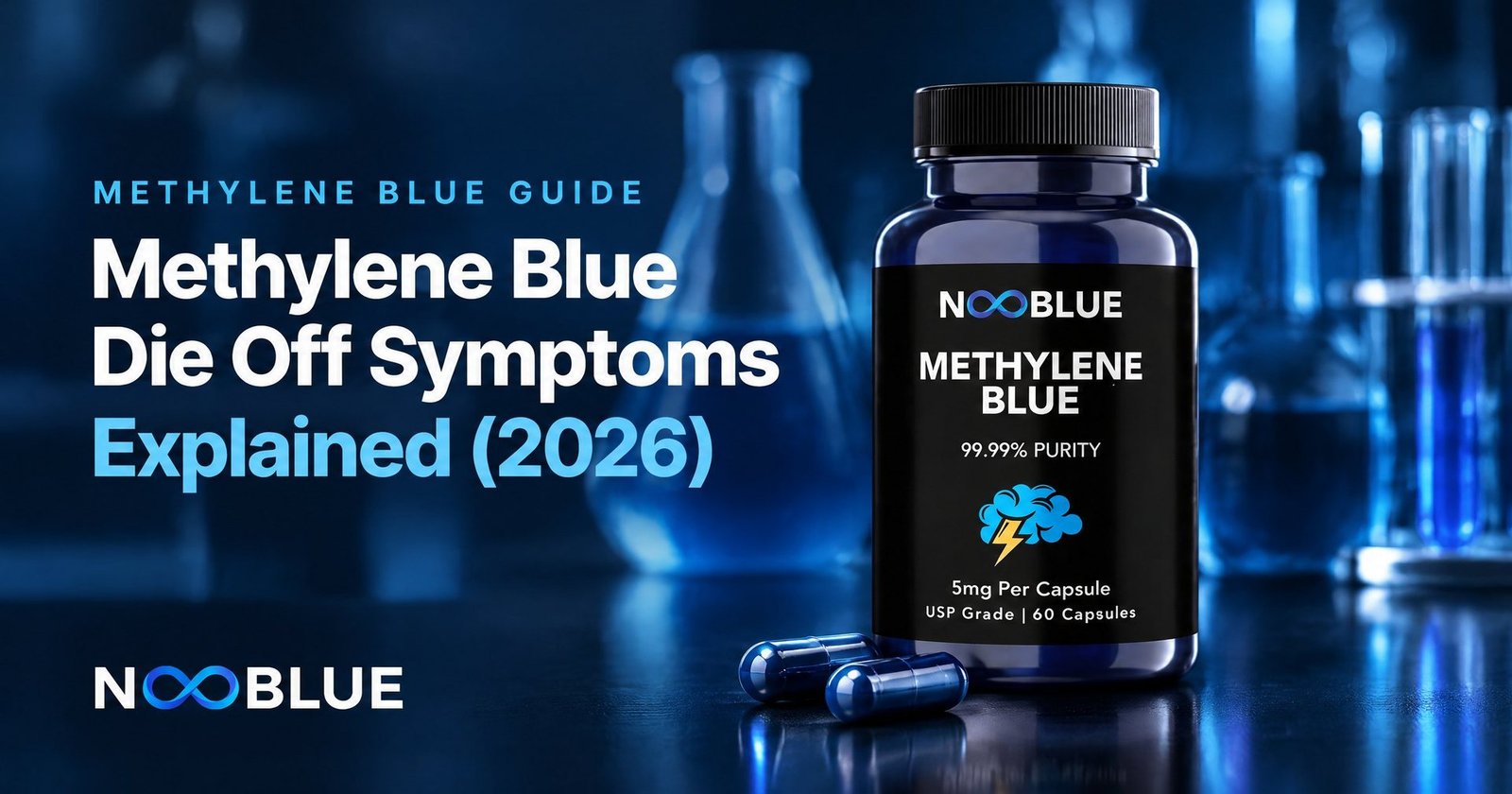
If you want to start carefully, our pick is NooBlue Ultimate Methylene Blue Capsules: a fixed 5 mg of USP grade methylene blue with 10 mg of vitamin C, one a day with food, so you always know exactly what you took.
Before your first dose: do not take methylene blue if you take an SSRI, SNRI, MAOI or other serotonergic medicine, if you have G6PD deficiency, if you are pregnant or breastfeeding, or if you are under 18. If you take any prescription medicine, ask your doctor first.
NooBlue makes the capsules, gummies and drops mentioned on this page.
Written by the NooBlue editorial team. We make and sell methylene blue, so we have a reason to want you to keep taking it. We would still rather you stop than push through a warning sign, and this page is written that way.
Search any wellness forum and you will find the same story. Someone starts methylene blue, feels rough for a few days, and is told it is “die-off”: microbes dying and releasing toxins. The methylene blue die off symptoms people describe are real experiences. The explanation attached to them usually isn’t. This guide goes through each symptom, what is more likely behind it, and which ones mean you should stop and get medical help rather than wait it out.
Table of contents
- 1. What People Mean by Methylene Blue Die Off Symptoms
- 2. Why Blue or Green Urine Is Not Detox
- 3. Symptom by Symptom: What Is More Likely Causing It
- 4. What the Research Says About Methylene Blue Side Effects
- 5. When Symptoms Are a Warning Sign, Not a Detox
- 6. How to Reduce Unwanted Effects on Methylene Blue
- 7. Safety: Read Before You Start
- 8. Methylene Blue Die Off Symptoms: FAQ
- 8.1. Are methylene blue die off symptoms real?
- 8.2. How long does methylene blue stay in your system?
- 8.3. What are the symptoms of taking too much methylene blue?
- 8.4. Is methylene blue killing parasites?
- 8.5. Is it true that methylene blue makes you look younger?
- 8.6. Should I lower the dose or push through?
- 8.7. What are the signs that toxins are leaving your body?
- 8.8. Can I take methylene blue if I’m on an antidepressant?
- 8.9. How many drops of methylene blue should I take?
- 9. The Verdict
- 10. Sources
What People Mean by Methylene Blue Die Off Symptoms
The idea runs like this. Methylene blue can kill microbes in the lab. Dying microbes release fragments that make you feel ill. So if you feel ill on methylene blue, microbes must be dying. Each step sounds plausible. The chain breaks when you ask what dose reaches which organisms, and whether the symptoms match that story or match the known effects of methylene blue itself.
The term borrows from the Jarisch-Herxheimer reaction. That is a real, documented response: a short-lived inflammatory reaction that can start within 24 hours of a first course of antibiotics for certain bacterial infections, with fever, chills, headache, nausea and a fast heart rate (Wood and Sbar, StatPearls). It is defined for that specific situation. It is not a general explanation for feeling unwell after starting a supplement.
Some practitioners prescribe methylene blue at doses many times a supplement serving, as one part of a multi-drug protocol, and tell patients to expect a “herx”. It has not been shown whether those reactions are true Herxheimer responses or simply side effects of the drugs. Either way, the context doesn’t carry over to a 5 or 10 mg supplement taken on its own by someone without that diagnosis. If you are on a prescribed protocol, follow your prescriber, not a supplement article.
Timing is another clue. Forum reports of die-off tend to start within hours of a dose. That fits a compound moving through your body. We could not find a single study showing a Herxheimer-type reaction to methylene blue at supplement doses. Our complete guide to methylene blue side effects covers the full list of known effects. This page asks one narrow question: does the die-off explanation hold up?
The difference matters in practice. If you believe a symptom is toxins leaving, the advice you will hear is to push through or even raise the dose. If the same symptom is a side effect, or a warning sign, pushing through is the worst thing you can do.
Why Blue or Green Urine Is Not Detox
Blue or green urine is the most common “sign” people point to, and it has the simplest explanation. Methylene blue is a dye. Your kidneys pass some of it, and its colorless reduced form, into your urine (Peter et al., 2000). A standard medical reference describes blue-green urine as “expected and benign” (StatPearls). In a brain imaging trial, every volunteer who received a single dose of methylene blue reported blue urine afterwards (Rodriguez et al., 2016). It happens whether or not anything in you is “dying”.
Two practical notes. The dye can interfere with urine tests that rely on a blue color change, such as some dipstick tests, so tell your doctor you take methylene blue before a urine test (prescribing information). And blue or green is the expected color. Urine that turns dark brown or cola-colored is different: together with unusual tiredness or yellowing skin or eyes, it can signal red blood cells breaking down, which needs a doctor the same day.
A blue tongue or mouth is not detox either. It is staining from liquid drops on contact. Capsules are swallowed whole, and NooBlue gummies don’t leave the blue mouth or tongue that drops can. For skin marks from spills, see methylene blue side effects on skin.
Symptom by Symptom: What Is More Likely Causing It
Here is each commonly reported “die-off” symptom set against a more likely explanation and what to do about it. None of the rows needs dying microbes to explain it.
| Reported symptom | More likely explanation | What to do |
|---|---|---|
| Blue or green urine | The dye leaving your body through the kidneys | Expected. Mention it before any urine test. |
| Blue mouth or tongue | Staining from liquid drops | Mix drops into a drink and rinse, or use capsules or gummies. |
| Nausea, upset stomach, diarrhea | Listed side effects of methylene blue | Take it with food, don’t exceed the serving, stop if it continues. |
| Headache | Among the most commonly reported side effects | Do not raise the dose. Stop if it persists. |
| Dizziness or confusion | Listed side effects, mainly at higher doses | Do not drive. Stop and speak to your doctor. |
| Restlessness or poor sleep | A dose taken late in the day | Move it to the morning. |
| Agitation, tremor, muscle twitching, heavy sweating, fever, racing heart | Possible serotonin syndrome, especially with serotonergic medicines | Stop. Get urgent medical help. |
| Breathlessness, wheezing, chest tightness, bluish lips | Reported at high doses, or an allergic reaction | Stop. Get urgent medical help. |
| Unusual tiredness with pale or yellow skin or eyes, or dark brown urine | Possible red blood cell breakdown, especially with G6PD deficiency | Stop. See a doctor the same day. |
| A vague “off” feeling in the first days | Hard to pin down: other new supplements, less caffeine, poor sleep, expectation | Change one thing at a time for a week. |
The last row is the honest one. Vague first-day tiredness is hard to explain, and anyone who tells you with confidence that it is toxins leaving your body is guessing. People often start methylene blue at the same time as other new supplements, a new sleep schedule or a cut in coffee, and any of those can cause a headache and flat energy by themselves. The same vague pattern shows up in reports about methylene blue gummies. For the usual onset window, see how long methylene blue takes to work.
What the Research Says About Methylene Blue Side Effects
Most of what we know about methylene blue’s side effects comes from hospital use, where it is given by injection, usually at 1 mg per kg of body weight (StatPearls). In that setting, the most commonly reported adverse reactions are headache, low potassium, diarrhea, low magnesium, muscle jerks, nausea and seizure-like episodes. Blue-green urine is listed as expected and harmless.
The more serious effects climb with the dose. The same reference reports:
- Single doses of 3 mg/kg or more: low blood pressure, wheezing and reduced oxygen levels.
- Cumulative doses of 7 mg/kg or more: significant toxicity, including nausea, vomiting, chest pain, breathlessness, a fast heart rate, tremor, dizziness, headache and confusion.
- Single doses of 20 mg/kg or more: severe breakdown of red blood cells, and deaths.
A 2022 review in Toxicology Research reached the same conclusion: methylene blue’s toxic effects are dose-dependent and include red blood cell breakdown, nausea and vomiting, chest pain, breathlessness and raised blood pressure (Bužga et al., 2022).
For scale, a 5 mg capsule taken by a 70 kg adult is about 0.07 mg/kg, and a 10 mg gummy is about 0.14 mg/kg. The 7 mg/kg threshold for the same adult is 490 mg. So the symptoms people call die-off are well documented, but mostly at doses far above a supplement serving. That makes a dramatic reaction to 5 or 10 mg less likely, not more.
There is one big exception, and it is the reason the dose argument must never make you relaxed about safety. Methylene blue is a potent inhibitor of monoamine oxidase A, the enzyme that breaks down serotonin (Ramsay et al., 2007). A review of reported cases of brain toxicity after methylene blue found that 13 of 14 were serotonin toxicity, triggered by methylene blue interacting with serotonin reuptake inhibitors. It noted that an injected dose of only 0.75 mg/kg reached levels that block this enzyme, and severe toxicity has occurred at 1 mg/kg (Gillman, 2011). Nobody has established a dose low enough to combine safely with these medicines. The rule is simply: don’t. Read more on methylene blue and serotonin syndrome.
When Symptoms Are a Warning Sign, Not a Detox
Four patterns should end any talk of die-off straight away.
- Signs of serotonin syndrome. Agitation, confusion, tremor, muscle twitching or stiffness, heavy sweating, fever, or a fast heart rate, especially if you take an SSRI, SNRI, MAOI or other serotonergic medicine. Stop and get urgent medical help.
- Breathing or chest symptoms. Breathlessness, wheezing, chest tightness or a bluish tinge to the lips or fingertips. These are reported at high doses and are not expected at a supplement serving, which is exactly why they need urgent attention if they appear.
- Signs of red blood cell breakdown. Unusual tiredness, pale skin, yellowing of the skin or eyes, or dark brown urine. People with G6PD deficiency should not take methylene blue at all, because it can break down their red blood cells. If you don’t know your G6PD status, ask your doctor before you start. See methylene blue and G6PD deficiency.
- Signs of an allergic reaction. Rash, hives, swelling of the face or throat, or trouble breathing. The prescribing information for methylene blue injection lists anaphylaxis as a warning. Get emergency help.
None of these is something to “titrate through” or wait out.
How to Reduce Unwanted Effects on Methylene Blue
Once you stop seeing symptoms as a milestone to endure, the practical steps are straightforward.
1. Don’t push through, and don’t raise the dose. Side effects of methylene blue rise with the dose. Taking more to “get through” a reaction moves you toward the effects you are trying to avoid. If something feels wrong, lower the dose or stop.
2. Know exactly what you are taking. A product should state the milligrams of methylene blue per capsule, gummy or drop. A NooBlue capsule is a fixed 5 mg. The NooBlue 1% drops give about 0.5 mg per drop with the calibrated dropper, so 10 drops is 5 mg. A NooBlue gummy is 10 mg. A bottle that doesn’t state milligrams per unit can’t be dosed. Our guide on how to take methylene blue drops covers measuring.
3. Buy methylene blue made for people. Aquarium and laboratory methylene blue are not made for people to take. “USP grade” refers to the USP monograph, which requires 97.0% to 103.0% methylene blue on the dried basis (USP-NF). Then read the lab report and check what it covers. Ours is from Contract Testing Laboratories of America (CTLA) and covers the raw methylene blue ingredient: an identity test that “Conforms” and results for arsenic, cadmium, mercury and lead. It does not give a purity percentage, test the finished product or cover every batch, and we say so on each product page. Our guide to finding safe, authentic methylene blue explains what to look for on any certificate.
4. Take it in the morning, with food if you use capsules. Restlessness and poor sleep are the easiest complaints to fix: move the dose earlier. The NooBlue capsule label says one daily with food, which can also help if you get an upset stomach. See morning or night for timing.
5. Change one thing at a time. If you started methylene blue alongside other new supplements or a change in coffee or sleep, you can’t tell what caused what. Add one new thing per week.
6. Check your medicines before you start, not after. Read our methylene blue interactions guide before you combine it with anything. If you plan to take it daily, see whether methylene blue is safe to take daily.
Safety: Read Before You Start
- Do not take methylene blue if you take an SSRI, SNRI, MAOI or any other serotonergic medicine, including many antidepressants. The combination can cause serotonin syndrome.
- Do not take it if you have G6PD deficiency (StatPearls).
- Not for use during pregnancy or while breastfeeding.
- Not for anyone under 18. Keep it out of reach of children.
- Talk to your doctor before use if you take any prescription medicine or have a kidney or liver condition.
- Methylene blue can turn urine blue or green. This is expected.
- Do not exceed the suggested serving.
The same warnings appear in the “Safety: read before use” box on every NooBlue product page. For a longer list, see who should not take methylene blue and what not to take with methylene blue.
Methylene Blue Die Off Symptoms: FAQ
Are methylene blue die off symptoms real?
The symptoms are real, but the die-off explanation has not been shown. Blue or green urine is the dye being excreted. Headache, nausea, diarrhea and dizziness are listed side effects of methylene blue. We found no published evidence of a Herxheimer-type die-off reaction to methylene blue at supplement doses.
How long does methylene blue stay in your system?
Estimates vary a lot. In seven volunteers given an injection, the whole-blood half-life was about 5.25 hours (Peter et al., 2000). The prescribing information for methylene blue injection gives a half-life of approximately 24 hours. Blue or green urine appears after a dose and fades as it clears, then returns with the next dose.
What are the symptoms of taking too much methylene blue?
At high doses, reported effects include nausea, vomiting, chest pain, breathlessness, a fast heart rate, tremor, dizziness, headache and confusion, with significant toxicity reported at cumulative doses of 7 mg/kg or more. Agitation, tremor, sweating and fever can also signal serotonin syndrome, which is a risk at much lower doses in anyone taking serotonergic medicines. If you notice any of these, stop and get medical help.
Is methylene blue killing parasites?
There is no evidence that a 5 or 10 mg supplement kills parasites in your body, and feeling unwell after a dose is not a sign that it did. Methylene blue has been studied as a drug in medical settings, at prescription doses and under supervision, and a supplement is not a substitute for that. If you think you have a parasite, see a doctor. We cover this in more detail in does methylene blue kill parasites.
Is it true that methylene blue makes you look younger?
That hasn’t been shown. In one lab study, methylene blue scavenged reactive oxygen species in cultured human skin cells, and when applied to a lab-grown 3D skin model it increased hydration and dermis thickness (Xiong et al., 2017). That was not a study of people, and it tested methylene blue applied to skin, not a supplement taken by mouth. See methylene blue for anti-aging for the full evidence.
Should I lower the dose or push through?
Lower it or stop. Side effects of methylene blue rise with the dose, so raising it to “get through” a reaction moves you in the wrong direction. If you have any of the warning signs above, stop and get medical help.
What are the signs that toxins are leaving your body?
There is no validated checklist for “toxins leaving the body”, and blue urine is not one. That color is the dye itself being excreted by your kidneys. Mistaking a normal route out of the body for evidence that toxins are leaving is the core error behind the die-off idea.
Can I take methylene blue if I’m on an antidepressant?
Not if it is an SSRI, SNRI, MAOI or another serotonergic medicine, which covers many antidepressants. The combination can cause serotonin syndrome, and no dose of methylene blue has been shown to be safe alongside them. Do not stop a prescribed medicine on your own. Talk to your doctor.
How many drops of methylene blue should I take?
Count from the concentration, not the dropper. With NooBlue’s 1% solution, one drop is about 0.5 mg, so 10 drops is 5 mg, the same as one capsule. The bottle gives about 100 servings at that amount. Fewer drops give a smaller dose: four drops is about 2 mg. Take it in the morning, and don’t go above the serving you have settled on. Our methylene blue guide for beginners walks through a careful start.
The Verdict
Methylene blue die off symptoms are real symptoms with a misleading name. Blue urine is expected. Headache, nausea and dizziness are known side effects that call for a lower dose, not a higher one. Agitation with tremor and sweating, breathing trouble, yellowing skin or dark urine are reasons to stop and get help. If you want to try methylene blue, start with a dose you can measure, take it in the morning, and read the safety list first. NooBlue’s 5 mg capsules are our pick for that: one a day with food, nothing to measure, nothing to stain, at $0.63 a day. You can compare every format on the NooBlue shop page.
Sources
- Wood JM, Sbar E. Jarisch-Herxheimer Reaction. StatPearls, 2025. PubMed 32491752
- Ostrovsky A, Afzal M. Methylene Blue. StatPearls, updated January 2, 2026. NCBI Bookshelf NBK557593
- Bužga M, Machytka E, Dvořáčková E, et al. Methylene blue: a controversial diagnostic acid and medication? Toxicology Research, 2022, 11(5), 711-717. PubMed 36337249
- Gillman PK. CNS toxicity involving methylene blue: the exemplar for understanding and predicting drug interactions that precipitate serotonin toxicity. Journal of Psychopharmacology, 2011, 25(3), 429-436. PubMed 20142303
- Ramsay RR, Dunford C, Gillman PK. Methylene blue and serotonin toxicity: inhibition of monoamine oxidase A (MAO A) confirms a theoretical prediction. British Journal of Pharmacology, 2007, 152(6), 946-951. PubMed 17721552
- Peter C, Hongwan D, Küpfer A, Lauterburg BH. Pharmacokinetics and organ distribution of intravenous and oral methylene blue. European Journal of Clinical Pharmacology, 2000, 56(3), 247-250. PubMed 10952480
- Prescribing information for methylene blue injection (ProvayBlue), revised February 2024. DailyMed, National Library of Medicine. DailyMed
- Rodriguez P, Zhou W, Barrett DW, et al. Multimodal randomized functional MR imaging of the effects of methylene blue in the human brain. Radiology, 2016, 281(2), 516-526. Full text (PMC5084971)
- Xiong ZM, O’Donovan M, Sun L, et al. Anti-aging potentials of methylene blue for human skin longevity. Scientific Reports, 2017, 7(1), 2475. PubMed 28559565
- United States Pharmacopeia. Methylene Blue monograph, USP-NF. doi.usp.org
- NooBlue product pages: capsules, gummies and drops (label facts, safety box and CTLA ingredient report, read September 26, 2026).
This article is for general information and is not medical advice. Methylene blue is a potent compound. Talk to a qualified healthcare professional before you start it, especially if you take any medication or have a health condition.