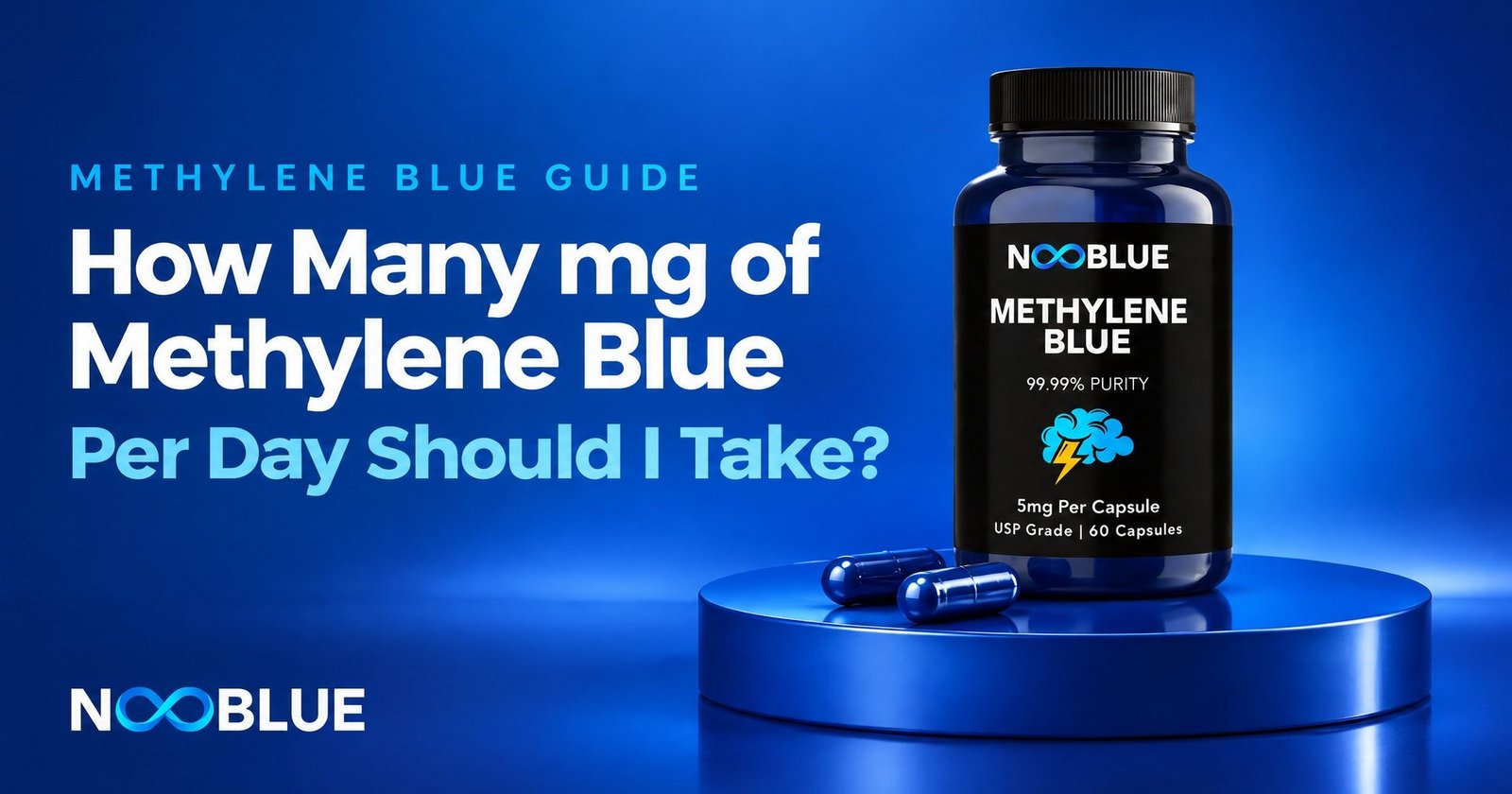
Quick answer: Most methylene blue supplement labels, ours included, land between 5 and 10 mg a day. Start with 5 mg (one NooBlue capsule, or 10 drops of a 1% solution) for the first week, and move to 10 mg (one gummy, or 20 drops) only if the lower amount sits well. Our labels stop at 10 mg a day. No clinical trial has set an ideal daily methylene blue dose for healthy adults: the best-known studies in healthy people used single oral doses of 100 to 500 mg, and hospitals inject 1 mg/kg. Do not take it at all if you use SSRIs, SNRIs, MAOIs or other serotonergic medicines, have G6PD deficiency, are pregnant or breastfeeding, or are under 18.
Key takeaways
- Start at 5 mg a day for a week. That is one 5 mg capsule, or 10 drops of a 1% solution.
- If you want more, 10 mg a day is the ceiling on NooBlue labels: one gummy, or 20 drops (one full dropper).
- One drop of a 1% solution holds about 0.5 mg, so 2 drops is 1 mg and 20 drops is 10 mg. Check your bottle first, because 0.5%, 2% and 5% products are sold too.
- Weight-based charts come from hospital and animal dosing. At 70 kg, a 5 mg dose works out to about 0.07 mg/kg, a small fraction of the 1 mg/kg hospital dose.
- Take it with food, at breakfast or lunch. Blue or green urine is normal.
- Never combine it with serotonergic medicines. Skip it with G6PD deficiency, in pregnancy or breastfeeding, and under 18.
Table of contents
- 1. The methylene blue dose ladder: start, step up, stop
- 2. Why methylene blue dosage numbers online disagree
- 3. What the human methylene blue studies actually used
- 4. Methylene blue dosage chart by weight
- 5. How many drops of methylene blue should I take?
- 6. Check the strength on your bottle before you count drops
- 7. Capsules and gummies: doses you don’t have to measure
- 8. Your first two weeks
- 9. How much methylene blue is too much?
- 10. Safety: who should not take methylene blue at any dose
- 11. Frequently asked questions
- 11.1. What is the methylene blue dosage chart by body weight?
- 11.2. How many drops of methylene blue should I take?
- 11.3. How many drops of methylene blue is 1 mg?
- 11.4. How many drops of methylene blue should a 70 kg or 90 kg man take?
- 11.5. How much Meraki Blu should I take?
- 11.6. What is the oral methylene blue dosage for humans?
- 11.7. Can I take more than 10 mg a day?
- 11.8. Is 20 mg of methylene blue too much?
- 11.9. Should I cycle methylene blue or take it every day?
- 11.10. Is the dose different for focus, energy or mitochondrial support?
- 11.11. Does methylene blue build up in the body?
- 11.12. What should you not mix with methylene blue?
- 11.13. What is the dosage for methylene blue gummies?
- 11.14. Does methylene blue stain your teeth?
- 12. Sources
The methylene blue dose ladder: start, step up, stop
Supplement dosing for methylene blue is simpler than the search results make it look. There are two steps and a ceiling, and plenty of people never move past the first step.
| Stage | Daily amount | Fixed-dose format | 1% drops |
|---|---|---|---|
| Gentler start (optional) | 2.5 mg | None (drops only) | 5 drops (0.25 mL) |
| First week | 5 mg | 1 capsule | 10 drops (0.5 mL) |
| Week two on, if you want more | 10 mg | 1 gummy | 20 drops (1 mL, one full dropper) |
| Above 10 mg | Not on NooBlue labels | Talk to a doctor first | Not covered here |
A few notes on the ladder. Our capsule label says one capsule a day with food, so if you settle on 10 mg, switch to one gummy or a full dropper instead of doubling up on capsules. The gummy label is one a day as well. Every NooBlue product page carries a “do not exceed the suggested serving” line in its safety box, and this page follows it.
Why is 10 mg the ceiling? No study shows harm just above 10 mg. The limit is there because nobody has tested daily oral use above that range in healthy adults over months, and our labels are written around 5 to 10 mg. Past that point you are outside anything our labels cover, and a doctor who knows your medicines should be part of the decision.
The optional 2.5 mg start (5 drops) is where one 1% brand’s label begins. It suits people with a small frame or a sensitive stomach, and anyone who likes to test a new supplement at a low amount first.
Why methylene blue dosage numbers online disagree
Look up a methylene blue dosage and you will find numbers that differ a hundredfold: 1 mg, 10 mg, 0.5 mg/kg, 280 mg. Most are correct in their own setting. They come from three very different settings, and most pages don’t say which one they are quoting.
1. Hospital doses, given by injection
The prescribing information for methylene blue injection gives 1 mg/kg intravenously over 5 to 30 minutes, with a repeat 1 mg/kg dose an hour later if needed. For a 70 kg adult that is 70 mg straight into a vein, given once or twice under a doctor’s care. The same label reports low blood pressure, wheezing and reduced oxygenation at doses of 3 mg/kg or more, nausea, vomiting and heart effects at cumulative doses of 7 mg/kg or more, and severe breakdown of red blood cells and death at 20 mg/kg or more. Those numbers describe injected doses in patients. They say little about a capsule with breakfast, except that the gap between the two is very wide.
2. Research doses: single, large and swallowed
The human studies people cite for focus and memory used one large oral dose. In the 2016 Radiology trial by Rodriguez and colleagues, 26 healthy adults took either 280 mg of USP methylene blue or a placebo and had brain scans an hour later. The authors picked 280 mg as roughly 4 mg/kg for a 70 kg person. The methylene blue group showed a 7% increase in correct answers on a memory-retrieval task and more activity in brain areas used for attention and short-term memory. A 2017 follow-up from the same team, in Brain Imaging and Behavior, enrolled 28 participants and used the same single 280 mg dose. That is 28 to 56 times a 5 to 10 mg supplement serving, taken once rather than every day.
Pharmacology studies went higher. A phase I study in Germany gave 16 healthy volunteers a single 500 mg oral dose, alongside a 50 mg intravenous dose a week apart, and measured an absolute oral bioavailability of 72.3% (Walter-Sack 2009). A Swiss study gave 7 volunteers 100 mg by mouth and by vein (Peter 2000). None of these studies tested what 5 or 10 mg a day does over months.
3. Animal doses, in mg/kg
Many online charts use mg/kg figures that come from rodent work or from hospital dosing. A 2012 review by Rojas, Bruchey and Gonzalez-Lima describes memory effects in rodents within 1 to 4 mg/kg, a loss of that effect by 10 mg/kg, and adverse effects at 50 mg/kg or more. Rodent doses don’t carry over to people one for one, and many of those doses were injected. A chart that tells a 70 kg adult to take 0.5 mg/kg is asking for 35 mg, or 70 drops of a 1% solution, which is more than three times the top of our label.
A three-part check for any dose you read
Before you act on a number, check three things: the route (injected or swallowed), the subject (person, rat or cells in a dish) and the duration (one dose or every day). A figure that doesn’t come with all three isn’t usable, however confident the page sounds.
What the human methylene blue studies actually used
This table lists the oral studies in healthy people that dosage pages cite most often. Every dose in it is at least ten times a supplement serving.
| Study | Who | Dose and route | What it measured |
|---|---|---|---|
| Rodriguez et al., Radiology, 2016 | 26 healthy adults aged 22 to 62 (13 methylene blue, 13 placebo) | Single 280 mg by mouth (about 4 mg/kg) | Brain activity on functional MRI one hour later, plus memory retrieval |
| Rodriguez et al., Brain Imaging and Behavior, 2017 | 28 participants (14 methylene blue, 14 placebo) | Single 280 mg by mouth | Task and resting-state brain connectivity |
| Walter-Sack et al., European Journal of Clinical Pharmacology, 2009 | 16 healthy volunteers | Single 500 mg by mouth and 50 mg by vein | Absorption: 72.3% oral bioavailability |
| Peter et al., European Journal of Clinical Pharmacology, 2000 | 7 volunteers | 100 mg by mouth and by vein | Blood levels over time and estimated half-life |
Two things stand out. Each dose was given once, and each is far above what supplement labels suggest. The honest summary is that 5 to 10 mg a day is a label convention shared by most supplement brands, ours included, rather than an amount a trial has tested and refined. What the studies do show is that methylene blue is well absorbed when swallowed, so a small oral dose does reach the bloodstream.
Methylene blue dosage chart by weight
Weight-based dosing belongs to hospitals and animal labs. Supplement labels use fixed amounts, and no trial has tested whether a heavier person needs more at 5 to 10 mg a day. This chart shows what a fixed supplement dose works out to per kilogram at different body weights, next to the hospital injection dose for scale.
| Body weight | 5 mg a day (1 capsule or 10 drops) | 10 mg a day (1 gummy or 20 drops) | Hospital injection at 1 mg/kg |
|---|---|---|---|
| 50 kg (110 lb) | 0.10 mg/kg | 0.20 mg/kg | 50 mg |
| 60 kg (132 lb) | 0.08 mg/kg | 0.17 mg/kg | 60 mg |
| 70 kg (154 lb) | 0.07 mg/kg | 0.14 mg/kg | 70 mg |
| 80 kg (176 lb) | 0.06 mg/kg | 0.13 mg/kg | 80 mg |
| 90 kg (198 lb) | 0.06 mg/kg | 0.11 mg/kg | 90 mg |
| 100 kg (220 lb) | 0.05 mg/kg | 0.10 mg/kg | 100 mg |
| 110 kg (243 lb) | 0.05 mg/kg | 0.09 mg/kg | 110 mg |
Per-kilogram figures are the daily amount divided by body weight, rounded to two decimals. The last column is for scale only: it is an injected hospital dose, not a supplement dose.
Read it this way. A 70 kg man taking 5 mg is at about 0.07 mg/kg, and at 10 mg about 0.14 mg/kg. A 90 kg man taking 10 mg is at about 0.11 mg/kg. All of these sit far below the 1 mg/kg hospital dose, and below 0.75 mg/kg, an injected dose that a 2011 review says produces blood levels high enough to inhibit the enzyme MAO-A in the brain (Gillman 2011). That same review notes serious serotonin toxicity in people on serotonin reuptake inhibitors at an injected 1 mg/kg. Nobody has worked out an oral dose low enough to be safe alongside those medicines, so the serotonin warning applies to every dose on this page.
So how many drops of methylene blue should a 70 kg man take? The same as anyone else following a supplement label: 10 drops of a 1% solution (5 mg) to start, and 20 drops (10 mg) at most on our label. A 90 kg man follows the same steps. Body weight changes the per-kilogram figure, not the label.
How many drops of methylene blue should I take?
The drop math rests on two facts. A 1% solution holds 10 mg of methylene blue per mL. A typical dropper releases about 20 drops per mL, so each drop is about 0.05 mL and carries about 0.5 mg. NooBlue drops are labeled at 0.5 mg per drop and 10 mg per full dropper.
That gives the answers to the questions people search most. How many drops of methylene blue is 1 mg? Two drops of a 1% solution. How many drops is 10 mg? Twenty drops, which is one full 1 mL dropper. How many drops of methylene blue per day? On most 1% labels, ours included, 10 to 20 drops, taken once.
| Target dose | 1% solution | 0.5% solution | 2% solution | 5% solution |
|---|---|---|---|---|
| 1 mg | 2 drops | 4 drops | 1 drop | Can’t be measured by the drop |
| 2.5 mg | 5 drops | 10 drops | 2 to 3 drops | 1 drop |
| 5 mg | 10 drops (0.5 mL) | 20 drops (1 mL) | 5 drops (0.25 mL) | 2 drops |
| 10 mg | 20 drops (1 mL) | 40 drops (2 mL) | 10 drops (0.5 mL) | 4 drops |
Assumes about 20 drops per mL. A 0.5% solution holds 5 mg per mL, a 2% solution 20 mg per mL and a 5% solution 50 mg per mL.
Calibrate your dropper once
Drop size depends on the dropper tip, the angle you hold it at and the temperature of the liquid. A 20% error in drop size is a 20% error in your dose. The fix takes two minutes. Count how many drops it takes to reach the 1 mL mark on a graduated pipette or a 1 mL oral syringe from a pharmacy, then divide 10 mg by that count. If it takes 25 drops, each drop holds 0.4 mg, and your 5 mg serving is about 12 drops rather than 10.
How to take methylene blue drops
Measure the drops into a glass of water or juice, stir and drink it. Our drops page suggests mixing with water or juice for this reason. A straw keeps the blue off your teeth and tongue, and a glass is easier to rinse clean than a plastic bottle. Methylene blue stains skin, fabric and countertops, so measure over the sink and wipe spills straight away. Our guide on how to take methylene blue drops covers mixing, storage and cleanup step by step.
Check the strength on your bottle before you count drops
The drop counts above only work if you know the concentration. Most bottles sold for oral use are 1%, but 0.5%, 2% and 5% products are on sale, and one drop of a 5% solution holds five times as much methylene blue as one drop of a 1% solution. Here is what the product pages of some common brands state, as of Sep 2026. NooBlue makes the first product in the table, so read it as our own listing, not a neutral review.
| Product | Strength as labeled | Per drop | What the brand’s page suggests |
|---|---|---|---|
| NooBlue Methylene Blue Drops, 50 mL | 1% USP | 0.5 mg (10 mg per full dropper) | About 100 servings of 5 mg (10 drops) per bottle |
| Biopharm Methylene Blue 1% USP | 1% | 0.5 mg | No suggested use on the product page |
| Blissta USP Grade Methylene Blue 1% | 1% (10 mg/mL) | 0.5 mg | Start at 5 drops (2.5 mg), build over a week to 10 to 20 drops (5 to 10 mg), no more than 20 drops a day |
| Meraki Blu | 150 mg in 30 mL (0.5%) | About 0.25 mg | Beginners 1 to 3 drops, typical use 5 to 15 mg a day |
| Chemist Labs Methylene Blue 2% Liquid | 2% | About 1 mg (our estimate at 20 drops per mL) | 10 mg per 0.5 mL serving |
| Nootlyn Methylene Blue Drops 5% (Amazon) | 5% | About 2.5 mg | 4 drops for 10 mg |
How much Meraki Blu should you take? Its bottle holds 150 mg in 30 mL, so each mL carries 5 mg and each drop about 0.25 mg, half the strength of a 1% solution. Meraki’s page states that 5 mg is 20 drops, so 20 drops of Meraki Blu equals 10 drops of a 1% product, and 40 drops (2 mL) equals 10 mg. The same page also describes 1 to 3 drops as about 1 to 3 mg. By the label’s own concentration, 1 to 3 drops is closer to 0.25 to 0.75 mg, so go by the concentration. Meraki’s product description also says “for research purposes only”.
Biopharm (sold at bphchem.com, and what some people search for as BPH methylene blue) states 0.5 mg per drop, so the 1% column above applies to it directly. The stronger products need the most care. At 5%, the 20 drops that make 10 mg of a 1% solution would deliver about 50 mg. If you switch brands, recalculate before the first dose.
Capsules and gummies: doses you don’t have to measure
If counting drops sounds like a chore, a fixed-dose format removes the arithmetic. NooBlue sells two, and each one matches a step on the ladder.
- Capsules: 5 mg of USP methylene blue with 10 mg of vitamin C in each capsule, 60 capsules per bottle. The label says one capsule a day with food. This is the 5 mg starting step without a dropper, and a capsule never touches your teeth.
- Gummies: 10 mg of USP methylene blue with 25 mg of vitamin C in each Wild Blueberry gummy, zero sugar, 60 per bottle, one a day. This is the 10 mg step. NooBlue gummies don’t leave the blue mouth or blue tongue that drops can. Vitamin C can donate electrons to methylene blue and turn it into its colorless reduced form, leucomethylene blue, and the gummy’s purple color comes from blueberry extract.
| NooBlue format | Dose step | Price (as of Sep 2026) | Cost per serving | Cost per 5 mg | Best for |
|---|---|---|---|---|---|
| Drops, 1%, 50 mL | 0.5 mg per drop | $29.99 | $0.30 (5 mg serving) | $0.30 | Fine steps and the lowest cost per milligram |
| Capsules, 60 x 5 mg | 5 mg | $37.99 | $0.63 | $0.63 | The 5 mg start with no measuring |
| Gummies, 60 x 10 mg | 10 mg | $49.99 | $0.83 | $0.42 | A settled 10 mg a day with no blue mouth |
Buying more than one bottle of the same product lowers the price per bottle: the product pages show 10% off two bottles, 15% off three and 20% off five. Orders of $100 or more ship free worldwide, with 30-day returns and dispatch in 1 to 2 business days with tracking. For how these prices compare across the market, see our breakdown of what methylene blue should cost.
Quality matters for dosing, because a dose is only as accurate as what’s in the bottle. The USP monograph requires methylene blue to contain 97.0% to 103.0% of the compound, calculated on the dried basis. NooBlue publishes a report from Contract Testing Laboratories of America (CTLA) on its methylene blue ingredient, lot 2025022801: an HPLC identity result of “Conforms” plus individual results for arsenic, cadmium, mercury and lead. It covers the raw ingredient, not each finished batch, and it doesn’t state a purity percentage. You can read it on our quality and testing page. Don’t dose from aquarium or lab-reagent products. Our guide to food-grade methylene blue explains the difference.
Still choosing between formats? We compare them head to head in gummies vs capsules and gummies vs liquid drops, explain the chewing routine in how to take methylene blue gummies, and look at the wider gummy market in our best methylene blue gummies guide.
Your first two weeks
- Before day one: read the safety list below and check every medicine and supplement you take against it. If you take any prescription medicine, ask your doctor or pharmacist first.
- Days 1 to 7: take 5 mg with breakfast or lunch. That is one capsule, or 10 drops stirred into water.
- Expect blue or green urine within a day. In the 2016 brain-imaging trial, every volunteer who got methylene blue reported blue urine after leaving the imaging center. It is expected, and it fades after you stop.
- Days 8 to 14: if 5 mg sat well and you want to try more, move to 10 mg (one gummy, or 20 drops). If 5 mg feels right, there is no reason to change.
- If something feels off (an upset stomach, a headache, lighter sleep), go back to the last amount that felt fine, or take it earlier in the day.
When to take it
Our capsule label says to take it with food, and most people fit it into breakfast or lunch. No trial has compared morning and evening doses of methylene blue. People take it for daytime focus, so a morning or midday dose is the usual choice, and moving it earlier is the first thing to try if your sleep changes. We cover timing in more detail in methylene blue in the morning or at night and the best time to take methylene blue.
Storage
Keep bottles tightly closed, away from heat and sunlight, which is what our drops label says. Our methylene blue shelf life guide explains how long an opened bottle keeps.
How long a bottle lasts at each dose
A 50 mL bottle of 1% drops holds about 500 mg of methylene blue. At 5 mg a day it lasts about 100 days, and at 10 mg a day about 50 days. A bottle of capsules lasts 60 days at one a day, and so does a bottle of gummies.
How much methylene blue is too much?
For a supplement user, “too much” has two meanings: more than helps, and more than is safe. They start at very different places.
More than helps
Lab work shows that methylene blue follows a hormetic curve. Low to moderate doses raise measured responses such as cytochrome oxidase activity, and higher doses push the same responses back down and eventually below baseline (Bruchey and Gonzalez-Lima 2008). The authors link this to methylene blue’s ability to take up and hand on electrons. Those curves were mapped in animals and cell systems, and the turning point in people isn’t known. What the pattern does tell you is that a bigger dose is not a stronger version of a smaller one.
More than is safe
The serious toxicity data come from injections in hospital patients: breathing and blood-pressure problems at 3 mg/kg or more, and severe red-blood-cell breakdown at 20 mg/kg or more, according to the injection label. For a 70 kg adult, 3 mg/kg is 210 mg given straight into a vein. At supplement doses, the realistic dangers are interactions and certain health conditions rather than overdose: serotonin syndrome with serotonergic medicines, and red-blood-cell breakdown in people with G6PD deficiency. Both are in the safety section below.
Signs that a dose doesn’t suit you
Blue or green urine is expected at any dose, and it isn’t a warning sign. Watch the pattern instead. If an upset stomach, a headache, jitteriness or poor sleep started when you raised the dose and eases when you drop back, the higher dose isn’t for you. Stop and get medical help straight away if you develop confusion, agitation, a fever, heavy sweating, muscle twitching or a racing heart, especially if you take any other medicine. Those can be signs of serotonin syndrome. Our methylene blue side effects guide goes through what to watch for.
Safety: who should not take methylene blue at any dose
- Serotonergic medicines: do not take methylene blue if you take an SSRI, SNRI, MAOI or any other serotonergic medicine, including many antidepressants, tramadol and other opioids, triptans, dextromethorphan and St John’s wort. Methylene blue inhibits the enzyme MAO-A, and the combination can cause serotonin syndrome, which can be serious or fatal. The injection label carries a boxed warning on exactly this.
- G6PD deficiency: do not take it. It can cause red blood cells to break down.
- Pregnancy and breastfeeding: not for use while pregnant or breastfeeding.
- Age: not for anyone under 18.
- Urine color: it can turn urine blue or green. This is expected.
- Other medicines: talk to your doctor before use if you take any prescription medicine or have a kidney or liver condition.
The same list appears on every NooBlue product page in the “Safety: read before use” box. For the full interaction list, see what not to take with methylene blue. For health conditions that rule it out, see who should not take methylene blue, and for long-term use, whether methylene blue is safe to take daily.
Frequently asked questions
What is the methylene blue dosage chart by body weight?
Supplement labels use fixed amounts rather than mg/kg. At 5 mg a day, a 50 kg adult is at about 0.10 mg/kg, a 70 kg adult at about 0.07 mg/kg and a 100 kg adult at about 0.05 mg/kg. At 10 mg a day those become 0.20, 0.14 and 0.10 mg/kg. The hospital injection dose, for comparison, is 1 mg/kg. The full chart is in the section above.
How many drops of methylene blue should I take?
With a 1% solution, start with 10 drops (5 mg) a day and go up to 20 drops (10 mg) only if the lower amount sits well. Each drop holds about 0.5 mg. Check the strength on your bottle first, because 0.5%, 2% and 5% products change the count.
How many drops of methylene blue is 1 mg?
Two drops of a 1% solution, or four drops of a 0.5% solution. With a 2% solution, one drop is about 1 mg. A 5% solution can’t measure 1 mg by the drop, because one drop is about 2.5 mg.
How many drops of methylene blue should a 70 kg or 90 kg man take?
The same as anyone else following a supplement label: 10 drops of a 1% solution (5 mg) for the first week, then up to 20 drops (10 mg) if you want more. At 70 kg that is about 0.07 to 0.14 mg/kg, and at 90 kg about 0.06 to 0.11 mg/kg. Charts that ask for 0.5 mg/kg or more borrow from animal and hospital dosing, and at 70 kg they would mean 70 drops or more.
How much Meraki Blu should I take?
Meraki Blu holds 150 mg in 30 mL, which is a 0.5% solution at about 0.25 mg per drop. Meraki’s page says 5 mg is 20 drops. So the 5 mg starting step is 20 drops, and 10 mg is 40 drops (2 mL). Meraki’s page suggests that beginners start at 1 to 3 drops.
What is the oral methylene blue dosage for humans?
For supplement use, 5 to 10 mg a day by mouth, which is what most labels suggest, ours included. Human research has used single oral doses of 100 mg, 280 mg and 500 mg, and hospitals inject 1 mg/kg. No trial has tested a daily oral supplement dose over months.
Can I take more than 10 mg a day?
Not on NooBlue products. Our labels are written around 5 to 10 mg a day and say not to exceed the suggested serving. Some brands suggest up to 15 mg a day. Healthspan, a telehealth service that prescribes methylene blue, says a typical protocol starts around 5 mg and rises gradually to a maximum of about 25 mg a day, adjusted by a clinician. If you want to go above 10 mg, do it with a doctor who knows your medicines.
Is 20 mg of methylene blue too much?
It is twice the top of our label. For a 70 kg adult, 20 mg is about 0.29 mg/kg, still well under the 1 mg/kg hospital dose, but no study has looked at taking 20 mg a day by mouth for months, so nobody can tell you it is safe long term. It is also four capsules, two gummies or 40 drops of a 1% solution, which is hard to reach by accident. If you have been taking that much, drop back to 10 mg or less.
Should I cycle methylene blue or take it every day?
No study has tested cycling. Most people take it daily. Some take weekends off out of general caution, which is fine, but that habit isn’t based on methylene blue data. Our guide to daily methylene blue use covers the long-run picture.
Is the dose different for focus, energy or mitochondrial support?
No. There is no evidence that one goal needs a different supplement dose from another, so the same 5 to 10 mg range applies whatever your reason for taking it.
Does methylene blue build up in the body?
In a small study of 7 volunteers, methylene blue had an estimated terminal half-life of about 5.25 hours in whole blood after an intravenous dose (Peter 2000). With a half-life measured in hours, most of a once-daily dose has cleared before the next one. Published figures vary with the route and with whether plasma or whole blood is measured. Our methylene blue half-life guide explains why.
What should you not mix with methylene blue?
Serotonergic medicines above all: SSRIs, SNRIs, MAOIs and other drugs and supplements that raise serotonin, such as tramadol, triptans, dextromethorphan and St John’s wort. Methylene blue inhibits MAO-A, and combining it with these can cause serotonin syndrome. People with G6PD deficiency should not take it at all. The full list is in our methylene blue interactions guide.
What is the dosage for methylene blue gummies?
For NooBlue gummies, one gummy a day, which is 10 mg of methylene blue with 25 mg of vitamin C. Each gummy is a fixed 10 mg, so if you want a 5 mg first week, start with a capsule or 10 drops and switch to the gummy once you know 10 mg suits you.
Does methylene blue stain your teeth?
Drops can stain the mouth, tongue and teeth, because the blue liquid touches them. Mixing the drops into water and drinking through a straw cuts that down a lot. Capsules are swallowed, so they don’t touch your teeth. NooBlue gummies don’t leave the blue mouth or tongue that drops can. Any format can still turn urine blue or green. Our guide to methylene blue and teeth staining goes further.
Sources
- Rodriguez P, Zhou W, Barrett DW, et al. Multimodal randomized functional MR imaging of the effects of methylene blue in the human brain. Radiology. 2016, 281(2):516-526. PubMed 27351678. Dose details in the full text.
- Rodriguez P, Singh AP, Malloy KE, et al. Methylene blue modulates functional connectivity in the human brain. Brain Imaging and Behavior. 2017, 11(3):640-648. PubMed 26961091.
- Walter-Sack I, Rengelshausen J, Oberwittler H, et al. High absolute bioavailability of methylene blue given as an aqueous oral formulation. European Journal of Clinical Pharmacology. 2009, 65(2):179-189. PubMed 18810398.
- Peter C, Hongwan D, Küpfer A, Lauterburg BH. Pharmacokinetics and organ distribution of intravenous and oral methylene blue. European Journal of Clinical Pharmacology. 2000, 56(3):247-250. PubMed 10952480.
- Gillman PK. CNS toxicity involving methylene blue: the exemplar for understanding and predicting drug interactions that precipitate serotonin toxicity. Journal of Psychopharmacology. 2011, 25(3):429-436. PubMed 20142303.
- Bruchey AK, Gonzalez-Lima F. Behavioral, physiological and biochemical hormetic responses to the autoxidizable dye methylene blue. American Journal of Pharmacology and Toxicology. 2008, 3(1):72-79. PubMed 20463863.
- Rojas JC, Bruchey AK, Gonzalez-Lima F. Neurometabolic mechanisms for memory enhancement and neuroprotection of methylene blue. Progress in Neurobiology. 2012, 96(1):32-45. PubMed 22067440.
- Methylene Blue Injection, USP (0.5%) prescribing information: dosage, boxed warning and overdosage sections. Drugs.com.
- USP-NF monograph: Methylene Blue (assay limits). USP.
Brand product details in the strength table come from each brand’s own product page, read in September 2026. NooBlue product details come from our shop pages.