Men look at methylene blue for three reasons: focus, steady energy and, often, questions about testosterone or sexual health. The honest summary is shorter than most articles admit. Methylene blue supports the mitochondrial pathways behind cellular energy, and one small human trial found better memory retrieval after a single large dose. There is no human evidence that it raises testosterone, improves erections or slows aging. This guide sorts what has been measured from what has only been suggested, and ends with how to take it safely.
NooBlue sells methylene blue capsules, gummies and drops, so we have an interest in the topic. Every study below is linked so you can check it yourself.
Table of contents
- 1. Methylene Blue Benefits for Men at a Glance
- 2. Methylene Blue for Brain Health and Focus
- 3. Methylene Blue and Energy Levels
- 4. Methylene Blue, Mood and Medicines
- 5. Methylene Blue, Sexual Health and Fertility
- 6. Methylene Blue and Testosterone Support
- 7. How to Take Methylene Blue Safely
- 8. Key Takeaways
- 9. Related Guides for Men
- 10. Frequently Asked Questions
- 11. The Bottom Line
- 12. Sources
Methylene Blue Benefits for Men at a Glance
| Claim you will see online | What the evidence shows |
|---|---|
| Sharper memory and focus | Small human signal: one randomized trial of a single 280 mg dose in healthy adults |
| More cellular energy | Mechanism shown in cell and animal studies; no trial of energy or fatigue in healthy men |
| Better mood | Not a benefit to chase. Its effect on serotonin breakdown is the reason for its most serious drug interaction |
| Higher testosterone | No human study showing it |
| Sexual performance | No evidence in healthy men |
| Slower aging | No human evidence |
| Faster exercise recovery | No human evidence |
Our methylene blue benefits guide covers the research beyond the questions men tend to ask.
Methylene Blue for Brain Health and Focus
Inside cells, methylene blue can accept electrons and pass them along the mitochondrial electron transport chain, the process that produces ATP. A 2018 review by Tucker and colleagues describes it rerouting electrons from NADH to cytochrome c. Most of that evidence comes from cell and animal work. Brain cells use a lot of energy, which is why this mechanism draws interest for focus.
The best human data come from Rodriguez and colleagues, published in Radiology in 2016. In a randomized, double-blind, placebo-controlled trial, 26 healthy adults aged 22 to 62 had brain MRI scans before and one hour after a single 280 mg dose of USP methylene blue (about 4 mg/kg) or placebo. The methylene blue group showed more brain activity during attention and short-term memory tasks and gave 7% more correct answers during memory retrieval (Rodriguez et al., 2016). A 2012 review in Progress in Neurobiology linked methylene blue’s memory effects to the respiratory enzyme cytochrome oxidase, mostly from animal studies (Rojas et al., 2012).
Two limits matter. The trial used one dose, 56 times a 5 mg capsule, and measured effects for about an hour. No long-term trial has tested daily supplement servings for focus in healthy men. Methylene blue may support the energy supply behind focus, but claims that it protects the aging brain go well past the evidence. If you are concerned about memory changes, talk to your doctor. Our guide to methylene blue vs other nootropics compares it with better-studied options.
Methylene Blue and Energy Levels
The energy argument rests on the same mechanism. If methylene blue helps electrons move through the mitochondrial chain, cells may make ATP more easily. That is a reasonable hypothesis and a product-page talking point. It has not been tested as a trial outcome in healthy men, so treat any “no-crash energy” promise with caution. Methylene blue is not a stimulant like caffeine, and people describe its effect as subtle when they notice one at all.
Exercise recovery is weaker still. Articles often cite lower oxidative stress in lab studies and then promise faster recovery. We found no human trial of methylene blue and exercise recovery. If recovery is your main goal, sleep, protein and training load are the proven levers. For a comparison with another energy supplement men often consider, see methylene blue vs NMN.
Methylene Blue, Mood and Medicines
Some articles present methylene blue as a mood supplement because it affects serotonin. The real story is a safety one. Methylene blue is a potent reversible inhibitor of monoamine oxidase A (MAO-A), an enzyme that breaks down serotonin (Ramsay et al., 2007). Combined with SSRIs, SNRIs, MAOIs or other serotonergic medicines, that can cause serotonin syndrome, a medical emergency. So if you take an antidepressant, methylene blue is off the table unless your doctor says otherwise. If you are struggling with your mood, speak to your doctor rather than experimenting with supplements. Our guide to what not to take with methylene blue lists the medicines involved.
Methylene Blue, Sexual Health and Fertility
You will see methylene blue described as good for blood flow and sexual vitality. There is no evidence that it improves libido, erections or sexual performance in healthy men, and hospital uses of the drug for specific acute problems do not tell you what a daily supplement does.
Fertility deserves a clear note. In lab dishes, methylene blue sharply reduces sperm motility. In one study, semen samples from 20 healthy men were mixed with surgical-strength methylene blue solution, and motility fell from about 70.3% to about 1.1% (Sheynkin et al., 1999). An earlier study found the same time- and dose-dependent effect (Coddington et al., 1989). These were test-tube experiments, not oral servings, but if you are trying to conceive, talk to your doctor before taking methylene blue.
Methylene Blue and Testosterone Support
Methylene blue is not a testosterone booster. The argument you will read goes like this: Leydig cells in the testes make testosterone, they rely on mitochondria, and methylene blue supports mitochondria, so it might help. Each step sounds plausible, but we found no human study that measured testosterone after methylene blue, and a chain of reasoning is not a result. If you are concerned about low testosterone, a blood test and a conversation with your doctor will tell you far more than any supplement.
How to Take Methylene Blue Safely
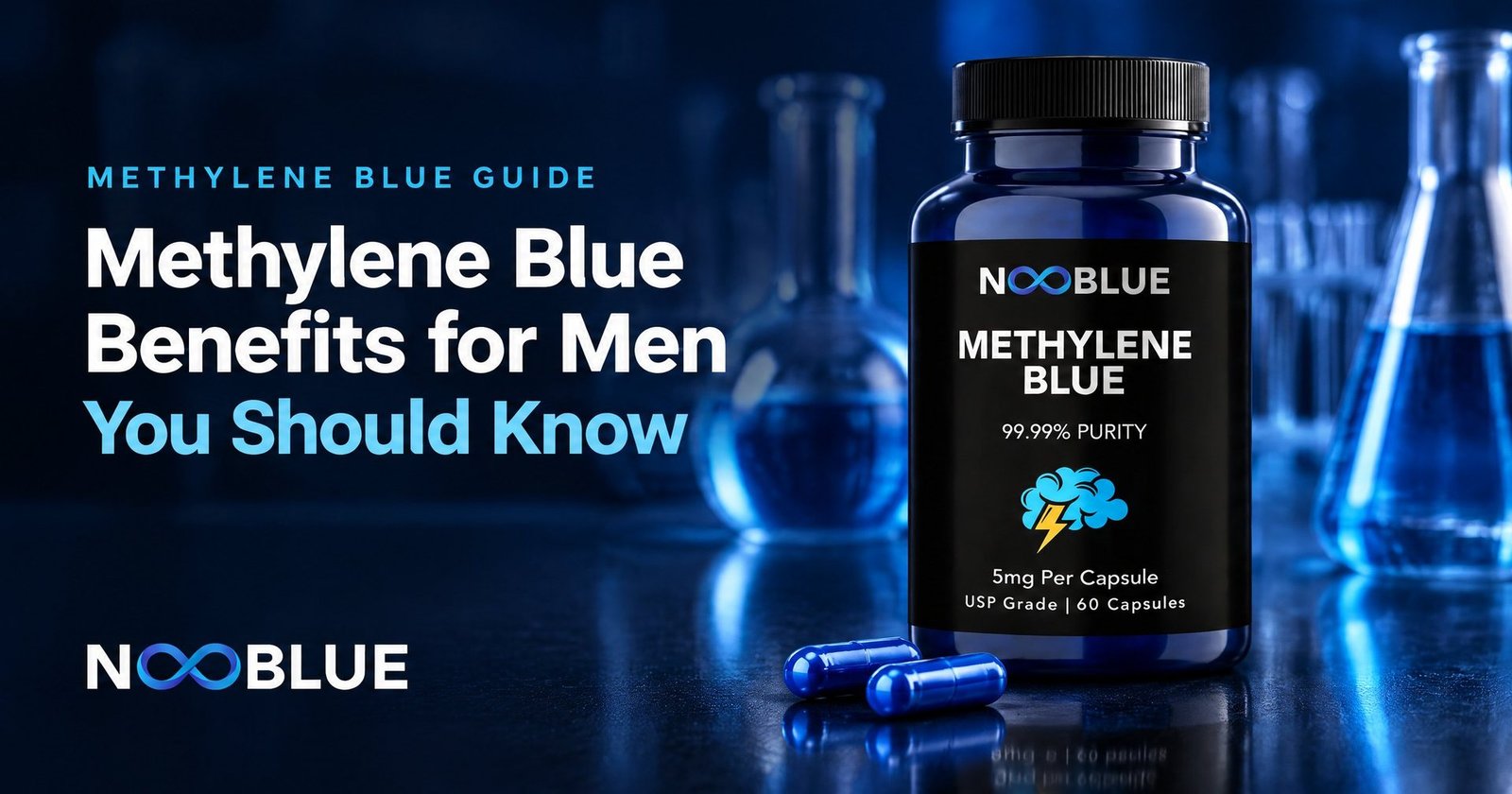
Use the label serving. NooBlue methylene blue capsules are 5 mg each, and the label serving is one capsule a day with food. Gummies are 10 mg each, one a day, and avoid the blue mouth that drops cause. Drops are a 1% solution at 0.5 mg per drop, with a 10-drop (5 mg) serving. Do not exceed the suggested serving.
Ignore weight-based study doses. Research doses are far above supplement servings. The 280 mg in the Rodriguez trial was about 4 mg/kg, and even 1 mg/kg for a 70 kg man comes to 70 mg, 14 times a capsule. Those doses were given once under supervision. Our guide to how many mg of methylene blue per day explains the gap.
Take it early. A morning capsule with breakfast is the easiest routine, and some people find methylene blue affects their sleep when taken late.
Buy a product made for people. Aquarium and lab-stain methylene blue are sold for other jobs. Look for USP grade, a stated amount per serving, directions and medication warnings. NooBlue’s product pages show a lab report from Contract Testing Laboratories of America on the methylene blue ingredient, with its scope stated: it confirms identity and reports four heavy metals, and it is not a test of every finished batch.
Know the safety rules. These match the “Safety: read before use” box on every NooBlue product page:
- Do not take methylene blue if you take an SSRI, SNRI, MAOI or any other serotonergic medicine, including many antidepressants. The combination can cause serotonin syndrome.
- Do not take it if you have G6PD deficiency.
- Not for use during pregnancy or while breastfeeding, and not for anyone under 18.
- Talk to your doctor first if you take any prescription medicine or have a kidney or liver condition.
- Methylene blue can turn urine blue or green, which is expected.
Our methylene blue side effects guide covers what else to expect.
Key Takeaways
- One mechanism sits behind every claim: methylene blue acts as an electron carrier in mitochondria. That is well described in the lab. What it does for healthy men at supplement servings has barely been tested.
- The strongest human result is a 7% gain in correct memory-retrieval answers after a single 280 mg dose in 26 healthy adults.
- There is no human evidence for testosterone, sexual performance, anti-aging or exercise recovery benefits.
- Trying to conceive? Talk to a doctor first. Methylene blue sharply cuts sperm motility in the lab.
- Two hard stops: never combine it with serotonergic medicines, and skip it entirely if you have G6PD deficiency.
Related Guides for Men
- How many mg of methylene blue per day: serving sizes and study doses explained
- Methylene blue side effects: what to watch for
- Methylene blue vs other nootropics: how it compares with the alternatives
- Methylene blue vs NMN: two popular energy supplements side by side
- Methylfolate vs methylene blue: two similar names, two very different compounds
- What not to take with methylene blue: the drug interactions that matter
Frequently Asked Questions
How quickly do methylene blue benefits appear?
No trial of daily supplement servings answers this. The Rodriguez study measured brain activity one hour after a single 280 mg dose, which is far more than a daily capsule. With a 5 mg serving, give it a few weeks of consistent use before deciding whether it helps you.
Is methylene blue a proven supplement?
No. Methylene blue has a long history as a medicine and a laboratory dye, and its effect on mitochondria is well described in cell and animal studies. Human trials of supplement use are few, small and short. Treat it as a supplement that supports cellular energy pathways, not a proven performance aid.
Who should avoid methylene blue?
Anyone taking SSRIs, SNRIs, MAOIs or other serotonergic medicines, because of the risk of serotonin syndrome. Also anyone with G6PD deficiency, anyone pregnant or breastfeeding, and anyone under 18. Talk to your doctor first if you take any prescription medicine, and if you are trying to conceive.
Can men take methylene blue every day?
The NooBlue label servings are daily amounts: one 5 mg capsule, one 10 mg gummy, or 10 drops (5 mg) of the 1% solution. Take it with breakfast, and do not exceed the suggested serving. Daily use is off the table if you take any serotonergic medicine or have G6PD deficiency.
What is the biggest benefit of methylene blue for men?
The only benefit with direct human evidence is cognitive: one randomized trial found more brain activity during attention and memory tasks and 7% more correct memory-retrieval answers after a single dose. That is a small, short-term signal. Claims about testosterone, sexual performance or aging in healthy men have no human evidence behind them.
The Bottom Line
For men, methylene blue is best understood as a supplement that supports the mitochondrial pathways behind cellular energy, with a small amount of human evidence on memory and attention. It is not a testosterone, sexual health or anti-aging product, whatever other sites claim. If the safety rules above do not rule you out, one 5 mg capsule with breakfast is the simplest place to start. You can compare the three formats below or browse the NooBlue shop.
Sources
- Rodriguez P, Zhou W, Barrett DW, et al. Multimodal randomized functional MR imaging of the effects of methylene blue in the human brain. Radiology. 2016;281(2):516-526. PubMed 27351678
- Rojas JC, Bruchey AK, Gonzalez-Lima F. Neurometabolic mechanisms for memory enhancement and neuroprotection of methylene blue. Progress in Neurobiology. 2012;96(1):32-45. PubMed 22067440
- Tucker D, Lu Y, Zhang Q. From mitochondrial function to neuroprotection: an emerging role for methylene blue. Molecular Neurobiology. 2018;55(6):5137-5153. PubMed 28840449
- Ramsay RR, Dunford C, Gillman PK. Methylene blue and serotonin toxicity: inhibition of monoamine oxidase A (MAO A) confirms a theoretical prediction. British Journal of Pharmacology. 2007;152(6):946-951. PubMed 17721552
- Sheynkin YR, Starr C, Li PS, Goldstein M. Effect of methylene blue, indigo carmine, and Renografin on human sperm motility. Urology. 1999;53(1):214-217. PubMed 9886615
- Coddington CC, Anderson TL, Accetta CR, et al. Adverse effects of methylene blue on human sperm motility, components of human reproductive tract fluids, and mouse embryo cleavage. Fertility and Sterility. 1989. PubMed 2493404