By NooBlue Editorial · About our editorial standards
Key takeaways
- Does methylene blue kill parasites? It acts against one group in research: Plasmodium, the single-celled blood parasites behind malaria. That work uses prescription doses in medical trials, usually alongside other drugs.
- In fish tanks, a concentrated aquarium solution is used against fungus and some external parasites on fish. It is labeled as not intended for human consumption.
- No study we found shows methylene blue clears intestinal worms in people, and there is no evidence for “parasite cleanse” routines.
- NooBlue methylene blue is a daily supplement for cellular energy and focus. It is not a treatment for any infection. If you think you have a parasite, see a doctor.
- Methylene blue is not for anyone taking SSRIs, SNRIs, MAOIs or other serotonergic medicines, anyone with G6PD deficiency, anyone pregnant or breastfeeding, or anyone under 18.
Short answer: in the lab and in medical trials, yes, for a specific kind of parasite and at doses far above a supplement. Methylene blue damages Plasmodium parasites and has been tested as an add-on to standard drugs under medical supervision. There is no evidence it clears worms or other gut parasites, and a daily supplement is not a way to treat any infection.
Does methylene blue kill parasites? The question comes up in three different places: people reading about its history as one of the first synthetic drugs, aquarium keepers with sick fish, and social media posts selling parasite routines. Each has a different answer. This guide goes through what the research actually tested, how methylene blue acts on parasite cells, where the evidence stops, and why a supplement is no substitute for a doctor. NooBlue sells methylene blue as a daily supplement, so we will also be clear about what our products are and are not for.
Because methylene blue and antiparasitic drugs often come up together online, you may also want our methylene blue vs ivermectin comparison.
Table of contents
- 1. Does Methylene Blue Kill Parasites? What the Research Shows
- 2. How Methylene Blue Affects Parasites at the Cellular Level
- 3. The Malaria Research: Medical, Supervised and High-Dose
- 4. Methylene Blue for Parasites in Fish Tanks
- 5. Worms, Gut Parasites and Online Protocols: Where the Evidence Stops
- 6. Safety: Why a Supplement Is No Substitute for Medical Care
- 7. What NooBlue Methylene Blue Is For
- 8. Frequently Asked Questions
- 8.1. Does methylene blue kill parasites in humans?
- 8.2. Is methylene blue used for malaria?
- 8.3. Does methylene blue kill intestinal worms?
- 8.4. Why is methylene blue used in fish tanks?
- 8.5. Is methylene blue an antifungal?
- 8.6. Does methylene blue kill good bacteria in the gut?
- 8.7. Should I take methylene blue for a parasite infection?
- 9. Sources
Does Methylene Blue Kill Parasites? What the Research Shows
Almost all of the parasite research on methylene blue is about Plasmodium, a single-celled parasite that lives in red blood cells and spreads through mosquito bites. A Heidelberg University review described methylene blue as having intrinsic activity against it and noted that it makes the parasite more sensitive to chloroquine (Schirmer and colleagues, Redox Report, 2003). Methylene blue is often called the first synthetic drug, with more than a century of medical and laboratory use (Schirmer and colleagues, Neurobiology of Aging, 2011), and interest in it against Plasmodium has grown again in recent years.
Here is where the evidence sits, and what each setting means for someone reading this at home.
| Parasite or context | Research setting | What was observed | What it means for you |
|---|---|---|---|
| Plasmodium in people | Supervised clinical trials, combined with standard drugs | Stopped mosquitoes picking up the parasite after treatment | A medical use at prescription doses, not a supplement use |
| Plasmodium in lab cultures and mosquito feeding tests | Laboratory | Killed or deformed the parasite’s transmissible stage | Lab evidence only |
| Drug-resistant rodent Plasmodium | Mouse study | Held parasite levels down where two standard drugs had failed | Animal evidence at very high doses |
| Fungus and external protozoa on fish | Aquarium water | Used as a long-standing water additive | Aquarium product, not for people |
| Intestinal worms and online parasite protocols | None found | No trials | No evidence it works |
To see how a textile dye ended up in medicine in the first place, read our guide to the history and uses of methylene blue.
How Methylene Blue Affects Parasites at the Cellular Level
Methylene blue is a redox dye. It picks up and gives away electrons easily, cycling between a blue form and a colorless form. Inside a parasite that cycling becomes a problem for the parasite.
The Heidelberg review describes two effects. Methylene blue interferes with how Plasmodium handles hemoglobin and heme in its digestive compartment, and it selectively blocks the parasite’s glutathione reductase, an enzyme the parasite uses to protect itself from oxidative damage. Blocking that enzyme drains the parasite’s glutathione, which is why methylene blue makes it more sensitive to chloroquine (Schirmer and colleagues, 2003).
The same electron cycling is what people are interested in when they take a low dose for cellular energy, but the context is completely different: a few milligrams supporting your own mitochondria versus large doses aimed at an organism in the blood. Our explainer on how methylene blue works in the body covers the energy side.
The Malaria Research: Medical, Supervised and High-Dose
This is the part of the story with real human data, and it is worth reading closely because the doses and conditions are nothing like supplement use.
Clinical trials. In a randomized trial in Mali, 80 male participants who carried the parasite were given standard drugs with or without an add-on. One group received dihydroartemisinin-piperaquine plus methylene blue at 15 mg per kg of body weight per day for three days. Among participants who could infect mosquitoes at the start, that group had a median 100% drop in mosquito infectivity two days later (Dicko and colleagues, Lancet Infectious Diseases, 2018). Only people who tested normal for G6PD were enrolled. For a 70 kg adult, 15 mg per kg is 1,050 mg a day. A NooBlue capsule is 5 mg.
Earlier, the Heidelberg team ran a pilot of chloroquine combined with methylene blue in Burkina Faso, again limited to adults with normal G6PD (Schirmer and colleagues, 2003).
Lab studies. When blood from patients carrying Plasmodium vivax was treated with methylene blue before being fed to mosquitoes, the average count of parasite cysts in the mosquitoes fell 1,438-fold, against 1.40-fold with chloroquine (Chaumeau and colleagues, Antimicrobial Agents and Chemotherapy, 2024). In lab cultures of Plasmodium falciparum from India, 48 hours of exposure either wiped out the transmissible stage or left the cells shrunken and deformed (Wadi and colleagues, Malaria Journal, 2018).
Animal study. In mice infected with a rodent Plasmodium that had become resistant to two standard drugs, methylene blue at 45 mg per kg per day held parasite levels down by more than 99% for at least 6 days (Mwangi and colleagues, Journal of Infection in Developing Countries, 2016).
Put together, the research treats methylene blue as a possible partner drug, given by doctors, screened for G6PD and dosed by body weight. None of it supports buying a supplement to deal with an infection yourself. If you have traveled somewhere with malaria and feel unwell, that needs a doctor the same day, not a supplement.
Methylene Blue for Parasites in Fish Tanks
A lot of searches about methylene blue and parasites come from aquarium keepers. Kordon, a long-standing aquarium brand, sells methylene blue as a water additive against superficial fungal infections on fish and fish eggs, and lists it as effective against some external protozoa such as Ich, Chilodonella and Costia. Its product page states that the solution is not intended for human consumption.
That is a different product for a different animal, used by adding it to tank water. Aquarium and lab grades of methylene blue are not made or labeled for people, and a human supplement is not a fish medicine either. If your search started with a sick fish, use an aquarium product and follow its directions.
Worms, Gut Parasites and Online Protocols: Where the Evidence Stops
Many people asking about methylene blue and parasites are really asking about intestinal worms or the routines shared on social media. The honest answer is short: we found no trial showing methylene blue clears worms or other gut parasites in people.
Every result above concerns Plasmodium, a single-celled parasite in the blood. Tapeworms, roundworms and other worms are multicellular animals with different biology, and we are not aware of any study testing methylene blue against them in humans. No study backs adding methylene blue to a “parasite cleanse”, and doing so can add interaction risk. If you think you have a gut parasite, ask a doctor for a stool test and a medicine that has been studied for that organism.
People also ask whether methylene blue harms gut bacteria. There is no solid human data either way at supplement doses. Our review of methylene blue and gut health goes through the microbiome studies that do exist.
Safety: Why a Supplement Is No Substitute for Medical Care
The research doses above are hundreds of times a supplement serving, given to screened people under medical care. Scaling up a supplement to copy them is where real harm happens. Cumulative doses of 7 mg per kg or more can cause significant toxicity, and methylene blue is contraindicated in G6PD deficiency because it can break down red blood cells (Ostrovsky and Afzal, StatPearls, 2026).
Safety: read before use
- Do not take methylene blue with SSRIs, SNRIs, MAOIs or any other serotonergic medicine, including many antidepressants. The combination can cause serotonin syndrome.
- Do not take it if you have G6PD deficiency.
- Not for use during pregnancy or while breastfeeding.
- Not for anyone under 18.
- It can color urine blue or green. This is expected.
- Talk to your doctor before use if you take any prescription medicine or have a kidney or liver condition.
- Do not use methylene blue to self-treat a suspected infection. See a doctor.
The serotonin risk comes from methylene blue’s action on monoamine oxidase A, and our guide to methylene blue and serotonin syndrome explains it. For the rest, see methylene blue side effects and safety precautions, methylene blue and G6PD deficiency, methylene blue liver safety and whether methylene blue is safe to take daily.
What NooBlue Methylene Blue Is For
NooBlue sells methylene blue as a daily supplement to support cellular energy and focus, at a few milligrams a day. It is not an antiparasitic and we do not sell it as one. Our guide to what the research shows about methylene blue benefits covers what low doses have actually been studied for, and our guide to how many mg of methylene blue per day explains supplement serving sizes.
If that is what you came for, grade matters. Aquarium and lab methylene blue are not made for people. Contract Testing Laboratories of America (CTLA) analyzed the methylene blue ingredient lot NooBlue uses and recorded an HPLC identity result and individual results for arsenic, cadmium, mercury and lead. That is ingredient-level evidence. It does not give a purity percentage or certify every finished batch. Our pages on what methylene blue purity claims mean and how to check if your methylene blue is real explain how to read reports like this, and our methylene blue supplements comparison sets the options side by side.
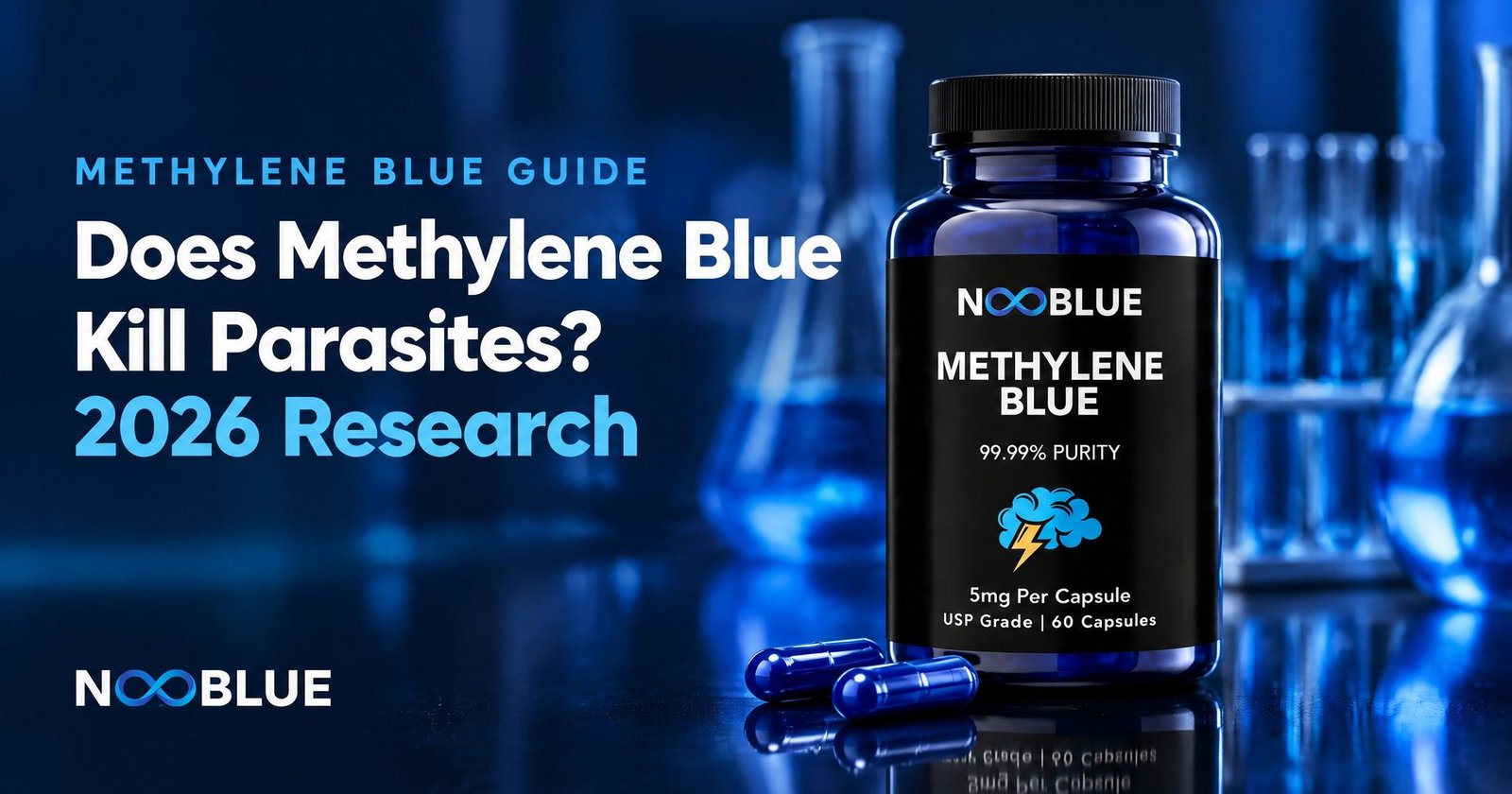
- NooBlue Methylene Blue Capsules: 5 mg methylene blue USP and 10 mg vitamin C per capsule, 60 capsules, $37.99. One a day with food.
- NooBlue Methylene Blue Gummies: 10 mg methylene blue USP and 25 mg vitamin C per gummy, 60 gummies, $49.99. One a day, no blue mouth.
- NooBlue Methylene Blue Drops: 1% solution in distilled water, 0.5 mg per drop, 50 mL, $29.99.
Orders over $100 ship free worldwide, or you can browse the full NooBlue range.
Frequently Asked Questions
Does methylene blue kill parasites in humans?
In medical research it acts against Plasmodium, a single-celled blood parasite, and has been tested as an add-on to standard drugs at doses set by body weight under medical supervision. It is not sold as an antiparasitic for people, and a supplement dose is not a substitute for medical care. If you think you have a parasitic infection, see a doctor.
Is methylene blue used for malaria?
Only in research and medical settings. It has a long research history against the parasite and has been studied in clinical trials as a partner to standard medicines, in people screened for G6PD. It is not a supplement use, and NooBlue does not sell methylene blue for it. Anyone who may have malaria needs a doctor urgently.
Does methylene blue kill intestinal worms?
We found no study showing that it does. The research concerns single-celled blood parasites, not worms, which are multicellular animals with different biology. For a suspected worm infection, ask a doctor for a stool test and a proven medicine.
Why is methylene blue used in fish tanks?
Aquarium methylene blue is added to tank water against fungus on fish and fish eggs and against some external protozoa such as Ich. It is a concentrated aquarium product labeled not intended for human consumption, and it is a separate thing from a human supplement.
Is methylene blue an antifungal?
In aquariums it is used against superficial fungus on fish and eggs. In people it is not an antifungal medicine, and a supplement should not be used for a fungal problem. See a doctor or pharmacist for that.
Does methylene blue kill good bacteria in the gut?
There is no solid human data either way at supplement doses. Lab antimicrobial effects come from concentrations and settings very different from a 5 or 10 mg daily dose. Microbiome effects remain an open question.
Should I take methylene blue for a parasite infection?
No. Do not self-treat a suspected infection with a supplement. The research used much higher, weight-based doses in screened patients alongside other drugs. A doctor can diagnose the organism and prescribe something tested against it.
Sources
- Schirmer RH, Coulibaly B, Stich A, et al. Methylene blue as an antimalarial agent. Redox Report. 2003;8(5):272-275. PubMed 14962363
- Schirmer RH, Adler H, Pickhardt M, Mandelkow E. “Lest we forget you, methylene blue…”. Neurobiology of Aging. 2011;32(12):2325.e7-16. PubMed 21316815
- Dicko A, Roh ME, Diawara H, et al. Efficacy and safety of primaquine and methylene blue for prevention of Plasmodium falciparum transmission in Mali: a phase 2, single-blind, randomised controlled trial. Lancet Infectious Diseases. 2018;18(6):627-639. PubMed 29422384
- Chaumeau V, Wasisakun P, Watson JA, et al. Transmission-blocking activities of artesunate, chloroquine, and methylene blue on Plasmodium vivax gametocytes. Antimicrobial Agents and Chemotherapy. 2024;68(9):e0085324. PubMed 39058023
- Wadi I, Pillai CR, Anvikar AR, et al. Methylene blue induced morphological deformations in Plasmodium falciparum gametocytes: implications for transmission-blocking. Malaria Journal. 2018;17(1):11. PubMed 29310655
- Mwangi VI, Mumo RM, Kiboi DM, et al. Methylene blue inhibits lumefantrine-resistant Plasmodium berghei. Journal of Infection in Developing Countries. 2016;10(6):635-642. PubMed 27367013
- Ostrovsky A, Afzal M. Methylene Blue. StatPearls. Updated January 2026. NCBI Bookshelf NBK557593
- Kordon. Methylene Blue (aquarium treatment) product information, kordon.com, read September 2026.
This article is for educational purposes only and is not medical advice. If you think you have a parasitic infection, see a doctor rather than self-treating. Talk to your doctor before starting methylene blue, especially if you take any prescription medicine.